
Tailings dams: Insights from science to address their risks
UTPL.
Mining begins by removing vegetation and topsoil. Next, miners excavate to extract metals and minerals from the subsoil. This process generates a large amount of waste or tailings: 200 kilograms of waste for every kilogram of economically valuable material in a high-efficiency mine.
This waste is a mixture of rock debris, water, and chemical compounds used in mining operations. But where does this waste end up?
They end up in tailings dams, permanent storage sites for mining waste located in the same areas where mining operations take place.
Despite being critical infrastructure—since their failure or collapse can seriously harm the environment and people—prior, transparent discussion regarding tailings dams and their risks is rare among authorities, mining companies, and affected communities.
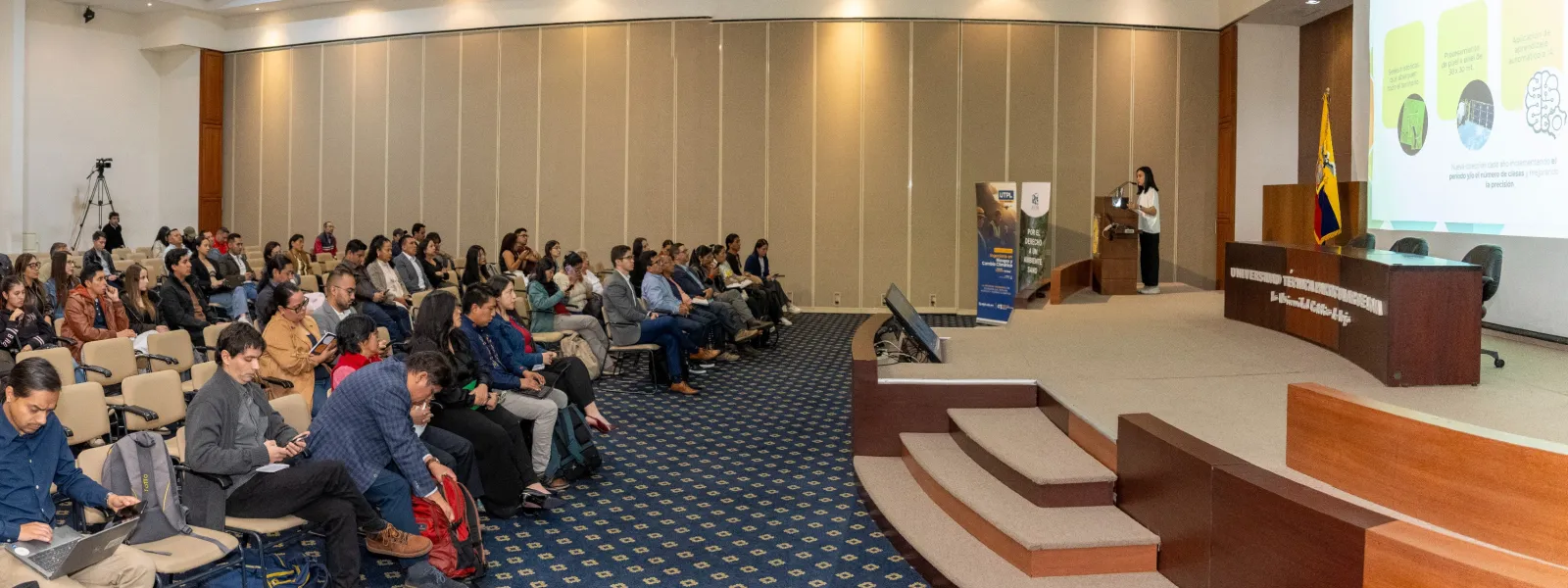
To address this gap, on July 22 and 23, AIDA—in partnership with the Universidad Técnica Particular de Loja (UTPL) and the Find an Expert in Mining (FAIME) project—organized an inclusive event in the city of Loja, Ecuador, featuring academic dialogue and scientific outreach on the management of risks associated with tailings dams.
The event brought together people from different regions and technical experts from Latin America for a diverse dialogue on managing mining waste.
This initiative is part of our efforts to promote science—including traditional knowledge—as a fundamental and accessible tool for defending territories and everyone’s right to a healthy environment.
Below, we share key information and insights from the event on tailings dams and the risks associated with them.
Concerns and uncertainties surrounding tailings dams
All crushed, chemically processed rock—from which valuable metals and minerals have been extracted, as well as rock with no economic value to the industry—remains in the area in tailings dams.
During mine operations, after mine closure, and in perpetuity, mining companies must ensure that these infrastructure systems completely isolate waste from the environment. Exposure to this mixture of mining waste has significant socio-environmental impacts. This raises concerns and questions that are rarely discussed, including:
- The dam's dimensions: How many metric tons of waste will be stored?
- Location: Where will this waste be allowed to be stored indefinitely?
- Isolation: How can we ensure that rocks containing toxic substances and heavy metals do not affect the soil, water sources, biodiversity, and people?
- Safety: How can we ensure infrastructure does not endanger people's lives or the environment they depend on?
The event highlighted that science, as a tool for territorial protection, makes it possible to identify the threats posed by tailings dams, describe them, and delve deeper into the specific risks that must be managed in each territory.
This is because those who have—or may potentially have—these so-called environmental "liabilities" in perpetuity where there was once a road, a forest, or a river face many unanswered questions that must be addressed.
Even for experts in related technical fields, tailings dams are challenging structures. Those who work closely with this issue can confirm that complete or freely available data is not always available to monitor these structures throughout their entire life cycle. Several factors help us understand, for each specific project, aspects related to the design, construction, operation, monitoring, closure, and post-closure of tailings dams, as well as the effects of climate change and their resilience.
In most projects, this information is confidential and may be reviewed only by mining companies and government regulatory agencies.
Challenging the usual narratives
Governments and companies often claim that they apply the highest standards at every stage of mining operations, but say little or nothing about the risks that mining waste poses to the environment and people.
Unfortunately, many generations have suffered disasters caused by the collapse of these dams:
- 2019: Brumadinho, Minas Gerais, Brazil.
- 2014: Mount Polley, British Columbia, Canada.
- 2010: Las Palmas, Maule, Chile.
- 2010: Huachocolpa, Huancavelica, Peru.
- 1965: El Cobre, Valparaíso, Chile.
These disasters were not foreseen despite monitoring efforts, nor were they prevented. While they may seem distant, the surrounding communities bear the brunt of the human losses and environmental damage. In addition to these well-known catastrophes, these structures collapse every year around the world. A chronology of major tailings dam failures dating back to 1960 is available on the Wise Uranium website.
A diverse and fruitful academic dialogue
Discussing the risks associated with tailings dams was key to understanding the concerns of those who already live near these structures. It was also important to recognize that with every new metal mining project, new communities will be forced to coexist with these tailings ponds. Regardless of where they are or may be located, understanding and managing these risks is essential.
The event in Ecuador showed us that dams exist in many forms, both on and off the continent (in Canada, Chile, Brazil, Ecuador, and Peru). It helped us learn more about standards, community-based monitoring systems, restoration efforts, and demands around the risks involved.
In working groups made up of experts—both technical specialists and members of the public—we shared knowledge, experiences, questions, and a few answers. We built alliances to continue spreading information and building a community that we hope will grow.
One of the most striking discussions centered on tolerable risk. Even when we know the risks and manage them, they remain. How much risk can we tolerate, and are we willing to? The answers vary depending on whether they come from industry or certain governments. But if we focus on the populations at risk, the answer is NONE. Of course. Who among us, in the name of development and the energy transition, would leave their home right now to live next to a tailings dam?
Using science to renew hope and bridge gaps
We heard stories from communities where water quality has been affected by metal mining projects. In these cases, for example, using science as a tool for territorial defense means maintaining a timeline of water quality parameters—monitored by the community—to show companies and authorities that water quality has changed and to demand immediate action. It is also reflected in directly affected communities that propose specific studies and monitoring initiatives for their territories, carry them out, and use the results to strengthen decision-making and legal action.
However, for many communities, developing scientific studies tailored to their realities remains a pipe dream. Funding gaps and a lack of technical tools limit communities’ ability to use the best available science to defend their territories and livelihoods. That is why AIDA and FAIME seek to connect consultants and technical teams with communities and the organizations that support them, to help ensure that the best available science is no longer a privilege.
Thank you
We at AIDA would like to thank the experts and representatives from various communities in the region for their participation in this academic dialogue. We will continue to foster these opportunities and find ways to ensure that communities affected by mining can use science as a useful and effective tool to defend their rights.
Patricia Rengel
Patricia Rengel is AIDA fellow scientist, working from Ecuador. She is a geologist from Yachay Tech University in Ecuador and holds a Master's degree in Environment and Sustainable Development from Kyung Hee University, South Korea. Patricia has experience in scientific data analysis and project management for sustainable development in international organizations. She has worked on dissemination of scientific topics with different audiences and has been part of several research groups in different areas of Earth sciences. Patricia is a volunteer mentor for university students who wish to apply for a scholarship to continue their professional training outside of Ecuador.