
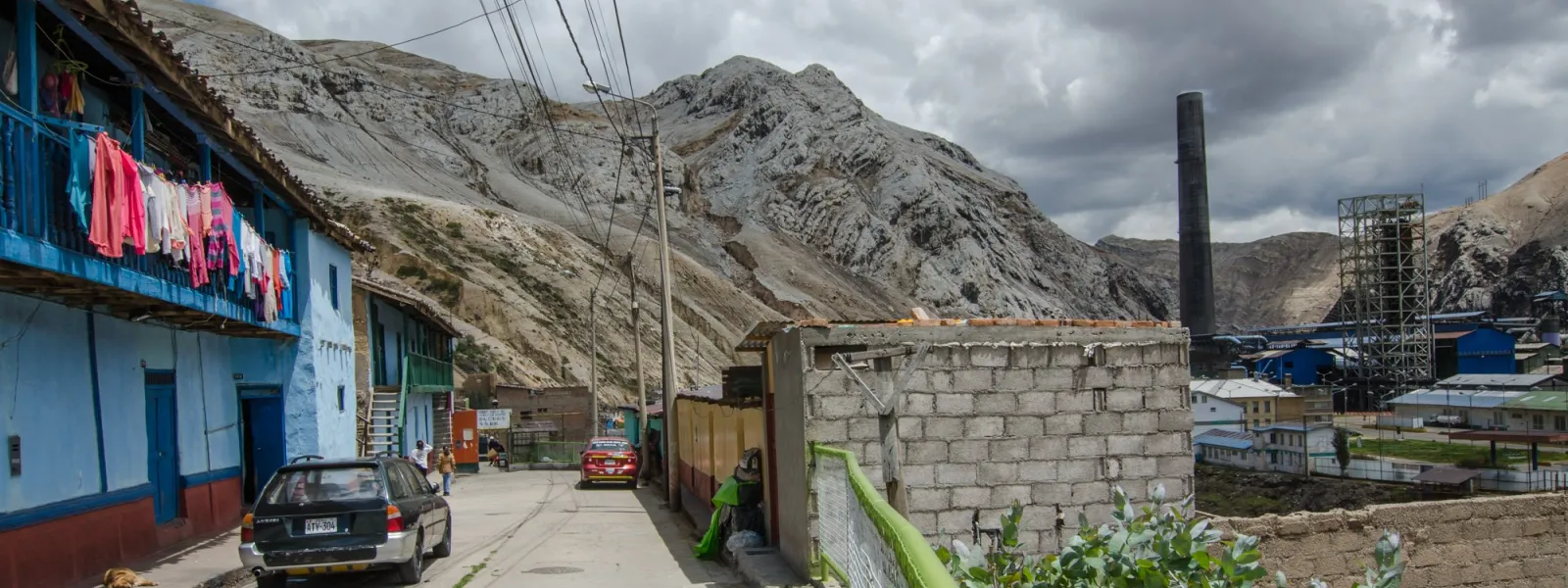
Families in La Oroya are calling on the Peruvian government to take four urgent actions to ensure effective compliance with the Inter-American Court’s ruling
Mitchell Gilbert.
In the absence of significant progress, they are calling on the government to identify the entities responsible for implementing each measure ordered by the Court, to provide comprehensive and specialized health care, to ensure the mitigation of pollution from the La Oroya Metallurgical Complex, and to immediately pay compensation to the victims of the case.
La Oroya, Peru. Given the minimal progress made in complying with the ruling issued two years ago by the Inter-American Court of Human Rights, families affected by decades of pollution in La Oroya are demanding that the government urgently take four necessary steps to ensure the effective implementation of the ruling in the short term.
On March 22, 2024, the international court issued a ruling holding the Peruvian government responsible for human rights violations against a group of 80 residents of La Oroya and ordering it to take comprehensive remediation measures.
However, implementation of the ruling remains in its early stages, primarily due to the government’s lack of political will and its constant shifting of arguments to delay the process. Progress to date has been limited to publicizing the ruling, making payments to the Victims’ Fund established by the Court, and launching criminal investigations into the stigmatization and persecution of victims for their environmental defense work.
Furthermore, in the two years since the ruling was issued, the La Oroya Metallurgical Complex, having resumed operations, has once again caused pollution levels in the city to exceed those recommended by the World Health Organization.
"The reactivation of the Metallurgical Complex in March 2024, without complying with current environmental standards, once again puts the health of the entire population of La Oroya at risk. Today, neither the victims in this case nor the rest of the city’s residents are guaranteed access to healthcare in the face of pollution. Furthermore, there is no clarity on when this situation will end, which creates significant uncertainty due to the government’s failure to act," stated Rosa Peña, senior attorney at the Inter-American Association for Environmental Defense (AIDA), the organization bringing the case before the Court alongside the Pro Human Rights Association (APRODEH) of Peru.
In light of this situation, the group of victims in the case is calling on the Peruvian government to move forward with implementing the ruling through four urgent actions:
- Issue a resolution determining jurisdiction that clearly defines which entity is responsible for each court order, and establishes a budget and specific implementation deadlines.
- Adopt and implement a specialized protocol for comprehensive health care, developed with the active participation of victims and with sufficient funding.
- Suspend operations at the Metallurgical Complex until an environmental management plan is in place that complies with the standards established by the Court; and evaluate transitional measures for property owners and workers to prevent further social impacts.
- Pay compensation to the victims as ordered by the Court.
After more than 20 years of struggle, the landmark ruling in the case has yet to translate into better living conditions for the victims or into reparations for the harm they suffered.
"It is deeply concerning that, two years after the ruling was issued, the government has not yet determined which agencies will be responsible for enforcing each of its provisions. This situation makes it impossible to even establish a forum for direct coordination on behalf of the victims and the general population of La Oroya and the country regarding mining and metallurgical activities. Let us not forget that the Court also ordered public policies at the national level to protect the environment and health in Peru," said Christian Huaylinos of APRODEH’s legal department.
Although Peru’s political instability has played a role, the main obstacle to steady progress in implementing the binding international ruling has been the government’s lack of determination.
Press contact
Lorena Zárate | AIDA | [email protected] | +52 553902 7481