
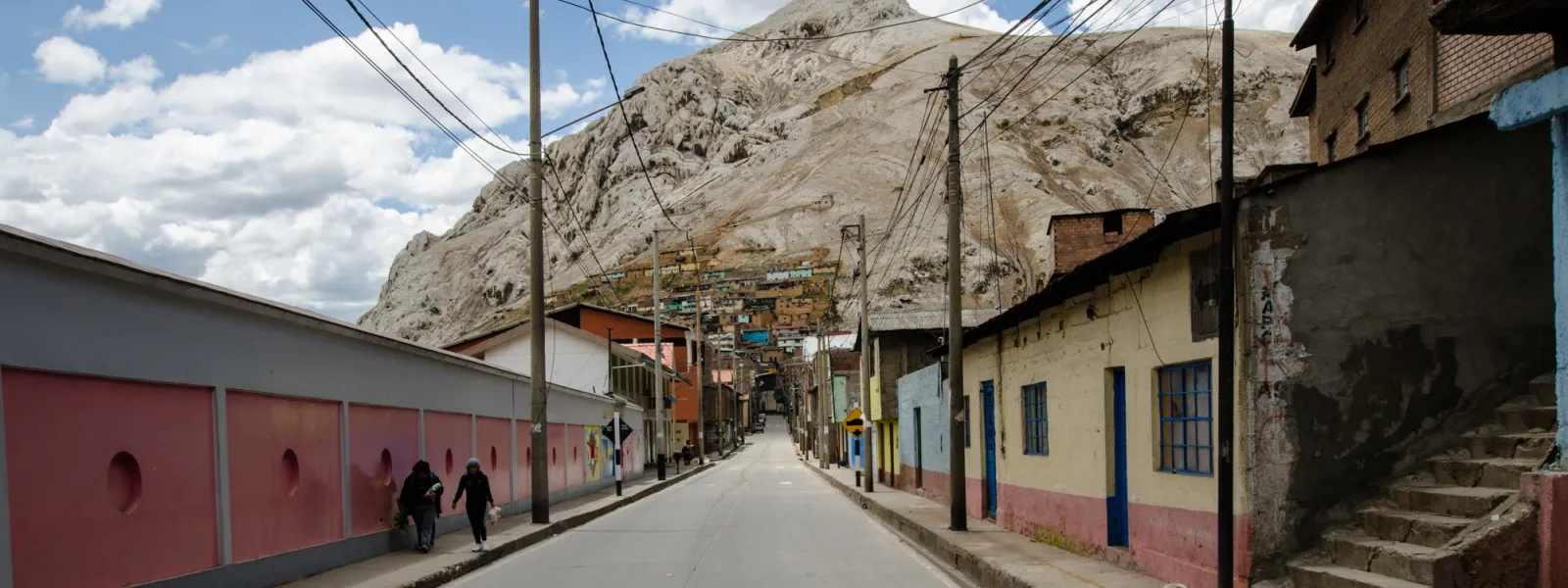
Victims in La Oroya call on the President of Peru to comply with the Inter-American Court ruling after nearly two years of delays
Mitchell Gilbert
The group of victims recognized by the international court emphasizes the urgency of implementing the ruling on issues related to ending pollution in the city of La Oroya, providing comprehensive and specialized medical care, and paying compensation.
La Oroya, Peru. Victims of decades of pollution caused by the operations of the La Oroya Metallurgical Complex sent a letter to the President of the Republic on December 19, 2025, urgently requesting compliance with the Inter-American Court of Human Rights' ruling ordering the Peruvian State to adopt comprehensive measures of justice and reparation.
In the letter, part of the group of 80 victims recognized by the international court in the La Oroya v. Peru case, the group emphasizes compliance with the ruling on issues related to pollution prevention in the city, comprehensive and differentiated medical care, and the payment of compensation.
"Mr. President, do we have to wait another 20 years to obtain some kind of reparation? Since we began this long struggle, seven people from this group of victims have died without obtaining justice. Two of them, including a minor, died as a result of health damage caused by pollution in La Oroya, as the Inter-American Court of Human Rights confirmed in its ruling," the victims point out.
Their request comes after almost two years of delays in the effective implementation of the ruling, notified on March 22, 2024, and after the Inter-American Court of Human Rights notified its interpretative judgment in November last year, in which it referred only to certain specific aspects of the original judgment that required further clarification to facilitate its execution. These points relate to health care measures, the relocation of affected persons, follow-up deadlines, compensation, and the acknowledgment of responsibility and a public apology.
However, both the victims and the organizations supporting their struggle emphasize that, as established by the Inter-American Court, all orders in the original judgment are in force and fully enforceable from the moment they were issued in March 2024, with no legal impediment to immediate compliance.
An essential step in achieving this is the urgent publication of the resolution determining jurisdiction by the Attorney General's Office.
"The victims have resorted to all legal and institutional mechanisms to access justice and see their rights restored. Today, preventing the population of La Oroya from continuing to be exposed to environmental pollution, guaranteeing comprehensive health care for those who have been affected by toxic metals, and ensuring the payment of compensation ordered by the Court are necessary and fully implementable steps for the Peruvian State to comply not only with its international obligations, but also with its fundamental duty to protect the life, health, and dignity of the people who inhabit its territory," said Rosa Peña, senior attorney at the Interamerican Association for Environmental Defense (AIDA).
Christian Huaylinos, from the legal department of the Pro Human Rights Association (APRODEH), highlighted the importance of implementing the ruling throughout the country: "Several of the provisions ordered by the Court are relevant at the national level, meaning that they benefit Peruvian citizens in general in relation to pollution from mining and metallurgical activities. These include harmonizing national-level air quality regulations, guaranteeing respect for human rights and due diligence, and designing and implementing an air and water quality information system in areas of Peru with greater mining and metallurgical activity. In this regard, achieving timely and efficient compliance by the State represents the significance of the case for the benefit of all Peruvians."
The victims emphasize that, given the clarifications made by the Inter-American Court in its interpretative judgment, there is no justification for the institutional delays that for more than two decades have prevented access to justice and reparation for the families affected by the pollution generated by the La Oroya Metallurgical Complex.
This case has become one of the most important precedents in Latin America for protecting the rights to a healthy environment, clean air, and health, especially for communities exposed to highly polluting business operations. After more than 20 years of struggle, the victims hope that the Peruvian State will finally guarantee the justice and reparation ordered by the Inter-American Human Rights System.
The victims, the population of La Oroya, and the organizations involved in the case reiterate their willingness to collaborate with the responsible institutions to ensure the effective implementation of all measures and to move toward comprehensive reparation and non-repetition.
Press contact
Víctor Quintanilla (Mexico), AIDA, [email protected], +521 5570522107