
5 keys to collective action: Lessons from the meeting of environmental defenders from the Southern Cone
Can an energy transition be just if it repeats the harms of traditional extractivism?
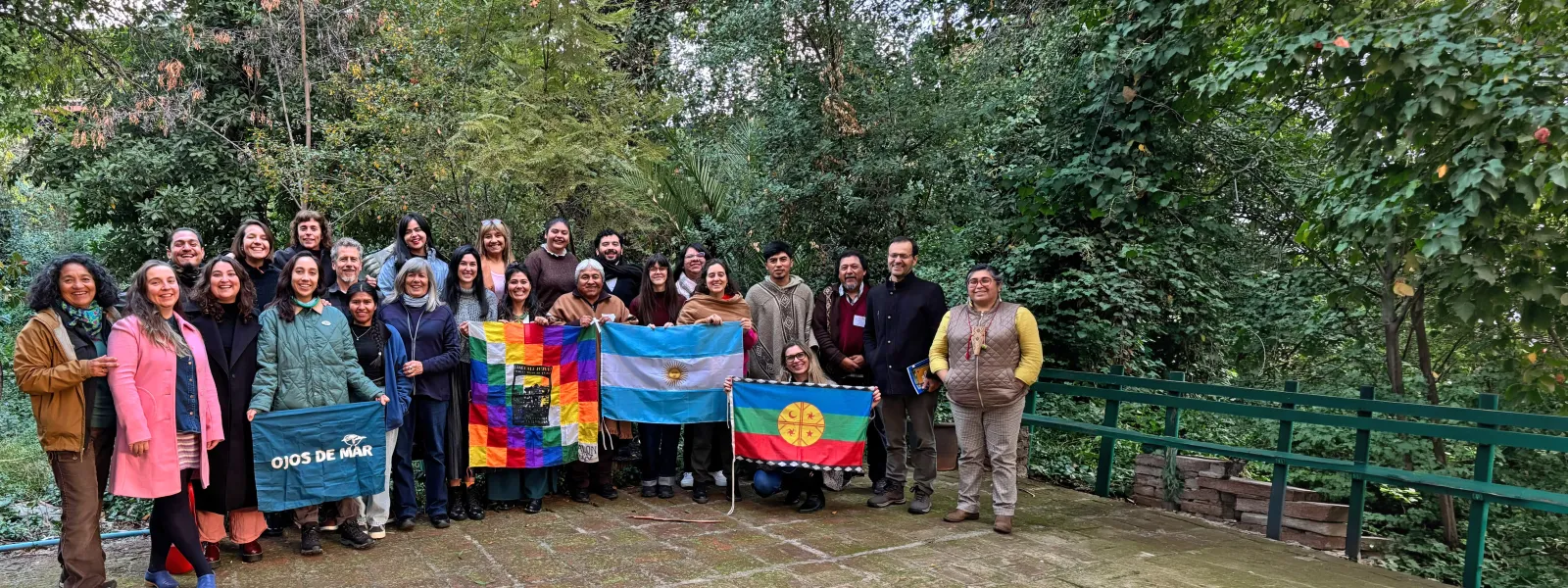
That was one of the central questions of “Articulando Territorios: Meeting of Defenders from the Southern Cone”, an event held on June 9 and 10 in Santiago, Chile, that brought together environmental defenders from Argentina, Bolivia, and Chile.
For years, AIDA has stood alongside those defending their territories against extractive and energy projects in Latin America. This meeting was part of that commitment: a space to share experiences, strengthen protection capacities, and collectively reflect on the impacts of the pressures of the global energy transition, including the rise of extractivism.
Here are the five key lessons we took away:
1. Communities are at the heart of the resistance for a just and sustainable energy transition
Many of the activities promoted under the global paradigm of the energy transition—such as lithium, copper, and other “strategic” metal mining, as well as port megaprojects—aimed at decarbonizing the energy mix continue to reproduce the historical dynamics of intensive resource extraction. The experiences and lessons shared in regions such as San Antonio in Chile, Salinas Grandes and Vaca Muerta in Argentina, and the salt flats of Bolivia point the way toward environmental justice. Against this new backdrop—and amid a wave of extractive expansion—local communities are shifting from being areas affected by these projects to becoming strategic allies in the resistance movements of the Southern Cone.
2. Defending the territory is a project that encompasses all aspects of life and shapes one's identity
Being an environmental defender is not a temporary job or activity, but a true life’s work. From this perspective, territorial defense goes beyond the protection of a physical or economic space. It involves cultural identity, collective memory, spirituality, and the intrinsic “body-territory” relationship. This framework explains why the impacts on ecosystems cannot be measured solely in economic terms: they directly damage the social fabric through community fragmentation, the forced migration of young people, and the painful loss of ancestral practices.
3. Protection must be comprehensive, collective, and proactive
The protection of those who defend the territory cannot depend on individual reactions or improvised measures when the risk is imminent. Protecting ourselves means identifying threats and strengths, and increasing our capacity to respond to risks. Building support networks, ensuring protection protocols are in place, and prioritizing collective care are the foundation for establishing robust processes for territorial and environmental defense.
4. Communication is about challenging narratives without revictimizing
Communication is a fundamental tool for political protection and strategic advocacy to counteract power imbalances. Communities must position themselves as primary sources of territorial knowledge and as the authors of their own narratives. Effective communication means bringing their knowledge, their proposals, and their capacity for organized resistance to the forefront, without reducing them to suffering or revictimizing them.
5. Recognize the right to defend the environment and use international tools as a means of protection
Recognizing that defending the environment is a holistic life project means recognizing and legitimizing the right to defend it. Territory and environmental defenders safeguard common goods that benefit society as a whole. It is necessary to explicitly recognize the legitimacy and dignity of this work by eliminating stigmas and criminalization, and by ensuring safe spaces for the exercise of this right.
In this context, the tools of international law are part of the range of protective measures, including:
- Strategic litigation. The success and transformative value of strategic environmental litigation go far beyond simply obtaining a favorable court ruling. Its true potential lies in bringing silenced conflicts to light, generating independent technical evidence, and opening up political spaces—all of which occur when it is well coordinated with community-based organizational processes.
- Escazú Agreement. The Escazú Agreement is a fundamental regional framework thanks to the three procedural rights—access to information, participation, and justice in environmental matters—that it guarantees and upon which it is built. It is key to the active protection of environmental human rights defenders. This framework must be transformed into a tool for defense in the hands of communities, particularly through well-founded legal action and the activation of the mechanisms provided for in the agreement.
The recent gathering of environmental defenders from the Southern Cone confirms something that AIDA has observed across the entire continent: the defense of the environment and human rights is built through networking.
We will continue to stand with communities and environmental defenders in Latin America to ensure that the energy transition does not come at the expense of their territories and their lives.
Camila Alejandra Inostroza Jara

Camila Alejandra Inostroza Jara was a fellow attorney with AIDA's Human Rights and Environment Program. She is a spokesperson for MODATIMA Wallmapu (Movimiento de Defensa por el Acceso al Agua, la Tierra y la Protección del Medioambiente). Camila is a graduate of the Universidad de la Frontera in Temuco. She has been dedicated to the protection of nature and the active defense of environmental causes of the Mapuche people. She has experience in strategic litigation for the protection of nature, the deprivatization of water, and the defense of the rights of the Mapuche people.