
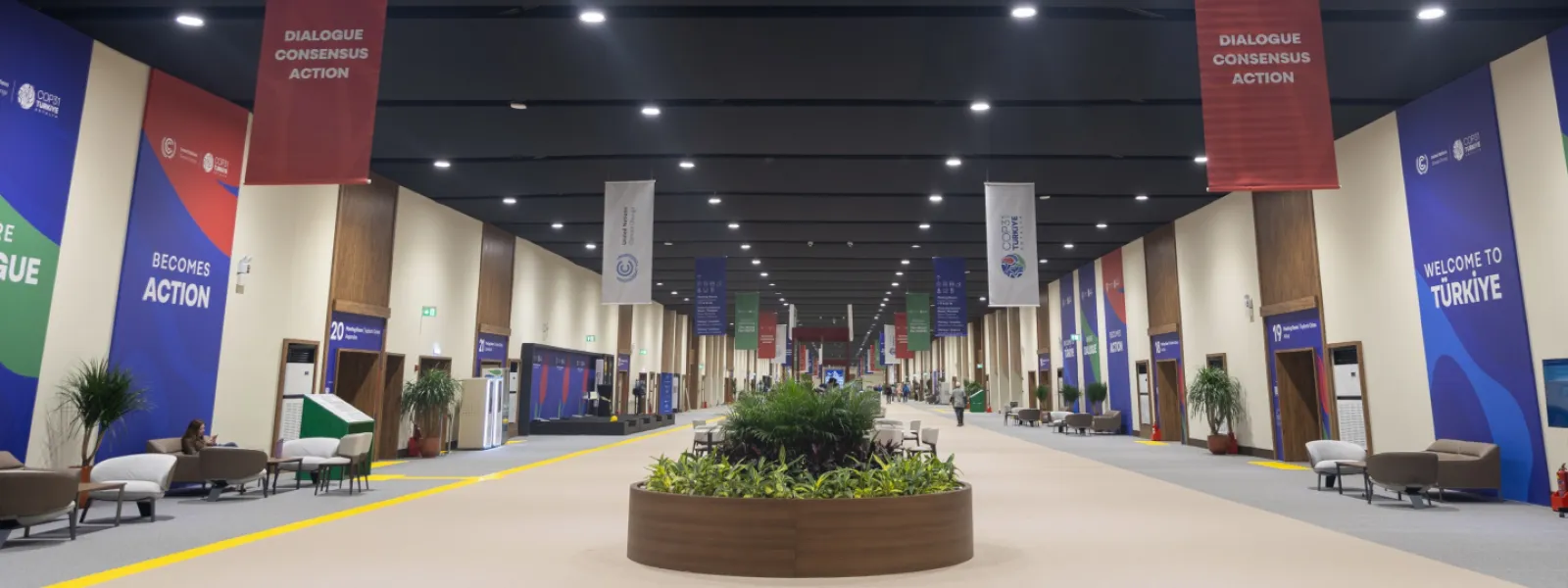
COP31 review: A stalled process and a transition that can no longer wait
UN Climate Change / Flickr (CC BY-NC-SA 4.0)
By Florencia Ortúzar Greene, Liliana Ávila, Jessica Solórzano and Karla Maass*
The 31st UN Climate Change Conference (COP31), held November 9–20, 2026, in Antalya, Turkey, failed to bridge the gap between political positions or to build on and continue the progress made at previous COPs.
The AIDA delegation was present throughout the two weeks of COP31, representing the voice of Latin America and closely following various negotiation tracks. Below, we share some reflections and outcomes.
The co-chair model between Turkey and Australia failed to put forward a collective vision or drive substantial progress on the most important issues on the table: climate finance and a just transition. This occurred in a context where the influence of sectors interested in prolonging the fossil fuel industry through new markets was evident, with more than 700 people linked to carbon capture and storage—a record that even surpassed the representation of 14 small island states in the Pacific.
On the other hand, the transition away from fossil fuels (TAFF) did not make it into the official process, but it is moving forward outside the conference halls—through national roadmaps and coalitions of countries.
Finally, the strong and organized presence of civil society from around the world—providing technical expertise to the delegations and keeping the focus on climate justice—was decisive.
According to the most recent report on the emissions gap by the United Nations Environment Programme (UNEP), exceeding the 1.5 °C threshold relative to preindustrial levels is inevitable, though not necessarily permanent. With deep and rapid emissions cuts, we could keep that overshoot as limited and brief as possible and return to below 1.5 °C before the end of the century. Despite the overwhelming evidence of the dangers that exceeding this limit poses to life on the planet, some tried to downplay it, which became one of the main underlying debates in Antalya.
COP31 promised to be the conference on implementation, but nothing can be implemented without adequate funding. And here lies the main problem: The countries with the greatest historical responsibilities arrived empty-handed, in stark contrast to their growing, multibillion-dollar military and defense spending. Meanwhile, countries in the Global South lack access to funding to address the consequences of the climate crisis or must rely on debt, further straining their limited fiscal space. This contrast left a bitter aftertaste that was palpable in the negotiating rooms.
Another notable aspect of this COP was the presidency’s deliberate decision to push for a cover decision from day one. This is a broad and discretionary text (not all COPs adopt one) that seeks to summarize the overall state of the negotiations, setting the political context and the level of ambition for the presidencies. Furthermore, it often addresses issues that “have no home” or on which no agreement was reached in the technical sessions. The discussion began in the first week and effectively created a new negotiation track that took more than 30 hours, diverting attention from core issues such as financing, the operationalization of the just transition mechanism, and the mitigation program, among others.
In the end, COP31 failed to adopt the cover decision, which—after several drafts—was rejected by the European Union, Panama, the Marshall Islands, Belize, Vanuatu, and Norway. The latest draft under discussion excluded fossil fuels and maintained a global aspiration to scale up carbon capture, utilization, and storage (CCUS) to the gigatonne level by 2035. The lack of a resolution reflects how polarized the positions of countries and groups are, and how disconnected the negotiations are from the urgency and social and economic justice that should guide the climate agenda.
However, despite all the setbacks at this COP, multilateralism is still alive and remains one of the few spaces where the countries that have contributed least to the crisis can hold accountable those who have caused it the most—and where we must continue to lay the groundwork for climate justice. Ultimately, the countries of the North—which have acknowledged their historical commitments—are failing to take concrete action, offering us instead empty rhetoric and proposals for more workshops and dialogues that do not put the necessary resources on the table.
The good news is that some countries explicitly opposed agreements that would leave us worse off than if we had ended up with no agreement at all. Panama was one such example: it warned in a letter to the presidency that it would not join a consensus that did not put science at the center, that did not curb the growth of oil production, or that did not require proportional contributions from those who have contributed most to the crisis and have the most resources to address it. Accordingly, it vetoed the draft decision text with a statement that references science and the principles of climate justice. Civil society, strongly organized across various constituencies, also played a key role in supporting this position.
*Florencia Ortúzar Greene is the director of AIDA's Climate Program; Liliana Ávila is the director of the Human Rights and Environment Program; Jessica Solórzano is an economics specialist at the organization; and Karla Maass is an external consultant.
Florencia Ortúzar Greene

Florencia is the Director of AIDA's Climate Program, and the Climate Finance Area Coordinator, working from Chile. She holds a law degree from the Catholic University of Chile and a master’s degree in Environmental Policy and Regulation from the London School of Economics in England. She has significant experience in litigation and climate governance. Florencia joined the AIDA team in 2012.