
Project
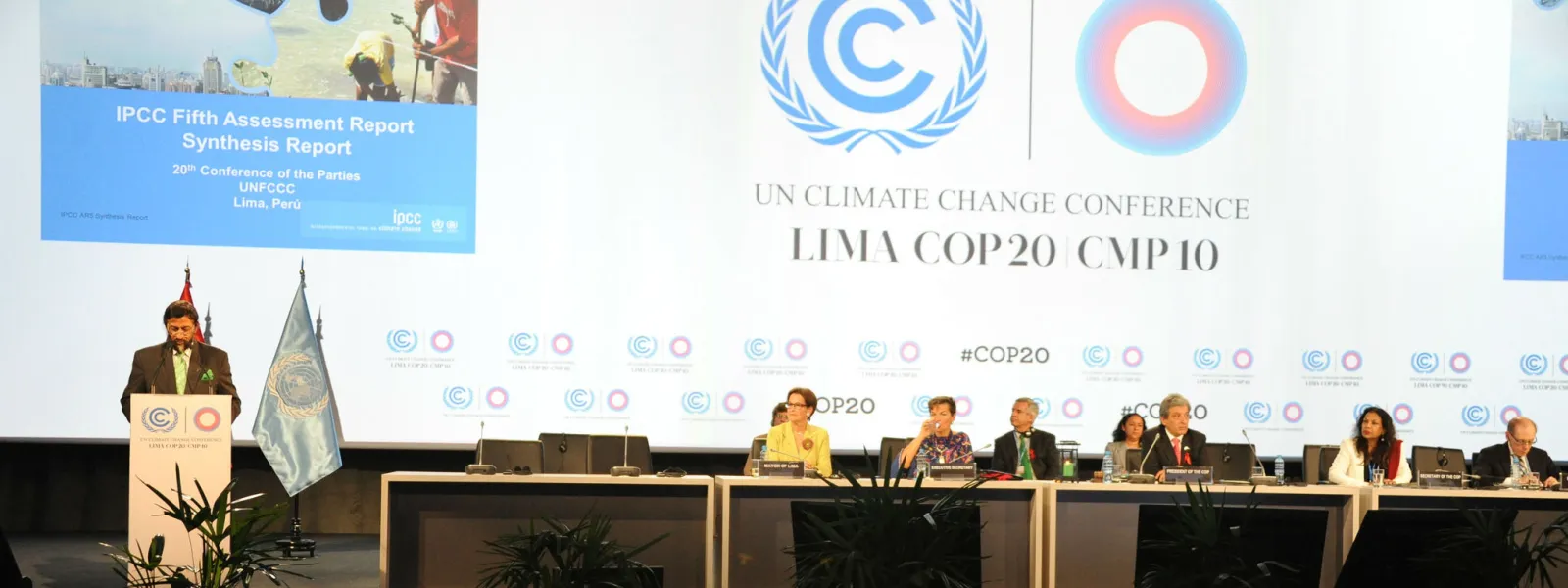
Photo: UNFCCCMonitoring the UN Climate Negotiations
As changes in climate become more extreme, their affects are being hardest felt throughout developing countries. Since 1994, the United Nations Framework Convention on Climate Change has laid out actions to limit the increase of global average temperatures and confront the impacts of climate change.
The States that are Parties to the Convention meet every year in the so-called Conference of the Parties (COP) to review their commitments, the progress made in fulfilling them, and pending challenges in the global fight against the climate crisis.
At COP21 in 2015, they adopted the Paris Agreement, which seeks to strengthen the global response to the climate emergency, establishing a common framework for all countries to work on the basis of their capacities and through the presentation of Nationally Determined Contributions (NDC) that will:
- Limit the increase in global temperatures to 2°C compared to pre-industrial levels and continue efforts to limit it to 1.5°C;
- Increase the capacity of countries to adapt to the impacts of climate change; and
- Ensure that financing responds to the goal of reducing greenhouse gas emissions.
Our focus areas
THE CLIMATE CRISIS AND HUMAN RIGHTS
The climate crisis, due to its transversal character, has repercussions in various fields, geographies, contexts and people. In this regard, the Preamble to the Paris Agreement states that it is the obligation of States to "respect, promote and fulfill their respective obligations on human rights, the right to health, the rights of indigenous peoples, local communities, migrants, children, persons with disabilities and people in vulnerable situations and the right to development, as well as gender equality, the empowerment of women and intergenerational equity."
AIDA at the COP
COP25: Chile-Madrid 2019
At COP25 in Madrid, Spain, we advocated for the inclusion of the human rights perspective in various agenda items. We promoted the incorporation of broad socio-environmental safeguards in the regulation of Article 6 of the Paris Agreement, which refers to carbon markets. We closely followed the adoption of the Gender Action Plan, as well as the Santiago Network, created "to catalyze technical assistance […] in developing countries that are particularly vulnerable to the adverse affects of climate change." We also encouraged the inclusion of ambitious and measurable targets for the reduction of short-lived climate pollutants in the climate commitments of States.
Related projects

Brazil secures Belo Monte site, but not human rights of affected people
Time doesn’t stop and, unfortunately, nor does the construction of the Belo Monte Dam. Work is advancing at an impressive rate on the Xingu River, in the Brazilian Amazon; 65% of the dam is complete. As it grows, the ecosystem—and the lives of people living in the area—deteriorates. Construction of the gigantic dam has opened an enormous gash through the thick Amazonian vegetation. Seeing it from the air creates a feeling of helplessness. And on land, it’s frustrating to see that the situation of indigenous peoples, coastal communities, and residents of the city of Altamira worsens. Recently, AIDA lawyers, María José Veramendi Villa and Alexandre Andrade Sampaio, visited the Arara indigenous community, nestled in the Big Bend of the Xingu River. Once Belo Monte dams the river, it will reduce the river’s flow so drastically that fishing, the livelihood of the Arara, will no longer be possible. Furthermore, the Arara will lose the track that leads to their sacred sites. They await the arrival of vehicles and construction of a road and a suitable well, because the quality of drinking water is not the best. In Altamira, the deteriorating situation is similar. Veramendi and Sampaio went there too. Once dam construction began, the population of the city grew massively. This boom has overwhelmed health services and the sanitation system and, worse, led to an increase in cases of sexual violence and human trafficking. Norte Energia, the consortium of government and private enterprises building the dam, has caused pisions among the affected population by paying more for some lands than for others. Many people were forced to sell their homes at a minimum price before they were evicted. And the small cinderblock cubes built for the relocation of displaced families do not qualify as adequate housing. Relocation also involves a change in lifestyle: from fishing to farming or hauling bags of cement. "This frays the social fabric,” explained Veramendi. “We work daily, along with our colleagues in Brazil, to make clear in the country and internationally that what is happening in Belo Monte constitutes human rights violations. We are constantly working to compel the government of Brazil to comply with the precautionary measures issued by the Inter-American Commission on Human Rights." On April 1, 2011, the Commission issued precautionary measures that Brazil should take to protect the life, health, and personal and cultural integrity of indigenous peoples in voluntary isolation; the health of other indigenous communities affected by the project; and demarcation of the ancestral lands of indigenous peoples. Our work, like the work of the human rights and environmental defenders we support in Brazil, is not easy. State security forces guard the construction site and Altamira. "We are surrounded, intimidated and harassed; there is no guarantee for our work," said Sampaio. With your help, we will continue fighting to see that the Belo Monte case progresses with the Commission, and that the Government of Brazil complies with its international human rights obligations rather than use the dam to bolster its electoral campaign at the cost of the environment and human welfare. Follow us on Twitter: @AIDAorg "Like" our page on Facebook: www.facebook.com/AIDAorg
Read moreClimate Marchers to Global Leaders: No dirty energy in the Green Climate Fund
New York, NY – As world leaders prepared to announce pledges of climate action and money for the Green Climate Fund, thousands of people flooded the streets of New York City yesterday demanding a financial commitment to clean energy and climate-resilient solutions. Heads of state are gathering at the United Nations tomorrow, at the invitation of UN Secretary General Ban Ki-Moon, in an attempt to jump-start negotiations for a new global climate deal. According to Janet Redman, climate policy director at the Institute for Policy Studies, “Reaching an agreement to stabilize the climate rests on developed countries making good on their promises. Contributions to the Green Climate Fund are past due. We need to see serious commitments from our governments to deliver financing for low-carbon, climate-friendly development now.” Andrea Rodríguez, Mexico-based legal advisor for the climate change program of the Interamerican Association for Environmental Defense (AIDA), added, “Billions of people still lack access to energy. The Green Climate Fund should support communities to meet that need through truly clean, decentralized, sustainable renewable energy. Despite the interest from various sectors in promoting carbon capture, natural gas, and large dams as climate solutions, this institution should not provide financial support for any project that emits greenhouse gas pollution.” The policies established by the Fund's 24 board members, from both developed and developing countries, have so far not excluded any energy sector from receiving finance, increasing the risk that dirty projects could ultimately receive support. “Dirty energy is more than fossil fuels,” noted Zachary Hurwitz, a consultant for International Rivers. “Hydropower dams can release methane, they can destroy carbon-sequestering forests, and they can displace thousands of people. And there’s nothing clean about the human rights violations that all too often result.” Lidy Nacpil, director of Jubilee South Asia Pacific Movement on Debt and Development, based in the Philippines, said, “In my country, we’re already facing the devastation of climate change. Wealthy industrialized countries have a legal and moral obligation to repay their climate debt and support adaptation through the Green Climate Fund. But that’s not enough. The fund must not exacerbate climate change and its impacts by financing dirty energy.” Additional information: Read the latest commentary from the Institute for Policy Studies on the Green Climate Fund. Read the Global South Position Statement on the Green Climate Fund. Read the open letter to governments, international institutions and financial mechanisms to stop considering large dams as clean energy and to implement real solutions to climate change.
Read moreClimate Marchers to Global Leaders: No dirty energy in the Green Climate Fund
New York, NY – As world leaders prepared to announce pledges of climate action and money for the Green Climate Fund, thousands of people flooded the streets of New York City yesterday demanding a financial commitment to clean energy and climate-resilient solutions. Heads of state are gathering at the United Nations tomorrow, at the invitation of UN Secretary General Ban Ki-Moon, in an attempt to jump-start negotiations for a new global climate deal. According to Janet Redman, climate policy director at the Institute for Policy Studies, “Reaching an agreement to stabilize the climate rests on developed countries making good on their promises. Contributions to the Green Climate Fund are past due. We need to see serious commitments from our governments to deliver financing for low-carbon, climate-friendly development now.” Andrea Rodríguez, Mexico-based legal advisor for the climate change program of the Interamerican Association for Environmental Defense (AIDA), added, “Billions of people still lack access to energy. The Green Climate Fund should support communities to meet that need through truly clean, decentralized, sustainable renewable energy. Despite the interest from various sectors in promoting carbon capture, natural gas, and large dams as climate solutions, this institution should not provide financial support for any project that emits greenhouse gas pollution.” The policies established by the Fund's 24 board members, from both developed and developing countries, have so far not excluded any energy sector from receiving finance, increasing the risk that dirty projects could ultimately receive support. “Dirty energy is more than fossil fuels,” noted Zachary Hurwitz, a consultant for International Rivers. “Hydropower dams can release methane, they can destroy carbon-sequestering forests, and they can displace thousands of people. And there’s nothing clean about the human rights violations that all too often result.” Lidy Nacpil, director of Jubilee South Asia Pacific Movement on Debt and Development, based in the Philippines, said, “In my country, we’re already facing the devastation of climate change. Wealthy industrialized countries have a legal and moral obligation to repay their climate debt and support adaptation through the Green Climate Fund. But that’s not enough. The fund must not exacerbate climate change and its impacts by financing dirty energy.” Additional information: Read the latest commentary from the Institute for Policy Studies on the Green Climate Fund. Read the Global South Position Statement on the Green Climate Fund. Read the open letter to governments, international institutions and financial mechanisms to stop considering large dams as clean energy and to implement real solutions to climate change.
Read more