Project
Organizing the Network for Environmental Justice in Colombia
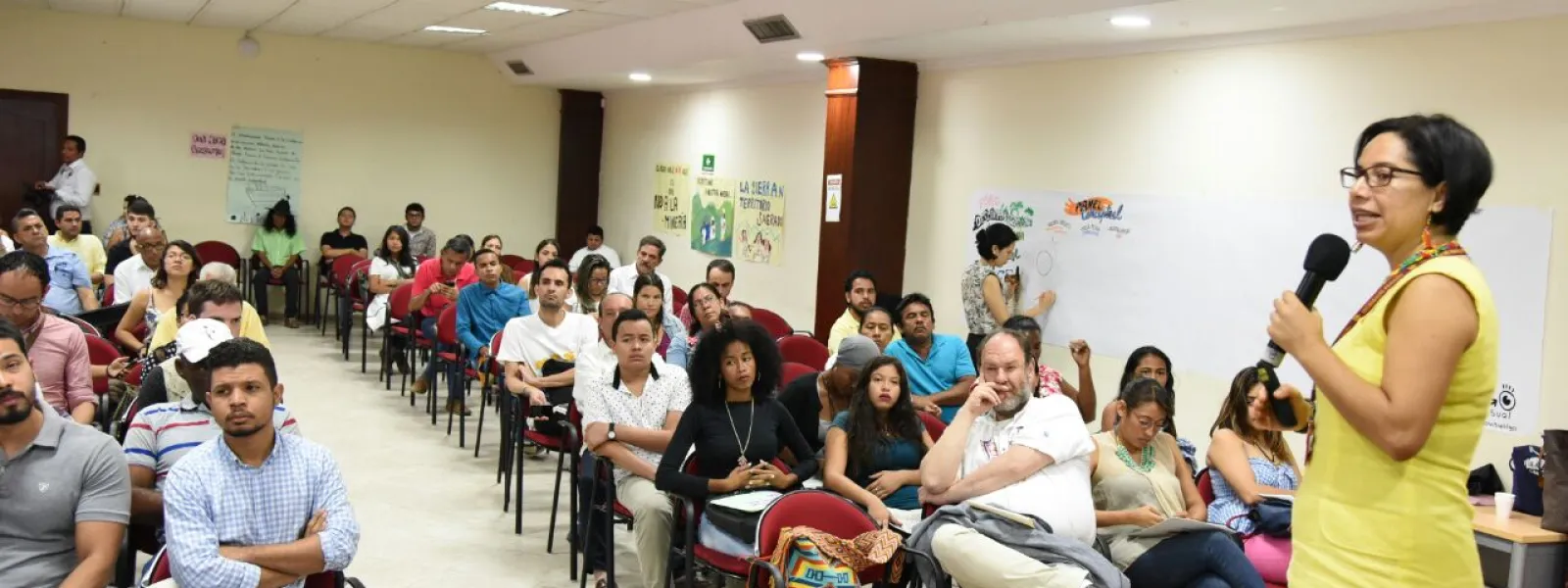
The Network for Environmental Justice in Colombia is an effort to coordinate organizations and legal resources for the protection of human rights and the environment.
The Network was founded in 2010 under the coordination of AIDA and with the help of the Latin American Institute for Alternative Society and Law, the Institute for the Study of Peace and Development, the Inter-Ecclesial Commission for Justice and Peace, and the University of Los Andes, the University of Caldas, and Del Rosario University. The network began with 79 participants and now includes more than 500 people and participating organizations.
The Network’s principal objective is to propose solutions to environmental conflicts in Colombia. It also aims to promote the fair and effective use of international and domestic environmental law, in particular, the right to a clean and healthy environment.
What does the network do?
- Facilitates the exchange of knowledge and information to implement legal strategies in precedent-setting cases. One such project was the Mandé Norte Mine, in which several members of the Network developed a legal strategy, resulting in a judicial decision that established Colombia’s need to perform an independent environmental impact assessment. Most importantly, the decision also mandated that developers obtain the consent of indigenous peoples before moving forward with any projects in their territory.
- Promotes organizational alliances, garners support, and connects legal work in defense of the environment.
- Organizes conversations, forums, and constructive debates on environmental issues.
- Provides access to legal resources including laws, court decisions, articles and legal analysis, and facilitates communication through its website and social media channels.
- Advises law students through the AIDA volunteer program. In doing so, the Network strengthens the capacity for environmental law in Colombia.
Partners:

Colombian government must immediately suspend the use of glyphosate
Bogota, Colombia. Glyphosate, the herbicide used to eradicate crops considered illicit in Colombia, has been classified as a substance probably carcinogenic to humans by the International Agency for Research on Cancer, the specialized cancer agency of the World Health Organization. Based on these findings, the Colombian Ministry of Health is recommending that the country’s Ministry of Justice "immediately suspend the use of glyphosate in the Illicit Crops Eradication Program’s aerial spraying operations." The Interamerican Association for Environmental Defense (AIDA) strongly supports this recommendation so that the human rights to health and a healthy environment, both closely linked to the right to life, are protected in Colombia. We urge the government to fulfill its national and international obligations, respecting the conclusions reached by the highest health authorities, in order to prevent further damage to the country’s people and environment. For 15 years, AIDA and partner organizations have been warning of the grave impacts glyphosate has on the environment and human health. We’ve advocated for the need to apply the precautionary principle to suspend Colombia’s fumigation program, which has been financed by the government of the United States. Astrid Puentes Riaño, attorney and co-director of AIDA: "Colombia, like no other country, has used millions of liters of glyphosate that have not succeeded in destroying coca and poppy plants, but have irreparably damaged the environment and human health. Without excuses or delays, the National Narcotics Council must act responsibly and immediately suspend the use of glyphosate in the eradication of illicit crops." Anna Cederstav, co-director of AIDA and PhD in Chemistry: "The scientific evidence on the impacts of glyphosate on the environment and human health is sufficient to support a decision of the suspension of aerial spraying of glyphosate in Colombia."
Read more
Green Climate Fund Begins Accreditation Process
2015. This is the year. Sink or swim. It’s all or nothing. Opening the Green Climate Fund’s Ninth Meeting of the Board last month, Executive Director Hela Cheikhrouhou spoke with an urgency characteristic of the lead-up to December’s UN Climate Conference in Paris, describing this year as one of the last opportunities humanity has to change course and steer a sustainable path. As we approach the signing of a new global agreement on climate change, the efficacy of the Green Climate Fund (GCF) holds particular importance. Counting now with $10.2 billion, it will serve as the primary vehicle to finance projects designed to help all societies – whether developed or developing – confront the causes, and the effects, of a changing climate. At last month’s meeting, the Fund’s Board accredited its first intermediary and implementing institutions – charged with channeling money into developing nations – and then announced plans to begin allocating its resources before the year’s end. These accreditations, in turn signaling the imminent arrival of the first project proposals, represent an important milestone in the rigorous, nearly five-year process since the Fund was first established. "This will be the ultimate test of the effectiveness of the institution," said Andrea Rodríguez Osuna, AIDA’s Senior Attorney for Climate Change, who has been monitoring the development of the Fund. "When it all comes down to it, this is the step that matters." The first seven entities accredited by the Board represent a broad geographic and thematic range, and will likely be the first to submit proposals for funding. Including organizations from Senegal to Peru, they specialize in issues such as coastal protection, biodiversity conservation, sustainable development, and improving the lives of low-income communities. While the accreditations represent an advance towards the actualization of the Fund’s mission, a number of significant organizational decisions remain under debate, or are as yet unaddressed. Among other topics on the agenda last month, the Board addressed the expected role and impact of the Fund, which will enable them to identify financing priorities, and the Initial Investment Framework, which will outline what types of projects will be financed and how they will be selected and assessed. "Alongside accreditation, these elements are essential. Without them, the Fund can’t advance toward the future, toward having more focused and productive discussions," Rodríguez explained. The criteria and methodology for the Fund’s Initial Investment Framework triggered a heated debate, which largely pitted developed against developing nations. On one side, the developed nations pushed for minimum required benchmarks that would enable simpler measurement of success; on the other side, developing nations pushed for qualitative measures with no strict requirements that would better ensure more equal access to funds. Finally, they reached a compromise, deciding to use non-mandatory indicative minimum benchmarks that would both encourage ambition and take into account the needs of those developing countries most vulnerable to the adverse effects of climate change. The Secretariat will present the proposed benchmarks for further development in about a year’s time, at the 13th meeting of the Board. Discussing the expected role and impact of the Fund, the Board came to an uncharacteristically unified decision – to keep the Initial Investment Framework under review, and to take action as needed regarding the criterion on needs of the recipient countries. Agreeing the document presented by the Secretariat lacked sufficient information, the Board requested they be presented with more technical and scientific data before beginning to outline their priorities. Notably missing from the conversation, due to lack of time, was an item particularly important to AIDA’s work, Enhanced Direct Access, which would obligate public participation in certain projects. If approved, this direct access would ensure the moreequitable involvement of all the actors working to confront the effects of a changing climate. The next meeting of the Board of the Green Climate Fund will be July 6-9 at the Fund’s headquarters in Songdo, South Korea. AIDA will be there again to monitor these issues and report back on important developments, as the world prepares for a new global climate accord, and the Green Climate Fund moves ever closer to implementation.
Read more
Citizens' petition urges Mexican government to revoke authorizations set to harm protected areas
Petition open for signatures on Change.org requests that CONANP and SEMARNAT stop the pending use of explosives in Los Tuxtlas rainforest reserve, and avoid the destruction of the country’s largest coral ecosystem, the Veracruz Reef System. Mexico City, Mexico. Along the Eastern Coast of Mexico, two of the greatest natural treasures in the state of Veracruz are at grave risk from the government-sanctioned expansion of the Port of Veracruz. In response to the shortsighted permission granted by Mexico's Secretary of the Environment and Natural Resources (SEMARNAT), the Interamerican Association for Environmental Defense (AIDA), CEMDA and other civil society organizations have joined together to support a citizens' petition requesting the authorizations be revoked and the country's natural heritage be protected. The petition, launched today on Change.org,[1] urges SEMARNAT to revoke the environmental permit granted to the Port Authority to mine basaltic rock in Los Tuxtlas Biosphere Reserve. It also asks the National Commission of Natural Protected Areas to increase protection of the Veracruz Reef System by adding it to the Montreux Record, a register of sites on the List of Wetlands of International Importance. Registering the Veracruz Reef would allow Mexico access to financial resources to help preserve it. The government authorized the extraction of two million cubic meters of basaltic rock to build the port’s new breakwater. The Los Tuxtlas Management Plan expressly prohibits the use of explosives within the Reserve, but the project requires them to release the rock. The noise and presence of workers will disrupt the habitual behavior of the reserve’s fauna, including the endangered Mexican howler monkey. Removal of rock from Los Tuxtlas will irreversibly alter the topography, vegetation and ecosystem services of the area, in addition to contravening the purposes of the Reserve. It would also increase the region’s vulnerability to climatic events such as tropical storms and hurricanes. To accommodate the port’s new footprint, the government shrunk the surface area of the protected Reef System without sufficient scientific information to understand the impact it would have.[2] The change allows the port to be built on a previously protected area of the reef. This action violates national and international standards and ignores the cumulative impacts that the project will have on the fragile ecosystem due to, among other things, increases in population and maritime traffic. The authorization granted by the Secretary of the Environment and Natural Resources would permit the construction of two breakwalls with a combined length of 7,740 meters, a main basin 800 meters in diameter, nine types of terminal docks, and 30 berths for boats. In total, the proposed enlargement of the Port of Veracruz covers an area of about 910 hectares, double the current size of the port. The removal, fragmentation and siltation of the coral reefs of the Veracruz Reef System and the disappearance of land reclaimed by the sea will irreversibly damage the health of the entirety of Mexico’s most resilient coral ecosystem. The Veracruz Reef System consists of at least 23 coral reefs of varying sizes, shapes and depth. Within its boundaries live coral ecosystems, subtidal seagrass beds, shallow marine waters, mangroves and sandy beaches. In 1992 the government declared it a Natural Protected Area, and in 2002 it was registered as a Wetland of International Importance under the Ramsar Convention, an intergovernmental treaty. The national park is the habitat of sea creatures such as dolphins and sea turtles. As a rich marine ecosystem, it supports abundant fisheries, and its incredible beauty draws sport and tourism to its shores. The coral reefs within are important climate regulators, and serve as a natural barrier against large waves and storms. In 2010, the reef protected the city of Veracruz from Hurricane Karl, a dangerous Category 4 storm.[3] For the great benefits these natural ecosystems provide, the Conserve Veracruz campaign is asking for the signatures and support of citizens around the world to urge the Mexican government to revoke the port’s environmental permit, and instead to fulfill its primary responsibility of protecting Mexico’s rich natural heritage. [1] https://www.change.org/p/semarnat-protect-the-coral-reefs-and-jungle-of-veracruz [2] The federal government issued a new decree removing protection from the Punta Gorda and Bahia Vergara reefs. [3] National Oceanic and Atmospheric Association (NOAA), United States Department of Commerce, available at: http://oceanservice.noaa.gov/podcast/feb10/dd022410transcript.html
Read more