
Groundwater: The importance of what we can’t see
Ave Calvar Martinez / Pexels.
Did you know that beneath the ground we walk on lies the planet’s most abundant source of fresh water?
These are aquifers, underground geological formations that store 99% of the world’s liquid fresh water.
That groundwater provides nearly half of the world’s drinking water; it is the sole source of drinking water for one-third of the world’s population (about 2.5 billion people); and it accounts for 43% of the water used for irrigation.
Therefore, keeping this resource accessible and high-quality is essential to the lives, health, and food security of millions of people.
Despite their importance, aquifers face risks from extractive activities. One such activity is exploiting unconventional oil and gas deposits through fracking, or hydraulic fracturing, a technique that can lead to groundwater contamination.
Key aquifers at risk: The case of Brazil
Some of the world’s most important aquifers are located in Latin America, primarily within Brazil. They include:
- The Guaraní Aquifer System, a transboundary aquifer shared by Brazil, Argentina, Paraguay, and Uruguay. It supplies water to about 90 million people, meeting domestic, agricultural, industrial, and tourism needs across more than 1 million km².
- The Greater Amazon Aquifer System, which spans several Brazilian states and adjacent areas of the Amazon basin in neighboring countries, is one of the world's largest underground water reservoirs and accounts for more than 80% of the water circulating in the Amazon cycle.
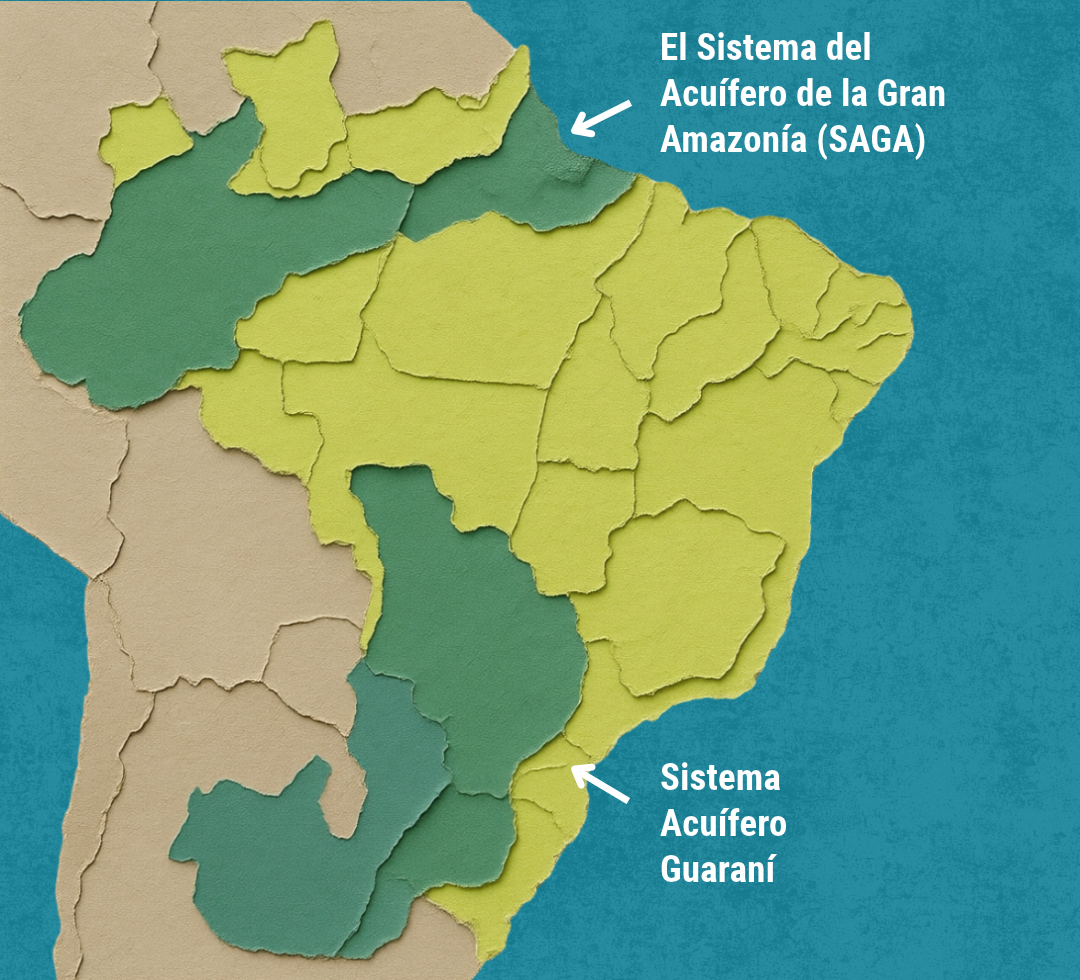
These strategic water reserves are currently at risk because fracking activities in Brazil could overlap with both aquifers, according to maps.
The future of fracking in Brazil—and water
Brazil’s Superior Court of Justice is currently deciding whether to authorize fracking in the country to extract unconventional oil and gas.
The technique involves drilling a straight well deep into the ground and then turning the drill to create an L-shaped well. Workers inject a mixture of water, sand, and chemical additives (some of which are toxic) into the well at very high pressure to fracture underground rocks and extract the hydrocarbons they contain.
Fracking could contaminate the Guaraní and Greater Amazon aquifers if the toxic chemicals used to fracture the rocks seep through well leaks or surface spills. For this reason, and because of its high water consumption, the technique may jeopardize the water security of populations that rely on these groundwater sources, including indigenous communities and peoples in voluntary isolation.
Because water from aquifers isn't just for drinking. It also irrigates crops, keeps rivers flowing, and sustains unique ecosystems.
Even though we can't see them, aquifers hold a treasure that is vital to humanity.
Protecting them means protecting life.
Mayela Sánchez García

Mayela Sánchez García is AIDA's digital community specialist, working from Mexico. She is a graduate in Journalism and Media Studies from the Instituto Tecnológico y de Estudios Superiores de Monterrey in Mexico. Mayela has significant experience as a journalist focused on social and human rights issues. She has worked in print and digital media, and has experience in podcast production.