
Project
Preserving the legacy of the Sierra Nevada de Santa Marta, Heart of the World
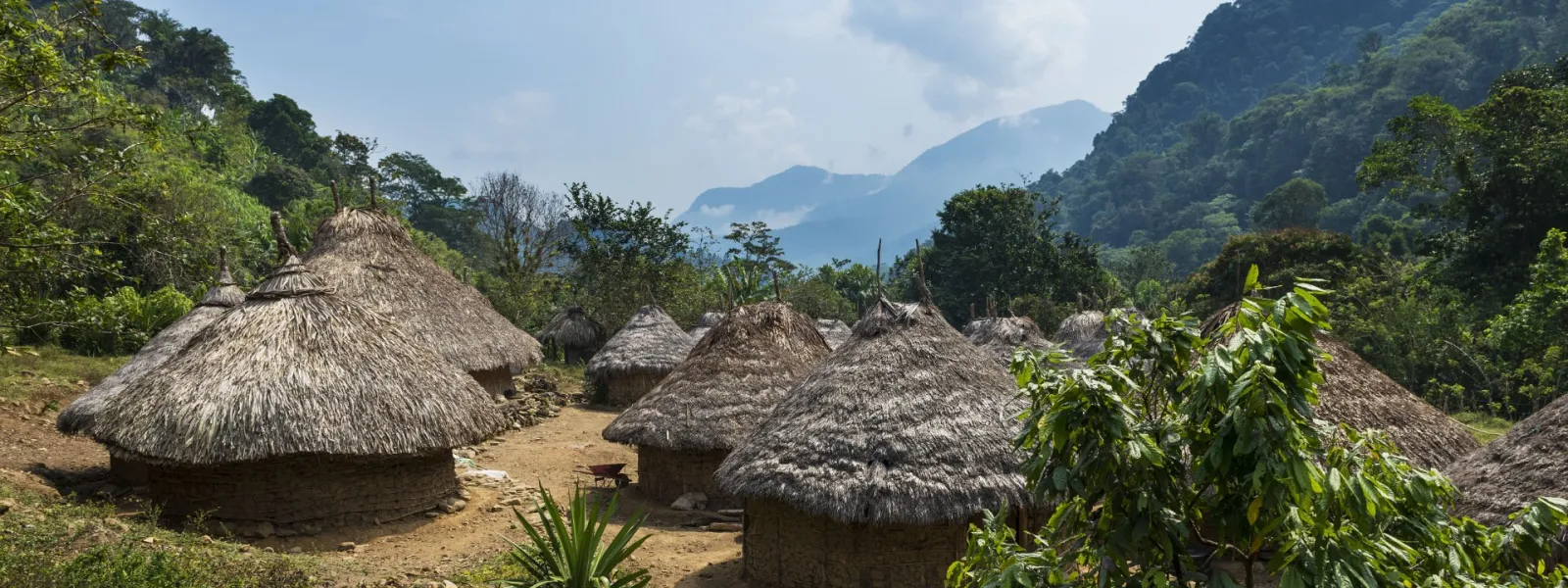
Rising abruptly from Colombia’s Caribbean coast, the Sierra Nevada de Santa Marta reaches 5,775 meters (18,946 ft.) at its highest points, the peaks of Bolívar and Colón. It is the highest coastal mountain system in the world, a place where indigenous knowledge and nature’s own wisdom converge.
The sheer changes in elevation create a wide variety of ecosystems within a small area, where the diversity of plant and animal life creates a unique exuberant region. The melting snows of the highest peaks form rivers and lakes, whose freshwater flows down steep slopes to the tropical sea at the base of the mountains.
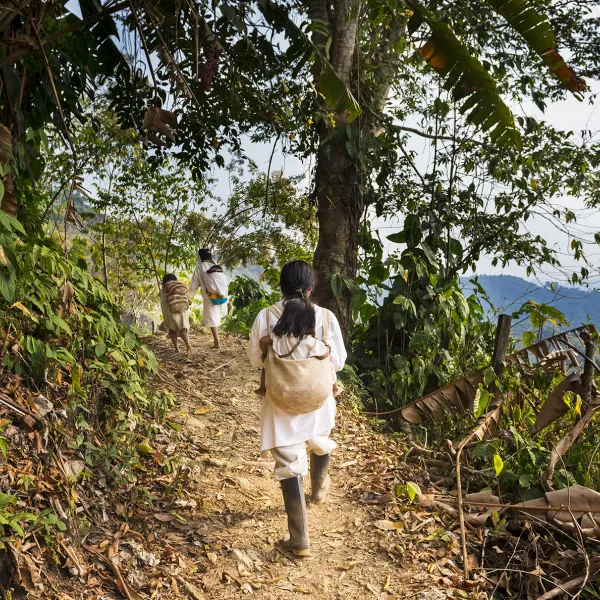
The indigenous Arhuaco, Kogi, Wiwa, and Kankuamo people protect and care for this natural treasure with an authority they have inherited from their ancestors. According to their worldview the land is sacred and shared in divine communion between humans, animals, plants, rivers, mountains, and the spirts of their ancestors.
Despite this ancestral inheritance, development projects proposed for the region have failed to take the opinions of these indigenous groups into consideration. The Sierra Nevada de Santa Marta is currently threatened by 251 mineral concessions, hydroelectric projects, agriculture, urban sprawl, and infrastructure projects.
Many of these concessions were granted without the prior consultation of the indigenous communities, which represents a persistent and systematic violation of their rights.
Mining, which implies the contamination and erosion of watersheds, threatens the health of more than 30 rivers that flow out of the Sierra; these are the water sources of the departments of Magdalena, César, and La Guajira.
These threats have brought this natural paradise to the brink of no return. With it, would go the traditional lives of its indigenous inhabitants, who are dependent on the health of their land and the sacred sites it contains.
The Sierra hosts the archaeological site of la Ciudad Perdida, the Lost City, known as Teyuna, the cradle of Tayrona civilization. According to tradition, it is the source from which all nature was born—the living heart of the world.
The four guardian cultures of the Sierra are uninterested in allowing this natural and cultural legacy to disappear.
Related projects
Belo Monte Dam may lead Brazil to OAS High Court
Local communities and NGOs deliver petition exposing human rights violations to Inter-American Commission on Human Rights. Brasilia, Brazil—Local communities and NGOs delivered a petition to the Organization of American States’ (OAS) human rights body today claiming that Brazil has steamrolled human rights in its rush to fast-track construction of the controversial Belo Monte Dam, slated for construction on the Xingu River in the Amazon interior. The petition, signed by representatives of indigenous communities and other populations threatened by the dam, denounced the Brazilian government and called on the Inter-American Commission on Human Rights (IACHR) to declare human rights violations and order the Brazilian government to cancel the project and pay damages. Two weeks ago the Brazilian government defied IACHR’s demand that Brazil halt the dam’s licensing process. Brazil instead granted Belo Monte’s installation license, clearing the way to commence construction despite blatant non-compliance with social and environmental protections. Petition-signers scrutinized illegal aspects of the dam’s licensing process, especially with regard to the rights of indigenous peoples living along the Big Bend of the Xingu River, where 80% of the river's flow would be diverted to an artificial reservoir, undermining livelihoods and potentially leading to the forced displacement of thousands of people in clear violation of Brazil’s Constitution and international law. NGO and legal groups expect the Commission to determine that the Brazilian government has violated the rights of local peoples, and will recommend compensation. If the government continues to ignore the IACHR, the case could go to the Inter-American Court on Human Rights, which could formally condemn the Brazilian government for violations of its international obligations. The petition delivery today follows an initial complaint submitted last November that led to the granting of "precautionary measures" by the IACHR in April 2011. These measures recommended to the Brazilian government that urgent action be taken to guarantee the rights of indigenous peoples—as required by the Brazilian Constitution and international agreements such as the American Convention on Human Rights, Convention 169 of the International Labor Organization (ILO) and the UN Declaration on the Rights of Indigenous Peoples—before proceeding with dam construction. That decision by the IACHR provoked a defensive response from the administration of President Dilma Rousseff, which refused to take additional measures to protect indigenous rights. Eleven civil actions lawsuits against the Belo Monte Dam, filed by the Federal Public Prosecutor's Office, are still pending in Brazilian courts. “It is clear that the Brazilian judicial system is not working to protect human rights in the case of mega-infrastructure projects such as Belo Monte, given the tremendous economic and political pressures, often linked to corruption,” said Antonia Melo, coordinator of the Xingu Forever Alive Movement (Movimento Xingu Vivo para Sempre). “As a result, we have no alternative but to request the support of the Inter-American Commission on Human Rights.” “Our community is under threat and the leaders are the ones who suffer the most,” stated José Carlos Arara, an indigenous chief of the Arara village in the Big Bend region of the Xingu. “I am stuck in my village and no longer leave my community after receiving death threats.” "Brazilian diplomacy is in serious danger of an international embarrassment,” said Roberta Amanajás, a lawyer with the Pará Society for the Defense of Human Rights. “The Rousseff administration's aggressive response to the IACHR, followed by the Brazilian Senate’s vote to censure the OAS last week is a dangerous sign.” "The Brazilian government's position on Belo Monte goes against the image it promotes as a regional leader and its role as the host of the UN Conference on Sustainable Development (Rio +20) in 2012," said Astrid Puentes, Co-Director of the Inter-American Association for Environmental Defense (AIDA). "We hope that the governments of the region stop promoting environmentally and socially harmful projects and instead seek truly sustainable development based on respect for human rights.”
Read moreOrganization of American States requests immediate suspension of Belo Monte Dam in the Brazilian Amazon
The Inter-American Commission on Human Rights considered that Indigenous Peoples must be consulted BEFORE the dam’s construction begins. Altamira, Brazil / Washington, D.C., USA - The Inter-American Commission on Human Rights (IACHR), part of the Organization of American States (OAS), has officially requested the Brazilian Government to immediately suspend the Belo Monte Dam Complex in the Amazonian state of Para, citing the project's potential harm to the rights of traditional communities living within the Xingu river basin. According to the IACHR, the Brazilian Government must comply with legal obligations to undertake a consultation process that is "free, prior, informed, of good faith and culturally appropriate" with indigenous peoples threatened by the project before further work can proceed. The Brazilian Ministry of Foreign Affairs must inform the OAS within 15 days regarding urgent measures undertaken to comply with the Commission's resolution. The IACHR's decision responds to a complaint submitted in November 2010 on behalf of local, traditional communities of the Xingu river basin. The complaint was presented by the Xingu Alive Forever Movement - (MXVPS), the Coordination of Indigenous Organizations in the Brazilian Amazon (COIAB), the Prelacy of the Roman Catholic Church in the Xingu region, the Indigenous Missionary Council (CIMI), the Pará Society for the Defense of Human Rights (SDDH), Global Justice and the Inter-American Association for Environmental Defense (AIDA). According to the complaint, there were no appropriate consultations with affected indigenous and riverine communities regarding the impacts of the mega-dam project. The document argues that the dam would cause irreversible social and environmental damage, including forced displacement of communities, while threatening one of the Amazon's most valuable areas for biodiversity conservation. "By recognizing the rights of indigenous people to prior and informed consultations, the IACHR is requesting that the Brazilian Government stop the licensing and construction of the Belo Monte dam project to ensure their right to decide," said Roberta Amanajas, SDDH lawyer. "Continuing this project without proper consultations would constitute a violation of international law. In that case, the Brazilian Government would be internationally liable for the negative impacts caused by the dam." The IACHR also requests Brazil to adopt "vigorous and comprehensive measures" to protect the lives and personal integrity of isolated indigenous peoples in the Xingu river basin, as well as effective measures to prevent the spread of diseases and epidemics among traditional communities threatened by the project. "The IACHR's decision sends a clear message that the Brazilian Government's unilateral decisions to promote economic growth at any cost are a violation of our country's laws and the human rights of local traditional communities," said Antonia Melo, MXVPS coordinator. "Our leaders no longer can use economic "development" as an excuse to ignore human rights and to push for projects of destruction and death to our natural heritage and to the peoples of Amazon, as is the case of Belo Monte." "The OAS's decision is a warning to the Federal Government and a call to Brazilian society to broadly discuss the highly authoritarian and predatory development model being implemented in this country," said Andressa Caldas, Global Justice director. Andressa recalls examples of human rights violations caused by other infrastructure projects within the federal government's Accelerated Growth Program (PAC). "There are numerous cases involving the forced displacement of families without compensation, as well as serious environmental impacts, social disruption of communities, rising violence in areas surrounding construction sites and poor working conditions." Criticism of the Belo Monte dam comes not only from civil society organizations, and local communities, but also from scientists, researchers, and government institutions. The Federal Public Prosecutor's office in Pará state has already filed ten civil lawsuits against the mega-project that are still awaiting final decisions. "I am very moved by this news," said Sheyla Juruna, an Indigenous leader of the Juruna community in Altamira. "Today, more than ever, I am sure that we were right to expose the Brazilian Government - including the federal judicial system - for violations of the rights of indigenous peoples in the Xingu and of all those who are fighting together to protect life and a healthy environment. We will maintain our firm resistance against the implementation of the Belo Monte Dam Complex." The IACHR's decision is founded on international law established by the American Convention on Human Rights, Convention 169 of the International Labour Organisation (ILO), the United Nations Declaration on Indigenous Rights (UNDRIP), and the UN Convention on Biological Diversity (CBD), as well as the Brazilian Constitution itself.
Read moreColombian Ministry of Mines announces wetlands protection from open pit mining
Bogotá, Colombia – Colombia has signaled it will halt construction of one of the world’s largest open-pit gold and other metals mine. In a surprisingly bold step March 17, Colombia’s Minister of Mines Carlos Rodado announced “Pursuant to Colombian law, mining projects cannot be developed in wetlands areas.” If enforced, this would prevent construction of the massive Angostura mine in the Santander department, on the Santurban paramo. "This is an important step in fulfilling Colombia’s obligations to its constitution and international wetlands protections,” said Natalia Jiménez Galindo, AIDA's legal adviser in Bogotá. “The State should refrain from approving any phase of the Angostura project, including any additional infrastructure." If built, the Angostura mine would jeopardize the Santurban paramo, a sensitive high-altitude wetland that supply freshwater to more than 1 million people in nearby communities. In collaboration with various partners, AIDA has advocated for the protection of the paramo ecosystems against mining and provided related legal advice to organizations and sending to the authorities an analysis on the international law applicable. “We applaud the Ministry of Mines for recognizing the prohibition against mining in paramos and we expect this will be reflected in an official decision” said Astrid Puentes Co- Director of AIDA. “This will send a strong message from the Government that it is truly interested in protecting paramos and making a difference in climate change”. AIDA calls upon the Colombian government to formally reject the entire Angostura mine project as proposed by Greystar Resources Corporation of Canada. This is the only decision consistent with the norms, the pronouncement by the Ministry of Mines and the Alexander von Humboldt Institute concept.
Read more