
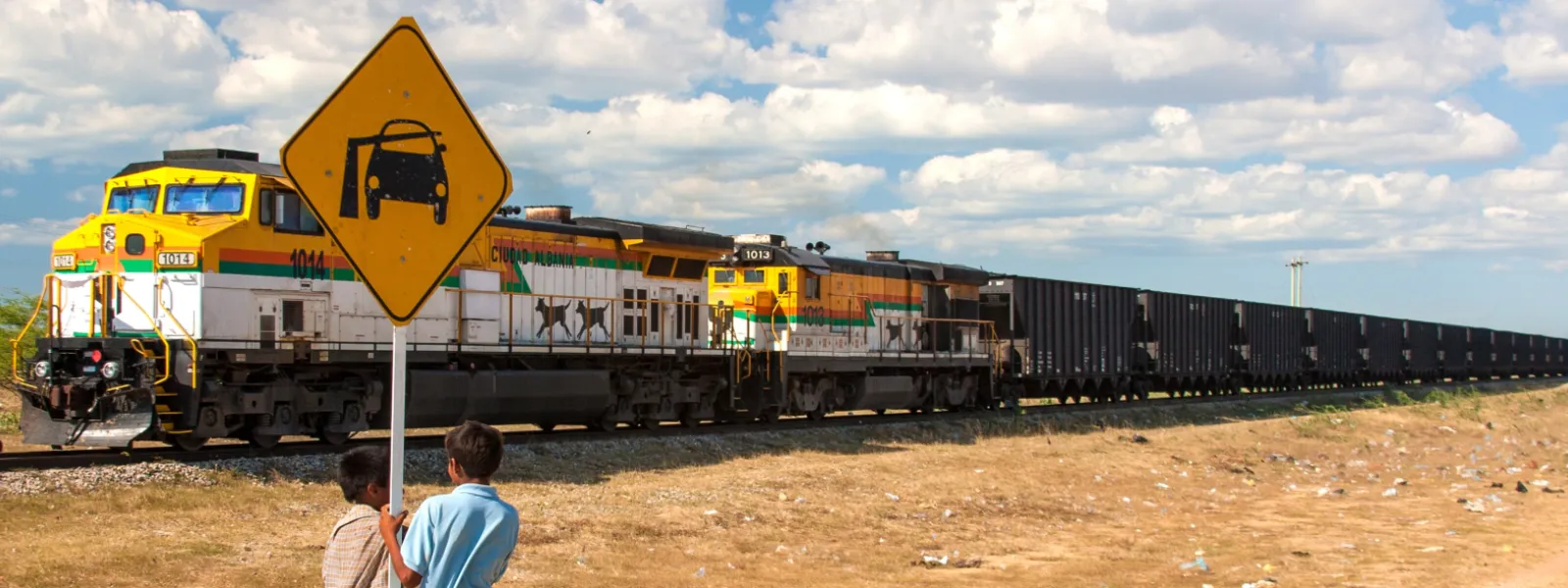
Toward the phase-out of coal in Latin America
Although coal has historically been an important non-renewable source of electricity, we now know that it is the fossil fuel that generates the highest levels of carbon dioxide (CO2) emissions, a main greenhouse gas driving global warming.
As a region that produces and consumes coal, Latin America shares responsibility in global efforts to progressively curb its extraction and burning, favoring energy systems based on non-conventional renewable sources that are sustainable over time and respectful of the environment and people.
At AIDA, we are working not only to halt the expansion of coal on the continent but also to promote the responsible closure and exit from existing projects.
How is energy generated from coal?
Coal is a rock formed from plant remains that were buried in layers of sediment and did not decompose due to the absence of oxygen. Over millions of years, this organic matter was subjected to high temperatures and pressures, resulting in a material composed mainly of carbon.
The energy in coal is released during combustion. When burned, coal generates heat. In thermal power plants, that heat turns water into steam, producing electricity.
How much pollution does coal cause?
When coal is burned to produce heat or electricity, it releases large amounts of carbon dioxide into the atmosphere—the primary gas responsible for global warming.
And, in smaller quantities, it emits methane—a gas with a global warming potential up to 30 times greater than that of CO2 over a 100-year period—and nitrous oxide, whose global warming potential over a 100-year period is as high as 273.
In addition to greenhouse gases, coal combustion releases other pollutants, such as nitrogen oxides, sulfur dioxide, and black carbon (soot), which affect air quality and have indirect effects on the climate, including changes in precipitation patterns (e.g., acid rain).
Ash from coal-fired power plants, when not properly managed, is associated with serious impacts on human health: chronic lung inflammation, asthma, chronic bronchitis, lung cancer, high blood pressure, cardiac arrhythmias, and heart attacks.
On the other hand, coal mining pollutes the water and soil at mining sites, both through the mining process itself and the waste it generates.
Open-pit coal mining involves excavating and removing large amounts of earth to reach the coal-rich layers. This entails destroying landscapes, wiping out vegetation and wildlife, and even causing the forced displacement of communities. One example that illustrates the social and environmental damage caused by coal mining is El Cerrejón in Colombia, the largest open-pit coal mine in Latin America.
Latin America’s role in coal mining and use
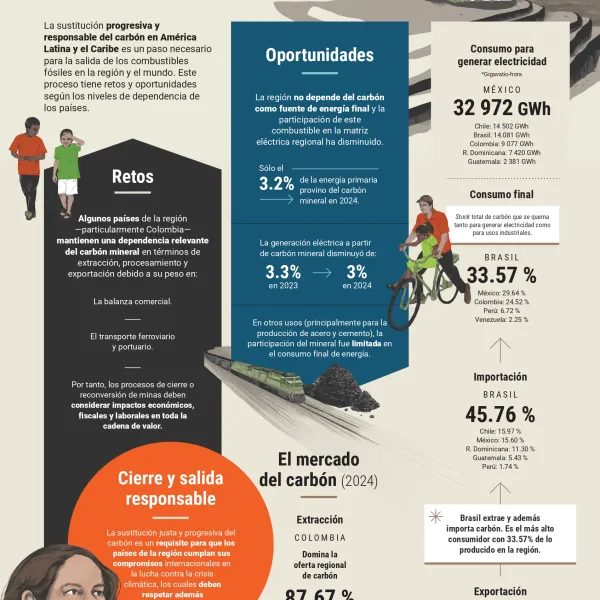
Despite the negative impacts associated with the coal value chain and the growing share of renewable energy in the global energy mix, global demand for coal continues to rise. In Latin America, the region continues to engage in coal mining for export or for burning to generate energy.
However, the region does not rely on coal as a final energy source, and coal’s share of the regional electricity mix has declined. This presents an opportunity to move away from coal, although some countries still rely heavily on it.
The most striking example is Colombia, the world’s fifth-largest coal exporter. In that country, only 8% of the coal produced is for domestic consumption. Traditionally, coal has accounted for more than 80% of mining royalties, but poverty rates in the departments where 90% of mining takes place—La Guajira and Cesar—exceed the national average.
In Mexico, coal-fired power plants generate only 4% of the country’s total electricity, but account for 10% of the electricity sector’s greenhouse gas emissions.
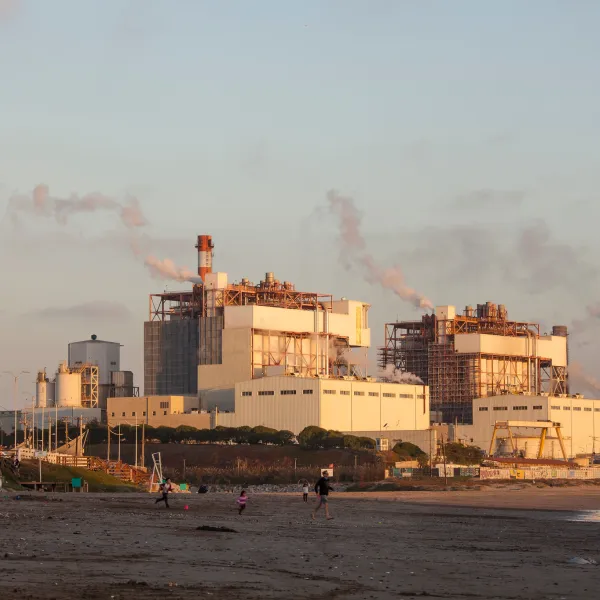
In Chile, coal-fired power generation has caused serious health and environmental impacts in what are known as "sacrifice zones." Although the country is making efforts to decarbonize and close all coal-fired power plants by 2040, this process is not being carried out in a fully responsible manner.
In addition to those mentioned, other countries in the region are involved in the coal market to varying degrees.
A responsible global transition away from fossil fuels requires Latin America’s contribution through the phasing out of coal, a process that presents both challenges and opportunities in each country.
Our region doesn’t just need to decarbonize its energy grid; it also needs to decarbonize the historical injustice that our peoples have endured… For the people who live in La Guajira, the land and water are not just resources—they are life itself. And the lives of our peoples cannot continue to be buried under coal.
Reasons to end the coal era
The negative impacts of coal mining and use far outweigh the benefits. In the face of companies and governments that continue to promote this industry in the current context, there are at least five reasons why continuing to mine and burn coal is a bad decision:
- Financial unfeasibility. The coal industry does not account for the external costs of the climate, environmental, and social damage it causes, which could double or even triple the price of electricity generated by burning coal.
- Rise in unemployment. The pollution caused by coal mining harms the health of those exposed, impairs their work performance, and puts them at a disadvantage in accessing other job opportunities. This results in high unemployment rates, reaching up to 40%.
- Increasingly risky investments. Banks and insurance companies are pulling out of the coal sector due to its high costs, high risks, and low profitability. At least 26 of the world’s largest banks and 18 major insurance companies have restrictions in place regarding this industry.
- Deepening of the global climate crisis. Coal accounts for 44% of CO2 emissions from fossil fuels. And during its extraction, handling, and combustion, methane is also released, with these emissions accounting for about 25% of global warming.
- Human rights violations, such as those related to health. One of the main impacts of coal mining is the deterioration of air quality, which in turn violates the right to health, life, and a healthy environment, leading to high rates of morbidity and mortality.
Our work to curb the expansion of coal with a focus on justice
At AIDA, we work to contribute to the gradual phase-out of coal extraction and use in Latin America’s energy and economic sectors, the protection and restoration of water sources and key ecosystems affected or threatened by the coal industry, and access to justice and reparations for affected communities.
How do we do it? In collaboration with partner organizations and communities:
- We develop and support strategic litigation at the national level to prevent the expansion of coal mining.
- We promote the design and implementation of plans for the responsible closure and exit from coal mines and coal-fired power plants.
- We promote the progressive phase-out of coal-fired power generation as part of a just energy transition.
- We advocate to international organizations to ensure that damage at various stages of the coal value chain is remedied.
- We support the inclusion of a coal phase-out in the climate commitments of governments in the region.
Closure and responsible exit
Moving away from fossil fuels is not enough. A just energy transition requires responsible processes for the closure and exit from existing projects involving the extraction and use of coal, gas, and oil.