
When environmental defenders in Latin America take the stage at key international forums
CIDH.
By Víctor Quintanilla and Mayela Sánchez García*
The voices of communities across Latin America and the Caribbean are powerful, especially when they call for environmental protection amid multiple, growing threats.
Often, this demand falls on deaf ears among those who deliver justice at the national or local level.
This trend makes it necessary to turn to complementary avenues of international justice.
One such platform is provided by the Inter-American Commission on Human Rights (IACHR), an international body with a critical mandate: the promotion and protection of human rights on the continent.
As an organization driven by the mission of guaranteeing the right to a healthy environment in Latin America and the Caribbean, the IACHR serves as a key forum for highlighting environmental issues that affect human rights in the region.
We do this in alliance with communities and partner organizations.
This allows the voices of local communities to be heard by an international body capable of urging the continent’s governments to change their practices and strengthen their standards for protecting populations affected by environmental degradation.
Testimonies calling for a responsible phase-out of fossil fuels
Bringing the voices of communities before the IACHR is also an opportunity to highlight regional patterns of risk and human rights violations.
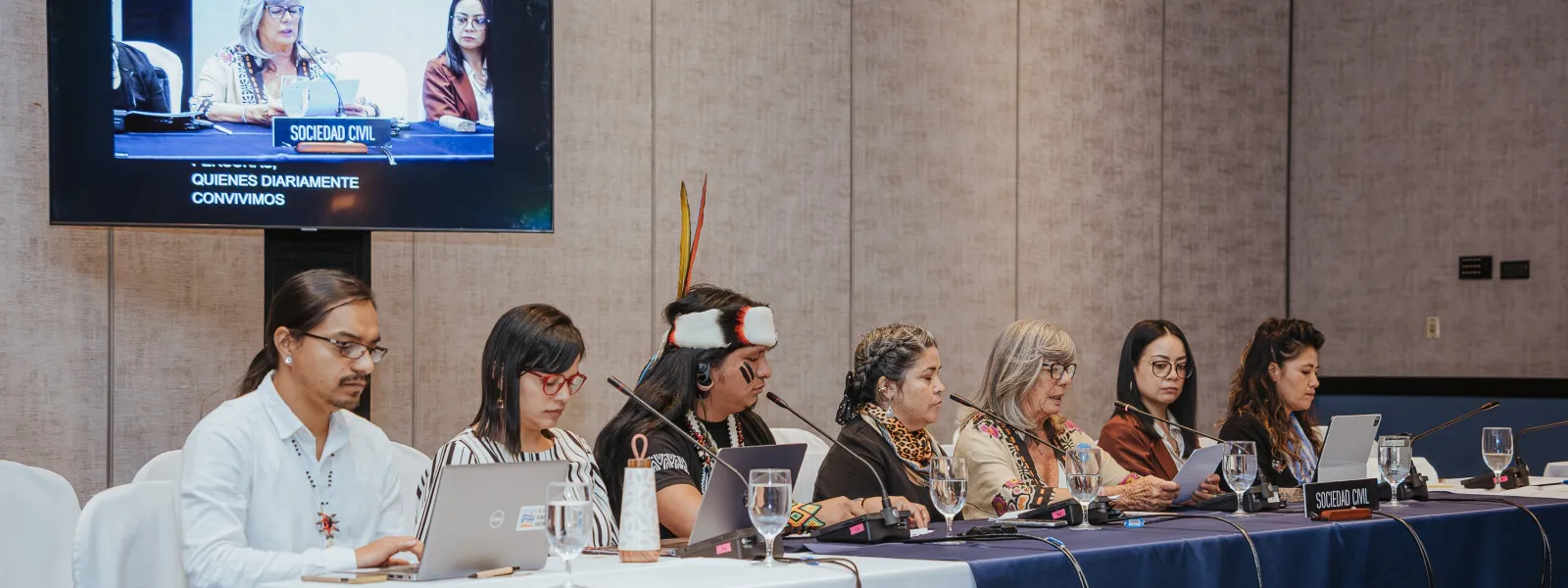
So it was on March 10, when representatives from communities in Colombia, Chile, Ecuador, and the Dominican Republic testified before the Commission about how decades of fossil fuel extraction and use have seriously violated human rights such as the right to a healthy environment, the right to health, and the right to access information and participate in environmental matters.
"Our region doesn’t just need to decarbonize its energy system; it also needs to address the historical injustice that our communities have endured," said Yaneth Ortiz, a representative of the Wayuu indigenous people of La Guajira, a region in northern Colombia that has been severely impacted by the operations of the Carbones del Cerrejón mining project.
Their messages were heard by the IACHR during a public hearing titled "Human rights situation related to fossil fuel extraction," held as part of its 195th Period of Sessions.
Community representatives also noted that, in the current context of the energy transition, these violations and risks have become more severe.
"Our children are getting sick in their own schools. Despite all this, there are no clear parties to blame and no structural solutions… For us, this decarbonization process [in Chile] has been insufficient and lacking in transparency," said Katta Alonso, speaking on behalf of the Chilean organization Mujeres en Zonas de Sacrificio en Resistencia.
The local experiences shared highlighted the urgency of implementing just transitions, which entail the responsible phase-out of fossil fuel projects throughout the region.
Meanwhile, Juan Bay, president of the Waorani Nationality of Ecuador (NAWE), stated: "We have not been consulted in a prior, free, and informed manner regarding oil exploration on our territory, nor regarding the establishment of the protected area. We now demand that our rights be respected in the process of closing down oil operations and in the environmental and social remediation."
AIDA requested the hearing in collaboration with the communities and partner organizations.
"We explained the risks and human rights violations faced by various communities in the context of the closure and irresponsible exit of coal, gas, and oil extraction and combustion projects," explains Rosa Peña, AIDA’s attorney.
The Commission views the purpose of these hearings as gathering information on human rights issues in specific countries or regionally, in order to issue recommendations to governments aimed at ensuring respect for and the enjoyment of human rights.
Before each session, it receives a huge number of requests to address various human rights issues across the continent during the hearings—issues that go beyond just the environment or climate.
"This is how we got here, after convincing the Commission of the importance of approaching this issue from a human rights perspective and of listening to the communities," says Liliana Ávila, director of AIDA’s Human Rights and Environment Program.
Over the years, AIDA has developed significant expertise and leadership in successfully bringing cases before the Inter-American Commission on Human Rights (IACHR) and the Inter-American Court of Human Rights—the two pillars of the Inter-American Human Rights System, a mechanism of the Organization of American States—to achieve regional impact in the protection of a healthy environment, in partnership with local communities.
Voices against the damage caused by illegal mining
Also, during the 195th Period of Sessions of the IACHR, we participated in the ex officio hearing titled "Impacts of illegal mining on economic, social, cultural and environmental rights," convened by the Commission itself.
Our contribution joined other voices in highlighting why this activity is now one of the most alarming phenomena on the continent, given its severe impact on ecosystems and human rights.
In Latin America, gold mining fuels illegal extraction that violates numerous rights, primarily those of indigenous peoples and traditional communities.
At the hearing, we proposed relevant measures to the Commission to address the issue from a regional perspective.
At AIDA, we seek to amplify the strength of local communities and their people, bringing their wisdom to decision-making forums with the potential to transform realities and build a better future for the continent.
*Víctor Quintanilla-Sangüeza is AIDA’s Content Coordinator, and Mayela Sánchez García is the organization’s digital community specialist.
Victor Quintanilla Sangüeza

Victor Quintanilla Sangüeza is AIDA's Content Coordinator, working from Mexico. He is a Bolivian freelance communications specialist and journalist. He earned a Bachelor of Science in Social Communication from the Universidad Mayor de San Andrés in La Paz, Bolivia. Victor also holds a master's degree and a PhD in communication from the Universidad Iberoamericana Ciudad de México. He has worked in print and television media, as well as in corporate communication in the public and private sectors. Victor is also a researcher in the field of journalism and technology studies.