
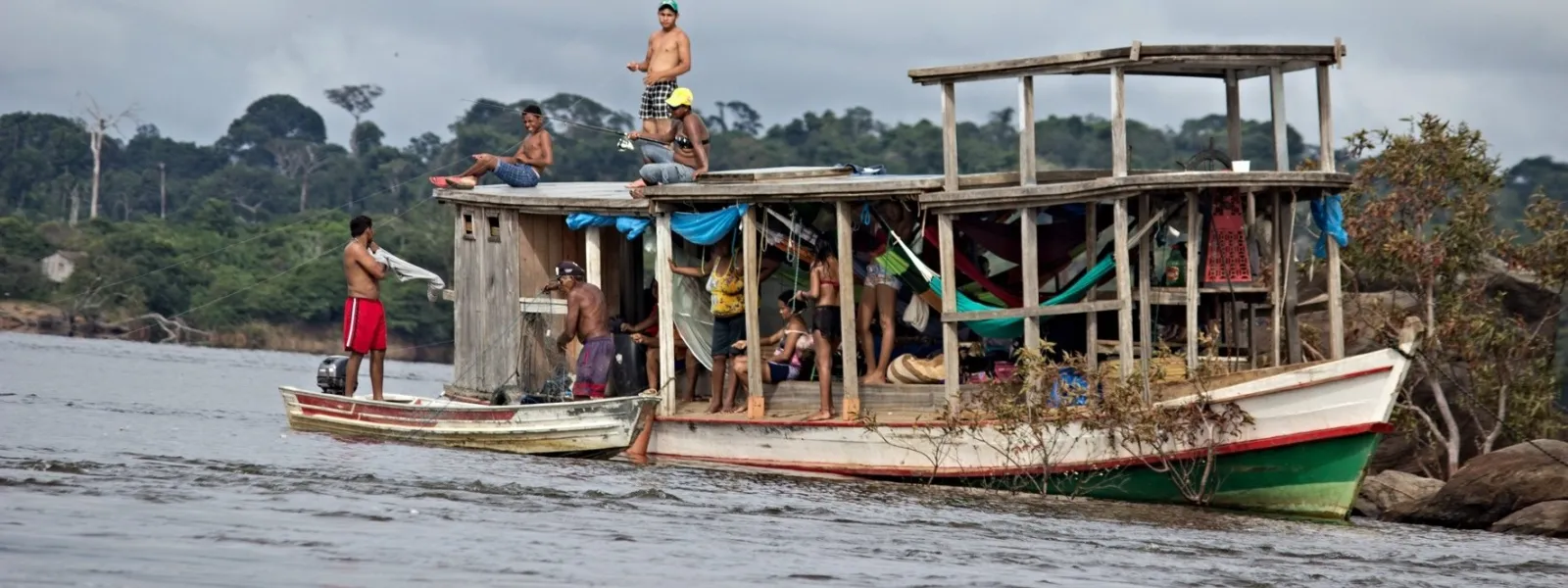
The Xingu River is being silenced, but not its people
Amazon Watch / Maíra Irigaray
A river is always a path, sustenance, and memory.
At the Volta Grande (or Great Bend) of the Xingu River, deep in the Brazilian Amazon, the water did more than just flow: it taught people when to plant, when to fish, and when to celebrate.
There, life moved to the rhythm of the river.
But that began to change in 2010, when plans were underway to build the Belo Monte hydroelectric plant, and a silent question began to grow: Who decides the fate of the water?
Six years later, on May 5, 2016, when the dam was inaugurated, nearly 80% of the Xingu River’s flow had been diverted.
As early as 2018, organizations and communities were warning that the flow management plan imposed on the Xingu River for the operation of the hydroelectric plant foreshadowed a future of drought.
That warning has come true.
Today, entire stretches of the river are dry. More than 100 kilometers of the Volta Grande have lost their natural flow. The water, which once sustained biodiversity and local ways of life, no longer flows as it once did.
Without enough water, the fish have stopped reproducing. There has been no spawning for three years.
The river’s silence has turned into hunger, uncertainty, and disruption.
The death of the fish is not just an environmental impact: it is the breakdown of a way of life.
Indigenous, riverine, and fishing communities have lost not only their primary source of food but also their autonomy and their connection to the land.
Today, the legacy of Belo Monte is a growing accumulation of ecological, social, and cultural degradation.
However, this story is not yet over.
Time for justice for the Xingu River and the life it sustains
Ten years after the Belo Monte Dam began operations, the reported impacts have been confirmed, but something unexpected has also grown stronger: resistance.
The affected communities remain organized, active, and determined. They continue to speak out, demand reparations, and defend their right to live alongside the river.
That strength is evident today in the protests against new projects in the area.
Because for these communities, the struggle is not just against a project; it is for the survival of their way of life.
Today is a moment of justice for them.
The complaint against the Brazilian State for its international responsibility in the case has been before the Inter-American Commission on Human Rights since 2011, pending a decision that could mark a turning point for the communities of the Xingu Basin.
The complaint contains the legal and evidentiary elements necessary for the Commission to admit it, determine that there were several human rights violations, and refer the case to the Inter-American Court of Human Rights, whose ruling could set a precedent for state regulation of megaprojects in the context of the climate crisis; public participation; and the protection of indigenous peoples, traditional communities, and key ecosystems such as the Amazon.
But as the process moves forward slowly, the impacts continue to worsen every day. The urgency is not legal; it is human. Every unanswered cycle is another cycle of drought, biodiversity loss, and mounting violations.
In this case, making a decision is not just an institutional matter; it is a matter of life expectancy for those who depend on the river.
What happened with Belo Monte has become a symbol.
It is a clear example of how projects marketed as “clean energy” can have profound and lasting impacts when they disregard human rights.
At a time when the world is seeking energy solutions to address the climate crisis, we cannot repeat old patterns of injustice.
Marcella Ribeiro d'Ávila Lins Torres

Marcella Ribeiro d’Ávila Lins Torres is a senior attorney with AIDA's Human Rights and Environment Program, as well as the Communities and Defenders Area Coordinator, working from Brazil. She holds an LL.B. in Law from the Universidade Federal da Paraíba, a LL.M in International Human Rights Law from the University of Notre Dame, and a diploma in Advocacy for NGOs from the Advocacy Hub. She specialized in economic, social, cultural, and environmental rights, international human rights systems, and climate justice. She is well-versed in the practice of human rights law through litigation, advocacy, and campaigning, and is responsible for the coordination of several cases and projects with traditional communities, indigenous people, and HRE defenders at AIDA. She coordinates the Brazilian team, being responsible for identifying opportunities for expanding AIDA’s work in the country. Marcella is AIDA’s focal point on work with defenders and the link between the Human Rights and Climate programs.