
Project
Photo: Anna Laurie Miller / AIDAConserving the Ciénaga Grande de Santa Marta
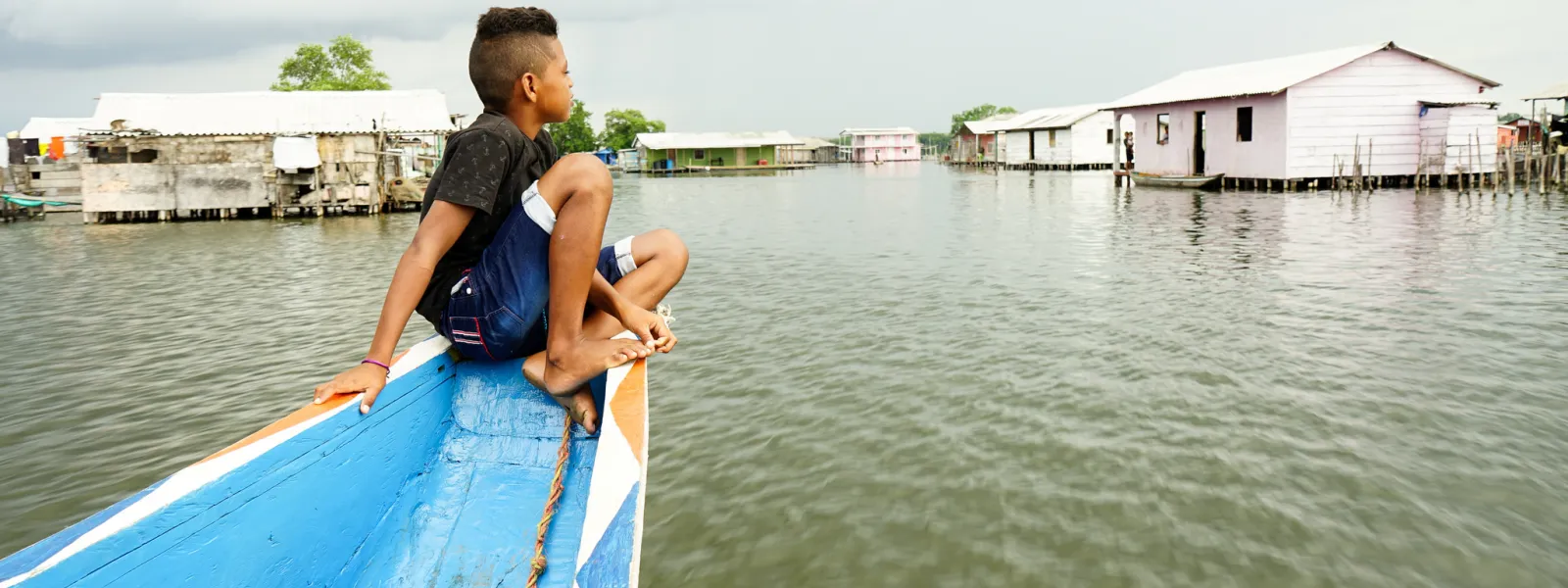
Ciénaga Grande de Santa Marta, the largest and most productive coastal wetland in Colombia, covers 45,000 hectares. At the confluence of the Magdalena River and the Caribbean Sea, the site boasts an immense variety of flora and fauna, including mammals, birds and fish. Its southern tip is a beautiful sanctuary of mangroves, swamp and amphibious forest.
On the calm waters of the marsh stand the Ciénaga’s famous stilt villages, supported by pillars or simple wooden stakes and inhabited by local fishermen since 1800. In a place accessible only by water, many of the things we take for granted—being served a glass of water, quick access to a doctor—are considered luxuries. Residents depend on the natural world around them. Sadly, in recent years mass fish die-offs caused by the marsh’s degradation have threatened the livelihoods of 2,500 people who call the Ciénaga Grande home.
Illegal activities are destroying this vital ecosystem: intentionally set forest fires, deforestation of large tracks of land for agriculture and livestock, logging and burning of mangroves, and 27 kilometers of illegally built dikes.
This destruction not only devastates the local fishery; it also has global impact. Ciénaga Grande’s mangroves absorb large quantities of carbon dioxide from the atmosphere, aiding in the global fight against climate change.
The importance of the Ciénaga Grande has been recognized both nationally – the Sanctuary of Flora and Fauna Ciénaga Grande de Santa Marta is a national park – and internationally: UNESCO’s Man and the Biosphere program declared the lagoon a biosphere reserve; and the Ciénaga Grande is listed as a Wetland of International Importance under the Ramsar Convention, an intergovernmental treaty for the protection of wetlands.
AIDA and our partners are advocating for the Colombian government to fulfill its national and international obligations to protect the Ciénaga Grande. After all, millions of animals, the local community, and our global climate depend on it.
Partners:
Related projects
Human Rights Body Calls on Peru to Protect Citizens from Contamination by American-Owned Smelter
For immediate release: September 5, 2007 PRESS CONTACTS: Astrid Puentes, AIDA (+5255) 52120141 [email protected] Martin Wagner, (510) 550-6700 [email protected] Human Rights Body Calls on Peru to Protect Citizens from Contamination by American-owned Smelter Oakland, CA; Lima, Peru – The Inter-American Commission on Human Rights (IACHR) has asked the government of Peru to take immediate steps to protect the health of inhabitants of La Oroya, Peru, who suffer severe health impacts due to contamination from a smelter owned by American billionaire Ira Rennert. Rennert’s company, Doe Run Peru, owns and operates the smelter. La Oroya residents suffer health problems related to emissions of lead, arsenic, cadmium, sulfur dioxide and other pollution from the smelter. In 2006, the Blacksmith Institute identified La Oroya as one of the ten most polluted places in the world (http://www.blacksmithinstitute.org/ten.php). The Commission ordered Peru to conduct comprehensive medical examinations to determine the extent of the injury to local people and to provide medical treatment to those who need it. The Commission acted in response to a petition submitted by lawyers from the Peruvian Society for Environmental Law (SPDA), the Inter-American Association for Environmental Defense (AIDA), Earthjustice, and the Center for Human Rights and Environment. The petition was filed on behalf of a group of La Oroya residents claiming that Peru’s failure to control the smelter pollution violates their human rights, and especially those of the most vulnerable population – the children impacted by the severe lead contamination. “Controlling contamination from the smelter is crucial to protect the rights and lives of these people,” said Astrid Puentes of AIDA. “The Commission’s action confirms that neither Peru nor the company have taken adequate steps to protect health and human rights in La Oroya,” she added. Since 1999, the Government of Peru has known that almost all the children living near the complex suffer from lead poisoning, yet has failed to remedy the situation. A March 2005 study showed that 99 percent of the children tested had blood lead levels vastly exceeding the safe limits established by the US EPA and the World Health Organization. “We are celebrating, with the hope that we will finally have positive results for the protection of the health of our children, and ourselves,” said one La Oroya petitioner, who, like all the petitioners, has asked to remain anonymous for fear of retaliation by company workers. “In calling on Peru to protective the people of La Oroya, the Commission is indicating its support for people throughout the hemisphere who are threatened by extreme toxic contamination,” said Earthjustice’s Martin Wagner. “The Commission is acknowledging that this kind of pollution violates human rights, and that international law thus requires governments to prevent such tragedies and to take steps to remedy them when they happen. The Commission’s request is based on its interpretation of Peru’s international legal obligations, and it is the government’s responsibility to satisfy those obligations.” “We hope to see the transparent, effective, and rapid implementation of these precautionary measures by Peruvian government authorities” declared Carlos Chirinos, from the SPDA. “The government has moved far too slow in addressing this health crisis,” he added. The Commission’s decision is a preliminary step in its consideration of the petition from the residents of La Oroya. “The Commission has clearly decided that the people in La Oroya cannot afford to await the outcome of the full petition process,” said Wagner. “No matter what the details of its final decision, the Commission is obviously convinced that rights are being violated and the government must act now.”
Read moreFederal Judge Suspends Construction of the La Parota Hydroelectric Project!
FOR IMMEDIATE RELEASE August 28, 2007 CONTACT: Claudia Gómez-Portugal, (5255) 5268-3323 ext. 23, [email protected] Federal Judge Suspends Construction of the La Parota Hydroelectric Project! Mexico DF. August 28, 2007 - On August 14th, a federal judge in Acapulco, in the state of Guerrero, ordered the temporary suspension of all work related to the La Parota Hydroelectric Project, in response to an accion de amparo (similar to an injunction) filed by small-scale farmers in the Community of Common Goods of Cacahuatepec. The farmers are represented by the Mexican Center for Environmental Law (CEMDA). The judge granted the suspension to prevent irreversible damage to the farmers’ constitutional rights to a healthy environment, a fair trail, and adequate judicial protection . The judge also accepted the amparo on the grounds that these rights could be violated by the environmental impact assessment authorization granted by SEMARNAT, and the water concession for the Papagayo River granted to the Federal Electricity Commission (CFE) by the National Water Commission to construct the hydroelectric project. Once completed, this dam will tower more than 700 feet high and have a capacity of 30 megawatts. It will flood approximately 41,000 acres of land, affecting more than 25,000 small farmers. “The suspension of La Parota is an important precedent in Mexico, because it places protection of the environment ahead of a very large infrastructure project, and enables the public interest to be protected,” asserted Xavier Martínez Esponda, a CEMDA lawyer. “Constructing the dam would cause grave and irreversible damage to the low and medium deciduous forests, impacting hundreds of threatened and endangered plant and animal species. It would also affect the quality and quantity of water in the Papagayo River, in addition to impacting the communities in the region,” he noted. In the amparo, the farmers allege that both the General Law of Ecological Equilibrium and Environmental Protection (LGEEPA) and the National Water Law (LAN) are unconstitutional because they do not allow the affected communities to participate in the procedures to grant the authorizations. This, in turn, violates their individual constitutional rights which grant that no one can be deprived of their life, liberty, property, possessions or rights without a fair trial. In this case, the authorities granted the environmental impact authorization and water concession without notifying the communities, despite the fact that these decisions would affect their lands and their right to water. “The goal of the injunction is to permanently suspend the unconstitutional construction of the dam. If the dam is constructed, the farmers would lose their lands, be displaced from their town, and additional irreversible social and environmental harm would take place. Therefore, this legal action attempts to prevent, as occurs in many cases, the development of a large-scale infrastructure project without adequate compensation and indemnization,” explains Astrid Puentes Riaño, Legal Director of AIDA. Past projects implemented by CFE have not included fair compensation, and when they were granted, did so long after the damages occurred. This injunction brought suit against eight government authorities, including the President of the Republic, the Federal Congress, the National Water Commission, the Secretary of the Environment and Natural Resources, and the Federal Electricity Commission. The decisions of each of these authorities are directly involved in the illegalities and violations of rights alleged in this legal action.
Read moreIACHR Forwards La Oroya Human Rights Petition to Peruvian Government for Comment
For immediate release: April 24, 2007 PRESS CONTACTS: Astrid Puentes, AIDA (+5255) 52120141 [email protected] Martin Wagner, Earthjustice (510) 550-6700 [email protected] Carlos Chirinos (+511) 422-2720 [email protected] U.S. Smelter's Pollution Now Human Rights Issue for Peru IACHR to Examine Peru’s Responsibility for Contamination from Doe Run Corp. Facility WASHINGTON DC, LIMA – The Inter-American Commission on Human Rights (a division of the Organization of American States) forwarded a petition alleging human rights violations to the Government of Peru, giving them two months to respond. The petition asserts that severe contamination from a smelter owned by U.S.-based Doe Run Corporation, and lack of effective pollution and human health controls by the government, gravely threaten the rights of the residents of La Oroya, Peru, including their rights to life, health, and integrity. “This first step by the IACHR is good news,” assured Carlos Chirinos, an attorney with the Peruvian Society for Environmental Defense (SPDA), an organization that has been associated with the case since its inception, and one of the lawyers representing the community. “It shows the strength of our petition, and is a positive step in the process to identify the government’s responsibilities.” The IACHR determined that the petition, prepared by Earthjustice, the Interamerican Association for Environmental Defense (AIDA), the Center for Human Rights and Environment (CEDHA), and Peruvian lawyer, Carlos Chirinos, met the Commission’s procedural requirements and forwarded it to the Peruvian government last week. According to the Commission’s rules, after this two-month period the IACHR will take into account Peru’s comments in evaluating the admissibility of the case, determining whether the contamination violates human rights, and the resulting responsibilities of the Peruvian government. The Commission is simultaneously evaluating a request by these groups for precautionary measures to address the urgent health threats to the citizens in La Oroya. “We are now waiting for the government’s comments on the petition, as well as a decision by the Commission on the request for precautionary measures. These measures could help considerably to provide effective protection for the people’s human rights in La Oroya,” added Astrid Puentes of AIDA. The precautionary measures requested include: adequate diagnosis and medical treatment for the persons represented, education programs and efficient access to information, effective emissions and contamination controls, an evaluation of contamination in key areas of the city, and implementation of adequate clean-up measures. According to Martin Wagner of Earthjustice, the goal of the precautionary measures is “to improve human rights conditions for the people we represent in La Oroya, and ensure that those responsible take definitive action to control the contamination.”
Read more