
Project
Photo: Manuel VictoriaDefending the Veracruz Reef from a port expansion project
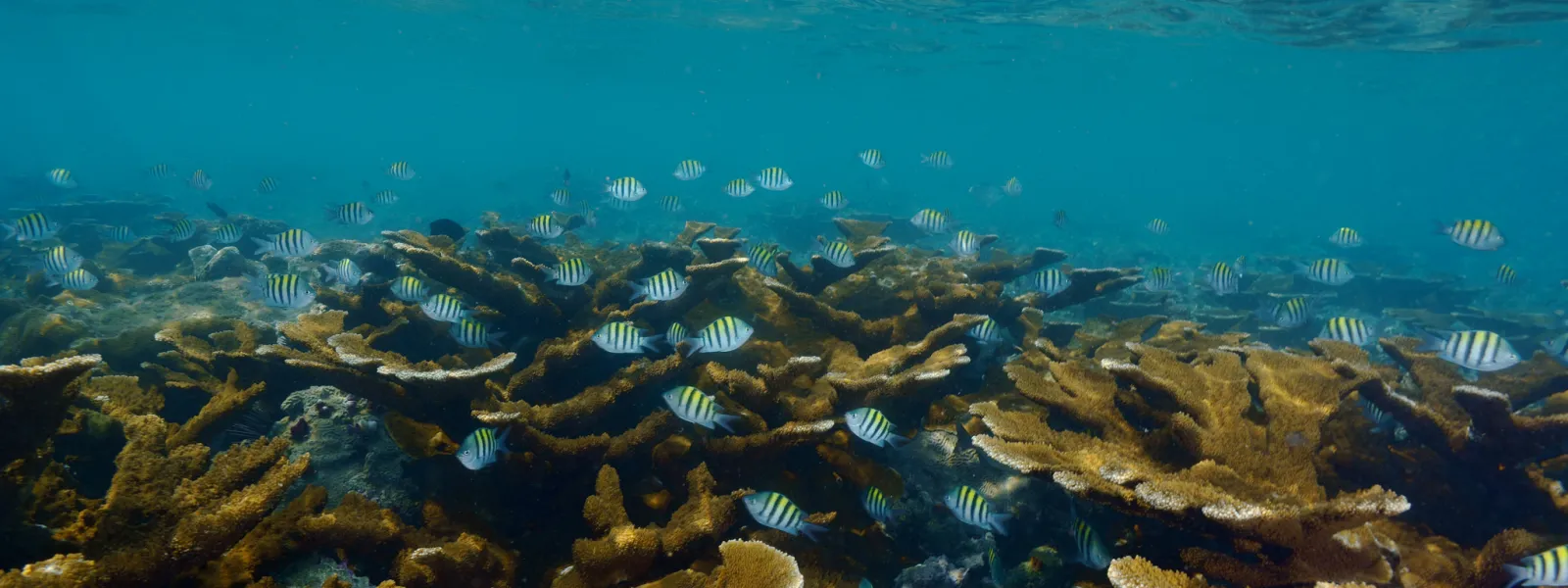
In the Gulf of Mexico, 27 coral reefs form a submarine mountain range running for miles between six islands. Hundreds of colorful fish species, sea urchins, starfish, and sea grasses share the reef with an abundance of other life forms. Fishing, sport diving, and beach tourism thrive along the coast. This is the magnificent Veracruz Reef, the largest coral ecosystem in the Gulf.
In 1992, Mexico’s government declared the Veracruz Reef System a Natural Protected Area. In 2004, it was listed as a Wetland of International Importance under the Ramsar Convention, a treaty for the protection of wetlands including reefs.
Despite the reef’s recognized significance, in 2013 the government reduced the size of the Natural Protected Area and approved a port expansion project. Local communities and organizations challenged the project's environmental permits, demanding protection of the right to a healthy environment.
On February 9, 2022, the Supreme Court of Justice of the Nation unanimously decided that the authorities violated the right to a healthy environment of Veracruz residents by authorizing the port expansion based on a fragmented environmental impact assessment. This means that the permits for the project are non-existent and that the impacts of the project on the health of the reefs must be studied again, this time in a comprehensive manner, and even the viability of the project.
The ruling is a historic precedent not only in Mexico, but for the entire region, as it allows access to environmental justice for the people neighboring an ecosystem affected by a project.
Partners:
Related projects
COP20: Towards a climate deal with human rights protections
The impact of climate change on human rights is clear. Yet no international treaty on climate change makes reference to human rights, nor does any human rights treaty reference climate change. The next climate agreement, recently drafted in Lima and to be signed in Paris next year, provides an important opportunity to make a clear, explicit connection between climate change and human rights through the incorporation of specific language. During an event at the UN Climate Summit, Gustavo Alanís, president of the Mexican Center for Environmental Law (CEMDA), cited the human rights to food and water, explaining that rising temperatures reduce crop productivity and decrease the availability of clean water. This relationship highlights the material vulnerability of many people's living conditions. Effective adaptation measures are needed to ensure that conditions do not worsen, added Manuel Pulgar Videl, Peru's Minister of the Environment and President of the COP20. María José Veramendia Villa, an AIDA senior attorney, recalled that the impacts of climate change on human rights were addressed in a 2009 report prepared by the UN High Commissioner for Human Rights. The report said that climate change will affect the right to life by causing increased hunger and malnutrition, and that related diseases would have consequences for the growth and development of children. Following the report, the UN Human Rights Commission issued a resolution that stated, "the impacts related to climate change have a series of implications, both direct and indirect, on the full enjoyment of human rights…" Agreements signed at COP16 in Cancun, Mexico provide that the State Parties to the United Nations Framework Convention on Climate Change "must fully respect human rights" in all climate change related activities. Given this background, added Veramendi Villa, a challenge for 2015 is to ensure that the new climate agreement includes specific and comprehensive language on the obligation of States to protect, promote, and respect human rights in all its climate actions. "If this happens," she explained, "we will have a binding international instrument that will guide the States' climate actions, and help them to implement the obligations they already have on human rights." For more information from COP20 and to post comments, visit our interactive blog at aida-cop.org
Read moreCOP20: Fracking, an experimental, hazardous and contaminating technique
During an event at the People’s Summit on Climate Change, a parallel event to the COP20 in Lima, fracking took center stage. Activists expressed their central argument about the controversial oil extraction method: that fracking is an experimental technique that involves serious risks to health and the environment, including the worsening of climate change. Fracking, or hydraulic fracturing, is an extreme method of exploration and/or exploitation of unconventional oil and gas (as both shale and tight gas). Special drills bore holes vertically into the subsoil and then horizontally into rock formations. Drill teams inject a mixture of water, sand, and chemicals at high pressure to fracture the rock, releasing trapped gas and oil. "These chemicals have unknown effects due to contact with elements of the subsoil," explained Eduardo D’elia, petroleum engineer and member of the Citizens Environmental Assembly of Rio Gallegos in Argentina, during Fracking: A Challenge for Latin America, organized by the Heinrich Böll Foundation in the People's Summit. "The fracturing of horizontal wells is highly complex and unpredictable, so this makes fracking an experimental technique." Fracking affects people in a number of unfortunate ways: the massive use of water (from 9 to 29 million liters of water per well) reduces availability of fresh water for drinking water, agriculture or other needs; fracking fluids can contaminate surface and groundwaters; the chemicals used may cause cancer, allergies, and malformation, among other diseases. Aroa de la Fuente, member of FUNDAR and the Mexican Alliance Against Fracking, made it clear that fracking is not an option for confronting climate change. She said that in hydraulic fracturing projects, up to eight percent of the natural gas (methane) produced escapes directly into the atmosphere. And methane holds a global warming potential 25 times that of carbon dioxide. "In 20 years, the climate impact of electricity generated by fracked gas would be higher than 20 percent of the impact of coal-fired electric generation," she stated. Argentina, Bolivia, Colombia and Mexico, among other Latin American countries, are intending to develop fracking broadly in coming years. Attendees at the People’s Summit wondered, "What can people do in the face of these hazardous plans?" Ariel Perez Castellón, an attorney with AIDA, emphasized the existence of legal tools designed to safeguard human health and the environment against fracking. The first, he said, is the precautionary principle, which is recognized in international law and which States and civil society should apply to address the threats of fracking. This principle establishes that "where there are threats of serious or irreversible damage, lack of full scientific certainty shall not be used as a reason for postponing cost-effective measures to prevent environmental degradation". [1] This means that when in doubt about the occurrence, scope, or magnitude of severe environmental damage, States must take proactive and effective measures to prevent such damage. "Based in this principle, States have three obligations related to fracking: to generate broad, clear and impartial information regarding this activity and its impacts; to protect the environment and the people with a moratorium on fracking activities, until there is a demonstration of its innocuous development; and to promote opportunities for public debate about fracking", Pérez said. Attendees in Lima stressed that social mobilization is key in supporting the legal strategies against fracking. Various civil society organizations within Latin American spoke of their efforts to promote public discussions, disseminate information in their communities, and take the necessary steps to prevent the damage that fracking may bring to their countries. In recent times, these organizations are starting to share experiences and articulate advocacy efforts within the region. On the occasion of COP20, 80 Latin American organizations issued a statement (text in Spanish) warning that fracking will have disastrous consequences for the environment and the population of Latin America, and that it will worsen climate change. The organizations asked their national governments to "prevent the use of hydraulic fracturing in their territory under the state obligation of the principle of precaution, and ensure the protection of fresh water resources and their peoples' health." [1] Rio Declaration on the Environment and Development of 1992, principle 15
Read moreCOP 20: And what about the effective use of climate finance?
The amount of money required to confront the effects of extreme climate changes is much larger than currently sought in global negotiations. Clearly more resources are needed, but it is also important to track the effective use of climate finance now being mobipzed. "We must recognize the funding gap for adaptation programming," said Annaka Peterson Carvalho of Oxfam America. She was a panel member Wednesday at a COP20 event entitled, A fair and accountable cpmate finance regime: Confronting the contentious issues. In her opinion, we must determine, on the basis of science, the real costs that countries must rightfully bear, and we need a responsible finance system to determine how much money each country needs and where it will come from. Sandra Guzmán, General Coordinator of the Cpmate Finance Group of Latin America and the Caribbean (GFLAC), agreed that while it is necessary to have more resources for the fight, it’s also necessary to use them effectively. "It’s not just about asking for more money," she said. "We must change priorities at a national level to distribute funding by reassigning it to activities that allow for reduced emissions." Guzmán explained that the Climate Finance Group has developed a methodology to know how much money each country receives, and how much they spend in deapng with climate change. Their analysis encompasses many activities, including some that are not traditionally labeled as relating to cpmate change. She identified five challenges in the task of tracking the use of cpmate finance: Transparency and access to information; Definition of the criteria of climate finance; Institutional structure and communication between different institutions; Public participation in the evaluation of projects; and Better methodology for monitoring, reporting, and verification to analyze the effective use of the money. The experience of the Institute for Climate and Sustainable Cities (iCSC) in the Philippines demonstrates that accountability on climate finance is “everybody’s business,” according its Executive Director, Red Constantino. The Institute tracks not only committed funding for adaptation, but also how it is channeled locally. The work that Constantino has done has enabled him to identify difficulties in apgning funding with the real needs and priorities of vulnerable communities; provide limited opportunities to involve communities in decision-making about adaptation; and understand that while money flows, it is not necessarily used efficiently or completely. Andrea Rodríguez, senior lawyer at AIDA, also referred to the importance of ensuring that climate change programs and projects meet the requirements of individual countries and are directed by them. To be effective, she said, the new climate regime must find ways for countries to monitor climate finance, learn from the experiences of other institutions, and reallocate their resources to be effective. "Climate finance responds to a specific need, it is not general assistance for development," Rodríguez added. "Public participation is central to the process, and if we know how much money we need and how to use it, we will know how much to ask for in global negotiations. In this sense, Constantino highlighted coordination between local and national levels, between governments and civil society. For more information from COP20 and to post comments, visit our interactive blog at aida-cop.org
Read more