
Project
Foto: Andrés ÁngelStopping the spread of fracking in Latin America
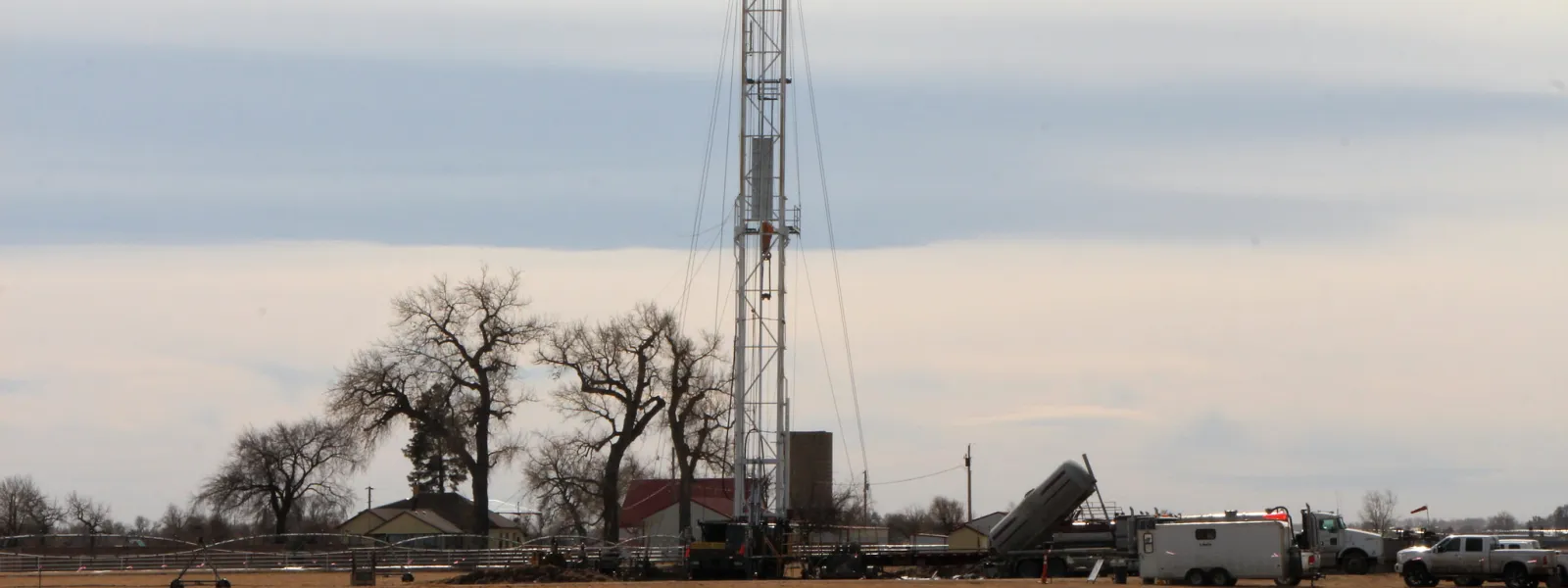
“Fracking” is short for hydraulic fracturing, a process used to extract oil and natural gas from historically inaccessible reservoirs.
Fracking is already widespread in the global North, but in Latin America, it is just beginning. Governments are opening their doors to fracking without understanding its impacts and risks, and without consulting affected communities. Many communities are organizing to prevent or stop the impacts of fracking, which affect their fundamental human rights. But in many cases they require legal and technical support.
What exactly is fracking, and what are its impacts?
A straight hole is drilled deep into the earth. Then the drill curves and bores horizontally, making an L-shaped hole. Fracking fluid—a mixture of water, chemicals, and sand—is pumped into the hole at high pressure, fracturing layers of shale rock above and below the hole. Gas or oil trapped in the rock rises to the surface along with the fracking fluid.
The chemical soup—now also contaminated with heavy metals and even radioactive elements from underground—is frequently dumped into unlined ponds. It may seep into aquifers and overflow into streams, poisoning water sources for people, agriculture, and livestock. Gas may also seep from fractured rock or from the well into aquifers; as a result, water flowing from household taps can be lit on fire. Other documented harms include exhausted freshwater supplies (for all that fracking fluid), air pollution from drill and pump rigs, large methane emissions that aggravate global warming, earthquakes, and health harms including cancer and birth defects.
AIDA’s report on fracking (available in Spanish) analyzes the viability of applying the precautionary principle as an institutional tool to prevent, avoid or stop hydraulic fracturing operations in Latin America.
Partners:

Related projects
Leaders of Brazilian movement opposed to controversial Belo Monte dam threatened with imprisonment, for Lawful Protests
72 Normal 0 21 false false false ES-MX X-NONE X-NONE /* Style Definitions */ table.MsoNormalTable {mso-style-name:"Tabla normal"; mso-tstyle-rowband-size:0; mso-tstyle-colband-size:0; mso-style-noshow:yes; mso-style-priority:99; mso-style-parent:""; mso-padding-alt:0cm 5.4pt 0cm 5.4pt; mso-para-margin:0cm; mso-para-margin-bottom:.0001pt; mso-pagination:widow-orphan; font-size:10.0pt; font-family:"Times","serif"; mso-bidi-font-family:"Times New Roman";} International Groups Denounce Attempts to Criminalize Civil Society Leaders before OAS and UN Human Rights Bodies. Altamira (PA), Brazil – Brazilian social movements and civil society organizations are facing politically motivated prosecutions for their lawful opposition to the Belo Monte dam complex in the heart of the Amazon, a leading international human rights and environmental organization said today. In a report issued to the human rights arms of the Organization of American States (OAS) and the United Nations (UN), Brazilian and international groups detailed attempts to prosecute human rights and environmental activists and seek the arrests of 11 civil society leaders. Among the accused are a local reporter, leaders of the Xingu Alive Forever Movement, a Catholic priest and nun who led a mass during the Xingu+23 protest, a documentary filmmaker and a fisherman whose house was recently demolished to make way for dam construction. “The complaints filed by the dam consortium and the request for arrest warrants are based on fabricated information and gross distortions of the facts, with the clear intention of criminalizing leaders of a legitimate social movement opposed to the federal government’s obsession with the construction of Belo Monte, regardless of the project’s human and environmental costs and the rule of law”, said Marco Apolo, lawyer and co-director of SDDH, a renowned human rights NGO based in the state of Para. The police request for the arrest still pending approval in a local court, came in response to a complaint filed by of the consortium of companies building the dam. The peaceful protests organized by Brazilian civil society groups were celebrating 23 years of resistance to the project. Activities were focused in Santo Antonio, a small riverside village whose inhabitants are being displaced by construction of the large dam. In an isolated incident, a small group of protestors autonomously entered the offices of the consortium, causing some damages. Despite the absence of evidence linking the incident to the leaders of the movement and the protests, the police request for arrest warrants charges them with invasion and damage to private property, theft, arson, and disturbing the peace. “We expect a prompt response from the OAS and the UN regarding this blatant attempt to intimidate and criminalize human rights and environmental defenders working to protect the communities affected by Belo Monte,” stated Joelson Cavalcante, a Brazilian lawyer with the Interamerican Association for Environmental Defense (AIDA), which co-authored the report. “The Brazilian government cannot simply silence critiques of its development policy by putting them in jail.” Some of the accused also are plaintiffs in a case before the Inter-American Commission on Human Rights against Brazil for failing to consult local communities and ignoring important safeguards to protect the rights and environment of the people affected by the dam. In April 2011, the Inter-American Commission requested special measures to protect the rights of 12 indigenous communities. The Brazilian government has refused to comply with the resolution so far. Brazilian and international groups, including AIDA, have raised multiple claims of human rights violations surrounding the development of the Belo Monte dam. The project would seriously harm the lands and livelihoods of indigenous and rural communities including un-contacted tribes in voluntary isolation. The dam is slated to be the world’s third largest and displace as many as 40,000 families. The attempt to silence protest against the project comes in the wake of recommendations from the UN Human Rights Council calling on the Brazilian government to safeguard the work of human rights defenders and protect the human rights of indigenous and African-descendant communities. “Belo Monte is a sad example of misdirected development policy gone awry,” said Astrid Puentes, Co-Director of AIDA. “We expect the Brazilian government to heed the recommendations of the UN and OAS and promote truly just and sustainable development, demonstrating that statements made at the Rio +20 Conference are real. Stopping the unwarranted criminalization of human right defenders in the Xingu would be a positive step in that direction.”
Read moreComplaint filed against World Bank Group for funding Eco Oro Minerals gold mine in fragile Colombian wetlands
Downstream community submits complaint to the IFC’s Ombudsman. Bucaramanga, Colombia – Today, local groups in Bucaramanga, Colombia filed a complaint against the World Bank Group’s investment in Eco Oro Mineral’s Angostura mining project with the Compliance Advisor Ombudsman (CAO), the independent grievance mechanism of the International Finance Corporation (IFC). The complaint cites, among ten main concerns, the IFC’s failure to evaluate the potentially severe and irreversible social and environmental impacts of the project, a large-scale gold mine located in a fragile, high-altitude wetland, called the Santurbán páramo, which provides water to over 2.2 million Colombians. The Committee for the Defense of Water and the Santurbán Páramo, a coalition of nearly 40 groups living downstream of the project in Bucaramanga, asserts that the IFC, the World Bank’s private-sector lending arm, ignored its own policies before investing US$11.79 million in Greystar Resources – now Eco Oro Minerals – in 2009. The IFC bought shares before the company had completed required environmental and social impact assessments. “There could be some twenty municipalities affected by this project. We think it is outrageous that such a damaging mining initiative has the backing of the World Bank, whose mission is to advance real and sustainable development,” said attorney Miguel Ramos, member of the Committee, which includes a diverse group of human rights, environmental, student and business organizations. Following tens of thousands-strong protests and controversial hearings, the Colombian Ministry of the Environment rejected the Vancouver-based company’s initial request for an environmental license, citing the country’s environmental and constitutional law prohibiting mining activity in páramo wetlands. Páramos are fragile ecosystems that supply about 75% of Colombia’s freshwater, including the drinking water of millions of people, and play a key role in mitigating and adaptation to climate change. The Interamerican Association for Environmental Defense (AIDA), the Center for International Environmental Law (CIEL) and MiningWatch Canada support the Committee’s request that the CAO audit the project and recommend a full withdrawal of IFC funds. “The IFC promotes itself as a leader in environmental and social standards,” said Natalia Jiménez Galindo, a lawyer with AIDA. “Its stamp of approval paves the way for other investors. In this case, the IFC did not even ensure minimal protection for communities and the environment by requiring an environmental and social impact assessment.” Eco Oro’s project has already stimulated investments from at least five other companies in the immediate area, more than doubling the area under mining concessions in the Santurbán Páramo. “The IFC invested in Eco Oro’s mine, explicitly stating that were it successful it would spur other investments in Colombia’s mining sector. But the IFC did not do its homework to consider the serious environmental, social and economic consequences, particularly in an area that has been a conflict zone,” said Jen Moore, Latin America Program Coordinator for MiningWatch Canada. “It should reevaluate its investment and pull out.” The complaint alleges that the IFC glossed over potential security issues related to Eco Oro’s project. It provides documented evidence of violence associated with guerrilla and paramilitary activity following the establishment of military installations in the area in 2003, which contradicts company claims. Eco Oro holds mining rights to nearly 30,000 hectares (74,130 acres) of land in the Santurbán páramo, near the city of Bucaramanga in the department of Santander. In response to the rejection of its 2009 open-pit mine proposal, the company said in 2011 that it would pursue a completely underground mining operation, but the people of Bucaramanga remain widely opposed to the project. The region is thought to contain important deposits of gold, coal and other minerals.
Read more
Who can protect us if the Inter-American System of Human Rights is weakened?
By Astrid Puentes, co-director of AIDA, @astridpuentes I’m writing from Cochabamba, where I’m attending the 42nd General Assembly of the Organization of American States (OAS). This is the first time I have come to Bolivia and to a General Assembly. I am here to support our efforts to truly “strengthen the Inter-American System” and to stand against proposals from OAS member states that could limit the independence and effectiveness of the Inter-American Commission on Human Rights (IACHR). Our goal is to preserve the autonomy and role of the IACHR, and, thus, to guarantee human rights in the region: To protect our rights, yours and mine. Here’s a summary of what is a complex story. A number of member states launched an effort to strengthen the Inter-American System of the Protection of Human Rights in 2011, two years after the IACHR and the Inter-American Court of Human Rights modified their rules of procedure. This effort is a direct response from several member states after the IACHR brought up concerns about human rights in their countries. A working group was then created last year to evaluate how the Inter-American System of Human Rights could be “strengthened.” The group produced a report that the Commission has responded to and that NGOs like ours will also comment on. A few days ago, the Secretary General of the OAS, José Miguel Insulza, published a report on the subject. Personally, I think it is inadequate because several of his recommendations will actually weaken, and not strengthen, the system. For example, he says there is “a loophole in the statute of the commission on the figure of the precautionary measures that could be filled by... the General Assembly of the OAS.” It is worth mentioning that it is the IACHR that determines its own rules, a way to ensure its independence. Insulza’s report left out issues he’d been asked to address, such as options for improving the financing for the Inter-American System. Based on his recommendations, the result would be contrary to the same objective that Insulza and member states have set as their main goal. Fortunately, Insulza in his declarations during the General Assembly dismissed some of the recommendations that could have drained the strength of the Inter-American Human Rights System. The important points of the “strengthening” process that will be discussed at the General Assembly in Cochabamba – and no doubt afterwards – include: Financing the Inter-American Human Rights System. This is essential, as you can’t ask the IACHR to operate efficiently on a meager budget. “Unify in a constructive manner” what the member states and the IACHR understand as the precautionary measures. This is an issue presented by some member states and brought up by Secretary Insulza. It was frankly a surprise that this point came from the very report of the secretary for two reasons: a) abiding by what the system dictates is part of what member states already agreed to in creating the System, and b) because the Inter-American Court has been very clear in determining that the measures are obligatory. What can we expect of member states? I mean, who likes to get their dirty laundry published in the media? This is not to say that they are acting irrationally. Whether the IACHR should have a greater role in promoting human rights than protecting them. That is to say, whether it should provide more advice to the member states on how to respect human rights, or rather review complaints of human rights violations that come its way. Pulling Ears To understand this process it is important to know the motivations that have prompted member states to push for these changes. Coincidentally, states like Brazil, Colombia, Ecuador, Peru and Venezuelawant “to strengthen” the system precisely when the IACHR has handed down important decisions against them, namely: 1. It has called on Brazil to suspend construction of the Belo Monte dam in Brazil for violating indigenous rights and threatening the environment, 2. The Report on Democracy and Human Rights in Venezuela exposed serious violations, 3. The severe human rights violations in Colombia have been included a number of times in Chapter IV of the commission’s annual report, 4. Ecuador has been questioned multiple times by the Special Rapporteur for Freedom of Expression, among other examples. A Conflict of Interests If we put this differently and speak instead of member states but of a director whose organization is about to hire a close relative, there would be no doubt that this would be declared incompatible because of a conflict of interests. Or, put even more plainly, if a referee was assigned to the final of the World Cup of Soccer and he had the same nationality as one of the teams, then obviously there would be protests from the other team. These impediments don’t exist in the OAS. The same member states against whom the complaints are made by the IACHR can modify its functions through the General Assembly. It is exactly for this reason that restraint is required even when they don’t agree with the System’s decisions. It is vital that the states respect the independence of the Inter-American System in discourse and practice. They must reiterate their compromise with the agreements dating back more than 60 years and support the bodies that were created for the very purpose of guaranteeing justice in cases of human rights violations. (This text in Spanish)
Read more