
Project
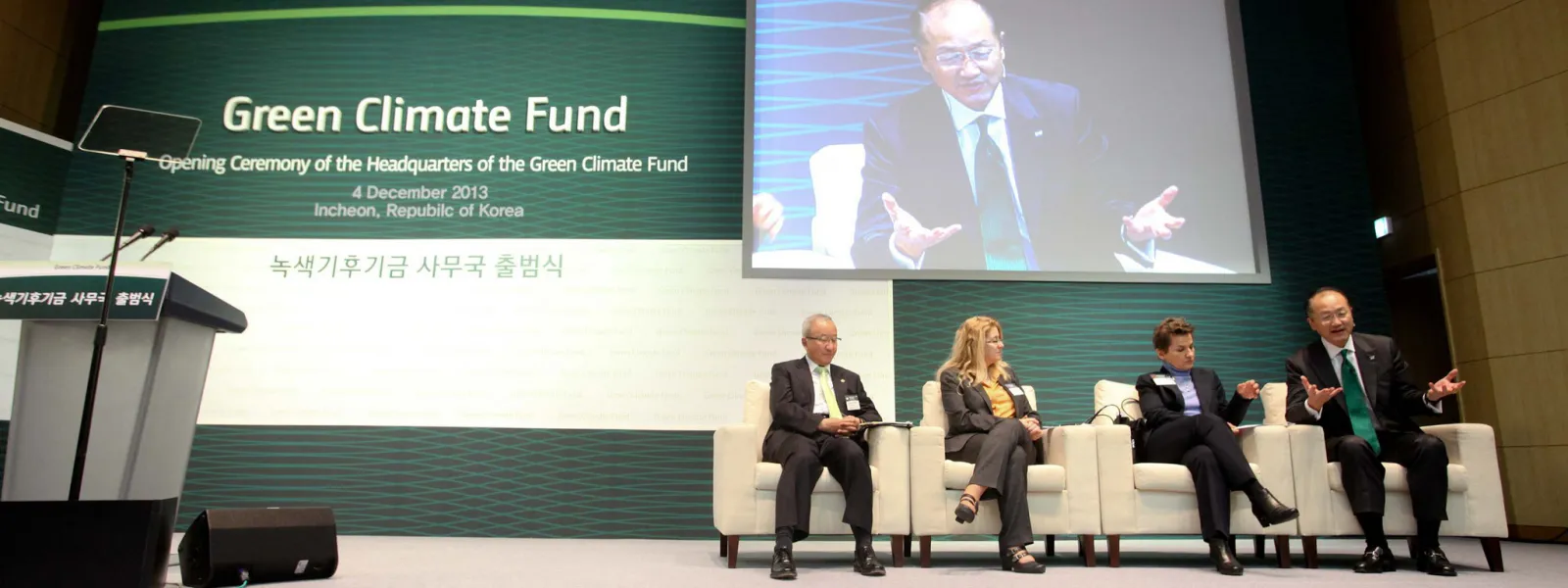
Photo: GCFAdvocating before the Green Climate Fund
The Green Climate Fund is the world's leading multilateral climate finance institution. As such, it has a key role in channelling economic resources from developed to developing nations for projects focused on mitigation and adaptation in the face of the climate crisis.
Created in 2010, within the framework of the United Nations, the fund supports a broad range of projects ranging from renewable energy and low-emissions transportation projects to the relocation of communities affected by rising seas and support to small farmers affected by drought. The assistance it provides is vital so that individuals and communities in Latin America, and other vulnerable regions, can mitigate greenhouse gas emissions and address the increasingly devastating impacts of global warming.
Climate finance provided by the Green Climate Fund is critical to ensure the transformation of current economic and energy systems towards the resilient, low-emission systems that the planet urgently needs. To enable a just transition, it’s critical to follow-up on and monitor its operations, ensuring that the Fund effectively fulfills its role and benefits the people and communities most vulnerable to climate change.
Reports
Read our recent report "Leading participatory monitoring processes through a gender justice lens for Green Climate Fund financed projects" here.
Partners:
Related projects
AIDA President Manuel Pulgar-Vidal named Peru Environment Minister
The Interamerican Assocation for Environmental Defense (AIDA) congratulates Manuel Pulgar-Vidal for being named head of Peru’s Environment Ministry. An accomplished environmental lawyer and thought leader, Pulgar-Vidal served as the President of AIDA's Board of Directors for eight years. He is only the third Peruvian to be sworn into the government's top environmental post. We are extremely thankful for all the hard work and guidance Pulgar-Vidal has provided AIDA since he helped found the organization in 1996. The appointment is a well-deserved recognition for a man who has dedicated his life to defending human rights and the environment. His new role won't be easy. Pulgar-Vidal joins a young government faced with its first crisis: widespread popular dissent over the potential environmental impacts of a massive proposed gold mine. But the opportunity to strengthen environmental governance and institutionalize environmental health protections is priceless. We know he's up for the challenge.
Read moreAIDA presents report at Durban linking climate change to decline of human rights in Latin America
Calls for measures to protect the human rights of the most vulnerable communities. Durban, South Africa – On Wednesday, December 7, 2011, the Interamerican Association for Environmental Defense (AIDA) presented delegates at climate meetings in Durban, South Africa with a report detailing the negative effects of climate change on human rights to life, access to water, health, food, and housing for millions of people in Latin America. “Climate change causes the greatest harm to the human rights of those who are least responsible for greenhouse gas emissions – vulnerable and historically disadvantaged communities such as peasant farmers, indigenous peoples, and the urban poor,” said AIDA staff attorney Jacob Kopas. “Governments disproportionately responsible for historical and current emissions have an international obligation to contribute more to lasting solutions.” The most troubling of the impacts detailed by the report is a dramatic reduction in access to freshwater in Latin America. Increased melting of glaciers, degradation of high-mountain páramo wetlands, erratic weather patterns and severe droughts will limit dry-season access to water for up to 50 million people in the Tropical Andean region by 2050. Other impacts include heavier rains and flooding, which affected 2.2 million people and caused $300 million of damages in Colombia alone in 2010, and the loss of 80% of Caribbean coral reefs due in large part to warming ocean temperatures and ocean acidification. “The parties must understand that the climate change problem can no longer be ignored. We need to act now to help the world’s most affected communities cope with climate change by securing urgent yet attainable solutions like the Green Climate Fund here in Durban,” said AIDA attorney Andrés Pirazzoli, who distributed the report to delegates at the meeting. AIDA backs the Green Climate Fund, which would finance low-carbon technology adoption and adaptation programs in the developing world. AIDA issued the report this week to inform an investigation by the Inter-American Commission on Human Rights (IACHR) on the link between climate change and human rights. The report calls for a binding climate treaty and for the biggest emitters to pay for adaptation and mitigation measures in the developing world.
Read moreAIDA presents report at Durban linking climate change to decline of human rights in Latin America
Calls for measures to protect the human rights of the most vulnerable communities. Durban, South Africa – On Wednesday, December 7, 2011, the Interamerican Association for Environmental Defense (AIDA) presented delegates at climate meetings in Durban, South Africa with a report detailing the negative effects of climate change on human rights to life, access to water, health, food, and housing for millions of people in Latin America. “Climate change causes the greatest harm to the human rights of those who are least responsible for greenhouse gas emissions – vulnerable and historically disadvantaged communities such as peasant farmers, indigenous peoples, and the urban poor,” said AIDA staff attorney Jacob Kopas. “Governments disproportionately responsible for historical and current emissions have an international obligation to contribute more to lasting solutions.” The most troubling of the impacts detailed by the report is a dramatic reduction in access to freshwater in Latin America. Increased melting of glaciers, degradation of high-mountain páramo wetlands, erratic weather patterns and severe droughts will limit dry-season access to water for up to 50 million people in the Tropical Andean region by 2050. Other impacts include heavier rains and flooding, which affected 2.2 million people and caused $300 million of damages in Colombia alone in 2010, and the loss of 80% of Caribbean coral reefs due in large part to warming ocean temperatures and ocean acidification. “The parties must understand that the climate change problem can no longer be ignored. We need to act now to help the world’s most affected communities cope with climate change by securing urgent yet attainable solutions like the Green Climate Fund here in Durban,” said AIDA attorney Andrés Pirazzoli, who distributed the report to delegates at the meeting. AIDA backs the Green Climate Fund, which would finance low-carbon technology adoption and adaptation programs in the developing world. AIDA issued the report this week to inform an investigation by the Inter-American Commission on Human Rights (IACHR) on the link between climate change and human rights. The report calls for a binding climate treaty and for the biggest emitters to pay for adaptation and mitigation measures in the developing world.
Read more