
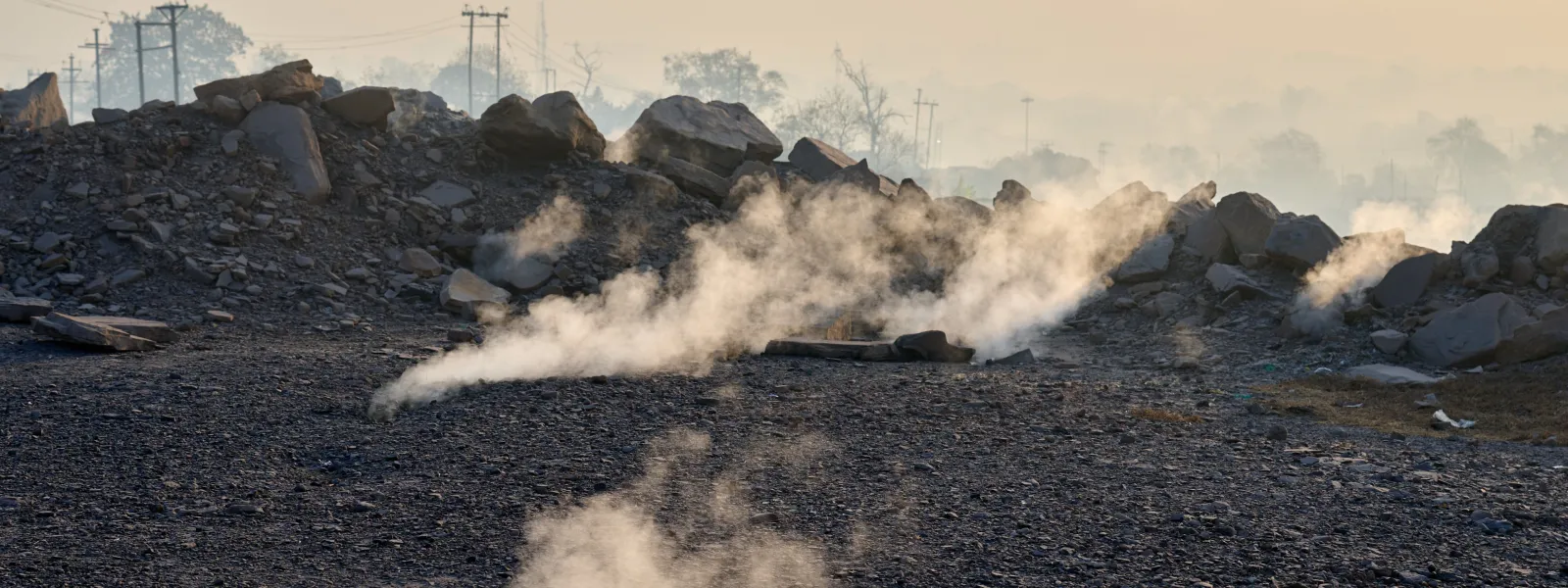
Coal, a dirty and obsolete fuel
Shutterstock.
Historically, coal has been identified as an important source of non-renewable energy. It was the fuel that powered the Industrial Revolution, transforming the world's production methods, and for a long time, it was the main fuel for transportation, electricity generation, and heating.
But it is time to leave that era behind. Today, we know that coal is the fossil fuel that generates the highest carbon dioxide (CO2) emissions, one of the main greenhouse gases driving global warming, with effects such as melting glaciers and rising sea levels.
In addition to climate and environmental arguments, there are economic, political, and human rights reasons to end the extraction and burning of this fuel.
To better understand why coal is so polluting and what its impacts are on the environment and health, we have taken a closer look.
Getting to know coal
Coal is a rock formed from plant remains that were buried in layers of sediment and did not decompose due to the absence of oxygen.
Over millions of years, through geological processes, this organic matter was exposed to high temperatures and pressures. The result was a material composed mainly of carbon.
The energy in coal is released during combustion. When burned, coal generates heat. In thermoelectric plants, this heat is used to generate steam and produce electricity.
When coal is burned to produce heat or electricity, it releases large amounts of carbon dioxide and, in smaller amounts, methane and nitrous oxide into the atmosphere.
All these gases harm the environment and human health.
Why is it so polluting?
Coal has an impact from the moment it is extracted, as open-pit coal mining involves excavating and removing large amounts of earth to reach the coal-rich layers.
This means destroying landscapes, razing vegetation and animals, and even causing the forced displacement of populations.
Coal mining also pollutes water and soil at extraction sites, both through mining the mineral and through the waste it generates.
But the chain of impacts does not end there. During coal combustion, large amounts of CO2 are generated, the main gas responsible for global warming.
At the same time, other gases are released during its extraction, handling, and combustion:
- Methane, which has a global warming potential up to 30 times greater than CO2 over a 100-year period.
- Nitrous oxide, whose global warming potential over a 100-year period is up to 273, and whose lifetime in the atmosphere extends up to 109 years.
In addition to greenhouse gases, coal combustion also releases other pollutants, such as nitrogen oxides, sulfur dioxide, and black carbon (soot), which affect air quality and have indirect effects on the climate, including altering precipitation patterns and contributing to acid rain.
What damage does it cause to health?
Despite the known environmental and health impacts of coal, for many economies it remains a reliable and cheap energy source.
Following the decline in coal consumption during the COVID-19 pandemic, global demand for coal has grown by more than 1.2 billion tons since 2020, according to the International Energy Agency's Coal 2024 analysis.
Despite increased electricity generation from renewable sources, major consumers such as China and India continue to rely on coal.
In Latin America, the future of coal is uncertain. On the one hand, the region continues to extract coal for export or for burning to generate energy. The most emblematic case is Colombia, the world's fifth-largest coal exporter.
On the other hand, there are efforts towards decarbonization, such as in Chile, where coal-fired power generation has caused serious health and environmental impacts in so-called “sacrifice zones.”
The government proposed a plan to have the entire National Electric System generate 100% clean energy by 2050. However, the recent accelerated burning of surplus coal at a thermoelectric plant, as part of its closure process, has put the spotlight on how this decarbonization is being carried out.
As a coal-producing and consuming region, Latin America has a share of responsibility in global efforts to curb coal mining and burning and instead promote energy systems based on non-conventional renewable sources that are sustainable over time and respectful of the environment and people.
Ending the coal era is possible. It is time to do so.
Mayela Sánchez García

Mayela Sánchez García is AIDA's digital community specialist, working from Mexico. She is a graduate in Journalism and Media Studies from the Instituto Tecnológico y de Estudios Superiores de Monterrey in Mexico. Mayela has significant experience as a journalist focused on social and human rights issues. She has worked in print and digital media, and has experience in podcast production.