
Project
Photo: Anna Laurie Miller / AIDAConserving the Ciénaga Grande de Santa Marta
Ciénaga Grande de Santa Marta, the largest and most productive coastal wetland in Colombia, covers 45,000 hectares. At the confluence of the Magdalena River and the Caribbean Sea, the site boasts an immense variety of flora and fauna, including mammals, birds and fish. Its southern tip is a beautiful sanctuary of mangroves, swamp and amphibious forest.
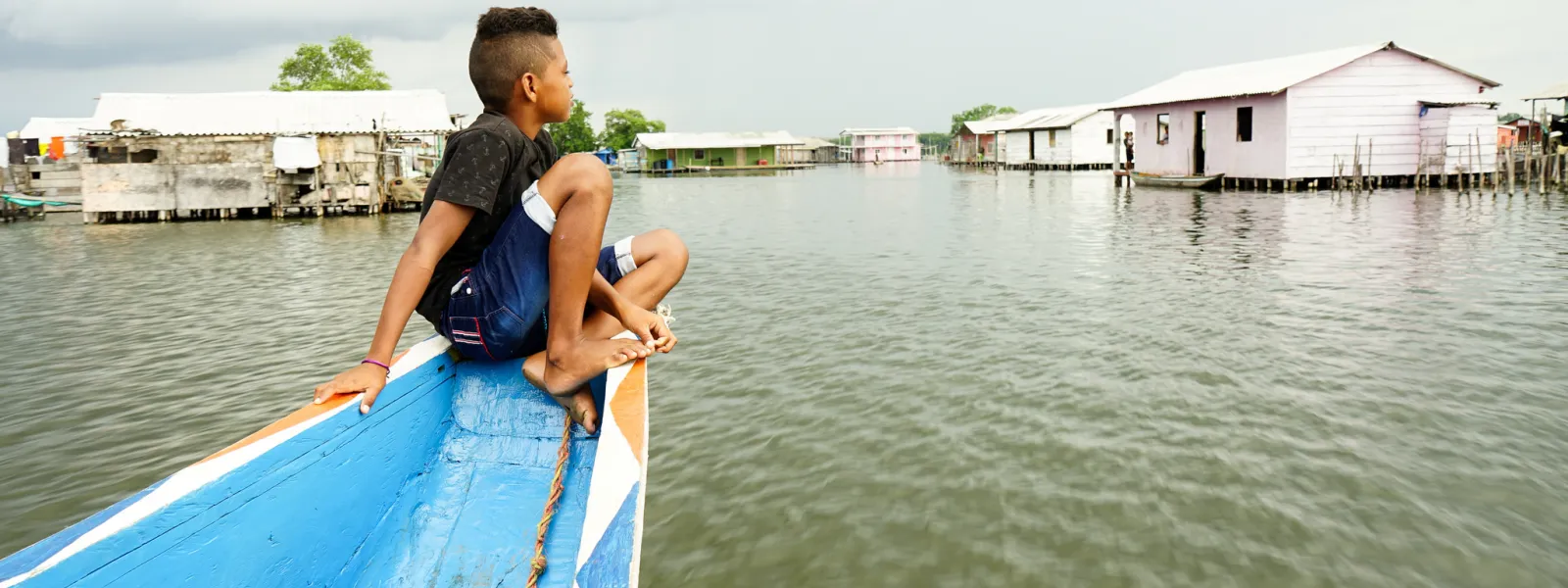
On the calm waters of the marsh stand the Ciénaga’s famous stilt villages, supported by pillars or simple wooden stakes and inhabited by local fishermen since 1800. In a place accessible only by water, many of the things we take for granted—being served a glass of water, quick access to a doctor—are considered luxuries. Residents depend on the natural world around them. Sadly, in recent years mass fish die-offs caused by the marsh’s degradation have threatened the livelihoods of 2,500 people who call the Ciénaga Grande home.
Illegal activities are destroying this vital ecosystem: intentionally set forest fires, deforestation of large tracks of land for agriculture and livestock, logging and burning of mangroves, and 27 kilometers of illegally built dikes.
This destruction not only devastates the local fishery; it also has global impact. Ciénaga Grande’s mangroves absorb large quantities of carbon dioxide from the atmosphere, aiding in the global fight against climate change.
The importance of the Ciénaga Grande has been recognized both nationally – the Sanctuary of Flora and Fauna Ciénaga Grande de Santa Marta is a national park – and internationally: UNESCO’s Man and the Biosphere program declared the lagoon a biosphere reserve; and the Ciénaga Grande is listed as a Wetland of International Importance under the Ramsar Convention, an intergovernmental treaty for the protection of wetlands.
AIDA and our partners are advocating for the Colombian government to fulfill its national and international obligations to protect the Ciénaga Grande. After all, millions of animals, the local community, and our global climate depend on it.
Partners:
Related projects

Moratoriums and bans on fracking: Comparative legislation
Hydraulic fracturing is a technique used to extract nonconventional petroleum products, such as tight gas and shale oil, from deep underground deposits. To release these hydrocarbons, the rock formations in which they are trapped must first be shattered into many small pieces. Hydraulic fracturing, or fracking, thus involves drilling 1000 to 5000 meters into the earth and injecting a high-pressure fluid mix of water, sand and various chemicals to fracture the rock and release the hard-to-reach hydrocarbons. This controversial technique has sparked resistance in many communities, regions, and countries where it is causing serious dangers to public health and the environment. Countries, regions, cities and communities around the world have chosen to prohibit or place moratoriums on fracking through various legal and administrative mechanisms. These fracking bans are driven by a number of concerns surrounding the dangers fracking poses to the environment and public health. We would like to point out the following arguments: Above ground and subterranean water sources, air, and soil in the vicinity of fracking operations are at serious risk of contamination. There remains scientific uncertainty regarding of the magnitude of fracking’s impacts on public health and the environment. Measures put in place by the hydrocarbon industry to prevent the impacts of fracking have not yet been proven effective. Moreover, a “general consensus” among actors in the hydrocarbon industry does not guarantee that fracking operations are safe for humans and the environment. There is a serious risk of contamination of soil and water sources in rural and agricultural areas. Fracking impacts communities’ ways of life, and limits consumer confidence that food and agricultural products grown or produced in areas affected by fracking are safe to consume. Fracking emits significant volumes of greenhouse gases into the atmosphere, exacerbating anthropogenic climate change. Among these gases produced by fracking are large volumes of methane, which traps roughly 30 times more heat in the atmosphere than carbon dioxide. There is a large and growing social opposition to fracking, driven by community organizations and citizen mobilization, demonstrating widespread popular opposition to the technique. Indigenous communities like the Cherokee argue that defending their territories against fracking is essential to their continued survival. Most of the moratoriums and bans on fracking surveyed in this report adopt the precautionary principle, either directly referencing the principle or indirectly alluding to it. For example, most fracking bans are based on the possibility of serious and irreversible harms caused by the extraction technique, or on the scientific uncertainty regarding the magnitude of fracking’s impacts. These measures invoke the precautionary principle, which states that in the event a technique could cause serious or irreversible dangers, or if there is a lack of scientific evidence that a technique is safe, decision makers should adopt proactive measures that protect the health of people and the environment above all. However, various measures to ban or pass moratoriums on fracking did first require exhaustive scientific investigations by government authorities to better understand the risks fracking could cause to public health and the environment. Those studies confirmed the serious risks of hydraulic fracturing, but could not prove with certainty the short and long-term impacts of fracking, nor the efficacy of industry efforts to prevent and mitigate those dangers. In a pair of case studies (in Northern Ireland and Wales) government authorities used the precautionary principle to establish a burden of proof, placing the onus on the hydrocarbon industry to clearly and scientifically demonstrate that the proposed fracking activities would not cause serious or irreversible harm to public health or the health of the environment. If the party pursuing hydraulic fracturing could not show evidence-based proof of the safety of fracking in a particular instance, authorities would maintain precautionary measures (such as prohibitions or moratoriums) in order to protect the health of people and the environment. The measures adopted in these cases were formalized via legislation or through orders issued by the executive branch or other administrative bodies. In two of the cases examined (New York and Maryland in the United States), prohibitions or moratoriums on fracking at the municipal level were key to securing political and legal support at larger, regional jurisdictions. Furthermore, social mobilization by grassroots organizations helped amplify and legitimize anti-fracking movements at the national or regional level. In all cases, anti-fracking measures were passed only after mobilizing social resistance to fracking, which built awareness, generated larger movements, and unified voices against the technique. Civil society organizations have employed a diverse and creative array of methods to build support with political actors. Among them are citizens’ legislative initiatives, petitions, letters and meetings with policymakers, marches, strikes and protests, and other collective action. All have proven effective in generating political support to pass fracking bans. The power of social mobilization against fracking has been a deciding factor in many cases in which authorities have recognized that widespread public opposition to fracking is the principal reason to pass local fracking bans or moratoriums. SEE THE REPORT (IN SPANISH)
Read more
World Bank Arbitration Tribunal Refuses to Listen to Those Affected by Mining in Santurbán, Colombia
The World Bank’s International Center for Settlement of Investment Disputes (ICSID) has declined to accept an Amicus Curiae that was to be presented by the Committee for the Defense of Water and the Páramo of Santurbán and allied international organizations. Bucaramanga, Bogotá, Washington, Ottawa, Amsterdam. National and international civil society organizations rebuffed the International Centre for Settlement of Investment Disputes’ (ICSID) refusal to accept an Amicus Curiae within the process of the ongoing international arbitration brought forth by Canadian mining company Eco Oro Minerals Corp. against Colombia. The arbitration centre is hearing the ongoing international arbitration put forth by the Canadian company in question against the Andean nation. The company is attempting to pursue its Angostura gold mining project in the Santurbán páramo, located in the northeast of the country. The arbitration questions the decisions taken by the Colombian State to protect its páramos, high mountain wetlands that are a natural source of water for 70% of its inhabitants. The arbitration is being heard at the ICSID, an organization dependent on the World Bank that is in charge of the resolution of disputes between investors and States. Colombia could be condemned to pay $746 million US dollars, an unprecedented sanction for the country. “At a time when Latin American countries are embracing the principles of environmental democracy with the adoption of the Escazú Agreement, ICSID is going in the opposite direction. It is regrettable that in the midst of the regional movement for transparency and participation, ICSID has opted to constrict itself even more. In doing so, it is only generating more anger and distrust, not only in the face of this mechanism, but also in the face of the whole system of Investor-State Arbitration worldwide,” stated Carla García Zendejas, Senior Attorney at the Center for International Environmental Law (CIEL). “The communities affected by mining in Santurbán have to be heard and can provide crucial elements for the case,” said Carlos Lozano, Senior AIDA Attorney. The organizations consider that the Committee for the Defense of Water and the Páramo of Santurbán has a significant interest in the outcome of the process and that they could have provided expertise to the arbitration tribunal, which would have been helpful for a better decision in the case. In the same way, they urge ICSID to expand citizen participation and make its decision-making processes more transparent. This is transcendental for the public interest of the countries whose governments are subject to its jurisdiction. Find more information on the case here. PRESS CONTACTS: Alix Mancilla, Comité para la Defensa del Agua y el Páramo de Santurbán, [email protected], +57 311 2439273 Carla García Zendejas, CIEL, [email protected], +1 202 374 2550 Carlos Lozano Acosta, AIDA, [email protected], +57 300 56 40 282 Kirsten Francescone, MiningWatch Canada, [email protected], +14373459881 Kristen Genovese, SOMO, [email protected], +31 65 277 3272, Manuel Perez Rocha, Institute for Policy Studies, [email protected] +1 240 838 6623
Read more
Herbivorous fish and coral reefs: a relationship we must protect
Vibrantly colored herbivorous fish feed on the macroalgae that covers coral reefs. These fish play a fundamental role in the health of marine environments by cleaning the algae that deprive corals of light and oxygen. They are vital for maintaining the ecological equilibrium necessary for the reef’s survival. Recommendations for saving herbivorous fish Targeted measures are urgently needed to maintain and improve the health of coral reefs. Protecting the colonies of herbivorous fish that sustain them would go a long way toward helping reefs recover. In order to do so, AIDA recommends: Establishing and adopting strong fishing management and conservation strategies that will help herbivorous fish (particularly parrotfish) populations recover. This includes fishing management initiatives, establishing temporary or location-based bans, and strict quotas on fishing. Other measures include encouraging fisheries to diversify the species they capture. In the Caribbean, for example, fishing for lionfish—an invasive species—could be promoted as a viable economic alternative in hundreds of fishing communities. Establishing marine protected areas and recovery zones where fishing is prohibited. These areas or zones, which should include at-risk habitats, need urgent protection because they are considered refuges for juvenile and adult fish. Allowing herbivorous fish species to complete their life cycles would contribute to the resilience of key marine environments like coral reefs. Standardize monitoring techniques of fish populations and implement alternative management practices. Encouraging optimal standard practices would allow scientists working in diverse habitats to improve monitoring, as well as fishery and ecosystem management. Among other options, reef restoration is also extremely beneficial, and has already been adopted in several areas of Mexico. Promote comprehensive regional management systems that allow local authorities to share experiences and establish shared management and conservation tools. Create and implement norms and laws that protect reefs and herbivorous fish. These could include laws that promote adequate fishing management practices and effectively combat threats like overfishing and tourism that damage reef habitats. Such laws could also encourage low impact coastal development that incorporates thorough scientific and technical evaluation into the planning process. See THE Fact Sheet (in Spanish)
Read more