
Project
Victory: Constitutional Court Defends Right to Prior Consultation
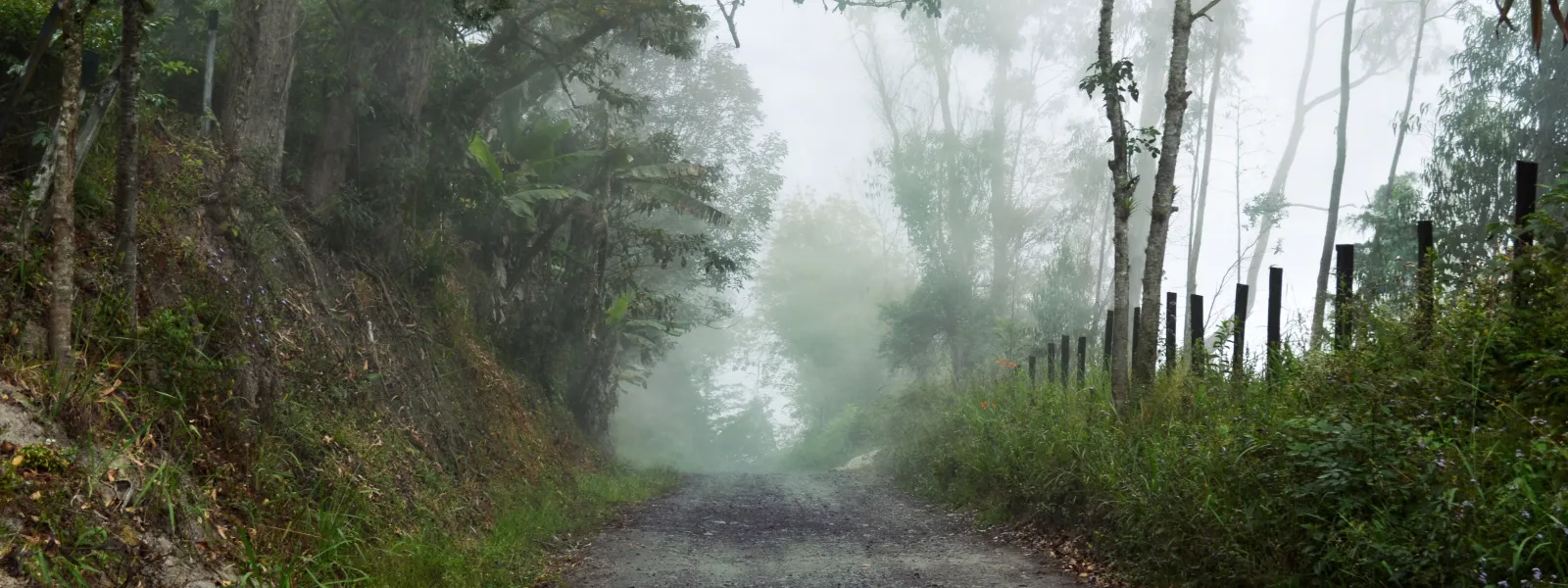
On January 23, 2008, the Colombian Constitutional Court declared the Forest Law of 2006 to be unconstitutional and therefore, invalid, because lawmakers did not consult with indigenous, afrodescendant, and tribal communities during development of the law as required.
This decision is an advance for these Colombian communities who view many economic development projects and policies as a threat to their traditional territory and cultural identity, as well as the environment. The ruling also establishes a valuable legal precedent that can be used to bolster indigenous and tribal communities’ rights in other legal cases throughout the Americas.
The Colombian government is required by law to consult with indigenous and tribal communities regarding administrative and legislative decisions that may affect them. It is obligated to do so because the Colombian Congress previously adopted into law “Convention 169,” a treaty of the International Labour Organization that protects this right and others.
In this case, the Court decided that indigenous and tribal communities should have been consulted because the Forest Law regulates forest issues in general terms, and contains provisions that “will likely affect areas generally used by the communities, which could impact their lifestyles and their close relationships with the forests.”
The court also declared that the requirement to consult with indigenous and traditional communities cannot be replaced with the general public participation process that the government carried out regarding the Forest bill. Rather, to comply with the law, the government should inform the communities about the proposed law, explain its implications and how it could affect them, and give them opportunities to effectively state their opinions regarding the bill.
As a result of this court ruling and civil society’s call to respect the right to prior and informed consultation, the Colombian government proposed a law to regulate and enforce this fundamental right. The Ministry of Agriculture also began developing a new forest law, this time using a process that complies with prior and informed consent procedures.
The lawsuit was brought by a group of students and professors from the University of Los Andes Law School in Bogota with the support of AIDA. Social organizations including the Proceso de Comunidades Negras, the National Indigenous Organization of Colombia (ONIC) and CENSAT Agua Viva also supported the group in presenting this case.
This group also filed a second lawsuit against the Forest Law alleging that the law violated Constitutional provisions protecting the environment. However, because of the January court decision, no decision will be made on this second suit.
Related projects
Letter to OAS Member States on the Financial Crisis at the IACHR
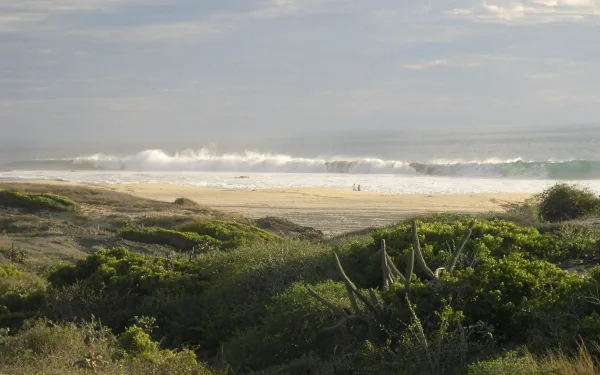
AIDA joins more than 300 organizations in calling on Member States of the Organization of American States to act swiftly in the face of the financial crisis affecting the Inter-American Commission on Human Rights. Our letter calls for urgent action to guarantee the immediate funding of the important human rights institution, as well as for the creation of a sustainable fund to guarantee ongoing financing. Read it below: OAS Member States, The Coalition for Human Rights in the Americas, and the members of other regional and global networks from civil society, express our deep concern over the severe financial crisis currently affecting the Inter-American Commission of Human Rights (IACHR). We endorse this statement in order to appeal all Member States of the Organization of American States (OAS) to take the necessary actions to guarantee the immediate and proper funding of the IACHR in order to fulfill its mandate. In addition, we urgently call for the creation of a sustainable fund to finance the Organs of the Inter-American Human Rights System (IHRS), in order to address the precarious situation, which both the Commission and Inter-American Court of Human Rights have been going through since in the last few years. The Inter-American Commission is mandated to promote the observance and protection of human rights in the Americas, and acts as a consultative organ to the OAS in this area. It is the only regional mechanism that supervises the obligations of all Member States of the OAS in this area, and constitutes the last resort for defending against violations of fundamental rights in the continent. The IACHR is an international referent, due to its great labour of protecting thousands of human rights defenders, who live threatened and criminalized in the Americas. This organ watches over the indigenous people and afro-descendant people’s rights, women and children, and the LGTBI community rights as well, among other vulnerable populations. The role of the IACHR, not only in the area of human rights protection, but also in the implementation of measures to promote their accomplishment, affects almost a billion people across the region. In spite of that, the Inter-American Commission has historically suffered from a structural lack of funds, which are currently reaching the point of effectively compromising the Commission's ability to fulfill its basic functions, including its mandate assigned by the OAS Member States. The Commission itself has announced that on July 31st of 2016 the contracts of 40 percent of its personnel will expire, and at this time the Commission does not have the funds—or the expectation of receiving the funds—to be able to renew them. In addition, the IACHR has reported that it has been forced to suspend the country visits it had planned for this year, as well as the 159th and 160th Period of Sessions, which had been scheduled for July and October of this year. In contrast with other human rights protection organs, either national or international, the financing received by the IACHR from the regular OAS fund, meaning from the Member States, is contradictory with the countries' wish to aspire to build a more democratic region. In 2016, the regular budget provided by the fund was around $5,4287.9 million dollars, which is 6.44 percent of the annual budget of the OAS – by comparison, the Council of European member States provides 41.5 percent of its annual budget to the promotion and protection of human rights. Even though the OAS General Assembly has approved in the past resolutions committing to address this matter, these changes have not materialized with the required increase of resources, that would allow both the Commission and Court – whose budget will be reduced in a third part by the end of the year, if nothing changes – to have with the proper funding to successfully fulfill their mandates. In addition, the aim of this petition is not only for the IACHR to be able to carry out with the scheduled activities for the current year, to renew the contracts of 40 percent of its staff and to conduct the 159th and 160th Period of Sessions, but also to create a structure for this purpose that converts the funding of those organs into a sustainable practice, significantly increasing the budget that the OAS provides to the Inter-American Human Rights System. The signing Civil Society organizations see in this crisis a unique opportunity to reinforce the OAS Member States' commitment to human rights in the continent. This is why we call on countries to figure out how to secure a strong and stable funding structure, which effectively guarantees the protective devices and tools that the ISHR provides to millions of people in the Americas.
Read more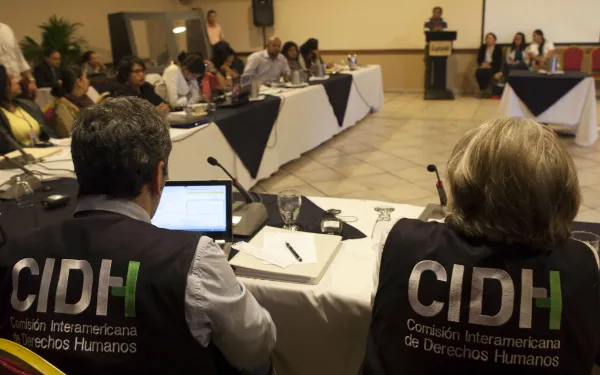
Statement of AIDA, APRODEH and Justiça Global on the financial crisis affecting the Inter-American Commission on Human Rights (IACHR)
The organizations decry the affront to human rights in the region and urges members of the Organization of American States to fulfill their responsibility to adequately fund the Commission. Washington, DC, USA. The Inter-American Commission on Human Rights (IACHR) announced yesterday that a grave financial crisis has led to the suspension of site visits, the cancellation of hearings, and the imminent loss of 40 percent of its staff. The Commission is an autonomous organ of the Organization of American States (OAS). Its mandate is to promote the protection of human rights on the American continent. Together with the Inter-American Court on Human Rights, it forms the Inter-American System for the Protection of Human Rights, which is often the last hope for people and communities whose human rights have been violated and who have failed to find justice in their own country. The Commission called upon OAS Member States to provide funds promised for its operation, and to adopt “a historic and far-reaching decision, one that reflects the States’ commitment to the defense of human rights in the region” at the General Assembly in June. In response to this urgent situation, the Interamerican Association for Environmental Defense (AIDA), the Asociación Pro Derechos Humanos (APRODEH) from Peru and Justiça Global from Brazil, stated: “The imminent loss of nearly half the Commission’s staff is a serious threat to human rights in the region and reflects the lack of political will of Member States to support the Inter-American Commission’s mandate. “Thousands of victims of human rights violations in the hemisphere have placed their trust and their last hopes for justice in the Commission. This is the case for people poisoned by heavy metals in La Oroya, Peru, as well as for communities that have lost their way of life due to the Belo Monte Dam in Brazil. Both groups have cases long pending before the Commission, and bravely continue to seek justice for the violation of their rights. “By not properly financing an organization that they themselves created, the States are establishing another obstacle for these people in their search for justice. “We call on Member States of the OAS to make a voluntary emergency contribution that will allow the Commission to keep its staff, make its planned visits, and undertake the hearings planned for July and October. “The States of the region have a responsibility to the Inter-American System. It is our hope that they honor it, not through speeches and resolutions filled with good intentions, but with concrete actions and immediate financing.”
Read more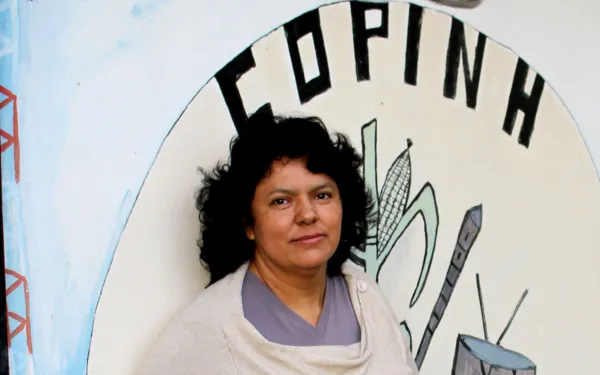
Correspondence with the World Bank Regarding Berta Cáceres and Large Dams
On May 11th, more than 300 organizations from around the world sent a letter to Dr. Jim Yong Kim, President of the World Bank, to respond to a statement he made during an event at the Union Theological Seminary in New York. In response to a question about the impacts of large dam projects as illustrated by the murder of Berta Cáceres in Honduras he stated, among other things, that “you cannot do the work we’re trying to do and not have some of these ‘incidents’ happen.” The organizations signing this letter consider these statements from the World Bank President unacceptable and urge him to immediately rectify his actions and make a public apology. Dr. Kim’s statement is available on video (minute 53). CONSULT the letter sent to the World Bank President in ENGLISH and SPANISH. On May 11th, the World Bank responded to the letter from organizations in a public brief on Honduras and indigenous peoples, which can be found on their website. On May 13th, a drafting committee from the coalition of organizations answered the World Bank, taking note of the President's condemnation of the murder of Berta Cáceres. The also noted that the reference the President of the World Bank made to the grave human rights violations caused by dams, such a involuntary displacement, is worrying and must be addressed. They reiterated the existence of alternatives to large hydroelectric projects and the need to implement such solutions. The organizations concluded: "In honor of your commitment to “hear the voices of the Berta Caceres of the world” we look forward to the World Bank Group moving towards energy alternatives that are respectful of the human rights of people and communities; that are more efficient, less expensive and actually respectful of the planet. That is the main way to achieve real prosperity for all."
Read more