
Project
Victory: Constitutional Court Defends Right to Prior Consultation
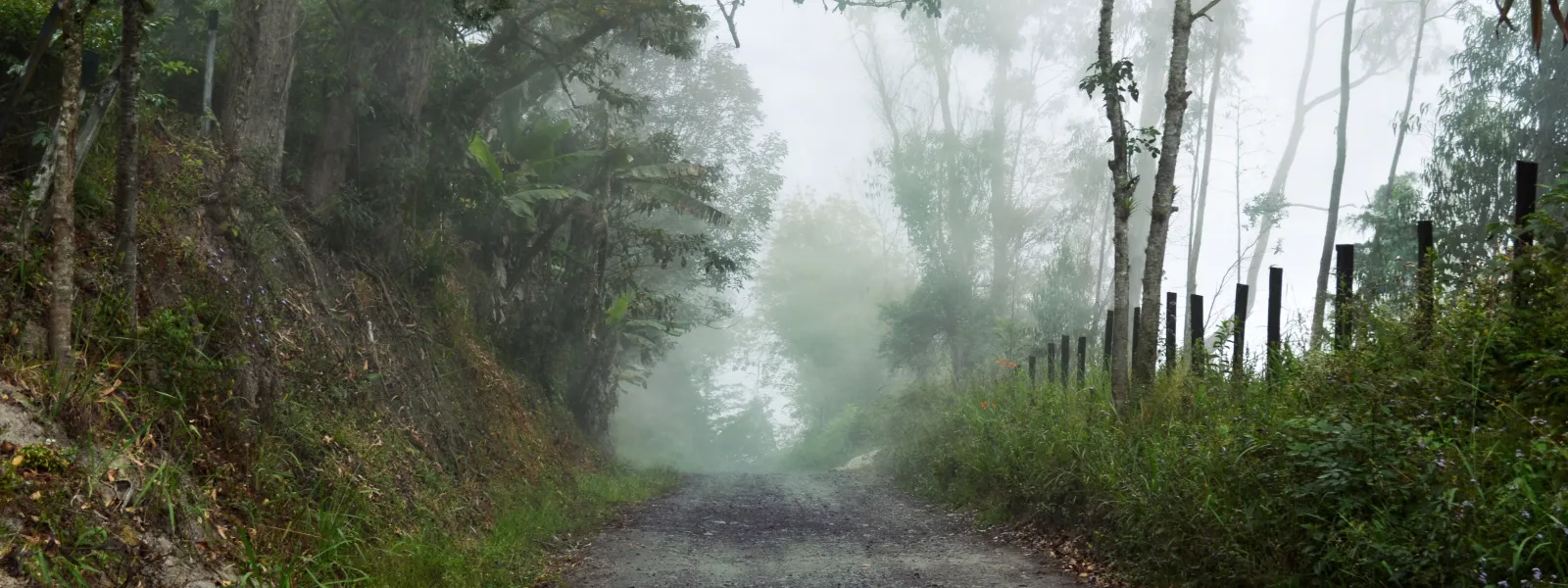
On January 23, 2008, the Colombian Constitutional Court declared the Forest Law of 2006 to be unconstitutional and therefore, invalid, because lawmakers did not consult with indigenous, afrodescendant, and tribal communities during development of the law as required.
This decision is an advance for these Colombian communities who view many economic development projects and policies as a threat to their traditional territory and cultural identity, as well as the environment. The ruling also establishes a valuable legal precedent that can be used to bolster indigenous and tribal communities’ rights in other legal cases throughout the Americas.
The Colombian government is required by law to consult with indigenous and tribal communities regarding administrative and legislative decisions that may affect them. It is obligated to do so because the Colombian Congress previously adopted into law “Convention 169,” a treaty of the International Labour Organization that protects this right and others.
In this case, the Court decided that indigenous and tribal communities should have been consulted because the Forest Law regulates forest issues in general terms, and contains provisions that “will likely affect areas generally used by the communities, which could impact their lifestyles and their close relationships with the forests.”
The court also declared that the requirement to consult with indigenous and traditional communities cannot be replaced with the general public participation process that the government carried out regarding the Forest bill. Rather, to comply with the law, the government should inform the communities about the proposed law, explain its implications and how it could affect them, and give them opportunities to effectively state their opinions regarding the bill.
As a result of this court ruling and civil society’s call to respect the right to prior and informed consultation, the Colombian government proposed a law to regulate and enforce this fundamental right. The Ministry of Agriculture also began developing a new forest law, this time using a process that complies with prior and informed consent procedures.
The lawsuit was brought by a group of students and professors from the University of Los Andes Law School in Bogota with the support of AIDA. Social organizations including the Proceso de Comunidades Negras, the National Indigenous Organization of Colombia (ONIC) and CENSAT Agua Viva also supported the group in presenting this case.
This group also filed a second lawsuit against the Forest Law alleging that the law violated Constitutional provisions protecting the environment. However, because of the January court decision, no decision will be made on this second suit.
Related projects
God is an Environmentalist. Are You?
God is with us in the fight to defend the environment. He is the first environmentalist. In his encyclical Laudato Si, also known as the environmental encyclical, Pope Francis says, “The violence present in our hearts, wounded by sin, is also reflected in the symptoms of sickness evident in the soil, in the water, in the air, and in all forms of life.” All religions agree that divinity created the planet we share with all forms of life. Caring for this creation is one of our ancient religious duties. This sentiment has been echoed by high representatives of churches around the world, from Catholic to Muslim, Hindu to Orthodox. The planet and the beings that inhabit it are currently suffering grave environmental impacts. The contamination of oceans and rivers, climate change, soil deterioration, the extinction of species and the disappearance of forests are just some of the ills afflicting the environment. Given this bleak picture, various churches agree they must admonish believers to care for their surroundings. What did Pope Francis say? In Laudato Si, Pope Francis recounts the lessons of Juan Pablo II, who said that “the destruction of the human environment is extremely serious, not only because God has entrusted the world to us men and women, but because human life is itself a gift which must be defended from various forms of debasement.” The encyclical also recognizes the position of the Turkish Orthodox Church. “Patriarch Bartholomew has spoken in particular of the need for each of us to repent of the ways we have harmed the planet,” the text reads. The Pope also adds that Saint Francis of Assisi, who invited us to “care for all that exists,” always asked that part of his friary garden remain uncultivated, so that wild flowers and herbs could grow. Thus, those who admired them could raise their thoughts to the creator of such beauty: God. The Pope praises all who join forces in defense of the environment: “I want to recognize, encourage and thank all those striving in countless ways to guarantee the protection of the home which we share. “ In this same vein, the Conference of Bishops of South Africa stated that the “talents and involvement of all is needed to repair the damage caused by human abuse of God’s creation.” What do other religions say? Islam also encourages defending the environment. Muslim scholars have recently qualified climate change as a serious threat. The Islamic Foundation for Ecology and Environmental Science declared: “God created the world in mizan (balance), but through fasad (corruption), human beings have caused climate change, together with a range of negative effects on the environment that include deforestation, the destruction of biodiversity, and the pollution of the oceans and of water systems.” To learn how Confucianism, Hinduism, Christianity and traditional indigenous religions promote environmental defense, you can consult Ecology and Religion, a book by John Grim and Mary Evelyn Tuckner, published by Island Press in 2014. Better today than tomorrow These religious and environmental lessons are very important, especially when we come to defining moments in this fight to protect God’s creation, our planet. In December the 21st Conference of Parties of the United Nations Framework Convention on Climate Change will take place in Paris. This is the last opportunity for the nations of the world to reach a new binding agreement and avoid a global climate catastrophe. Humanity faces similar challenges with respect to energy sources, the use of fossil fuels, growing food, waste management and the protection of natural areas. The religions of the world, and their commitment to protecting the planet, give us a compelling reason to join in the fight. At AIDA we do so daily. We use the law to protect freshwater sources, the human rights of communities affected by environmental degradation, marine and coastal ecosystems, and to promote appropriate solutions to climate change. We can all do something, from changing personal habits that damage the environment, to pushing for structural solutions. These may include renouncing the use of plastic bags or telling your elected representatives you’ll only vote for people who support a rapid transition away from fossil fuels. Whatever we do, let’s do it soon! Amen.
Read more
New Zealand sets shameful emission-reduction target, completely ignores public consultation
By Natalie Jones Natalie is a legal intern on the Climate Change team at AIDA, based in Mexico City. She is a delegate to COP21 with the New Zealand Youth Delegation, and volunteers for NZ youth climate group Generation Zero. In this post, she covers an issue AIDA is following closely in Latin America—emission-reduction targets—in her native country. Last week New Zealand released its INDC, or “intended nationally determined contribution,” for the post-2020 climate deal set to be agreed upon in Paris this December. It’s not good news. An INDC is the target each country must set for its future greenhouse gas emissions—in other words, its intended contribution to the effort to reduce climate-changing pollutants to a sustainable level. At the UN climate talks, the world’s governments agreed that these targets should be nationally determined, to allow each nation to respond best to its own needs, priorities, and abilities. Because climate change is an issue we all face together, New Zealand’s announcement is relevant to people in all parts of the world, including Latin America. New Zealand is one of the world’s higher emitters: the small country emits more than three times its share of global emissions per capita. So far, however, New Zealand is failing to live up to its historic responsibility. The Government announced an emissions reduction target of 30 percent below 2005 levels by 2030. While this may sound okay – 30 is a big percentage, right? – it actually equates to a cut of just 11 percent below 1990 levels, which is not that much bigger than our already-pitiful 2020 target of 5 percent below 1990 levels. To stay in line with the international effort to limit global warming to below 2 degrees Celsius, New Zealand’s target would need to be a minimum of 40 percent below 1990 levels by 2030 – a rate accepted by the European Union and other progressive nations. Instead, the target is worse than those proposed by China, Mexico and other developing countries. To make matters worse, New Zealand has already proposed a conditional target of 10-20 percent below 1990 levels by 2020, in addition to the unconditional 5 percent target. It is likely that all the conditions attached to the 10-20 percent target will be met. So the recent announcement is essentially lowering New Zealand’s ambition by giving the country ten more years to hit the low end of its conditional target. At this critical moment in history, we can’t afford a decade of inaction. Accounting rule mischief But it doesn’t stop there. The target will remain provisional until a final deal is reached in Paris, including rules on accounting for land sector emissions and carbon markets. This means the target is even worse than it seems. New Zealand’s existing 2020 target is based on gross emissions calculated for 1990, without accounting for the lower net amount of carbon once some of it is taken up and stored by forests. But for 2020, the target does account for forests as a carbon sink. This skewed approach means New Zealand is on track to meet its 5 percent reduction target by 2020, even though actual emissions are on track to increase 36 percent since 1990. If New Zealand plans to use the same methodology for the 2030 target, which seems likely, our target would actually be a 134 percent net increase from 1990 levels. A target for the 1% What’s more, the Government has completely ignored the results of its own public consultation, which overwhelmingly called for much stronger action. Ninety-nine percent of submitters called for a target of 40 percent below 1990 levels by 2030. Over 15,000 submissions were made, and more than 4,600 of those submissions were mobilized by youth climate organization Generation Zero’s Fix Our Future campaign, which I helped run. Generation Zero spokesperson Paul Young characterized the target as being “for the 1 percent who deny the need to transition to a low carbon economy.” Failing to take responsibility for the Pacific New Zealand is a neighbour to many vulnerable Pacific Island countries, such as Samoa, the Marshall Islands, Tuvalu and Vanuatu. These countries are some of the lowest contributors to climate change, but are the first to face its devastating impacts, such as rising sea levels and more frequent and severe storms. New Zealand has a responsibility to care for its neighbours. Oxfam New Zealand called the country’s recent announcement a “slap in the face” to Pacific Island nations. A wasted opportunity Perhaps most disappointing about this announcement is the fact that New Zealand has the ability to lead the way to a thriving, zero carbon world. Currently running on more than 80 percent renewable energy, the country is in a prime position to transition to 100 percent renewable energy, shift its transport and heat needs to electricity and other clean energy sources, and absorb carbon by planting forests. Instead, New Zealand is leaving it to other countries to pick up its slack. Historically, New Zealand has used the inaction of major emitters like the US and China as an excuse for its own inaction, but that simply won’t cut it any more. What’s holding us back now is not technology, but political vision. AIDA’s work on INDCs AIDA advocates for public participation in the formation of INDCs throughout Latin America, and calls on nations to include information in their INDCs about the finance needed to meet their commitments and respond to the impacts of climate change. It is important to monitor the contributions of countries outside Latin America, particularly developed countries who have contributed the most to the problem, in order to determine whether each country is upholding their responsibility on this collective issue and to ensure political accountability for poor contributions. Find Natalie on Twitter at @nataliejonesnz.
Read more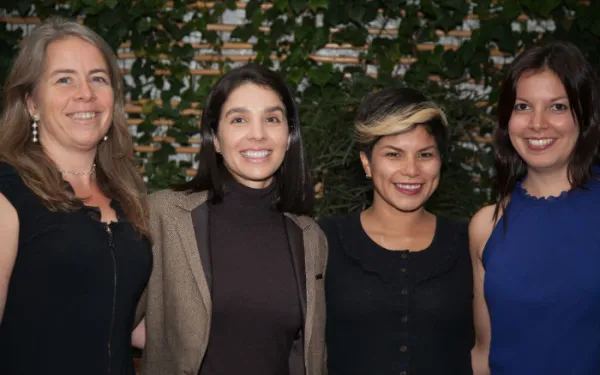
“My Mom Is the Best Lawyer in the World”
“My mom is the best lawyer in the world because she defends the turtles, the corals, the salted forests they have in the sea, and alllll the fish.” As I listened to my 4-year-old daughter, Daniela, say this to an auditorium full of parents, boy and girls, my eyes filled with tears and my heart filled with love and happiness. Listening to my little girl brag about what her mother does renewed my strength and enables me to continue working passionately. Daniela summed up quite well my work on AIDA’s team of attorneys in the Marine and Coastal Protection Program. My colleagues and I focus on three key areas: coral reefs, mangroves and fisheries. We use national and international standards to support marine ecosystems and the people who depend upon them. Coral Reefs We know that by protecting coral reefs, we’re preserving natural barriers that protect coastal communities from storms and hurricanes—which are growing ever stronger due to climate change. We’re also conscious that the many varieties of fish we enjoy on our dinner table exist only because of the important breeding grounds that corals provide. Mangroves Mangroves, or “salted forests” as my daughter calls them, are swampy forests that exist in lakes, rivers and tropical coasts where fresh river water mixes with saltwater from the sea. My colleagues and I are determined to safeguard these ecosystems because we know they are our greatest allies. Mangroves capture from the atmosphere 50 times more carbon dioxide than tropical forests. They are also an important food source for birds, and a center of breeding and development for shrimp, crab and some fish, which provide a livelihood for coastal communities. One example of these unique ecosystems is Marismas Nacionales, the largest mangrove forest in Mexico, which we’re currently fighting to protect. Fishing Conscious that ecosystems are interrelated and reliant upon each other, we work to create sustainable fisheries. If we care for one fish, the rest of the fish will also benefit. We hope that future generations will also be able to taste a fish from the sea, not just observe one in a photograph. We have seen that adopting appropriate measures has allowed fish populations to recover, as occurred with the hoki in New Zealand, the anchoveta in Spain and France, and the cod in the northern Atlantic ocean. Every day I appreciate and enjoy the privilege my children, Daniela and Agustín, have to run through a forest, stick their feet in the ocean and feel the movement of little fish between their toes, or marvel at their first glimpse of a magnificent butterfly or a towering tree. In these moments, I reaffirm the words my parents said one day to my husband and me: “Many good memories outside are worth much more than many toys in the house.” At AIDA we are 26 people working throughout the continent with dedication and commitment. We do it for Daniela and Agustín, and for the rest of the little boys and girls who are part of our organization: Amber, Esteban and Eloísa, Constanza, Jared, Isabelle and Caroline, Izabela, Paloma, Marc and Rosalie. We work for our children and for all children, so that current and future generations have the opportunity to enjoy a healthy environment. Thank you for supporting our work!
Read more