
Project
Shutterstock.
Pollution of the Motagua River in Guatemala: The Poqomam Maya people’s quest for environmental justice
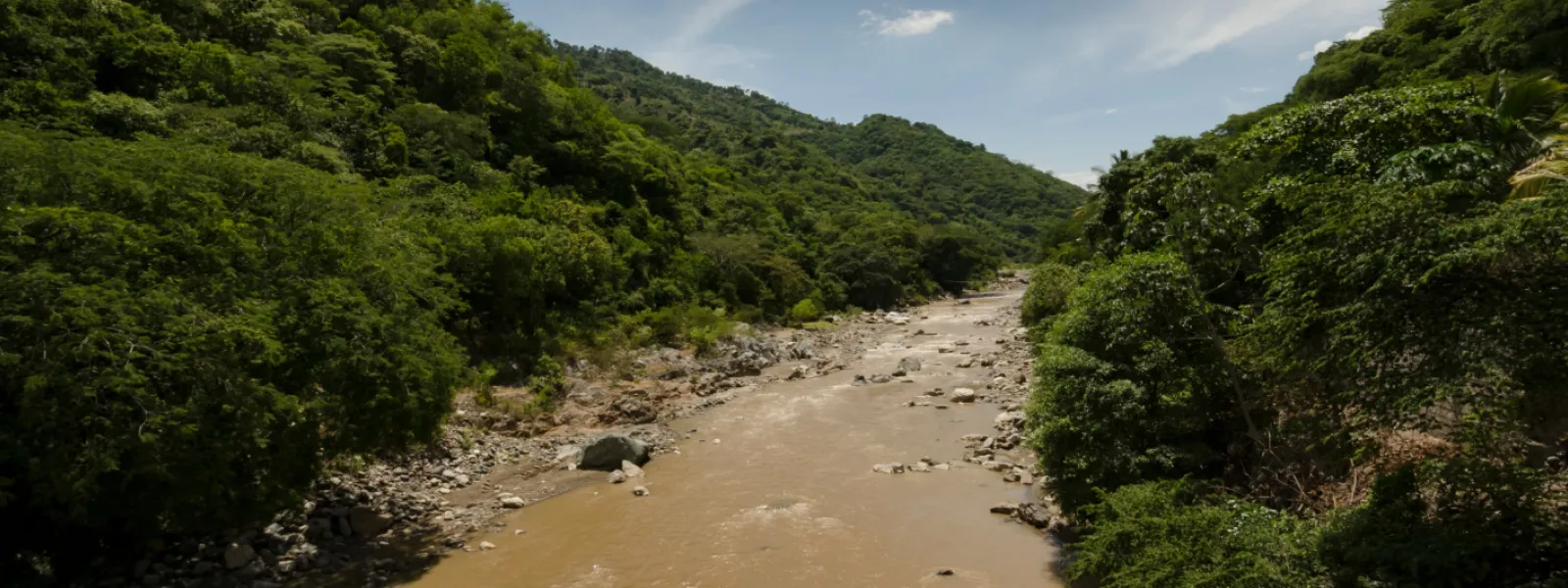
The Motagua River basin—Guatemala’s largest and most important river—is severely polluted with wastewater, solid waste, and other types of debris.
This is a cross-border issue because the Motagua’s polluted waters flow into the Caribbean Sea, reach the coast of Honduras, and threaten the Mesoamerican Reef System.
For decades, this has violated the rights to health, water, development, and a healthy environment of all the people living in the river basin.
In June 2025, the Poqomam Maya community of Santa Cruz Chinautla—supported by AIDA, the Indigenous Peoples’ Law Firm, and allied organizations—achieved an unprecedented legal victory to halt degradation in the basin. In response to the lawsuit it filed, a Guatemalan court ordered the municipality of Chinautla to comply with a series of obligations to curb the pollution of the area’s rivers and soil.
The government's response to the ruling has so far been limited to technical working group meetings. Meanwhile, the community continues to work toward the proper implementation of the ruling and to take other actions to defend its territory and its rights.
Background
The Motagua River, which is 486 km long, flows through 96 municipalities and 14 departments in Guatemala. It originates in Quiché, a department located in the northwest, and empties into the Caribbean Sea.
Polluting activities occur throughout the entire basin, including sub-basins and micro-basins. The largest volume of pollution comes from Guatemala City, the country’s capital, and is carried by the waters of the Las Vacas River, which in turn receives a large amount of waste from the Chinautla River.
The Chinautla River, which flows through the municipality of the same name, carries solid waste from a landfill located in Zone 3 of the capital—where trash from at least 14 municipalities in the department of Guatemala is dumped—as well as sewage generated by some 500,000 people living in the northern part of the capital, which undergoes no prior treatment.
Other sources of pollution include the numerous illegal dumps in the municipality of Chinautla, the waste that private vehicles and garbage trucks dump along the banks of its rivers, as well as the sand-mining companies—which began setting up operations in the area between 1996 and 1997—whose activities weaken the rivers' basins, causing solid waste to be more easily carried away by the river currents.
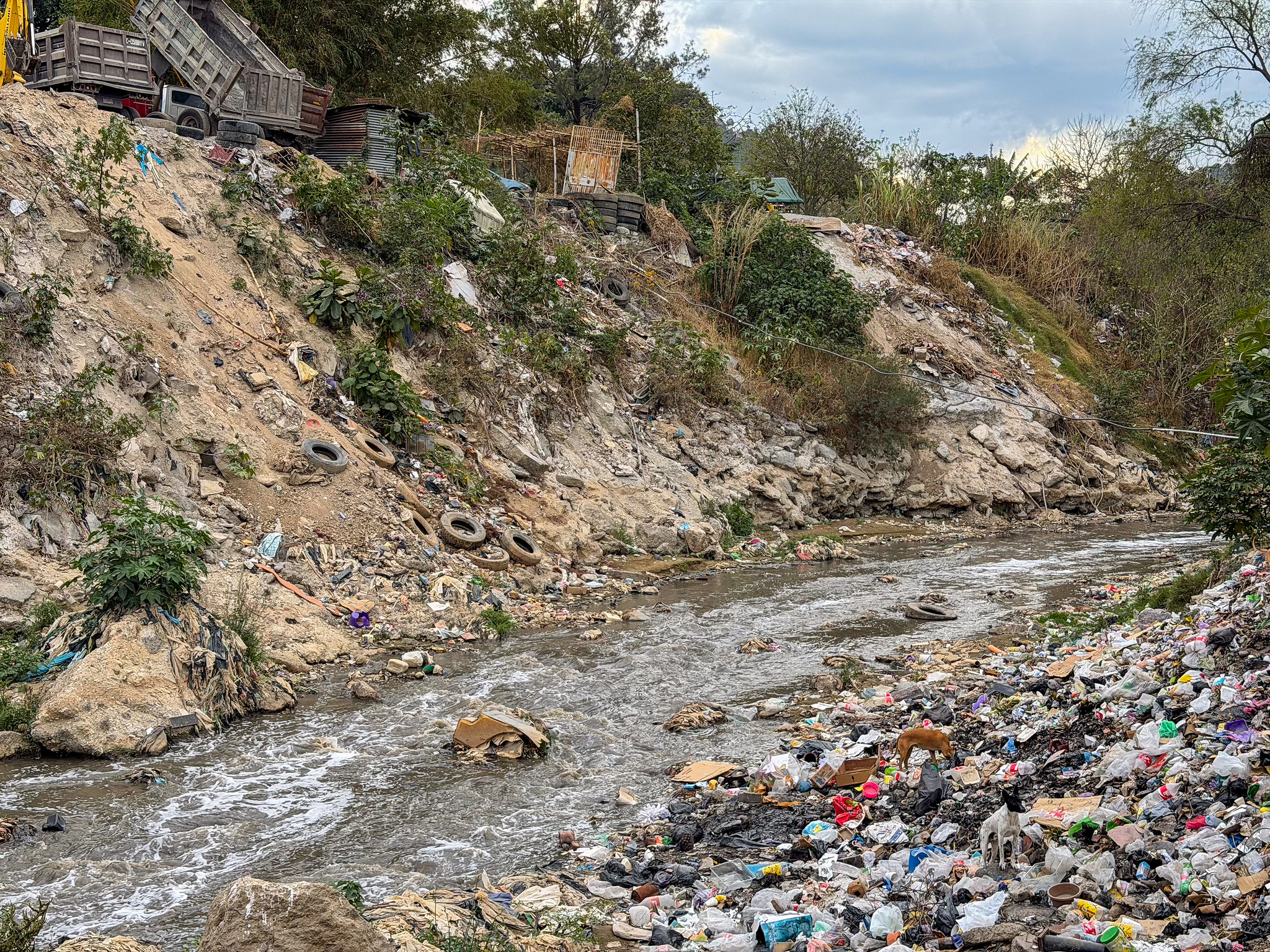
Photo: Mayela Sánchez García.
The situation extends beyond national borders. Every year, the Motagua River discharges some 20,000 metric tons of plastic into the Caribbean Sea, making it one of the rivers that contributes the most plastic pollution to the ocean worldwide, according to estimates contained in a 2025 report by the Inter-American Commission on Human Rights (IACHR).
The river flows into the Mesoamerican Reef at its mouth, so pollution also threatens to degrade one of the largest and most biodiverse transboundary reefs on the planet, which spans the territorial waters of Belize, Guatemala, Honduras, and Mexico.
In addition, the contaminated water reaches the coast of Honduras and spreads into Amatique Bay, located along the eastern coast of Guatemala, affecting the Caribbean Sea.
The roots of this chronic, cross-border problem are structural. Data from the Integrated Environmental Management of the Motagua River Basin project, funded by the United Nations Development Program (UNDP), show that in Guatemala, 66% of municipal solid waste is not collected, and there is no guarantee that the remaining 34% is disposed of properly. Furthermore, of all landfills nationwide, 88.32% are illegal or lack municipal authorization.
In other words, the core issues that need to be addressed are the mismanagement of solid waste and water resources in Guatemala; noncompliance with existing regulations on wastewater discharge and the disposal and treatment of solid waste and residues; and the lack of a water law.
The Poqomam Maya people's quest for justice
The rivers of Santa Cruz Chinautla, a community of the Poqomam Maya people located just twelve kilometers from Guatemala City, have become conduits of pollution that are degrading the Motagua River.
For decades, the local population has seen its health and livelihoods—including pottery, one of the main economic activities and a source of identity—damaged due to the lack of waste management in the municipality of Chinautla and the urban area of the country’s capital, as well as the activities of sand-mining companies.
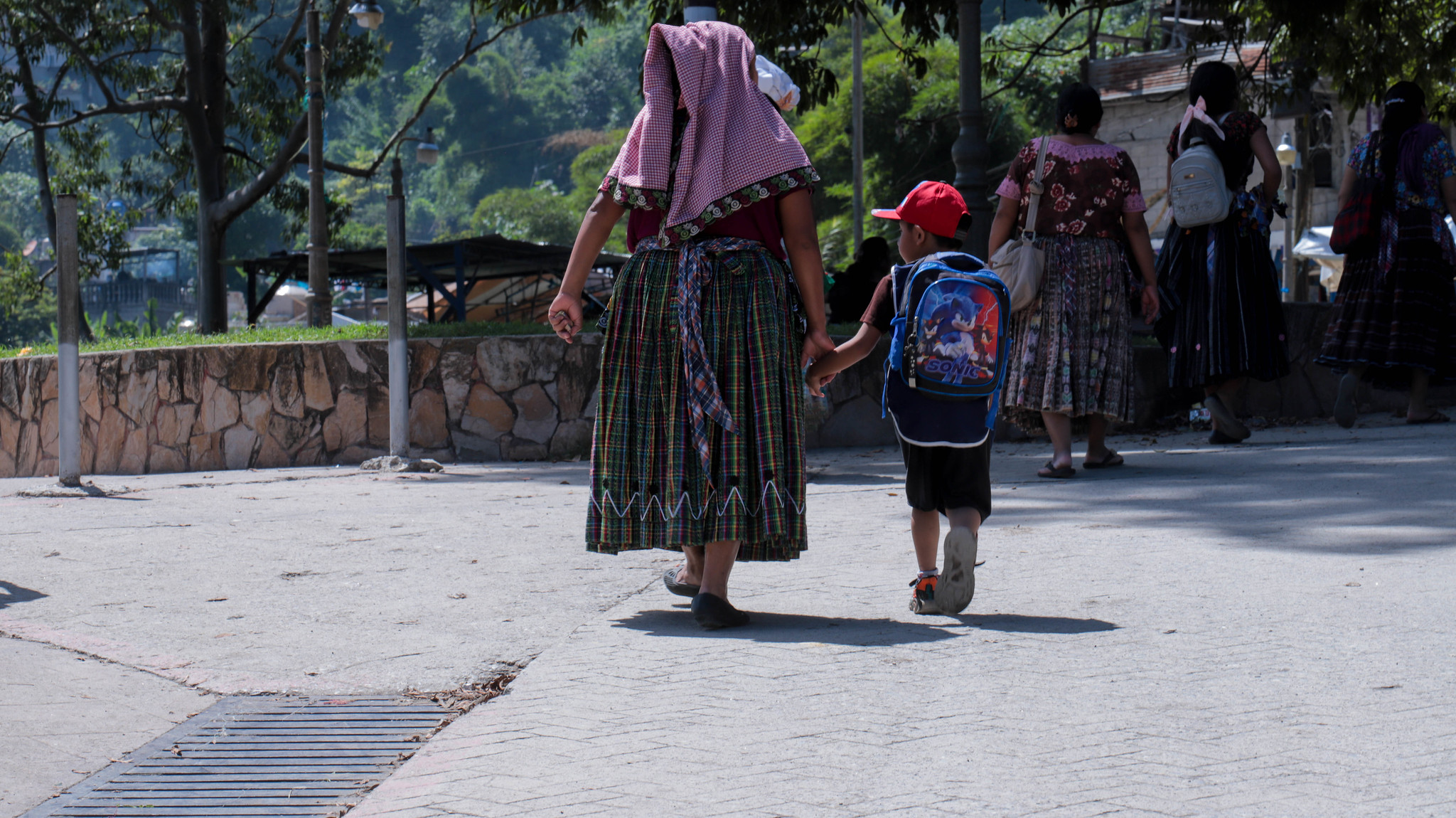
Photo: Mario Winter.
Voices for the Motagua River: Olga Vázquez.
Voices for the Motagua River: Nazario Pascual.
In early 2000, the Maya community organized to stop sand mining on their territory. At that time, the companies held mining permits that remained valid through 2021 and 2022. And although the permits expired, some companies continued to operate after requesting extensions. In June 2022, the indigenous authorities of the Poqomam people began a sit-in protest in front of the Piedrinera San Luis company, which they maintained for four years.
In July 2024, the Special Rapporteur on Economic, Social, Cultural, and Environmental Rights of the IACHR visited Santa Cruz Chinautla. During his visit, traditional authorities and community members spoke about the environmental, water-related, health, economic, and cultural impacts of the pollution in their rivers.
That same year, in October, the community—with support from AIDA, the Indigenous Peoples’ Law Firm, and partner organizations—filed a lawsuit (petition for amparo) against the municipality of Chinautla over its failure to take measures to address the contamination of its rivers and soil caused by improper solid waste management and the existence of illegal landfills.
AIDA’s scientific team, together with local residents and community authorities, collected key information on illegal landfills in the area. This community science initiative supported the litigation by highlighting the severity of the pollution, demonstrating the ongoing use of such practices, and providing evidence of the municipal authorities’ failure to fulfill their legal obligations regarding waste management.
Learn more about this community science initiative.
In June 2025, the Poqomam community won the support of the Guatemalan justice system when a constitutional court ordered the municipality of Chinautla to effectively address the claims in the lawsuit aimed at stopping the pollution of the rivers and soil in Santa Cruz Chinautla.
This is the first time a Guatemalan court has recognized a community's right to a healthy environment and its central role in finding solutions.
Find out the details of the legal victory.
Current situation
Since the ruling was issued, the municipality of Chinautla has held a series of “technical working groups” with representatives from the central government, civil society, and the community. A smaller group of technical experts was later created to develop a work plan with clear goals. Several months have passed without the municipality convening these working groups.
Furthermore, in December 2025, the IACHR noted in its report Human Rights Situation in Guatemala that the Motagua River basin is facing a severe pollution crisis that has had profound impacts on biodiversity and has resulted in systematic violations of the human rights of local communities, including the Maya Poqomam people.
And in May 2026, the Ministry of the Environment and Natural Resources revoked the license of the sand mining company Piedrinera San Luis for "failure to comply with environmental commitments."
AIDA continues to monitor the implementation of the court ruling to ensure the right to a healthy environment for the Poqomam Maya community and all those living in the Motagua River basin. Meanwhile, the residents of Santa Cruz Chinautla remain organized and mobilized to improve their environment and defend their rights.
Related projects
AIDA and CEMDA joint report on the UPR of Mexico
In accordance with the guidelines of the Human Rights Council, the Mexican Environmental Law Center (CEMDA) and the Interamerican Association for Environmental Defense (AIDA) present comments on the extent of Mexico’s compliance with the recommendations the country accepted as part of the 2009 Universal Periodic Review (UPR). We also present comments on other human rights violations related to environmental issues, which we believe should be taken into consideration during the next Universal Periodic Review set to take place later this year.
Read moreGroups seek investigation into Mexico’s approval of four “mega resorts”
FOR IMMEDIATE RELEASE April 11, 2013 Media contacts: Mexico Sandra Moguel, [email protected], +52 (164) 621-02353 USA Sarah Burt, [email protected], +1 (415) 217-2055 Serena Ingre, [email protected], +1 (415) 875-6155 Groups seek investigation into Mexico’s approval of four “mega resorts” Massive tourism developments threaten fragile ecosystems and endangered species San Francisco, USA/La Paz, Mexico. In a petition submitted to the Commission for Environmental Cooperation, eleven conservation groups charged the Mexican government with failing to enforce its own environmental laws in authorizing the construction of four “mega resorts” in the Gulf of California. The Commission is an international body established under the North American Free Trade Agreement to promote cooperation among Canada, Mexico and the U.S. on environmental issues of continental concern. “The Mexican authorities’ approval of massive tourism projects in violation of environmental laws is unacceptable and demonstrates little regard for threatened species, the environment and local communities”, said Sandra Moguel of the Inter-American Association for Environmental Defense, and one of the signers of the petition. “We urge the new Administration and Minister Guerra Abud to ensure that the approval process of development projects is transparent and not arbitrary”. The approval of projects such as Cabo Cortés, Paraíso del Mar, Entre Mares, and Playa Espíritu threatens the unique coral reefs and mangrove ecosystems of the region, and endangered species such as humpback and gray whales, whale sharks, manta rays, sea turtles, sea lions, jaguars, crocodiles and many species of migratory birds. The petition highlights the four projects as examples of the Mexican Ministry of Environment and Natural Resources’ repeated failure to enforce environmental laws when approving large-scale tourist development projects in the Gulf of California. In particular, the government ignores laws requiring effective environmental impact assessment, protection of endangered species, and conservation of coastal ecosystems. The petitioners are requesting that the Commission investigate and develop a factual record to examine Mexico’s lack of enforcement of its environmental laws when authorizing these developments. Such a finding would pressure Mexico to comply with its own environmental safeguards. “These natural treasures are of importance to Mexican communities that depend on them as cultural, economic and recreational resources”, says Judith Castro with the Friends for the Conservation of Cabo Pulmo. “Mexico cannot continue to approve mega projects that displace residents, bulldoze wildlife habitat, and pollute the waters of this vital ecosystem”. Known as the “World’s Aquarium”, the Gulf of California is considered one of the most diverse marine regions on the planet, and is home to thousands of species. Specifically, these mega projects, two of which are already under construction, threatened the following critical areas in the region: Cabo Pulmo National Park: One of the healthiest coral reef systems in the world, a UNESCO World Heritage Site and a Ramsar Wetland of International Importance, Cabo Pulmo is threatened by massive developments like Cabo Cortés. The Cabo Cortés proposal included the equivalent of nearly 30,000 guest rooms in its hotels, condominiums and villas, two 27-hole golf courses, a 490 berth marina, and a system of canals and artificial lakes. Additionally, because the region has a desert climate without sufficient water to accommodate such amenities and the expected population growth, the proposal included a desalination plant that could have discharged hypersaline brine into the reef. While the project was ultimately rejected in June 2012, Cabo Pulmo is threatened by similar developments still being considered. The Marismas Nacionales Wetlands: Playa Espíritu, a project already under construction that includes three golf courses, two marinas, a wastewater plant, and additional infrastructure spread across more than 35,000 acres, threatens the Marismas Nacionales, the most extensive and well-preserved mangrove forest habitat on the western coast of Mexico, and home to more than 280 species of migratory and resident bird species. The Bay of La Paz: One of the most productive water bodies in the Gulf of California and an important area for nesting birds, the Bay of La Paz is jeopardized by two adjacent projects, Paraíso del Mar, currently under construction, and Entre Mares, proposed for construction on a sandbar extending into the bay. Combined, these two projects will develop nearly ten thousand hotel rooms, plus 4,000 homes, two golf courses and a large marina and would bring an additional population of more than 10,000 people in high season. Earthjustice and the Interamerican Association for Environmental Defense (AIDA) are filing the petition on behalf of the Ecological Network for Escuinapa Development (REDES), Friends for the Conservation of Cabo Pulmo (ACCP), WiLDCOAST, SUMAR, Los Cabos Coastkeepers, Alliance for the Sustainability of the Mexican Coastal Northwest (ALCOSTA), the Natural Resources Defense Council (NRDC), Greenpeace México and AIDA. The petitioners are calling on Mexico to protect the marine and coastal ecosystems of the Gulf of California, particularly coral reefs like the ones in Cabo Pulmo. “By approving these projects, Mexico is failing its obligations to protect wetlands, coral reefs and species of environmental and international importance”, said Carolina Herrera, Latin America Advocate with the Natural Resources Defense Council. “What this region in the Gulf of California needs is low-impact sustainable development where the well-being of local communities and the environment is the first priority”. A map of the projects, photos, videos, and background information are available at: http://earthjustice.org/cortes Read the petition here: http://earthjustice.org/documents/legal-document/pdf/petition-to-commission-english
Read more
What’s the latest on the reform of the Inter-American System of Human Rights?
By Astrid Puentes Riaño, co-director, AIDA,@astridpuentes In June, I wrote about how some OAS member states had begun a process to introduce tough reforms on the Inter-American Commission on Human Rights (IACHR) and the Inter-American Human Rights System that would weaken their ability to operate and protect our human rights. I want to bring you up to date on how the discussions are faring. More importantly, though, I want to ask you to get involved by signing thepetitionto ask the member states to strengthen –not weaken– the Inter-American System. More than 3,000 people have already signed! You can sign too! Watch our video message to the Permanent Council of the OAS (Spanish only) The outlook last June was pretty thorny. Seldom has an OAS General Assembly been as tense as the last two, particularly the most recent one when the Inter-American System came under fierce attack and several member states even sought to re-establish it. The Assembly ended with a call to reform the statute at an Extraordinary Assembly, something that’s never happened in the history of the IACHR. The good news is that the member states appear to have somewhat cooled their clamoring. There are more signs of a willingness to talk. The Representative of Brazil made reference to this change during the Permanent Council’s extraordinary session with civil society representatives, saying the confidence and opportunities for negotiations have improved. He said this process should lead to an outcome in which the underlying question of human rights takes precedence over procedural matters. Watch our video message to the Permanent Council of the OAS (Spanish only) It’s an honor that the representative quoted us. Now we have to see if this good message gets translated into action by, for example, addressing the IACHR’s requests on Brazil including those regarding the contentious Belo Monte dam. The Brazilian government must respond and give its perspective on the case. The not so good news is that the process is not yet complete. We’re still waiting for a definition on what the reforms will be and how they will be implemented. For example, part of the reform package proposed by some states is that if the Inter-American Court rejects a request for precautionary measures then the IACHR has to do so too. That, as we have said, fails to recognize the natural differences of the Court and the IACHR and puts them at risk. The IACHR has committed to producing various reports, which will eat up a lot of its resources and thus could affect its duty to protect, its duty to proceed with cases of human rights violations affecting millions of people in the hemisphere. It is understood that neither the Inter-American System nor any of those involved are perfect. There is still a lot to improve. But it is essential that this process concludes with recommendations to make the System more effective. That means that AIDA and our colleagues in the hemisphere will continue to lobby the member states, the OAS and the IACHR itself. We will continue to offer our opinions. We will continue to share our experiences as users of the System. We will continue to fight to prevent any weakening of the System. That is why we ask you to sign TODAY and help us defend the IASHR and, in the process, our human rights. If you as an inpidual or community member believe that you could use one of the IACHR’s decisions in cases involving dams, mining projects, tourism developments, free speech, the protection of women or anything else, then speak out and sign up now! If not you, if not us, then who? Full video of the session In this recording you can hear the Representative of Brazil cite AIDA (last 5 minutes)
Read more