
Project
Alberto Peña Kay
Protecting the Santurban páramo from mining's damage
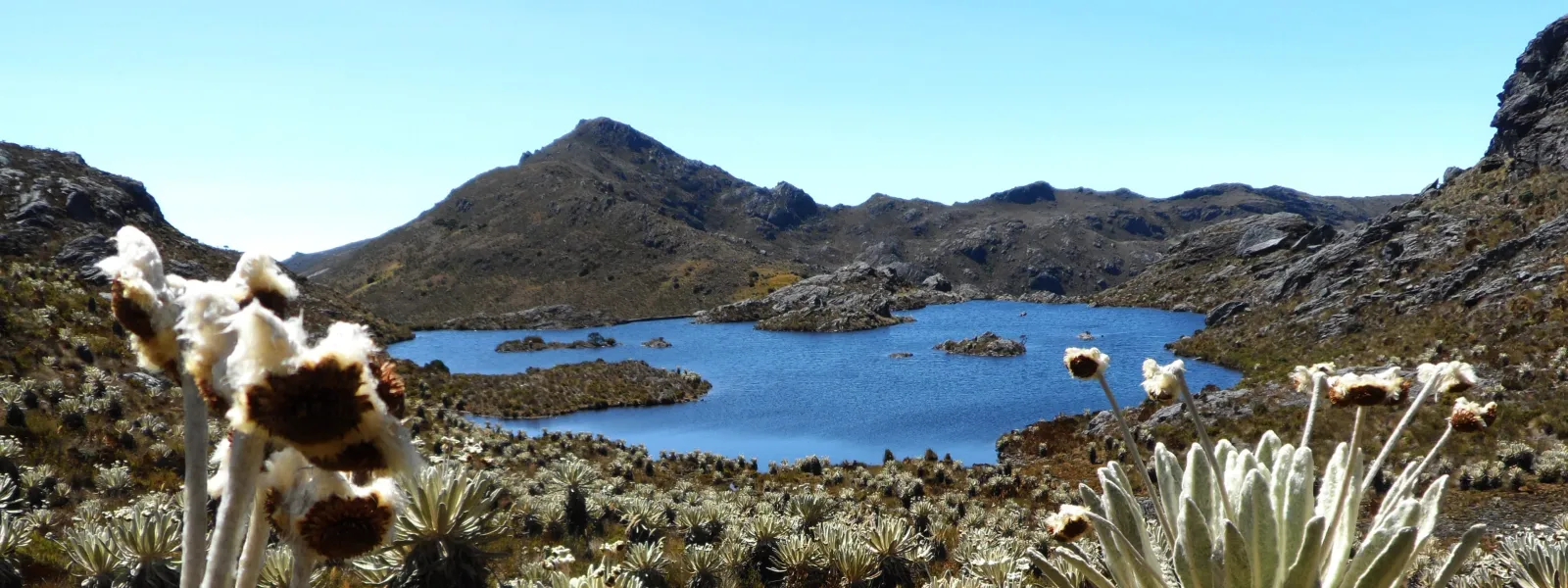
In the Andean region, high-mountain ecosystems known as páramos capture water from the fog and supply it to the lowlands. One such ecosystem is the Santurbán páramo, which provides fresh water to more than two million people in Colombia.
Santurbán, like the other páramos on the continent, also captures large amounts of carbon, making it a key ally in mitigating the climate crisis. It is also a refuge for hundreds of endangered species, including the iconic spectacled bear.
The land in and around the páramo contains gold and other minerals. This has put Santurbán in the spotlight of the multinational mining industry, which for decades has sought to establish large-scale projects in the ecosystem that threaten to degrade it.
The Committee for the Defense of Water and the Santurbán Páramo—a coalition of environmental advocates—has thwarted these ongoing attempts, with support from AIDA and other civil society organizations.
Background
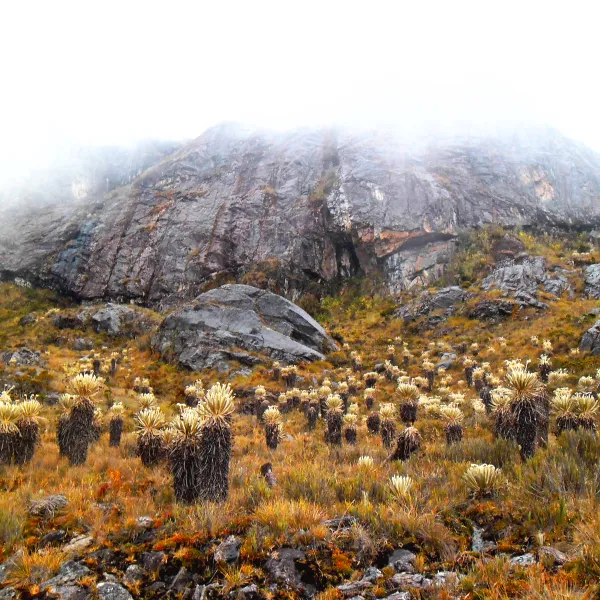
The Santurbán páramo is located in the heart of the Eastern Cordillera of the Colombian Andes, in the departments of Santander and Norte de Santander, at an elevation ranging from 2,200 to 4,290 meters above sea level.
It covers an area of 129,743 hectares and is home to 57 lakes. It serves as a habitat for 457 plant species and 293 species of vertebrate fauna.
There are mineral deposits in Santurbán, primarily gold, but also silver and copper. This explains the region’s mining tradition, particularly in the part of the páramo located in Santander, in the province of Soto Norte. The communities in the area have built their culture and identity around gold mining, which is mainly artisanal and small-scale.
But since the 1990s, the gold deposits in the páramo have also attracted foreign mining conglomerates seeking to develop large-scale projects. This has raised concerns among the population that relies on the Santurbán water sources, who have mobilized in defense of water, their land, and life.
Although national and international regulations prohibit mining in páramos, the Colombian government has granted mining concessions to transnational corporations in Santurbán.

Photo: Keishpixl / Pixabay.
The long struggle to protect the páramo
One of the companies that sought to develop large-scale mining in Santurbán is Eco Oro Minerals Corp.—formerly Greystar Resources—a Canadian company that intended to establish the Angostura open-pit mine there to extract gold and silver. Between 1994 and 1995, the company acquired its mining titles and conducted exploration. And in 2010, it applied for a mining permit.
That was the year AIDA became involved in defending the ecosystem, supporting the Committee for the Defense of Water and the Santurbán Páramo. Our legal work helped convince the Colombian government to deny the mine an environmental permit in May 2011.
In January 2013, the government designated a portion of the páramo (11,700 hectares) as a Regional Natural Park. That year—together with the committee and partner organizations—we carried out a campaign and advocacy efforts to urge the government to recognize the entire Santurbán area as a páramo ecosystem through a delimitation based on scientific criteria. In December 2014, the Ministry of the Environment established a delimitation that protected 76% of the páramo (98,954 hectares).
Furthermore, as a result of a litigation supported by AIDA, in February 2016, Colombia’s highest court reaffirmed that mining in páramos is prohibited.
That same year, in December, the International Finance Corporation (IFC), the World Bank Group’s private sector arm, decided to divest from Eco Oro Minerals. This achievement was the result of a process that began in 2012, when the committee—advised and supported by AIDA and international partner organizations—filed a complaint before an independent accountability mechanism, which concluded that the IFC’s investment in the Angostura project failed to take into account the project’s social and environmental impacts, thereby contradicting the financial institution’s internal policies.
Also in 2016, Eco Oro Minerals filed an arbitration claim against the Colombian government with the International Centre for Settlement of Investment Disputes (ICSID), arguing that it had been adversely affected by government decisions aimed at protecting the country’s páramos, including the delimitation of Santurbán.
In 2017, the Constitutional Court invalidated the delimitation because the affected communities were not consulted. The high court ordered that a participatory delimitation be carried out.
And that year, a new threat to Santurbán emerged when the Canadian multinational Aris Mining applied for an environmental permit for Soto Norte, a gold mining project located near the páramo. Following citizen protests and technical objections, in October 2020, the National Environmental Licensing Authority shelved the project.

Photo: Aztlec.
Current situation
In March 2025, the Colombian government designated the western flank of the Santurbán massif as a temporary renewable natural resource reserve area, delimiting and protecting an area of 75,344.65 hectares. This resulted in a two-year suspension of the Soto Norte project. However, Aris Mining's contract to formalize Calimineros' small-scale mining activities through the purchase and processing of mineralized material remains in effect.
In addition, the Canadian mining company continues to move the project forward. In September 2025, it released its prefeasibility study, revising the mine’s original design.
Meanwhile, members of the Committee for the Defense of Water and the Santurbán Páramo face threats and stigmatization because of their work. In March 2025, UN Special Rapporteurs and the Working Group on Business and Human Rights denounced these incidents in communications sent to the governments of Colombia, Canada, and the United Arab Emirates, as well as to the companies Aris Mining and MDC Industry Holding Company LLC, the former co-owner of the Soto Norte project.
Regarding the arbitration claim filed by Eco Oro Minerals, in July 2024, ICSID ruled in favor of the Colombian government and rejected the Canadian company’s claim for USD 1.1 billion in compensation.
Concerning the delimitation of Santurbán, in July 2026, the Ministry of the Environment issued a resolution introducing the concept of "progressive delimitation." On that basis, the government proposes to progressively demarcate the páramo, covering 29,199 hectares across 19 municipalities—those where the participatory agreements required by the Constitutional Court in its 2017 ruling have already been finalized. It also proposes two measures on the creation and expansion of reserves to restrict mining in the ecosystem.
Learn more about the impacts of mining on the páramos of Latin America (in Spanish).
Partners:
Related projects

Climate finance: Questions and answers
The climate crisis knows no borders. It impacts people, ecosystems and species around the world. Addressing this global crisis requires profound and innovative transformations in all facets of human life: the production of energy, food and other goods; the design and construction of infrastructure; the use and management of terrestrial, marine and freshwater habitats; the transport of people and products; and more. These systemic changes demand financial resources and sound investments. This is why we hear time and again that addressing the climate crisis is costly and requires financing. Climate finance is a complicated topic, and so we offer you a glimpse of the basics. What do we mean by climate finance? The United Nations Framework Convention on Climate Change (UNFCCC) describes climate finance as the type of local, national or transnational finance used to support and implement climate change mitigation and adaptation actions with financial resources from public, private and alternative sources. These resources are defined as "new and additional" and cannot include those previously committed, for example, for official development assistance. To better understand this definition, we can point out that climate finance is captured and used to reduce greenhouse gas (GHG) emissions and enhance carbon sinks, or seeks to reduce vulnerability, as well as to maintain and increase the resilience of human and ecological systems to the negative effects of the climate crisis. Why is climate finance important? To echo UN Climate Change Executive Secretary Simon Stiell's message at the Sustainable Investment Forum, "We cannot achieve our climate goals without finance. Whether we are talking about transitioning to renewable energy, improving energy efficiency or protecting vulnerable communities from the effects of climate change, all of these efforts require significant investment." Climate finance impacts everything from national policies to changes occurring at the local level that make a concrete difference in people's lives. "Climate finance is ultimately about what we as societies value: the world we want to live in and the lives and hardships we can save by channeling our money into building resilience to the ravages of climate change," Stiell said in his speech. Financing by and for whom? The impacts of the climate crisis are inversely proportional to the weight of responsibility, in that the countries historically responsible for the highest levels of GHG emissions are often the least affected. This is why the UNFCCC advocates that developed countries, those with the most economic resources, should financially assist the least developed and most vulnerable countries. This is what the principle of "common but differentiated responsibilities and respective capabilities" established in the Convention is all about. On the other hand, the Paris Agreement—a legally binding international treaty in force since November 2016—reaffirms the obligation of developed countries in addition to promoting, for the first time, voluntary contributions from other States. It further provides that developed countries should continue to take the lead in mobilizing climate finance from a wide variety of sources, instruments and channels, taking into account the important role of public funds, as well as the needs and priorities of developing countries. It’s key to note that this mobilization of finance should represent a progression from previous efforts. What climate finance mechanisms exist? Under the UNFCCC, there are three main mechanisms for climate finance to reach nations, created for different purposes and with different scopes: Global Environment Facility (GEF): Grants financial resources to developing countries or countries with economies in transition to meet the objectives of international environmental conventions and agreements. It also manages the Special Climate Change Fund and the Least Developed Countries Fund. Adaptation Fund: Created as a financial instrument for adaptation and resilience in those countries that are part of the Kyoto Protocol. Green Climate Fund (GCF): Created with the objective of financing mitigation and adaptation programs and projects aimed at low-emission and climate-resilient development. It is the main multilateral climate finance entity worldwide. How much financing do we need? In the framework of the UN climate negotiations in 2009, developed countries committed to transfer $100 billion per year to developing countries by 2020 (target extended to 2025 in the Paris Agreement). But this amount has not been achieved. For example, in 2016 they only reached $58.5 billion and, although the amount increased significantly for 2019, they only reached $79.6 billion. In that sense, to meet the goal of net zero emissions by 2050, the Climate Policy Initiative organization estimates that global financing of $4.35 trillion is needed by 2030 (when the 2020 estimate was only $632 billion dollars). What are the main challenges of climate finance today? The main challenge, as we have seen, is the need for a substantial increase in the flow of finance. Another key challenge is to measure and track this type of finance, which is not subject to a common universal definition. Along the same lines, given that developed countries’ commitment to the UN does not include official guidelines on what activities count as climate finance, it’s difficult to ensure that money is not double-counted or that it goes to efforts that will actually help reduce global warming and its impacts. There is also the need to balance the allocation of funds more equitably between mitigation and adaptation activities, as well as those related to loss and damage already suffered by communities around the world. In 2020, 90 percent of global funding went to mitigation, while only 7 percent to adaptation projects and 3 percent to dual activities. On the other hand, it’s important that the financing channeled does not result in human or environmental impacts, as often happens when there are large investments in which adequate consultation and participation processes are not implemented. An energy project, however renewable and clean it may be, can accentuate inequalities and vulnerabilities if it is poorly planned or if it is designed without the participation of local communities. Finally, it should be considered that, although a lot of money is allocated to address the climate crisis, at the same time, businesses that promote dependence on fossil fuels, and that keep us in a predatory and unjust economic system that perpetuates extractivism as a mode of development, continue to increase around the world. This, of course, counteracts the progress we can make in favor of the environment and communities. What is clear is that a specific annual amount of climate finance is not enough; what we really need at this point is that all the money mobilized contributes to the regeneration of the planet and to resolving the environmental and climate crisis, not exacerbating it. At AIDA we monitor the climate finance coming to the region because we understand how important it is to increase the possibilities of building a future where we can live well and in harmony with the environment. We also understand that the problems often caused by poorly designed financing are due to a lack of connection between the territories that suffer the impacts of the climate crisis, and the decision-making spaces where projects are proposed to overcome them. In this sense, AIDA seeks to build a bridge between these two worlds, motivating organizations in the region to be active, to follow up on projects and to participate in decisions. Only in this way can we ensure that scarce climate funds not only exist, but also reach their full potential towards the paradigm shift we all need. Join the "Observatory of the Green Climate Fund for Latin America and the Caribbean", a joint effort to better monitor the world's largest climate fund.
Read more
The dilemmas of a just energy transition
Humanity has an urgent task ahead: to transform energy systems without continuing to fill the atmosphere with warming gasses and pollutants. This is a fact proven by science. Failure to do so means that our planet will no longer be a safe haven for the the many species that call it home. The problem is that the necessary transition is far from simple. In addition to the difficulty of cutting dependence on the fossil fuels that have dominated for centuries, it turns out that not just any transition will do. It’s not just a matter of stopping to burn these fuels, we must also consider other ways to leave behind the development model that has for centuries been separating humanity into winners and losers, while violating human rights. What is a JUST transition? There is currently no single concept of what it means for the energy transition to be just. At AIDA, we believe that to be just, the transition must be equitable and inclusive, recognizing that the impacts of climate change and the necessary transition are not evenly distributed. Thus, certain groups—such as those working in traditional energy sectors and/or marginalized communities—may be disproportionately affected. To get a glimpse of the problem, it’s worth understanding that humanity today is suffering from a myriad of crises that affect the lives and well being of people, especially those in the most vulnerable conditions. These crises include the climate emergency, pollution, biodiversity loss, global pandemics and democratic crises. And at the heart of it all is social inequality, that widening gap between rich and poor that generates disparities in all aspects of life, including access to health, education and economic opportunities. These crises are interconnected and mutually reinforcing. Responses to one can help solve others, but they can also aggravate them. For example, when transitioning to clean energy sources not only helps combat climate change, but also reduces air pollution and improves public health, we are solving two problems in one. An example in the opposite direction occurs when a rapid and unchecked transition to electric mobility results in the aggressive extraction of rare minerals such as lithium, which comes from fragile ecosystems on which local communities depend. Where do we start? To ensure a just transition, we must be guided by the principles of justice, equity and inclusion, and ensure that the most vulnerable populations are not disproportionately affected. As Naomi Klein said in her book This Changes Everything, to address the climate crisis we must understand that climate change is not only an environmental, but also a human rights issue. A just energy transition requires not only ending the burning of fossil fuels, but also addressing economic inequality, including a gender perspective, strengthening social safety nets, protecting workers' rights, respecting the rights of indigenous peoples, empowering communities to participate in decisions that affect their lives, and making reparations to those who have been affected by the current economic and energy model. What role can litigation play? Litigation is already moving in step with the dilemmas of the energy transition. We have seen an increase in lawsuits that appear to go against the energy transition, such as those challenging renewable energy generation projects, or pro-transition regulations, or otherwise hindering the transition. But can it be said that these are always "regressive" lawsuits? A lawsuit to challenge the environmental permitting of a wind generation venture might be blocking the transition, but it is not necessarily regressive. If it is a mega-project, for example, owned by a transnational company that will export all the energy generated without benefiting local communities, and if it intends to be located on indigenous lands without local participation, then it is a project aimed at an "unjust transition" that does not serve us because it reinforces the same model, the one that has us so badly on track. The report Litigation for a Just Transition in Latin America, published in January 2023 by the Sabin Center for Climate Change Law at Columbia University, and translated into Spanish by AIDA, refers to this type of case. The report questions the purpose of just transition litigation, asking whether it promotes or obstructs an energy and climate-resilient transition. In this regard, the authors conclude that just transition litigation cannot be fully characterized as regressive or non-regressive in relation to the transition. As such, they consider that just transition litigation should be seen and understood as a new category of climate litigation, with its own diverse rationale. The issue allows us to reflect on the complexity of the longed-for transition. Faced with this type of dilemma, in AIDA we generally choose to analyze each case, without marrying a dogmatic position. But a constant and, in this sense, valuable starting point is that everything that is carried out in favor of the energy transition—whether projects, policies or actions—must have a strong and decisive focus on the environment, human rights and gender. Without that there is no justice; and without justice there is no remedy or solution. So we believe that litigation does have a role to play, not only in making the transition happen, but also in making it just.
Read more
Offshore drilling: Resisting a growing threat in Latin America
Offshore drilling is expanding in Latin America and the Caribbean as part of a government and business strategy implying the continuity of the oil and gas industry, despite the role of fossil fuels in aggravating the global climate crisis. The advance of offshore hydrocarbon activity also risks serious damage to the ocean—our planet's greatest climate regulator—the vast biodiversity it harbors, and to the livelihoods of coastal communities. Worldwide, offshore areas represent 30 percent of total hydrocarbon reserves and are concentrated in surface waters up to 125 meters deep, according to academic research. The United States, Mexico, Norway, Brazil and Saudi Arabia are the main producers, accounting for 43 percent of the world total. The current expansion of drilling in Latin America is tending towards extremes with greater environmental complexity, in ultra-deep waters, with wells that exceed 1,500 meters in depth. The authorization of new offshore drilling projects deepens dependence on the use of fossil fuels, representing a step backwards in global efforts to avoid global warming with catastrophic consequences. It also constitutes an obstacle in the transition towards sustainable energy systems, based on renewable sources and respectful of people and the environment. However, there are cases in the region that demonstrate a growing collective resistance to the blind advance of offshore drilling projects. With the help of strategic litigation and citizen participation, these cases are creating an opportunity to set important precedents at national and international levels for the protection of the environment, the climate and human rights from the damages caused by offshore drilling. In defense of the Argentine Sea In May 2019, the Energy Secretariat awarded several companies a total of 18 areas (225,000 square kilometers of surface area) in the Argentine Sea—a sector of the Southwest Atlantic Ocean—for the search for gas and oil. In December 2021, the Ministry of Environment and Sustainable Development authorized a seismic exploration project in three of the awarded areas, located off the coast of the province of Buenos Aires, about 300 kilometers from the beaches of Mar del Plata, one of the country’s most popular beaches. The project includes the drilling of an exploratory well, and is being managed by the Norwegian state-owned company Equinor, the Argentine YPF and the Anglo-Dutch Shell. The governmental decision has been questioned and rejected by the scientific community and by the assemblies of several coastal cities. In January 2022–in view of the threats to biodiversity, climate and local economies posed by the prospecting and possible exploitation of hydrocarbons off the Argentine coast—scientific groups and environmental organizations filed a class action lawsuit before a Federal Court in Mar del Plata against the Argentine State, the Ministry of Environment and the Secretariat of Energy, requesting the nullity of the resolution authorizing the seismic exploration project and the process by which the 18 areas of the Argentine Sea were licensed off. The lawsuit was followed by protests in the streets and other actions, which have swelled into an ongoing legal battle. In February 2022, the court temporarily suspended seismic exploration through a precautionary measure. However, in December of that year, the Court of Appeals lifted that suspension. This decision was appealed before the Supreme Court of Justice, which has not yet ruled on the matter. Moratorium at risk in Belize In October 2017, the government of Belize established by law a permanent moratorium on oil activity in its maritime zone. This occurred after an informal referendum organized by environmental groups in 2012 resulted in 96 percent of participants voting against oil activity; and after the global outrage generated in October 2016 by the government's decision to allow seismic testing for oil exploration just one kilometer away from the Belize Barrier Reef, one of the most diverse ecosystems in the world. However, offshore hydrocarbon exploitation is still a risk for the Caribbean nation. In 2022, the Prime Minister expressed the government's willingness to allow seismic exploration without lifting the moratorium. In view of this, organizations dedicated to environmental protection seek to reinforce the prohibition by forcing a referendum on whether or not to lift the moratorium. Court victory in Guyana In Guyana, since the early 2000s there have been reports of discoveries of large offshore oil and gas reserves in the so-called Guyana Suriname Basin. Guyana is the South American nation with the most oil reserves discovered in the last decade, and has decided to expand its gas reserves as well. Offshore gas production in Guyana has also been the subject of controversy due to environmental and safety concerns. Recently, a court decision rejected an attempt by multinational ExxonMobil and the government to dissolve the written commitment that obliges the company to bear all cleanup, restoration, and damage compensation costs of any oil spill in its offshore operations. The judge in the case found that ExxonMobil is in violation of the permit issued to the Liza 1 project—which requires financial guarantees in case of oil spills and accidents—and that Guyana's environmental regulators are not enforcing the terms of the permit. Biodiversity and climate defense Carrying out offshore hydrocarbon exploration and/or exploitation projects may involve the violation of international commitments, including those undertaken by States under the Convention on Biological Diversity, the UN Convention on the Law of the Sea and the Convention on Migratory Species. Offshore seismic exploration generates sounds at levels far in excess of natural levels. Many of these overlap with the hearing and vocalization ranges of marine species (mammals, turtles, fish, diving birds and others). This can cause serious injuries, long-term physical and physiological effects and even death, explains Pablo García Borbroglu, expert and leader of the Global Penguin Society, while affirming that it can also lead to a reduction in fishing activity. The impacts of the drilling are not limited to the exploited area, but affect the entire sea and all the species that inhabit it, aggravating the precarious situation of a large number of already threatened or endangered species. The expansion of the offshore industry also implies nations are failing to comply with global commitments to reduce their greenhouse gas emissions, or adopt measures aimed at the management of key ecosystems such as marine areas, both contained in the UN Framework Convention on Climate Change and the Paris Agreement. The cases described above, which bring together diverse voices under a common cause, have the potential to establish precedents that will force States to take responsibility for the possible environmental and social consequences of endorsing harmful industries such as offshore hydrocarbons. They are key opportunities for courts and other decision-making bodies to set exemplary precedents for the hemisphere in the protection of the environment and human rights, especially in the face of the global climate and biodiversity crises.
Read more