
Project
Victory: Constitutional Court Defends Right to Prior Consultation
On January 23, 2008, the Colombian Constitutional Court declared the Forest Law of 2006 to be unconstitutional and therefore, invalid, because lawmakers did not consult with indigenous, afrodescendant, and tribal communities during development of the law as required.
This decision is an advance for these Colombian communities who view many economic development projects and policies as a threat to their traditional territory and cultural identity, as well as the environment. The ruling also establishes a valuable legal precedent that can be used to bolster indigenous and tribal communities’ rights in other legal cases throughout the Americas.
The Colombian government is required by law to consult with indigenous and tribal communities regarding administrative and legislative decisions that may affect them. It is obligated to do so because the Colombian Congress previously adopted into law “Convention 169,” a treaty of the International Labour Organization that protects this right and others.
In this case, the Court decided that indigenous and tribal communities should have been consulted because the Forest Law regulates forest issues in general terms, and contains provisions that “will likely affect areas generally used by the communities, which could impact their lifestyles and their close relationships with the forests.”
The court also declared that the requirement to consult with indigenous and traditional communities cannot be replaced with the general public participation process that the government carried out regarding the Forest bill. Rather, to comply with the law, the government should inform the communities about the proposed law, explain its implications and how it could affect them, and give them opportunities to effectively state their opinions regarding the bill.
As a result of this court ruling and civil society’s call to respect the right to prior and informed consultation, the Colombian government proposed a law to regulate and enforce this fundamental right. The Ministry of Agriculture also began developing a new forest law, this time using a process that complies with prior and informed consent procedures.
The lawsuit was brought by a group of students and professors from the University of Los Andes Law School in Bogota with the support of AIDA. Social organizations including the Proceso de Comunidades Negras, the National Indigenous Organization of Colombia (ONIC) and CENSAT Agua Viva also supported the group in presenting this case.
This group also filed a second lawsuit against the Forest Law alleging that the law violated Constitutional provisions protecting the environment. However, because of the January court decision, no decision will be made on this second suit.
Related projects
Voices for the Motagua River: Olga Vázquez, hands that shape hope
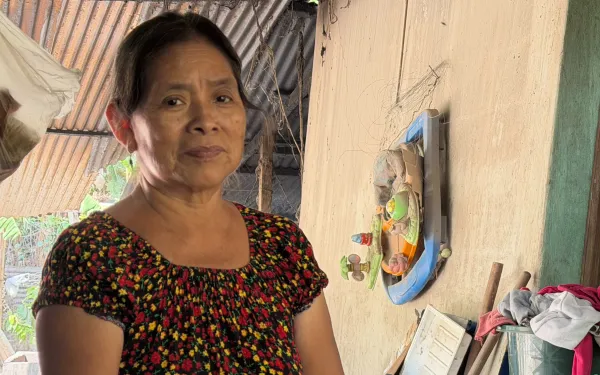
Stories of courage, dignity, and resistance for life in the face of pollution in Guatemala’s longest river.For generations, clay was the heart of Santa Cruz Chinautla. It emerged from the earth as a daily gift, was shaped by patient hands, and transformed into pots, jugs, whistles, and comales that were taken to the markets in the capital.There, between the river and the wood-fired kilns, doña Olga Noemí Vázquez grew up. From childhood, she learned the art of pottery from her mother. Today, at nearly sixty years old, she continues to work with clay, but the craft is no longer the same. Clay is scarce, the river smells like sewage, and her hands crack from the chemicals carried by the polluted water.Doña Olga fondly recalls how she first got into pottery. "I learned it when I was ten years old. My mom taught me. I wanted to make different shapes and styles, because sometimes tourists would bring different figurines, and here we’d try to imitate them," she says from the small workshop she’s set up in her home. Every piece she creates is an act of remembrance, a way to resist oblivion and the loss of the landscape and her livelihood.He also recalls that in the past, the town's inhabitants didn't go to the capital to work. "We made our living right here. We grew vegetables, güisquiles, and corn. Everything was produced right here. And we made a living from clay. Today, it’s not like that anymore." Photo: Mayela Sánchez García. From drainage to destruction The change was slow, like a tide that rises without you noticing. First came the drainage systems. Then, the trucks. The city’s trash found its final destination in Chinautla. "There was nowhere else to dump it, so they dumped it on us," she says. That’s how the tragedy began: the rivers turned into channels of waste, the banks became covered in gray crusts, and the odors became unbearable, especially during the rainy season. "The river carries all the trash from Zone 3. It smells awful. There’s no clean clay anymore; we can’t dig it up as we used to."The 1976 earthquake left a mark on the town’s memory, but it was systematic neglect that ultimately disfigured the landscape. The municipal government, she says, moved from Santa Cruz to Zone 6, and since then the town has been left without any real representation. "There’s no mayor here. They come here to put up their campaign posters, they hold office, but they’re never here. They’ve never taken us into account," she laments. Women who resist In the face of institutional silence, associations, collectives, and struggles emerged. Among them was the Chinautla Women’s Association. "We organized because if we didn’t, we would have been left with nothing. The clay was running out, the sand miners were advancing, and the river was washing everything away. The women here don’t go to the capital to work. They make pottery at home and take care of their children. If we ran out of clay, we’d have no life left."In 2010, disaster struck with full force. Two rivers, Las Vacas and Chinautla, overflowed due to the accumulation of sand that had been extracted without any controls. The water swept away a bridge. The community banded together and built another one with their own hands. The municipality did not cooperate. "That bridge is in ruins, but we, the neighbors, built it. Otherwise, we’d still be cut off."Sand mining has become their most persistent enemy. "The sand miners are wearing us down. They take out tons and tons of sand every day. Our clay is gone with them. We’re left with almost nothing. And what little remains is contaminated," he says. The damage isn’t limited to the landscape—people’s health is suffering as well. Photo: Mayela Sánchez García. The value of words and justice The expansion of businesses, the passivity of the authorities, and social erosion have caused divisions within the town. "Politics has planted ideas in people’s minds. There are thousands of residents, but only 500 support us. The rest don’t cooperate. They don’t understand that this isn’t about a political party—it’s about our town," she explains.In recent years, the women’s association has joined forces with the town’s ancestral authorities. Together, they have succeeded in opening channels of dialogue with government ministries, halting the renewal of extractive licenses, and bringing the conflict to the government's attention. The 2025 ruling, handed down after years of legal battles, was a ray of hope amid the neglect. A court ordered the municipality to assume its environmental responsibility. For the first time, someone listened. "Thanks to that ruling, a businessman was stopped. His license hasn’t been renewed. It wasn’t like that before: you’d go to talk to them, and the ministers only thought about making a profit. Now, at least, they listen to us."The future is uncertain. Drinking water is delivered only once every eight days. Mining permits can be renewed at any time. The river continues to carry trash. But there’s one thing doña Olga is not willing to lose: her dignity. "I advise women to get involved, to stay informed. We can’t just stay at home without knowing what politicians, businesspeople, and ministers are doing. If you get involved, you’ll find out. And once you know, you’ll fight."When asked what Chinautla was like 50 years ago, her eyes fill with lost images: girls playing in the street, clean water flowing over stones, women shaping clay at sunset. "It was peaceful," she says. “It was ours.” Today, amid pollution and plundering, Chinautla endures thanks to women like her, who continue to shape its history with clay, memory, and courage.
Read more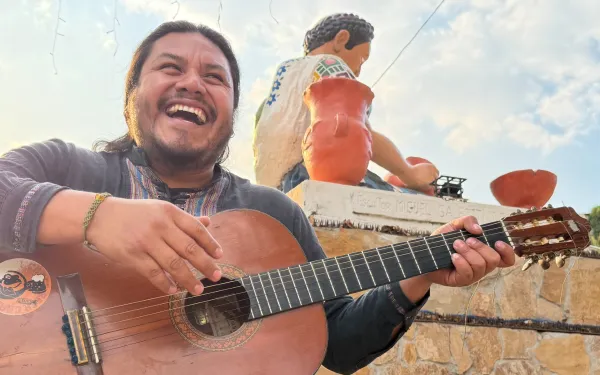
Voices for the Motagua River: Nazario Pascual, an artery of the Poqomam people
Stories of courage, dignity, and resistance for life in the face of pollution in Guatemala’s longest river.Nazario Pascual needs no embellishments to define himself: "I am a Poqomam warrior who uses music and sung poetry to plant a little seed in people’s minds. I am an artery of the Poqomam people."A musician, cultural promoter, and independent producer, Nazario lives in Santa Cruz Chinautla, a community affected by pollution in the Motagua River. From there, he sings in Poqomam so that his language will not disappear, and so that the children who listen to him will grow up knowing that the river, too, has a memory.His journey began in the church pews, watching his father play. But it was an intimate moment that ignited the spark: one night, he heard his dad praying in Poqomam. "I thought, ‘Wow, God hears us in Poqomam. It’s your heritage.’ That’s where I started." The landscape that took away his childhood When Nazario talks about his childhood, he describes fruit trees, springs, and a communal washhouse where mothers washed clothes while the children played. Today, all of that is gone.The uncontrolled expansion of the capital and the diversion of stormwater to the Zone 3 landfill have turned the river into an open wound. Added to this are the sand pits that extract material without any oversight: "They’ve eaten away at a large part of the Poqomam territory. Here we call it ‘black gold.'"His family has lost their land dozens of times. When it rains in the city, the smells reach Chinautla even if not a single drop falls there. Houses are sinking, the ground is cracking, and residents are being displaced."The river is a monster coming from the city," he says. Photo: Mayela Sánchez García. A legacy of struggle, but also of weariness Nazario inherited his father’s conviction to protest. He took part in demonstrations, organized meetings, and, together with others, built a retaining wall under the red bridge with community support. But he also bears the weight of so many years: "At first there were 17 of us at the protests, then 12, then 7, and now barely 4."An aunt told him straight out: "Don’t try to be a folk hero." The remark made him reflect on the limits of commitment… and on the need for new forms of resistance. Seeds that sing Nazario found that new path in music. He formed a band with his cousins and later began working with children. Together, they write lyrics about the river, compose melodies, and sing in Poqomam. That’s how "Mamut" was born—one of the songs sung in the community today."Getting children and young people involved is the small contribution I’m trying to make,” he explains. “They’re the ones who will remain here." Photo: Mayela Sánchez García. A message that endures Nazario knows the problem is bigger than he is. The Motagua River carries trash that ends up in the Caribbean, affecting entire communities. But he also believes that local struggles have power."It’s understandable to go to work—because we have to—but we shouldn’t be indifferent to what’s happening in the town."He fears that the real plan of the polluting and extractive industries is to wipe the Poqomam people off the map. But he dreams of a different story:"I imagine Chinautla with the river stabilized, children growing up in a dignified environment, knowing their rights and fighting for them." The pulse of a community His voice is a blend of pain and hope. He speaks of losses—of his father, of the land, of the river—but also of music, of living languages, and of children singing along to his songs."I am an artery of the Poqomam people," he repeats.And like any artery, he beats to keep his community alive.
Read more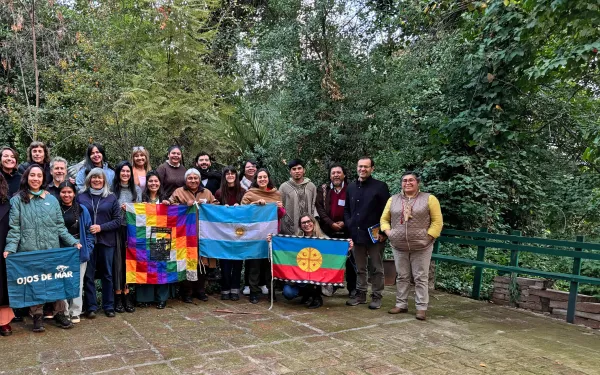
5 keys to collective action: Lessons from the meeting of environmental defenders from the Southern Cone
Can an energy transition be just if it repeats the harms of traditional extractivism?That was one of the central questions of “Articulando Territorios: Meeting of Defenders from the Southern Cone”, an event held on June 9 and 10 in Santiago, Chile, that brought together environmental defenders from Argentina, Bolivia, and Chile.For years, AIDA has stood alongside those defending their territories against extractive and energy projects in Latin America. This meeting was part of that commitment: a space to share experiences, strengthen protection capacities, and collectively reflect on the impacts of the pressures of the global energy transition, including the rise of extractivism.Here are the five key lessons we took away: 1. Communities are at the heart of the resistance for a just and sustainable energy transitionMany of the activities promoted under the global paradigm of the energy transition—such as lithium, copper, and other “strategic” metal mining, as well as port megaprojects—aimed at decarbonizing the energy mix continue to reproduce the historical dynamics of intensive resource extraction. The experiences and lessons shared in regions such as San Antonio in Chile, Salinas Grandes and Vaca Muerta in Argentina, and the salt flats of Bolivia point the way toward environmental justice. Against this new backdrop—and amid a wave of extractive expansion—local communities are shifting from being areas affected by these projects to becoming strategic allies in the resistance movements of the Southern Cone. 2. Defending the territory is a project that encompasses all aspects of life and shapes one's identityBeing an environmental defender is not a temporary job or activity, but a true life’s work. From this perspective, territorial defense goes beyond the protection of a physical or economic space. It involves cultural identity, collective memory, spirituality, and the intrinsic “body-territory” relationship. This framework explains why the impacts on ecosystems cannot be measured solely in economic terms: they directly damage the social fabric through community fragmentation, the forced migration of young people, and the painful loss of ancestral practices. 3. Protection must be comprehensive, collective, and proactiveThe protection of those who defend the territory cannot depend on individual reactions or improvised measures when the risk is imminent. Protecting ourselves means identifying threats and strengths, and increasing our capacity to respond to risks. Building support networks, ensuring protection protocols are in place, and prioritizing collective care are the foundation for establishing robust processes for territorial and environmental defense. 4. Communication is about challenging narratives without revictimizingCommunication is a fundamental tool for political protection and strategic advocacy to counteract power imbalances. Communities must position themselves as primary sources of territorial knowledge and as the authors of their own narratives. Effective communication means bringing their knowledge, their proposals, and their capacity for organized resistance to the forefront, without reducing them to suffering or revictimizing them. 5. Recognize the right to defend the environment and use international tools as a means of protectionRecognizing that defending the environment is a holistic life project means recognizing and legitimizing the right to defend it. Territory and environmental defenders safeguard common goods that benefit society as a whole. It is necessary to explicitly recognize the legitimacy and dignity of this work by eliminating stigmas and criminalization, and by ensuring safe spaces for the exercise of this right.In this context, the tools of international law are part of the range of protective measures, including:Strategic litigation. The success and transformative value of strategic environmental litigation go far beyond simply obtaining a favorable court ruling. Its true potential lies in bringing silenced conflicts to light, generating independent technical evidence, and opening up political spaces—all of which occur when it is well coordinated with community-based organizational processes.Escazú Agreement. The Escazú Agreement is a fundamental regional framework thanks to the three procedural rights—access to information, participation, and justice in environmental matters—that it guarantees and upon which it is built. It is key to the active protection of environmental human rights defenders. This framework must be transformed into a tool for defense in the hands of communities, particularly through well-founded legal action and the activation of the mechanisms provided for in the agreement. The recent gathering of environmental defenders from the Southern Cone confirms something that AIDA has observed across the entire continent: the defense of the environment and human rights is built through networking.We will continue to stand with communities and environmental defenders in Latin America to ensure that the energy transition does not come at the expense of their territories and their lives.
Read more