
Project
Victory: Ecuador’s High Court Orders Halt to Contamination from Palm Oil Production
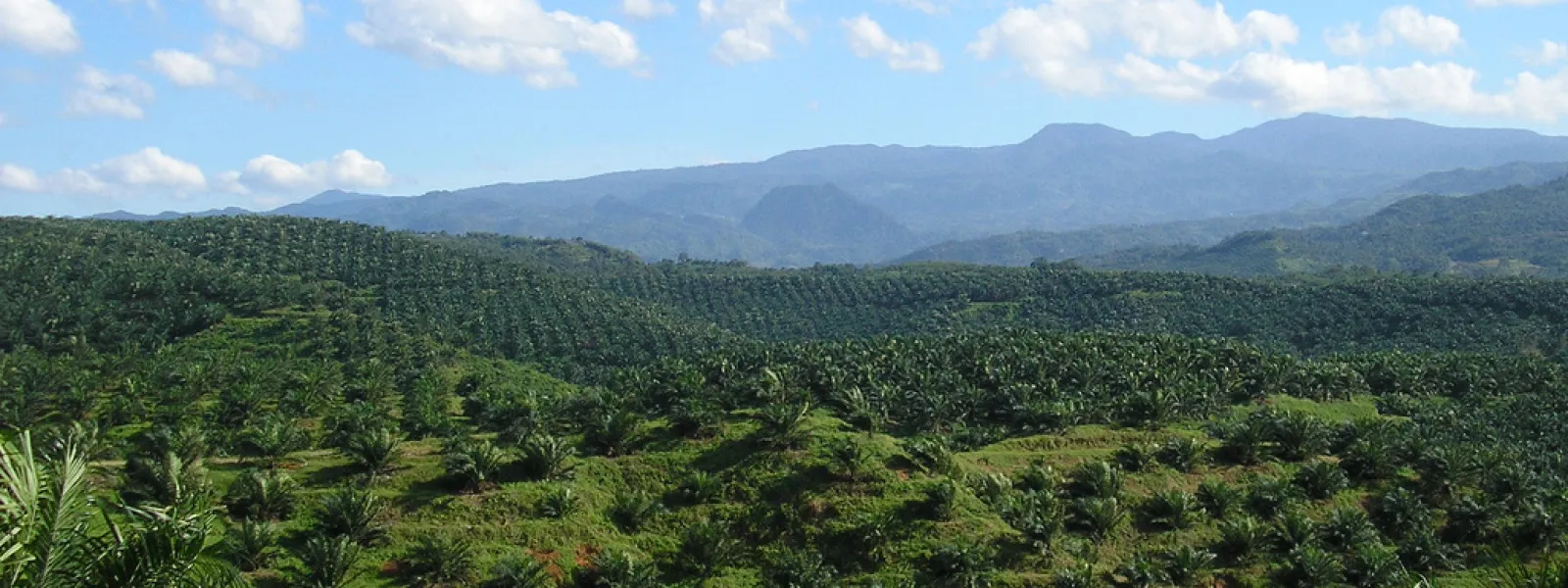
Palm oil plantations are threatening the biodiversity of Chocó, an ancient forest in Ecuador. The companies managing these plantations have caused massive destruction to the forest, endangering rare species and displacing local farmers with near impunity. In September 2007, the Constitutional Court ordered remediation and accountability for the damage.
The order came a year after AIDA teamed up with its Ecuadorean partner, ECOLEX, to document and shed light on the negative impacts of palm oil cultivation in Ecuador. The waste from the plantations, including pesticides and dangerous chemicals, contaminated nearby rivers and waterways. This harmed fish and plants and significantly affected the health and livelihoods of local communities.
The evidence was compelling enough to lead ECOLEX in September 2006 to file a constitutional suit against the Ministry of the Environment and plantation owners to protect the human right to a healthy environment. AIDA supported ECOLEX’s legal action with arguments from international environmental law.
The following year, the Constitutional Court (the highest court in Ecuador) ordered the Ministry to remediate the damages caused by the palm oil plantations and take measures to control and mitigate future potential harms.
Shortly after, the Ministry filed an appeal. But the appeal was not successful, and the Constitutional Court reinforced its original decision.
The decision is an important victory for those who suffered from the irresponsible palm oil cultivation in Ecuador. More importantly, the high court set a legal precedent that can be used by lower Ecuadorean courts in deciding environmental cases. With the victory, AIDA will be looking for more opportunities to protect Ecuador’s natural bounty.
Related projects

Groundwater: The importance of what we can’t see
Did you know that beneath the ground we walk on lies the planet’s most abundant source of fresh water?These are aquifers, underground geological formations that store 99% of the world’s liquid fresh water.That groundwater provides nearly half of the world’s drinking water; it is the sole source of drinking water for one-third of the world’s population (about 2.5 billion people); and it accounts for 43% of the water used for irrigation.Therefore, keeping this resource accessible and high-quality is essential to the lives, health, and food security of millions of people.Despite their importance, aquifers face risks from extractive activities. One such activity is exploiting unconventional oil and gas deposits through fracking, or hydraulic fracturing, a technique that can lead to groundwater contamination. Key aquifers at risk: The case of BrazilSome of the world’s most important aquifers are located in Latin America, primarily within Brazil. They include:The Guaraní Aquifer System, a transboundary aquifer shared by Brazil, Argentina, Paraguay, and Uruguay. It supplies water to about 90 million people, meeting domestic, agricultural, industrial, and tourism needs across more than 1 million km².The Greater Amazon Aquifer System, which spans several Brazilian states and adjacent areas of the Amazon basin in neighboring countries, is one of the world's largest underground water reservoirs and accounts for more than 80% of the water circulating in the Amazon cycle. These strategic water reserves are currently at risk because fracking activities in Brazil could overlap with both aquifers, according to maps. The future of fracking in Brazil—and waterBrazil’s Superior Court of Justice is currently deciding whether to authorize fracking in the country to extract unconventional oil and gas.The technique involves drilling a straight well deep into the ground and then turning the drill to create an L-shaped well. Workers inject a mixture of water, sand, and chemical additives (some of which are toxic) into the well at very high pressure to fracture underground rocks and extract the hydrocarbons they contain.Fracking could contaminate the Guaraní and Greater Amazon aquifers if the toxic chemicals used to fracture the rocks seep through well leaks or surface spills. For this reason, and because of its high water consumption, the technique may jeopardize the water security of populations that rely on these groundwater sources, including indigenous communities and peoples in voluntary isolation.Because water from aquifers isn't just for drinking. It also irrigates crops, keeps rivers flowing, and sustains unique ecosystems.Even though we can't see them, aquifers hold a treasure that is vital to humanity.Protecting them means protecting life.
Read more
A raw materials transition instead of a raw materials rush: Civil society calls for a change of course in raw materials policy
Berlin. From today until October 8th, more than 35 organizations from Germany and numerous other countries will share their perspectives at events on raw material extraction and global justice during Alternative Raw Materials Week. With 25 events on the circular economy, human rights, and environmental protection, the week is intended as a civil society intervention in current international raw materials policy. The highlight will be the Raw Materials Summit on October 6, 2026.While Germany and the EU are securing their supply of critical raw materials and pushing ahead with new raw materials projects, a broad coalition of civil society organizations warns against sacrificing environmental, human rights, and participatory standards in the pursuit of faster raw materials supply.Hannah Pilgrim, coordinator of the Raw Materials Working Group and initiator of Alternative Raw Materials Week: "The federal government is setting completely the wrong priorities with its raw materials policy. It cannot keep up in a race against China or the U.S. Instead, it should focus on a sustainable raw materials policy that prioritizes reducing external dependencies by cutting raw materials consumption and expanding the circular economy. To be taken seriously by raw materials-rich partner countries, it must defend hard-won standards in the areas of human rights and the environment.Through the Alternative Raw Materials Week, we bring together voices that need to be heard more clearly in the current debate: from mining regions, academia, labor unions, and international civil society.”Víctor Quintanilla-Sangueza, Content Coordinator of the Interamerican Association for Environmental Defense (AIDA): “European raw materials policy poses significant risks to the people of Latin America because of the serious environmental and social impacts associated with mining lithium, copper, and other raw materials. That is why we join critical forums for debate—such as the one facilitated by the Alternative Raw Materials Week—to amplify the voices of affected communities. We are countering the prevailing narrative of the energy transition with one that puts life at the center. We are questioning who is setting the rules for transition processes in the Global North and who is bearing the costs. We conduct this work in collaboration with communities and organizations in Latin America, including the Andean Wetlands Alliance”.During Alternative Raw Materials Week, various international guests from Argentina, Bolivia, the Democratic Republic of the Congo, and Portugal will be available for interviews. Here is a selection:Pía Marchegiani - FARN, ArgentinaNik Völker - MiningWatch Portugal Check the events calendarPress contactsAK Rohstoffe | [email protected] | + 49 (0)30 41 93 41 82Press | [email protected] | +49 1577 7764 847
Read more
A victory for climate justice: Colombia includes climate obligations in environmental impact studies
In Colombia, a case that began as a requirement for the coal sector ultimately became a regulation applicable to all projects requiring an environmental permit.This refers to the publication of the General Methodology for the Preparation and Submission of Environmental Studies, a regulatory "master key" that requires quantifying greenhouse gas (GHG) emissions and including climate mitigation and adaptation measures in mining, hydrocarbon, energy, and infrastructure projects, among others.Colombia's Ministry of Environment and Sustainable Development published this methodology in late July 2026, in compliance with a 2023 ruling by the Council of State.This important resolution was the result of a compliance action filed by a coalition led by AIDA and also comprising the "José Alvear Restrepo" Lawyers’ Collective (CAJAR), Censat Agua Viva, the Center for Research and Popular Education (CINEP), POLEN Transiciones Justas, the University of Magdalena, and researchers.The new methodology for environmental studies represents a major step forward in protecting the right to a healthy environment and ensuring the right to a healthy climate through preventive measures.It also marks a victory for climate litigation in the region, demonstrating that the Colombian government failed to fulfill specific climate commitments and securing a ruling ordering one of the competent authorities to take concrete actions for proper climate management.Other countries in the region may replicate the strategy employed and the precedent set. A three-year path toward climate justiceIn May 2023, AIDA led a coalition of civil society organizations, think tanks, researchers, and a university that filed a compliance action with the Administrative Court of Cundinamarca. The goal was to demand compliance with laws related to addressing the climate crisis in the coal sector.In Colombia, neither environmental regulations nor climate change management regulations address GHG mitigation or the climate impacts generated by the coal sector, despite the significance of coal projects in the country and their role in exacerbating the climate crisis.Colombia is by a wide margin the largest coal producer and exporter in Latin America. In 2024, it accounted for 87.67% of regional production and 99.84% of exports, playing a significant role in its trade balance and its rail and port infrastructure. Furthermore, it ranks third in the region in terms of final consumption (24.52%), and in the last 12 months, nearly 5% of the country’s electricity was generated from coal.But without specific regulations, environmental authorities lack the tools to establish effective measures to prevent, mitigate, and manage the climate impacts of coal industry activity.The Administrative Court of Cundinamarca ruled in the coalition's favor in the first instance. The Council of State—the country’s highest authority on administrative matters—upheld the ruling on second instance. Consequently, it ordered the Ministry of Environment and Sustainable Development to comply with the obligations outlined in Law 1931 of 2018, which establishes the minimum actions the country must take to honor its international climate commitments.And this is where the case went beyond its initial objective: the ruling established a specific obligation for the ministry to regulate the consideration of climate impacts not only in coal sector projects but in all projects requiring an environmental permit. In other words, it includes the mining, hydrocarbons, energy, and infrastructure sectors, among others.This entails, among other things, quantifying GHG emissions from these projects and assessing how environmental offset measures can help Colombia meet its climate commitments under the United Nations Framework Convention on Climate Change.The ruling also ordered the government agency to issue a resolution adopting the Mandatory Emissions Report, which would require major greenhouse gas emitters to report their total emissions annually on a disaggregated basis. Similarly, it ordered the agency to issue the environmental sector’s climate change management plan and coordinate actions with territorial climate change plans. A significant and reproducible rulingThe Ministry of the Environment’s publication of the methodology for environmental studies marks a milestone in environmental permitting by incorporating specific procedures to ensure environmental impact studies account for the climate impacts generated by projects seeking permits.It also focuses on environmental permitting and human rights, considers indirect emissions, and introduces new guidelines for assessing projects' environmental impacts.In addition, it sets a regulatory precedent that demonstrates, in practice, the climate unfeasibility of new coal mining and burning projects.In short, it is a regulatory instrument that seeks to close gaps in environmental permitting processes and strengthen the assessment of shortcomings associated with the climate impacts of certain projects, particularly in the coal sector. It incorporates a human rights perspective—a first within an environmental permitting process.Its scope is ambitious: stricter technical and climate management requirements would raise the compliance costs of coal-fired projects—making them more expensive than cleaner alternatives—and could support strategies to phase out coal as part of the country’s efforts to meet its climate obligations.The orders contained in the Council of State’s ruling do not end with the publication of the methodology. Other orders also seek to incorporate specific guidelines for climate change management.Among these is the Mandatory Emissions Report, a key tool for establishing processes to monitor, verify, and control the mitigation actions implemented by major greenhouse gas emitters. However, the ministry has published only a draft resolution adopting this instrument, which, if confirmed, would represent a unique regulatory advancement in the region with strong potential for replication.In other words, the Council of State’s ruling sets a very important precedent for the region for two reasons: it demonstrates that strategic litigation can lead to concrete regulatory actions to address the climate crisis, and it highlights the need to update regulatory frameworks to incorporate specific measures for climate change mitigation and adaptation in specific sectors and procedures.Therefore, it will be important to design strategies that allow both the litigation approach and the results achieved during implementation to be replicated in other countries in the region.
Read more