
Project
Victory: Ecuador’s High Court Orders Halt to Contamination from Palm Oil Production
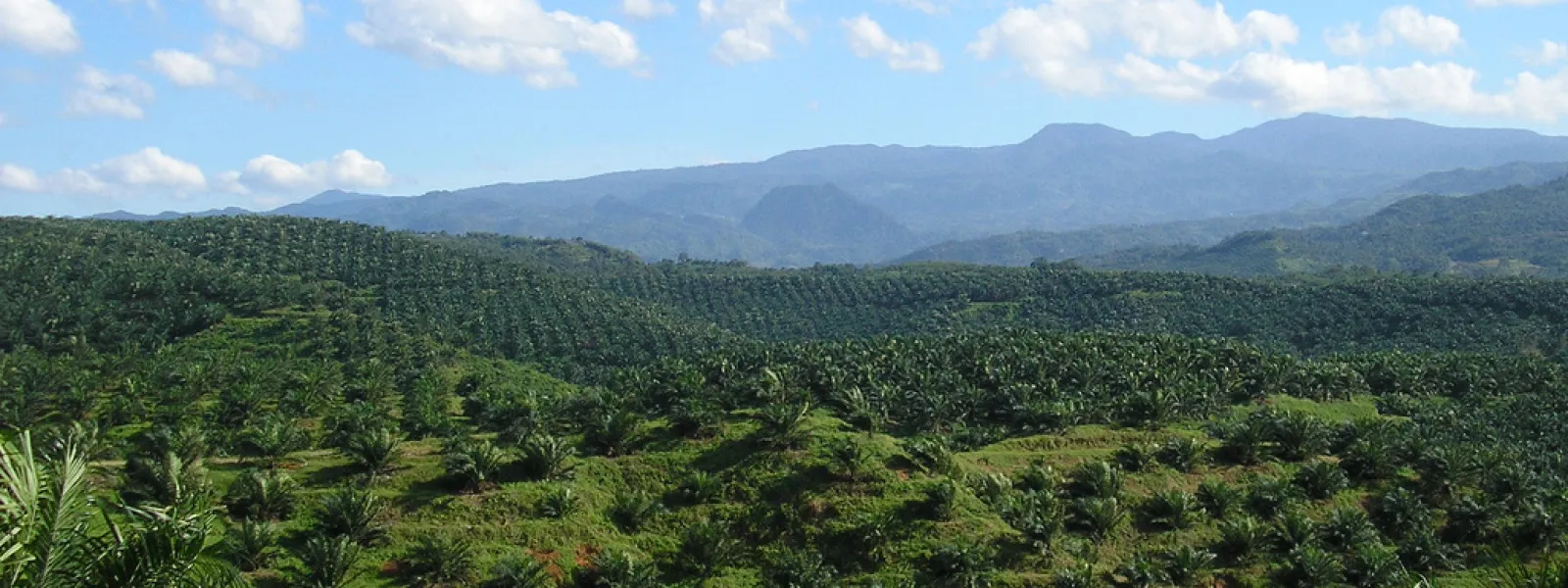
Palm oil plantations are threatening the biodiversity of Chocó, an ancient forest in Ecuador. The companies managing these plantations have caused massive destruction to the forest, endangering rare species and displacing local farmers with near impunity. In September 2007, the Constitutional Court ordered remediation and accountability for the damage.
The order came a year after AIDA teamed up with its Ecuadorean partner, ECOLEX, to document and shed light on the negative impacts of palm oil cultivation in Ecuador. The waste from the plantations, including pesticides and dangerous chemicals, contaminated nearby rivers and waterways. This harmed fish and plants and significantly affected the health and livelihoods of local communities.
The evidence was compelling enough to lead ECOLEX in September 2006 to file a constitutional suit against the Ministry of the Environment and plantation owners to protect the human right to a healthy environment. AIDA supported ECOLEX’s legal action with arguments from international environmental law.
The following year, the Constitutional Court (the highest court in Ecuador) ordered the Ministry to remediate the damages caused by the palm oil plantations and take measures to control and mitigate future potential harms.
Shortly after, the Ministry filed an appeal. But the appeal was not successful, and the Constitutional Court reinforced its original decision.
The decision is an important victory for those who suffered from the irresponsible palm oil cultivation in Ecuador. More importantly, the high court set a legal precedent that can be used by lower Ecuadorean courts in deciding environmental cases. With the victory, AIDA will be looking for more opportunities to protect Ecuador’s natural bounty.
Related projects
Climate-focused environmental assessment: Key to protecting human rights
In a landmark ruling for climate justice in Latin America, on June 16, Costa Rica’s Constitutional Court ordered the government to include a climate impact analysis in the assessment of any project, construction, or activity that could affect the environment.The decision builds on similar achievements in other countries on the continent, resulting from strategic climate litigation.The ruling in Costa Rica was the result of litigation supported by AIDA, in which we filed a legal brief presenting solid arguments demonstrating that incorporating a climate perspective into project assessments is an obligation under national legislation, international agreements, and the experience of other countries in the region.Since the climate crisis is the most urgent environmental and human rights threat the world currently faces, it is important for courts to uphold the requirement that governments assess climate-related risks and impacts before authorizing any project or activity.The procedure established to conduct this analysis—known as an environmental impact assessment (EIA)—is specifically designed to identify, anticipate, analyze, mitigate, and/or prevent the environmental impacts of potentially harmful projects or activities.At the same time, it is a key tool for preventing development proposals from violating the rights of individuals and communities, including the universal right to a healthy environment.Below, we detail the reasons why governments must assess a project’s climate impacts before giving it the green light—these were our contributions to the recent legal victory in Costa Rica. National and international obligationsSeveral national regulations establish the obligation to include climate change criteria in project environmental assessments. In Costa Rica, for example, we have: Decree 42465 of 2019, which requires institutions carrying out public infrastructure projects to assess climate risks, climate change, and other natural or human-induced factors at all stages of the project. Our brief also refers to a series of documents that analyze climate risk in Costa Rica, a country that, due to its location in the Central American tropics, is exposed to extreme weather events—hurricanes, tropical storms, droughts, and floods—whose frequency and intensity have increased as a result of global warming.At the international level, Costa Rica, like other countries on the continent, is a party to treaties and other instruments of international law that entail obligations regarding the environment and human rights, which make reference to the environmental assessment of projects: United Nations Framework Convention on Climate Change. It requires governments to use appropriate methods, such as project impact assessments, to minimize the adverse effects of climate change on the economy, public health, and the environment.Paris Agreement. It requires governments to take and report on the actions they will undertake to reduce climate-damaging gas emissions and to adapt to the impacts of climate change, all of which must respect human rights.Convention on Biological Diversity. It requires countries to implement appropriate procedures to ensure that projects likely to have a significant adverse impact on biological diversity are assessed, with a view to preventing or minimizing such impacts, and to allow for public participation where appropriate.Sendai Framework for Disaster Risk Reduction 2015–2030. It calls on countries to develop, strengthen, and implement relevant actions to align sustainable development and growth, food security, health and safety, climate variability and change, environmental management, and disaster risk reduction.Advisory Opinion No. 23 of the Inter-American Court of Human Rights. It requires that environmental assessments of projects take into account their cumulative impacts, prevent harm to indigenous communities and tribal peoples, include contingency and mitigation plans, and ensure that the assessments are objective, independent, and subject to state oversight. Lessons from other Latin American countriesIn several countries on the continent, the requirement to incorporate climate criteria into environmental assessments has been institutionally established and also upheld by court rulings. Two recent cases illustrate this:Chile. In a 2022 litigation related to the Mejillones thermal power plant, located in the Antofagasta Region, the Supreme Court ordered Chile’s Environmental Assessment Service to analyze the atmospheric component—including those elements that have changed in the terrestrial environment due to climate change—from the start of the project’s implementation to the present.Colombia. In response to a lawsuit challenging the country’s environmental permitting regulations, the Constitutional Court ruled in 2024 that environmental impact studies must include an assessment of climate change impacts: “a global phenomenon determined by multiple biophysical and socioeconomic variables that interact over long periods of time, which is having an increasingly decisive effect on natural processes and impacts territories, communities, and individuals in different ways, with Colombia being one of the most affected countries.” Protecting a healthy environment in the face of the climate crisisAs noted above, incorporating climate change criteria into the environmental assessment of projects is essential for the enjoyment of the right to a healthy environment. This implies:Assessing the impacts that the project or activity may have on climate change. This includes quantifying and documenting direct and indirect greenhouse gas emissions; determining whether, and to what extent, these emissions increase or decrease; and analyzing appropriate mitigation strategies to address anticipated impacts.Considering the effects of the climate crisis (such as climate-induced accidents or disasters) on the development, viability, and sustainability of the project or activity over time, this analysis should inform the decision on its authorization. The climate crisis is not a threat, but a reality that is already severely affecting the region. In this context, it is imperative that development projects continue to undergo proper environmental assessments that require mandatory, systematic consideration of climate impacts for both mitigation and adaptation. Through strategic litigation, AIDA will continue to contribute to this effort. Learn more in our fact sheet, "Climate Change Perspectives in Environmental Impact Studies" (in Spanish). Check out our report, "Global Best Practices for Environmental Impact Studies" (in Spanish).
Read more
Climate justice unlocked
How the Inter-American Court’s Advisory Opinion 32/25 Rewrites the Rules for Climate Litigation in Latin America. This article was originally published on Verfassungsblog. The Inter-American Court of Human Rights has just handed climate litigators in Latin America the most powerful tool they have ever had. Advisory Opinion OC-32/25, issued in 2025, does not merely interpret existing rights in the context of the climate crisis. It restructures the procedural architecture of climate litigation by inverting burdens of proof, authorising the presumption of causal links between state emissions and climate harm, and recognising satellite imagery as evidence that states must make accessible to victims. For organisations that have spent years fighting for communities on the front lines of the climate emergency, this is not an incremental development. It is a transformative moment.The Opinion did not emerge from a vacuum. Over the past decade, the Inter-American Court has built the foundations step by step. In 2017, Advisory Opinion OC-23 established the right to a healthy environment as an autonomous right under the American Convention – not a derivative entitlement, but a freestanding legal guarantee with its own independent status. That standard moved from theory to practice in the contentious case of La Oroya v. Peru, where the Court found that severe environmental contamination created a systemic risk to life, health, and physical integrity. OC-32/25 is the third step in this trajectory – and by far the most ambitious.The Opinion characterises the climate crisis as a human rights problem that falls disproportionately on those already marginalised. It maps the vulnerabilities of Latin America and the Caribbean with precision, identifying Central America, the Amazon, the Caribbean and the Andes as zones of existential risk. The figures the Court cites are sobering. In 2021, the region counted 17.1 million internally displaced persons due to climate-related causes. The top one per cent of the population generated 92 per cent of per-capita CO₂ emissions in 2019, while the bottom 50 per cent generated just 0.27 per cent. Those who emit the least suffer the most. Across these ecosystems, indigenous peoples and traditional communities are disproportionately affected by ongoing violations of their rights linked to climate change. A New Autonomous RightFrom the right to a healthy environment, the Court derives a new autonomous right: the right to a healthy climate, defined as the right to live in a climate system free from dangerous anthropogenic interference. The Opinion treats this right as an indispensable precondition for the exercise of all other human rights in the context of the climate emergency. States are accordingly bound by a standard of heightened due diligence. Climate governance is no longer treated as a matter of political discretion alone. States must prevent climate harm inside and beyond their borders, require environmental impact assessments to include specific analyses of greenhouse gas emissions before authorising projects, and set ambitious, progressive reduction targets calibrated to the best available science. The scientific consensus reflected in IPCC assessments is explicitly treated as the legal reference standard.The Court adds a prohibition on regression: protection levels already achieved are a floor, not a ceiling. It extends due diligence obligations not only to states’ own activities but also to companies operating under their jurisdiction. These propositions are not entirely new, but the Opinion consolidates them into a unified framework and gives them the authority of a definitive Inter-American interpretation. For litigation purposes, the catalogue of obligations is now largely settled. Procedural Rights as the Real InnovationIf the substantive obligations are important, the procedural innovations are transformative. The most significant contribution of OC-32/25 for climate litigation is not the declaration of a right to a healthy climate – it is the way the Opinion restructures the access rights framework. Indeed, the Court developed two very valuable elements: the right to science, and standards of proof and evidence that strengthen climate litigation. "The right to science includes access to the benefits of scientific and technological progress and to the co-production of knowledge between scientists and holders of local, traditional and indigenous knowledge." (par. 473) The right to science, grounded in Article 13 of the International Covenant on Economic, Social and Cultural Rights and read together with OC-32/25, creates enforceable obligations for states to guarantee effective access to scientific climate knowledge. States can no longer rely on claims of scientific uncertainty or insufficient knowledge: policies must be based on the best available science and updated as that science evolves. Environmental impact assessments (par. 362), national adaptation plans (par. 388), and Nationally Determined Contributions are treated as auditable documents that must rely on scientifically credible evidence and remain transparent (parr. 510, 511 and 486). Most significantly, judges can and must evaluate whether the scientific basis relied upon by the state satisfies Convention standards (parr. 488–539). This substantially expands the scope of judicial review of climate policy within the Inter-American system. Reversing the Burden of ProofProving a direct causal link between a specific state’s emissions and a specific harm has historically been the single greatest obstacle in climate litigation – technically demanding, judicially contested, and practically out of reach for most affected communities. OC-32/25 dismantles that obstacle in four concrete moves.The Opinion acknowledges that climate litigation is characterised by marked asymmetries between parties in their access to technical and scientific information. National courts must therefore adopt measures – including the reversal of the burden of proof – to guarantee effective judicial protection. The language is direct: "the burden of justifying any denial always falls on the State" (par. 490). In matters of information access passivity is not an option for the state.Second, the Opinion accepts a presumption of the causal nexus between a state’s greenhouse gas emissions and the degradation of the global climate system, and in turn the link between that degradation and the risks facing people and ecosystems – provided this is anchored in IPCC assessments. This responds directly to the attribution problem that has shaped the limits of climate litigation for decades. Courts are no longer required to resolve the full scientific chain of causation in each individual case.Third, the Opinion introduces alternative standards of proof. Access to climate justice does not require proving individualised causation for each harm. It is sufficient to demonstrate the generation or tolerance of significant risks through state inaction, and the effective exposure of people or groups to those risks. Communities do not need to show that a specific tonne of CO₂ from a specific state caused their specific flood. They need to show that they were exposed to foreseeable risks that the state failed to address.Fourth, the Court highlights satellite evidence as particularly relevant in climate cases and requires states to ensure cooperation and technology transfer to make such evidence accessible to victims in judicial proceedings. This is a practical recognition that the evidentiary tools needed for climate litigation are often technically sophisticated and economically inaccessible to the communities that need them most. What Changes for LitigationTaken together, these four innovations transform the strategic landscape for climate litigation across the Americas. Organisations like AIDA can now challenge fossil fuel projects whose environmental impact assessments fail to incorporate adequate climate analysis – invoking the right to science directly. We can contest state climate policies on the grounds of scientific insufficiency or obsolescence. We can bring cases on behalf of entire communities without proving individual, direct harm, thanks to the broad standing the Opinion recognises. And we can defend indigenous territories by connecting climate damage to collective territorial rights through a framework that no longer demands the near-impossible standard of individualised causation.OC-32/25 is not a self-executing judgment. Its standards will need to be invoked, argued, and developed case by case before the Inter-American Court, the Commission, and national courts across member states. Resistance from states that seek to preserve the status quo is predictable. But the architecture is now in place: the applicable rules have changed.At AIDA, we have spent years litigating in a region where the gap between states’ formal climate commitments and the actual protection experienced by communities is vast. OC-32/25 gives us legal instruments to narrow that gap. It does not ask us to be more optimistic. It asks us to be more ambitious – in the cases we choose, in the standards we invoke, and in the connections we draw between international law and the communities on the front lines of the climate crisis.
Read more
Pre-COP31 sessions in Bonn: A worn-out climate system with glimmers of hope
By Florencia Ortúzar Greene and Karla Maass* The world has been negotiating on climate change for 30 years. For 30 years, governments have been meeting annually, accompanied by increasingly alarming scientific reports. The multilateral process has matured; it now has implementation rules and mechanisms in place to drive global climate action, but that action remains limited and discretionary.What's going on? How can we breathe new life into this very important global process?The following are our reflections after participating in the 64th Sessions of the Subsidiary Bodies (SB64) of the United Nations Framework Convention on Climate Change (UNFCCC), held June 8–18 in Bonn, Germany, to advance negotiations leading up to the 31st UN Climate Change Conference (COP31). The stalemate in international climate negotiationsIt would be unfair to say that the sessions in Bonn were a failure, let alone to be surprised by the lack of concrete results. What is happening is simply a reflection of a process in slow decline. This becomes evident at a time when there is sustained and widespread talk of the need for “implementation” and “cooperation” to put the Paris Agreement into effect, while, time and again, two irreconcilable rifts continue to block progress. Being able to identify them so clearly brings a certain sense of reassurance.The main point of contention remains financing. Developing countries consistently raise in negotiating rooms that the Paris Agreement not only sets targets for emissions reductions and adaptation but also establishes concrete commitments for financial support from developed countries. However, discussions on the provision of financing are completely stalled. This is happening in a context where commitments are not only insufficient but also inadequate in quality, accessibility, and predictability.In response to this demand, developed countries have placed increasing emphasis on mobilizing private capital and creating enabling conditions for investment. Although these flows can play an important role, private investment tends to be directed toward sectors and projects with clear financial returns. Meanwhile, critical areas such as adaptation, loss and damage, and capacity building continue to depend on concessional public financing. Added to this are structural debt-related issues that ultimately exacerbate shortcomings in countries already struggling to cope.The second point of contention relates to phasing out fossil fuels. For several States Parties, the willingness to embark on phasing out fossil fuels is not on the table. This is despite the fact that they are signatories to the Paris Agreement ad, at COP28 in Dubai, agreed to move toward a just, orderly, and equitable transition away from fossil fuels. There is talk of a just transition, but plans to expand fossil fuel use are as certain as they are concrete. The role of science in addressing the climate crisis has been sidelined One cause for concern at SB64 was the intention of representatives from various countries to downplay the role of science in climate decision-making. This is nothing new. It has been happening for years, gradually and steadily—perhaps so slowly that we hadn’t noticed it until now.This phenomenon became evident when contrasted with the results of the First International Conference on the Transition Beyond Fossil Fuels, held recently in Santa Marta, Colombia. There, science served as the common thread and central foundation of the political dialogue. The way science was given a platform reminded us of how it was handled at the early COPs, which opened with presentations of the findings of the Intergovernmental Panel on Climate Change (IPCC). Today, that no longer happens. These days, science appears as a second-rate guest, with a contested and unclear role.This is extremely important because, without science, the process loses its foundation and becomes a purely political negotiation, in which the side with the most power wins. Climate action: A new wind of hopeThis story doesn't end on a completely bleak note. At the climate talks in Bonn, some encouraging developments took place—the result of this long and complex process.The Brazilian COP30 Presidency took on the task of developing roadmaps to transition away from fossil fuels and to halt and reverse deforestation by 2030, thereby reinforcing the two central pillars of any effective and reliable climate action. This demonstrates leadership willing to break away from the official path to make progress.In addition, at COP30, it was agreed to implement a just transition mechanism (known as BAM), a decision that responded to the urgent call from civil society and affected communities. And in Bonn, countries made progress in implementing it. While there is still much to be done, the process is still on track and will be finalized at COP31, to be held November 9–20 in Antalya, Turkey.Furthermore, the Santa Marta Conference—organized within the framework of COP30 and bringing together 57 countries willing to discuss the energy transition—succeeded in launching a renewed process of dialogue, which is also an undisputed source of hope that will continue to grow stronger as we look ahead to the second conference, to be hosted by Tuvalu and Ireland. Learn more in our review of the SB64 (in Spanish). *Florencia Ortúzar Greene is the director of AIDA's Climate Program, and Karla Maass is an external consultant for the organization.
Read more