
Project
Shutterstock.
Pollution of the Motagua River in Guatemala: The Poqomam Maya people’s quest for environmental justice
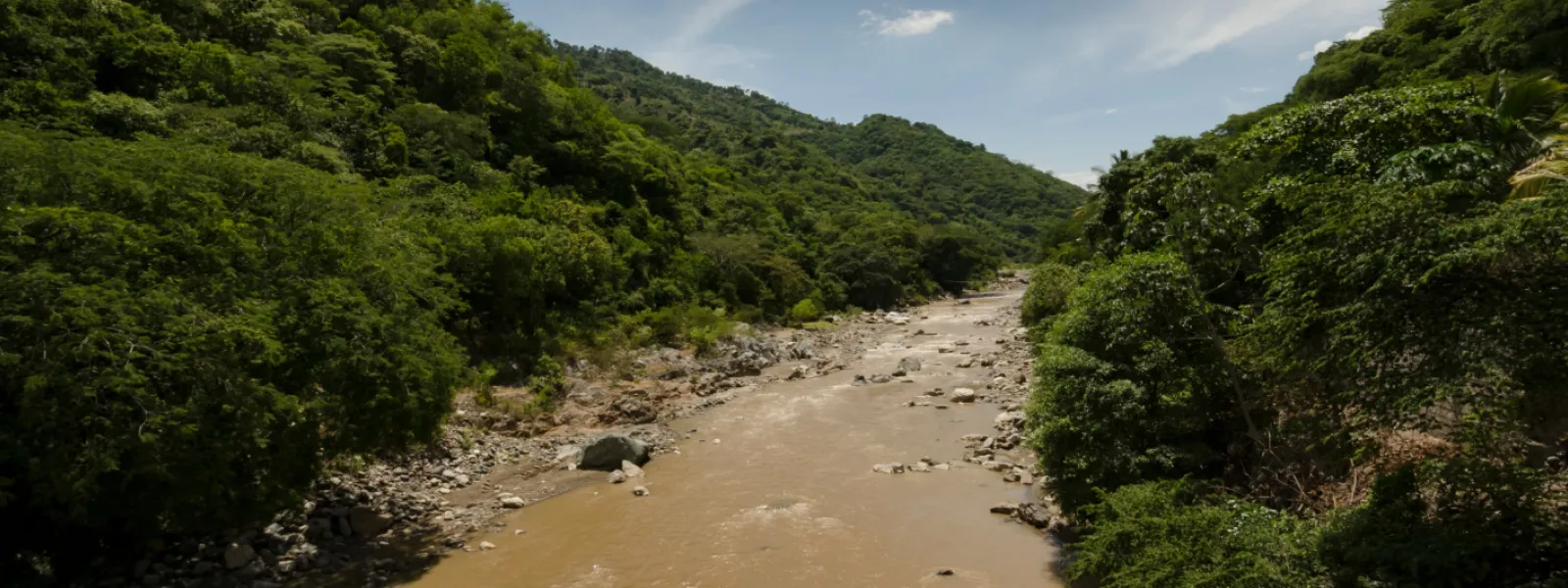
The Motagua River basin—Guatemala’s largest and most important river—is severely polluted with wastewater, solid waste, and other types of debris.
This is a cross-border issue because the Motagua’s polluted waters flow into the Caribbean Sea, reach the coast of Honduras, and threaten the Mesoamerican Reef System.
For decades, this has violated the rights to health, water, development, and a healthy environment of all the people living in the river basin.
In June 2025, the Poqomam Maya community of Santa Cruz Chinautla—supported by AIDA, the Indigenous Peoples’ Law Firm, and allied organizations—achieved an unprecedented legal victory to halt degradation in the basin. In response to the lawsuit it filed, a Guatemalan court ordered the municipality of Chinautla to comply with a series of obligations to curb the pollution of the area’s rivers and soil.
The government's response to the ruling has so far been limited to technical working group meetings. Meanwhile, the community continues to work toward the proper implementation of the ruling and to take other actions to defend its territory and its rights.
Background
The Motagua River, which is 486 km long, flows through 96 municipalities and 14 departments in Guatemala. It originates in Quiché, a department located in the northwest, and empties into the Caribbean Sea.
Polluting activities occur throughout the entire basin, including sub-basins and micro-basins. The largest volume of pollution comes from Guatemala City, the country’s capital, and is carried by the waters of the Las Vacas River, which in turn receives a large amount of waste from the Chinautla River.
The Chinautla River, which flows through the municipality of the same name, carries solid waste from a landfill located in Zone 3 of the capital—where trash from at least 14 municipalities in the department of Guatemala is dumped—as well as sewage generated by some 500,000 people living in the northern part of the capital, which undergoes no prior treatment.
Other sources of pollution include the numerous illegal dumps in the municipality of Chinautla, the waste that private vehicles and garbage trucks dump along the banks of its rivers, as well as the sand-mining companies—which began setting up operations in the area between 1996 and 1997—whose activities weaken the rivers' basins, causing solid waste to be more easily carried away by the river currents.
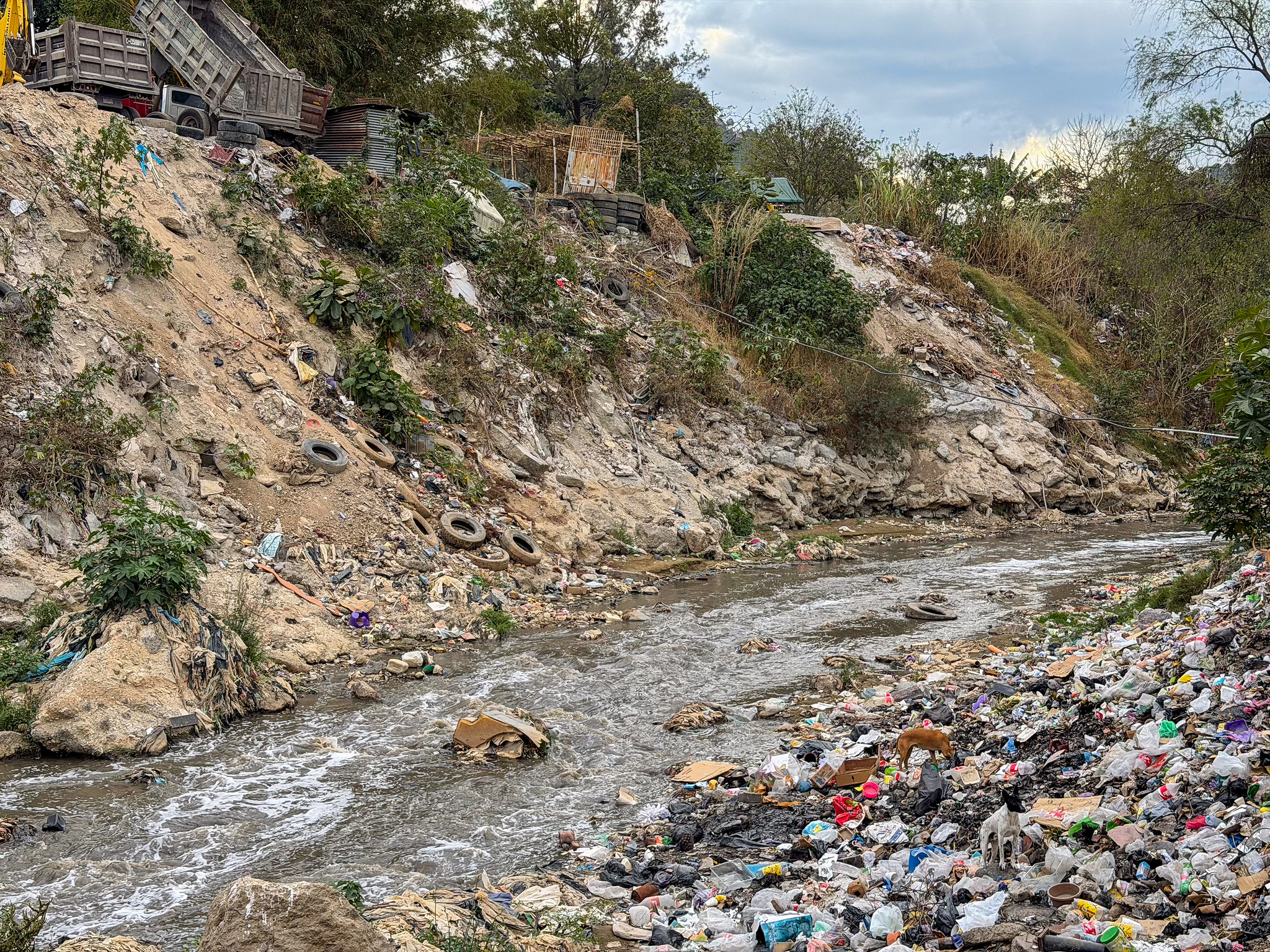
Photo: Mayela Sánchez García.
The situation extends beyond national borders. Every year, the Motagua River discharges some 20,000 metric tons of plastic into the Caribbean Sea, making it one of the rivers that contributes the most plastic pollution to the ocean worldwide, according to estimates contained in a 2025 report by the Inter-American Commission on Human Rights (IACHR).
The river flows into the Mesoamerican Reef at its mouth, so pollution also threatens to degrade one of the largest and most biodiverse transboundary reefs on the planet, which spans the territorial waters of Belize, Guatemala, Honduras, and Mexico.
In addition, the contaminated water reaches the coast of Honduras and spreads into Amatique Bay, located along the eastern coast of Guatemala, affecting the Caribbean Sea.
The roots of this chronic, cross-border problem are structural. Data from the Integrated Environmental Management of the Motagua River Basin project, funded by the United Nations Development Program (UNDP), show that in Guatemala, 66% of municipal solid waste is not collected, and there is no guarantee that the remaining 34% is disposed of properly. Furthermore, of all landfills nationwide, 88.32% are illegal or lack municipal authorization.
In other words, the core issues that need to be addressed are the mismanagement of solid waste and water resources in Guatemala; noncompliance with existing regulations on wastewater discharge and the disposal and treatment of solid waste and residues; and the lack of a water law.
The Poqomam Maya people's quest for justice
The rivers of Santa Cruz Chinautla, a community of the Poqomam Maya people located just twelve kilometers from Guatemala City, have become conduits of pollution that are degrading the Motagua River.
For decades, the local population has seen its health and livelihoods—including pottery, one of the main economic activities and a source of identity—damaged due to the lack of waste management in the municipality of Chinautla and the urban area of the country’s capital, as well as the activities of sand-mining companies.
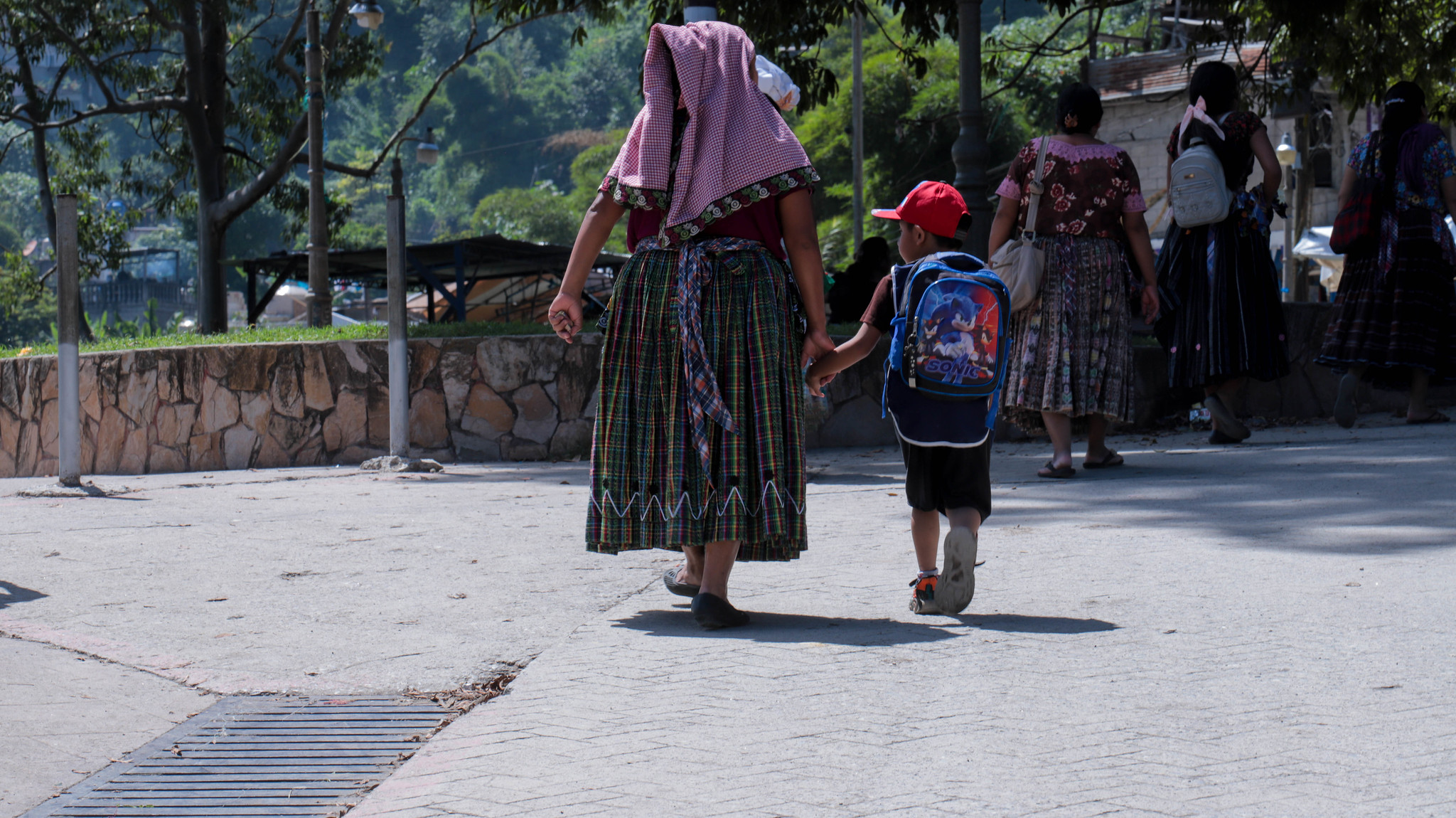
Photo: Mario Winter.
Voices for the Motagua River: Olga Vázquez.
Voices for the Motagua River: Nazario Pascual.
In early 2000, the Maya community organized to stop sand mining on their territory. At that time, the companies held mining permits that remained valid through 2021 and 2022. And although the permits expired, some companies continued to operate after requesting extensions. In June 2022, the indigenous authorities of the Poqomam people began a sit-in protest in front of the Piedrinera San Luis company, which they maintained for four years.
In July 2024, the Special Rapporteur on Economic, Social, Cultural, and Environmental Rights of the IACHR visited Santa Cruz Chinautla. During his visit, traditional authorities and community members spoke about the environmental, water-related, health, economic, and cultural impacts of the pollution in their rivers.
That same year, in October, the community—with support from AIDA, the Indigenous Peoples’ Law Firm, and partner organizations—filed a lawsuit (petition for amparo) against the municipality of Chinautla over its failure to take measures to address the contamination of its rivers and soil caused by improper solid waste management and the existence of illegal landfills.
AIDA’s scientific team, together with local residents and community authorities, collected key information on illegal landfills in the area. This community science initiative supported the litigation by highlighting the severity of the pollution, demonstrating the ongoing use of such practices, and providing evidence of the municipal authorities’ failure to fulfill their legal obligations regarding waste management.
Learn more about this community science initiative.
In June 2025, the Poqomam community won the support of the Guatemalan justice system when a constitutional court ordered the municipality of Chinautla to effectively address the claims in the lawsuit aimed at stopping the pollution of the rivers and soil in Santa Cruz Chinautla.
This is the first time a Guatemalan court has recognized a community's right to a healthy environment and its central role in finding solutions.
Find out the details of the legal victory.
Current situation
Since the ruling was issued, the municipality of Chinautla has held a series of “technical working groups” with representatives from the central government, civil society, and the community. A smaller group of technical experts was later created to develop a work plan with clear goals. Several months have passed without the municipality convening these working groups.
Furthermore, in December 2025, the IACHR noted in its report Human Rights Situation in Guatemala that the Motagua River basin is facing a severe pollution crisis that has had profound impacts on biodiversity and has resulted in systematic violations of the human rights of local communities, including the Maya Poqomam people.
And in May 2026, the Ministry of the Environment and Natural Resources revoked the license of the sand mining company Piedrinera San Luis for "failure to comply with environmental commitments."
AIDA continues to monitor the implementation of the court ruling to ensure the right to a healthy environment for the Poqomam Maya community and all those living in the Motagua River basin. Meanwhile, the residents of Santa Cruz Chinautla remain organized and mobilized to improve their environment and defend their rights.
Related projects
Joint letter: Mexico – Detention of environmental and human rights defender Mr. Marco Antonio Suástegui Muñoz
The 57 organizations and persons signatory to the letter, which work for the protection of human rights and the environment, express their deep concern at the detention of Mr. Marco Antonio Suástegui, leader of the Consejo de Ejidos y Comunidades Opositores a la Presa La Parota – CECOP (Council of Communal Lands and Communities Opposing the La Parota Dam), on 17 June by members of the Ministerial Police of the Attorney General of Justice of Guerrero State. We call upon the Mexican State to take effective and urgent measures to guarantee the human rights of Mr. Suástegui and the important work that the human rights defender performs in defence of the Papagayo River. In particular, we consider it fundamental that the State: Take measures to ensure that the competent authorities guarantee the right to a defence and due process of Mr. Marco Antonio Suástegui, and reverse any action taken in the detention procedure and past transfers that tainted by illegalities, Take measures to guarantee his physical and psychological integrity, and Take all necessary measures to secure the work for the defence of human rights and the environment undertaken by Marco Antonio Suástegui, and take an active role in avoiding any act that hinders the actions taken to defend the Papagayo River.
Read more
Colombia must choose between gold and water: Al Gore
Colombia faces a pivotal choice for its future. It must choose between protecting its high-altitude moors as its water source for millions of people or authorizing large-scale mining in these fragile ecosystems. AIDA, together with its allied organizations, is working to convince the authorities to choose water and this cause recently won a new ally: Al Gore. The former U.S. vice president, a Nobel Peace Prize laureate for his success at raising awareness about climate change, brought up the issue of mining in the moors, known locally as páramos, in April. “Colombia must choose between the gold in the páramo and profits for a few people, or the drinking water that supplies all of its citizens,” he said at an international summit on the environment in Bucaramanga, a city in northeastern Colombia that gets its water from the Santurbán Páramo. We’ve been calling on the Colombian government to protect this moor and others around the country from mining, given that they provide 85% of the country’s water. Will this happen? By law, the government must keep mining out of the páramos. But to do this, their boundaries must first be mapped. This poses a problem. In April, the government unveiled its map showing that the Santurbán Páramo stretches over 42,000 hectares (104,000 acres). That’s more than the 11,000 hectares of previous estimates. But it’s only about half the 82,000 hectares measured by the Alexander von Humboldt Biological Resources Research Institute, an independent state research center that used a larger scale map than the government. The larger scale provides richer details that show how the moor extends further. The government has not adopted an official measurement, leaving important parts of the moor open to mining, an industry it is promoting to spur economic growth. But at what costs? Large-scale mining will cause irreversible damage to these flora-rich moors that not only supply water to millions of people but also help mitigate the effects of climate change by capturing carbon emissions. Gore was clear on what choice he recommends for Colombia or any country facing questions of economic growth versus environmental protect. “Without a planet, there is no economy that is worth anything,” he said. You can help us spread the message by making a donation and signing our petition so that we can continue the fight to save Colombia’s moors. Thank you!
Read moreOrganizations come out in defense of the Veracruz Reef System
Technical and legal arguments are submitted in support of a lawsuit against modifying the boundaries of the Veracruz Reef System National Park in eastern Mexico, a site protected by international obligations to preserve the natural barrier against storms and hurricanes. Veracruz, Mexico. Six civil society organizations have submitted to a Mexican court an amicus curiae brief containing legal and technical arguments that strengthen arguments in a lawsuit against a government decree to modify and reduce the boundaries of the Veracruz Reef System National Park. The proposed modification puts conservation of this internationally important wetland at stake. The organizations submitted the friend of the court brief to the Third Tribunal of the District of Veracruz on April 25. They are the Interamerican Association of Environmental Defense (AIDA), the Mexican Center for Environmental Law (CEMDA), the Strategic Human Rights Litigation Center (Litiga OLE), Pathways and Encounters for Sustainable Development (SENDAS), Pobladores A.C. and the Veracruz Assembly of Environmental Initiatives and Defense (LAVIDA). The Veracruz Reef System in eastern Mexico was declared a natural protected area in 1992 to safeguard its diversity of species and a rational use of its resources, and to encourage research into the ecosystem and its balance. In 2004, the Veracruz Reef System was included as a wetland of international importance under the Ramsar Convention, an international treaty to protect wetlands. The amicus curiae (friend of the court) brief highlights the importance of the reef system for Mexico and the region. “Coral reefs are natural barriers against large waves and storms like Hurricane Karl, which hit Veracruz in 1992,” said Sandra Moguel, a legal advisor to AIDA. “Reefs also provide abundant fishing and valuable information for medical research. They’re great spots for recreation and they help to sustain marine life.” The legal brief also argues that the decree, from Mexico’s National Commission on Protected Areas (CONANP), threatens regional biodiversity, violates the human right to a healthy environment, and breaches Mexico’s international obligations to protect this ecosystem. “The local population is more exposed to suffer the impacts of hurricanes and other climate phenomena, because the decree removes the Punta Gorda and Bahía de Vergara reefs from the national park,” said Xavier Martínez Esponda, regional director of CEMDA for the Gulf of Mexico. The organizations’ brief explains how CONANP’s decree infringes specific national laws and international treaties. For example, the Organization of American States’ Convention on Nature Protection and Wild Life Preservation in the Western Hemisphere states that natural park limits can only be modified by legislative authorities. CONANP is not such an authority. The decree also violates the Ramsar Convention, given that the modification of the national park’s defined boundaries did not follow the procedures established by that intergovernmental treaty for the protection of wetlands of international importance. The brief concludes by making it clear that CONANP’s decree is a regressive measure that erases the benefits of environmental protection attained with the creation of the protected area in 1992. “Setbacks like this can cause irreparable damage,” said Moguel.
Read more