
Project
Shutterstock.
Pollution of the Motagua River in Guatemala: The Poqomam Maya people’s quest for environmental justice
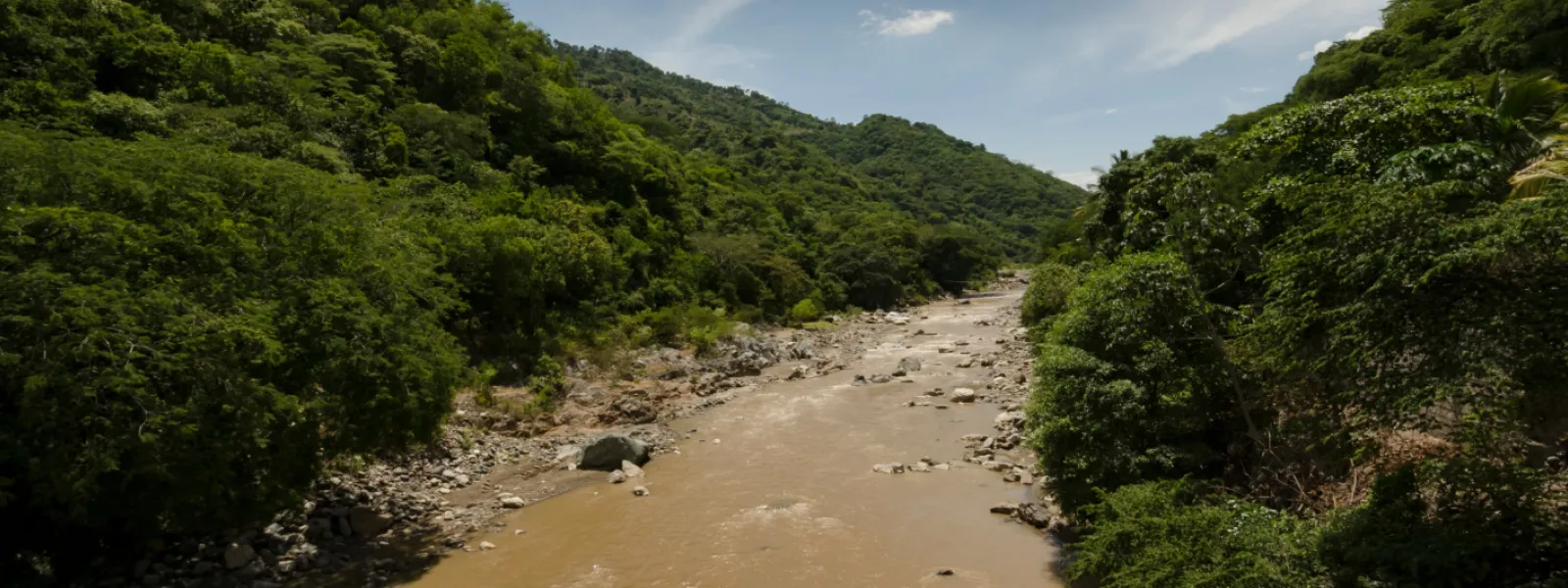
The Motagua River basin—Guatemala’s largest and most important river—is severely polluted with wastewater, solid waste, and other types of debris.
This is a cross-border issue because the Motagua’s polluted waters flow into the Caribbean Sea, reach the coast of Honduras, and threaten the Mesoamerican Reef System.
For decades, this has violated the rights to health, water, development, and a healthy environment of all the people living in the river basin.
In June 2025, the Poqomam Maya community of Santa Cruz Chinautla—supported by AIDA, the Indigenous Peoples’ Law Firm, and allied organizations—achieved an unprecedented legal victory to halt degradation in the basin. In response to the lawsuit it filed, a Guatemalan court ordered the municipality of Chinautla to comply with a series of obligations to curb the pollution of the area’s rivers and soil.
The government's response to the ruling has so far been limited to technical working group meetings. Meanwhile, the community continues to work toward the proper implementation of the ruling and to take other actions to defend its territory and its rights.
Background
The Motagua River, which is 486 km long, flows through 96 municipalities and 14 departments in Guatemala. It originates in Quiché, a department located in the northwest, and empties into the Caribbean Sea.
Polluting activities occur throughout the entire basin, including sub-basins and micro-basins. The largest volume of pollution comes from Guatemala City, the country’s capital, and is carried by the waters of the Las Vacas River, which in turn receives a large amount of waste from the Chinautla River.
The Chinautla River, which flows through the municipality of the same name, carries solid waste from a landfill located in Zone 3 of the capital—where trash from at least 14 municipalities in the department of Guatemala is dumped—as well as sewage generated by some 500,000 people living in the northern part of the capital, which undergoes no prior treatment.
Other sources of pollution include the numerous illegal dumps in the municipality of Chinautla, the waste that private vehicles and garbage trucks dump along the banks of its rivers, as well as the sand-mining companies—which began setting up operations in the area between 1996 and 1997—whose activities weaken the rivers' basins, causing solid waste to be more easily carried away by the river currents.
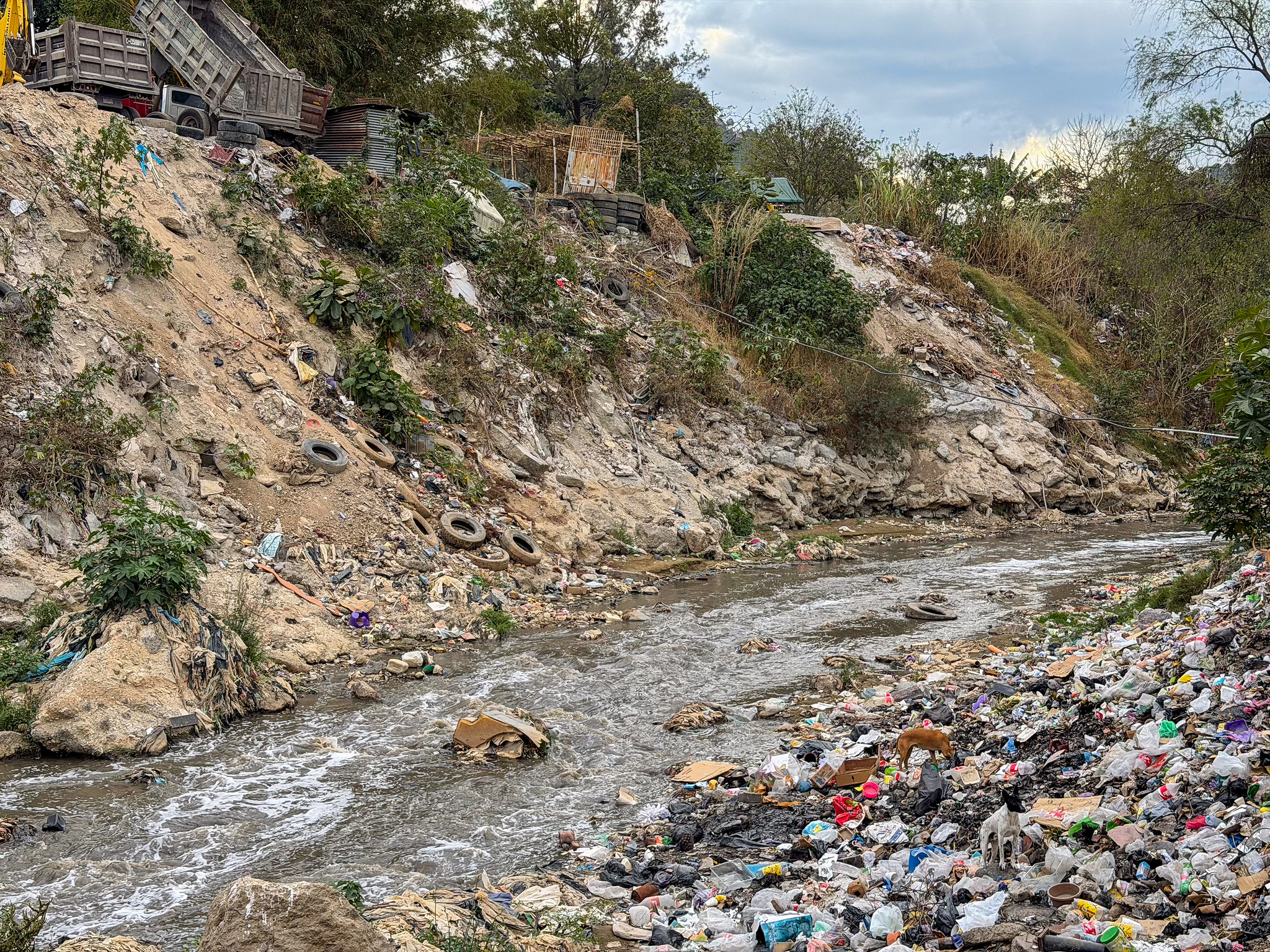
Photo: Mayela Sánchez García.
The situation extends beyond national borders. Every year, the Motagua River discharges some 20,000 metric tons of plastic into the Caribbean Sea, making it one of the rivers that contributes the most plastic pollution to the ocean worldwide, according to estimates contained in a 2025 report by the Inter-American Commission on Human Rights (IACHR).
The river flows into the Mesoamerican Reef at its mouth, so pollution also threatens to degrade one of the largest and most biodiverse transboundary reefs on the planet, which spans the territorial waters of Belize, Guatemala, Honduras, and Mexico.
In addition, the contaminated water reaches the coast of Honduras and spreads into Amatique Bay, located along the eastern coast of Guatemala, affecting the Caribbean Sea.
The roots of this chronic, cross-border problem are structural. Data from the Integrated Environmental Management of the Motagua River Basin project, funded by the United Nations Development Program (UNDP), show that in Guatemala, 66% of municipal solid waste is not collected, and there is no guarantee that the remaining 34% is disposed of properly. Furthermore, of all landfills nationwide, 88.32% are illegal or lack municipal authorization.
In other words, the core issues that need to be addressed are the mismanagement of solid waste and water resources in Guatemala; noncompliance with existing regulations on wastewater discharge and the disposal and treatment of solid waste and residues; and the lack of a water law.
The Poqomam Maya people's quest for justice
The rivers of Santa Cruz Chinautla, a community of the Poqomam Maya people located just twelve kilometers from Guatemala City, have become conduits of pollution that are degrading the Motagua River.
For decades, the local population has seen its health and livelihoods—including pottery, one of the main economic activities and a source of identity—damaged due to the lack of waste management in the municipality of Chinautla and the urban area of the country’s capital, as well as the activities of sand-mining companies.
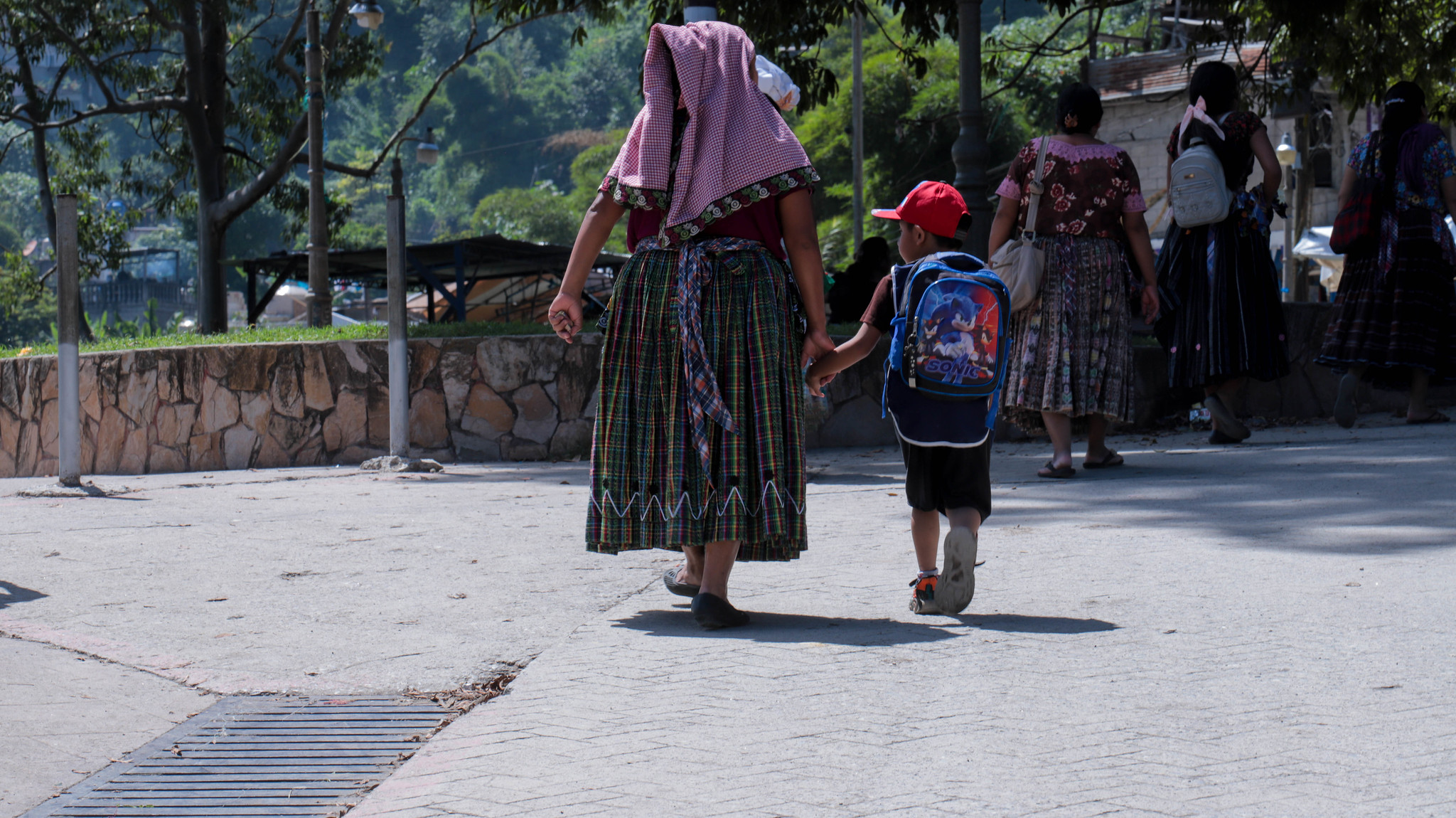
Photo: Mario Winter.
Voices for the Motagua River: Olga Vázquez.
Voices for the Motagua River: Nazario Pascual.
In early 2000, the Maya community organized to stop sand mining on their territory. At that time, the companies held mining permits that remained valid through 2021 and 2022. And although the permits expired, some companies continued to operate after requesting extensions. In June 2022, the indigenous authorities of the Poqomam people began a sit-in protest in front of the Piedrinera San Luis company, which they maintained for four years.
In July 2024, the Special Rapporteur on Economic, Social, Cultural, and Environmental Rights of the IACHR visited Santa Cruz Chinautla. During his visit, traditional authorities and community members spoke about the environmental, water-related, health, economic, and cultural impacts of the pollution in their rivers.
That same year, in October, the community—with support from AIDA, the Indigenous Peoples’ Law Firm, and partner organizations—filed a lawsuit (petition for amparo) against the municipality of Chinautla over its failure to take measures to address the contamination of its rivers and soil caused by improper solid waste management and the existence of illegal landfills.
AIDA’s scientific team, together with local residents and community authorities, collected key information on illegal landfills in the area. This community science initiative supported the litigation by highlighting the severity of the pollution, demonstrating the ongoing use of such practices, and providing evidence of the municipal authorities’ failure to fulfill their legal obligations regarding waste management.
Learn more about this community science initiative.
In June 2025, the Poqomam community won the support of the Guatemalan justice system when a constitutional court ordered the municipality of Chinautla to effectively address the claims in the lawsuit aimed at stopping the pollution of the rivers and soil in Santa Cruz Chinautla.
This is the first time a Guatemalan court has recognized a community's right to a healthy environment and its central role in finding solutions.
Find out the details of the legal victory.
Current situation
Since the ruling was issued, the municipality of Chinautla has held a series of “technical working groups” with representatives from the central government, civil society, and the community. A smaller group of technical experts was later created to develop a work plan with clear goals. Several months have passed without the municipality convening these working groups.
Furthermore, in December 2025, the IACHR noted in its report Human Rights Situation in Guatemala that the Motagua River basin is facing a severe pollution crisis that has had profound impacts on biodiversity and has resulted in systematic violations of the human rights of local communities, including the Maya Poqomam people.
And in May 2026, the Ministry of the Environment and Natural Resources revoked the license of the sand mining company Piedrinera San Luis for "failure to comply with environmental commitments."
AIDA continues to monitor the implementation of the court ruling to ensure the right to a healthy environment for the Poqomam Maya community and all those living in the Motagua River basin. Meanwhile, the residents of Santa Cruz Chinautla remain organized and mobilized to improve their environment and defend their rights.
Related projects
Judge Orders Measures to Protect Public Health in La Oroya
FOR IMMEDIATE RELEASE: April 14, 2005 Judge Orders Measures to Protect Public Health in La Oroya In April of 2005, a Lima civil court ordered the Peruvian Ministry of Health (MINSA) and the General Directorate for Environmental Health (DIGESA) to take steps to alleviate a public health crisis in La Oroya, Peru, a city where the Doe Run company of Missouri operates a large multi-metal smelter. The court ruled that MINSA and DIGESA have failed to carry out the government’s duty to protect the population in La Oroya. In spite of numerous studies showing a severe health crisis in the city, the government has taken no action to protect public health. The Doe Run smelter emits large amounts of toxic heavy metals and sulfur dioxide into the environs of the city. According to a recent study by the company and health authorities, the contamination is so severe that 99.9 percent of the children in the neighborhood closest to the smelter—La Oroya Antigua—have blood lead levels that far exceed the permissible levels recommended by the World Health Organization.
Read moreLegal Action Temporarily Protects Leatherback Sea Turtles in Costa Rica
FOR IMMEDIATE RELEASE March 30, 2005 CONTACTS: Rolando Castro, CEDARENA, (506) 283-7080, [email protected] Anna Cederstav, AIDA / Earthjustice (510) 550-6700, [email protected] LEGAL ACTION TEMPORARILY PROTECTS LEATHERBACK SEA TURTLES IN COSTA RICA SAN JOSE, Costa Rica — By admitting a suit filed by environmental organizations to protect the leatherback turtle, the Constitutional Chamber of the Costa Rica Supreme Court has granted an injunction against construction projects in the Leatherback Turtle Marine Park. The defendants -- the National Technical Environmental Secretariat (SETENA), the Municipality of Santa Cruz, the Ministry of Finance, and the Ministry of Environment and Energy, are charged with violating the constitutional right to a healthy environment. The suit, brought by the Interamerican Association for Environmental Defense (AIDA) and its Costa Rican participating organizations – the Environmental and Natural Resources Law Center (CEDARENA), and Justice for Nature (JPN) – seeks the effective protection of the park. Specifically, the suit aims to halt construction of beach houses and tourist developments within the national park area, and to prevent the government from authorizing potentially detrimental construction before the lands dedicated to the park have been protected. The leatherback turtles are ancient reptiles surviving from the age of the dinosaurs. The species is highly endangered; with Pacific populations threatened with extinction within a decade, and as such is protected under various international treaties and the Costa Rican legislation. The presence of humans and particularly lights from houses, disturb turtles coming ashore to lay eggs and prevent the hatchlings from finding their way to the sea, thus posing a severe threat to the reproduction and future viability of the leatherback turtle. The Costa Rican Congress created the Leatherback Turtle Marine Park in 1995, to protect critical habitat where the leatherback turtle is known to reproduce. The park includes the most important remaining nesting beaches on the Pacific Coast of the Americas -- The Carbon, Ventanas, Langosta, and Grande beaches. In fact, eighty percent of the leatherbacks that nested in the 2001-2002 seasons in Costa Rica did so in the Park. Other Costa Rican nesting beaches, such as Flamingo, and Tamarindo, have already been destroyed by the lack of coastal environmental planning. “The Leatherback Marine Park should be protected from poorly planned development,” said Anna Cederstav, AIDA Program Director. “Costa Rica has an important opportunity to protect this species, which is not only part of our global environmental heritage but also a valuable economic resource for the nation.” In a 2004 report, the Costa Rican General Attorney’s office urged the authorities to not permit construction in the Park, citing impacts on the leatherbacks. The recommendation has not been heeded. The NGOs assert that the government has failed to fulfill their obligations to protect the Park and endangered marine biodiversity. The Santa Cruz Municipality should defend local interests and guarantee environmental protection within its jurisdiction. SETENA must ensure that development does not damage fragile ecosystems and protected areas. The Ministry of Environment is responsible for expropriating and conserving the land within the national park limits, and the Ministry of Finance is supposed to dedicate the necessary funds. “The injunction against construction and further permitting sends a clear message to SETENA and the Municipality that in the case of National Parks, governments must act with caution and not approve projects that threaten the ultimate goal for which the parks were established,” said Rolando Castro, attorney with CEDARENA. “We trust that the Constitutional Court will decide in favor of the leatherback turtle, a species that the court has previously determined to be a shared and highly migratory resource. The Park has great potential for scientific and tourism purposes and is an important source of local income.” This case will prevent irreparable damage to the area designated as National Park while the expropriation proceeds, and will establish an important precedent in that there are many other parks, not only in Costa Rica but throughout the Americas, that face similar threats.
Read moreHealth Risks in La Oroya are Higher Than Expected: Lead and Lead Compounds Classified as Carcinogens (Spanish text)
PARA PUBLICACIÓN INMEDIATA: 8 de febrero de 2005 Contactos: Carlos Chirinos, SPDA, +51-4211394, [email protected] Eliana Ames, LABOR, +51-2616515, [email protected] Anna Cederstav, AIDA, +1-510-550-6748 (EEUU) RIESGO DE SALUD EN LA OROYA ES MAYOR DE LO PENSADO: PLOMO Y COMPUESTOS DE PLOMO CLASIFICADOS COMO CANCERÍGENOS. LIMA, PERÚ – El 31 de enero de 2005, el Departamento de Salud y Servicios Humanos de los Estados Unidos publicó el Informe Semestral sobre Cancerígenos, el cual incluye por primera vez el plomo y todos los compuestos con contenido de plomo como sustancias que probablemente causan cáncer en seres humanos. Este informe enlista las sustancias cancerígenas en dos categorías, aquellas “conocidas como cancerígenas para el hombre,”y aquellas “con probabilidad razonable de ser un cancerígeno para el hombre.”Debe resaltarse en este Informe la inclusión del plomo y de los compuestos del plomo en la categoría de “probabilidad razonable de ser un cancerígeno humano”. Esta nueva clasificación de plomo y todos los compuestos de plomo se ha basado en datos epidemiológicos de estudios en humanos y en evidencia sustancial de estudios en animales experimentales. Por ejemplo, se demostró que la exposición al plomo aumenta la presencia de tumores en los riñones, el cerebro, el sistema hematopoyético y los pulmones en ratas y/o ratones (IARC 1980, 1987). Todavía no se entienden completamente los mecanismos por los que el plomo causa cáncer, pero los estudios realizados en seres humanos que estuvieron expuestos por su ocupación al plomo, han sugerido que el plomo daña los cromosomas o el ADN, lo cual puede causar cáncer (ATSDR 1999, NTP 2003). El plomo es liberado en el ambiente predominantemente por procesos industriales. Dentro de estos procesos, las fundiciones de plomo por sí solas son actualmente la fuente principal de las emisiones de este metal pesado, contabilizando más del 78% de todas emisiones de plomo en 2001 en los Estados Unidos (EPA 2003). Además de incluir el plomo y sus compuestos en la clasificación de sustancias con “probabilidad razonable de ser un cancerígeno para el hombre”, en noviembre de 2004 la Agencia de Protección Ambiental (EPA) de los Estados Unidos anunció el inicio de un proceso de recopilación de información necesaria para revisar los estándares de calidad de aire respecto del plomo. El estándar actual de los Estados Unidos de 1.5 ug/m3 como promedio anual, el que sirvió de base a los estándares fijados para el Perú en 2003, no ha sido revisado en más de veinte años, por lo que no toma en cuenta la información científica más reciente y esta alejado de los estándares internacionales. De hecho, el estándar de la Organización Mundial de la Salud (OMS) es de 0.5 microgramos de plomo por metro cúbico en el aire, siendo hasta tres veces más estricto que el de los Estados Unidos. Estas ultimas dos acciones del gobierno de los Estados Unidos evidencian la rigurosidad necesaria con la que se viene asumiendo el tema del plomo, debido al alto riesgo que este conlleva para la salud humana. En contraste, en el caso peruano resulta particularmente preocupante la situación de ciudades como La Oroya y otras poblaciones ubicadas en áreas de influencia minero metalúrgicas en donde se producen concentrados de plomo, por las altas concentraciones de este contaminante, que claramente representan un riesgo para las personas. No hay duda entonces de la urgencia de implementar medidas eficientes para evitar el aumento del riesgo para la salud humana, incluso la posibilidad de sufrir cáncer, que enfrentan las personas que viven y trabajan en estos lugares.
Read more