
Project
Shutterstock.
Pollution of the Motagua River in Guatemala: The Poqomam Maya people’s quest for environmental justice
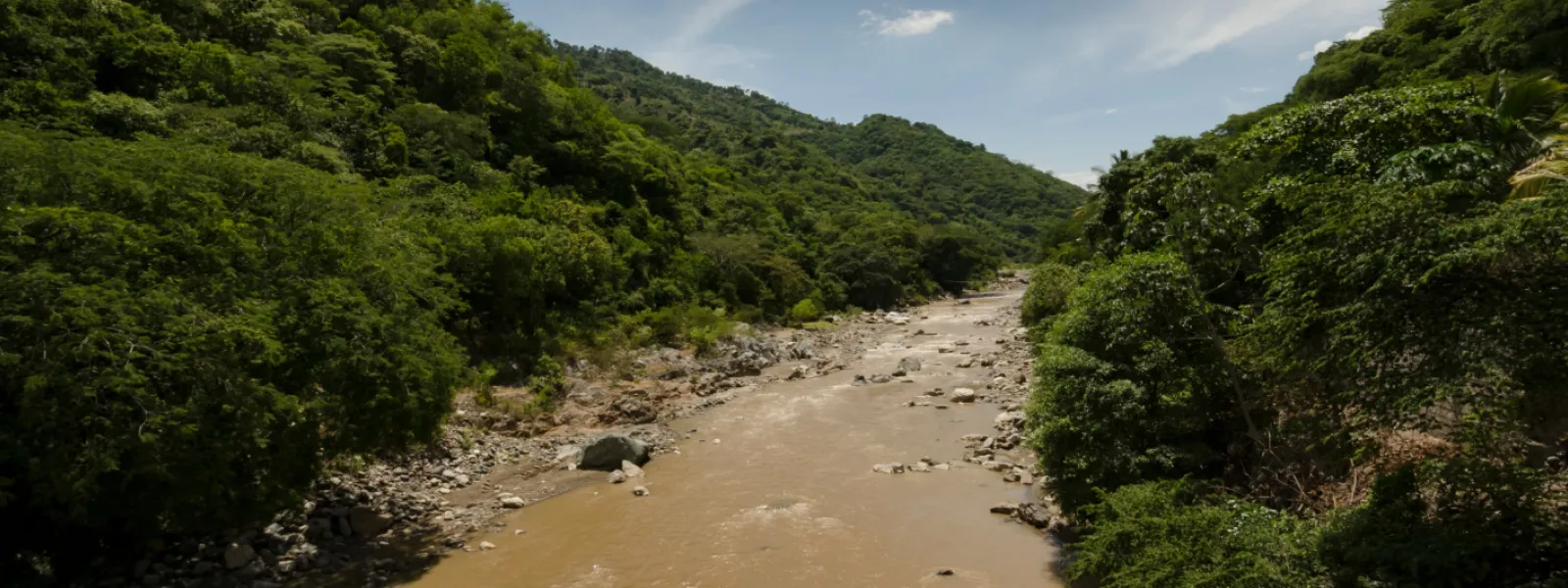
The Motagua River basin—Guatemala’s largest and most important river—is severely polluted with wastewater, solid waste, and other types of debris.
This is a cross-border issue because the Motagua’s polluted waters flow into the Caribbean Sea, reach the coast of Honduras, and threaten the Mesoamerican Reef System.
For decades, this has violated the rights to health, water, development, and a healthy environment of all the people living in the river basin.
In June 2025, the Poqomam Maya community of Santa Cruz Chinautla—supported by AIDA, the Indigenous Peoples’ Law Firm, and allied organizations—achieved an unprecedented legal victory to halt degradation in the basin. In response to the lawsuit it filed, a Guatemalan court ordered the municipality of Chinautla to comply with a series of obligations to curb the pollution of the area’s rivers and soil.
The government's response to the ruling has so far been limited to technical working group meetings. Meanwhile, the community continues to work toward the proper implementation of the ruling and to take other actions to defend its territory and its rights.
Background
The Motagua River, which is 486 km long, flows through 96 municipalities and 14 departments in Guatemala. It originates in Quiché, a department located in the northwest, and empties into the Caribbean Sea.
Polluting activities occur throughout the entire basin, including sub-basins and micro-basins. The largest volume of pollution comes from Guatemala City, the country’s capital, and is carried by the waters of the Las Vacas River, which in turn receives a large amount of waste from the Chinautla River.
The Chinautla River, which flows through the municipality of the same name, carries solid waste from a landfill located in Zone 3 of the capital—where trash from at least 14 municipalities in the department of Guatemala is dumped—as well as sewage generated by some 500,000 people living in the northern part of the capital, which undergoes no prior treatment.
Other sources of pollution include the numerous illegal dumps in the municipality of Chinautla, the waste that private vehicles and garbage trucks dump along the banks of its rivers, as well as the sand-mining companies—which began setting up operations in the area between 1996 and 1997—whose activities weaken the rivers' basins, causing solid waste to be more easily carried away by the river currents.
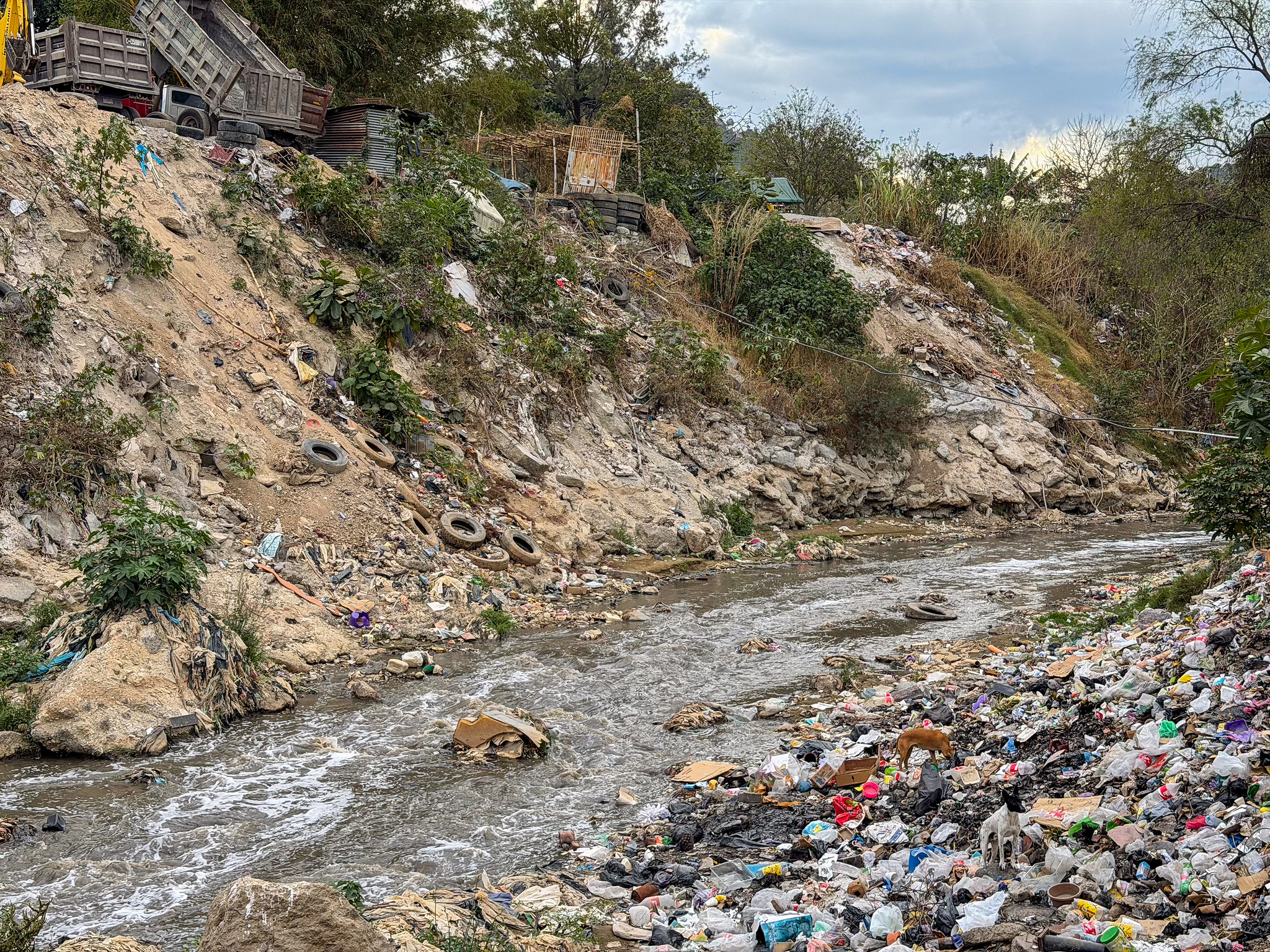
Photo: Mayela Sánchez García.
The situation extends beyond national borders. Every year, the Motagua River discharges some 20,000 metric tons of plastic into the Caribbean Sea, making it one of the rivers that contributes the most plastic pollution to the ocean worldwide, according to estimates contained in a 2025 report by the Inter-American Commission on Human Rights (IACHR).
The river flows into the Mesoamerican Reef at its mouth, so pollution also threatens to degrade one of the largest and most biodiverse transboundary reefs on the planet, which spans the territorial waters of Belize, Guatemala, Honduras, and Mexico.
In addition, the contaminated water reaches the coast of Honduras and spreads into Amatique Bay, located along the eastern coast of Guatemala, affecting the Caribbean Sea.
The roots of this chronic, cross-border problem are structural. Data from the Integrated Environmental Management of the Motagua River Basin project, funded by the United Nations Development Program (UNDP), show that in Guatemala, 66% of municipal solid waste is not collected, and there is no guarantee that the remaining 34% is disposed of properly. Furthermore, of all landfills nationwide, 88.32% are illegal or lack municipal authorization.
In other words, the core issues that need to be addressed are the mismanagement of solid waste and water resources in Guatemala; noncompliance with existing regulations on wastewater discharge and the disposal and treatment of solid waste and residues; and the lack of a water law.
The Poqomam Maya people's quest for justice
The rivers of Santa Cruz Chinautla, a community of the Poqomam Maya people located just twelve kilometers from Guatemala City, have become conduits of pollution that are degrading the Motagua River.
For decades, the local population has seen its health and livelihoods—including pottery, one of the main economic activities and a source of identity—damaged due to the lack of waste management in the municipality of Chinautla and the urban area of the country’s capital, as well as the activities of sand-mining companies.
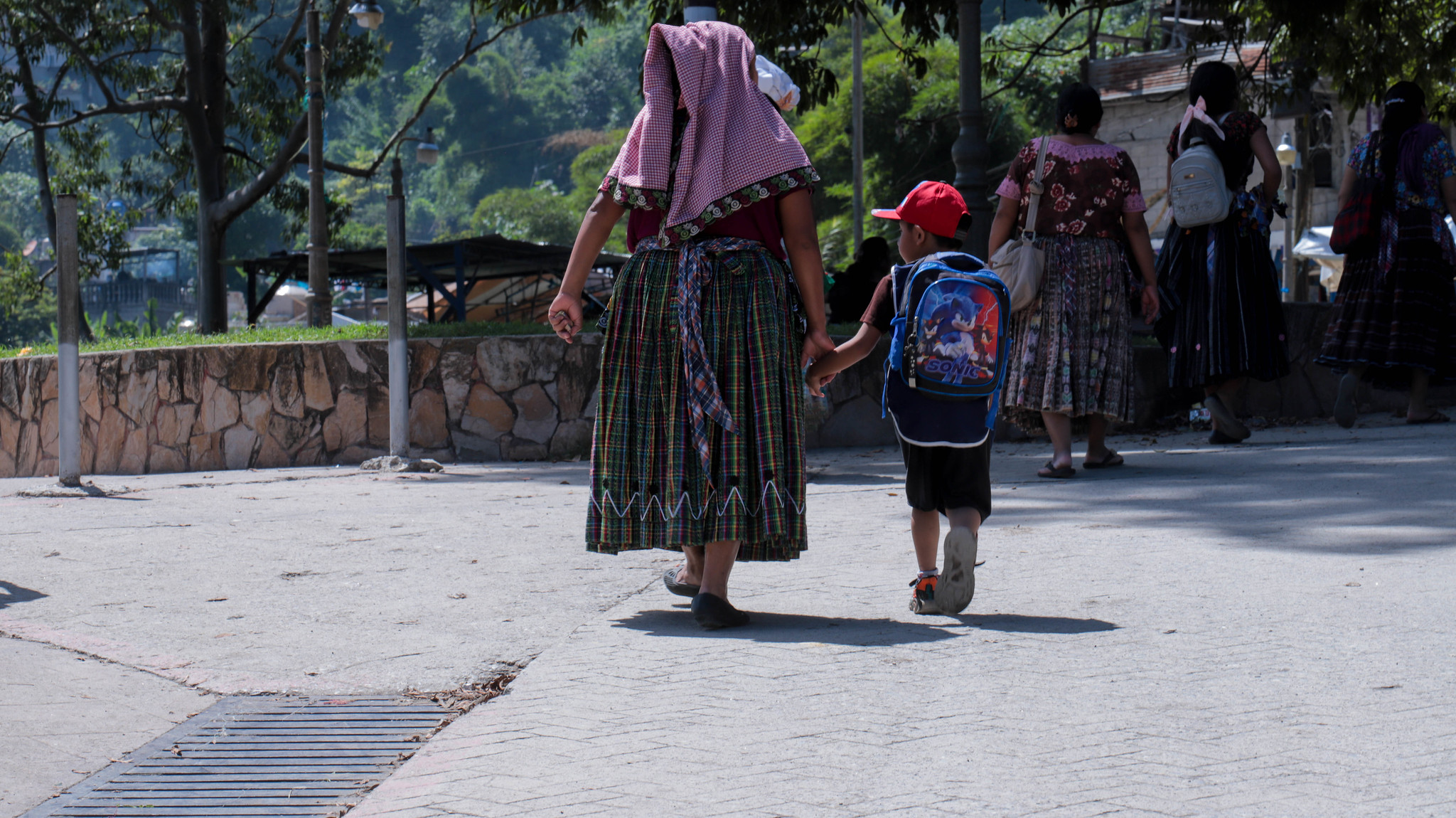
Photo: Mario Winter.
Voices for the Motagua River: Olga Vázquez.
Voices for the Motagua River: Nazario Pascual.
In early 2000, the Maya community organized to stop sand mining on their territory. At that time, the companies held mining permits that remained valid through 2021 and 2022. And although the permits expired, some companies continued to operate after requesting extensions. In June 2022, the indigenous authorities of the Poqomam people began a sit-in protest in front of the Piedrinera San Luis company, which they maintained for four years.
In July 2024, the Special Rapporteur on Economic, Social, Cultural, and Environmental Rights of the IACHR visited Santa Cruz Chinautla. During his visit, traditional authorities and community members spoke about the environmental, water-related, health, economic, and cultural impacts of the pollution in their rivers.
That same year, in October, the community—with support from AIDA, the Indigenous Peoples’ Law Firm, and partner organizations—filed a lawsuit (petition for amparo) against the municipality of Chinautla over its failure to take measures to address the contamination of its rivers and soil caused by improper solid waste management and the existence of illegal landfills.
AIDA’s scientific team, together with local residents and community authorities, collected key information on illegal landfills in the area. This community science initiative supported the litigation by highlighting the severity of the pollution, demonstrating the ongoing use of such practices, and providing evidence of the municipal authorities’ failure to fulfill their legal obligations regarding waste management.
Learn more about this community science initiative.
In June 2025, the Poqomam community won the support of the Guatemalan justice system when a constitutional court ordered the municipality of Chinautla to effectively address the claims in the lawsuit aimed at stopping the pollution of the rivers and soil in Santa Cruz Chinautla.
This is the first time a Guatemalan court has recognized a community's right to a healthy environment and its central role in finding solutions.
Find out the details of the legal victory.
Current situation
Since the ruling was issued, the municipality of Chinautla has held a series of “technical working groups” with representatives from the central government, civil society, and the community. A smaller group of technical experts was later created to develop a work plan with clear goals. Several months have passed without the municipality convening these working groups.
Furthermore, in December 2025, the IACHR noted in its report Human Rights Situation in Guatemala that the Motagua River basin is facing a severe pollution crisis that has had profound impacts on biodiversity and has resulted in systematic violations of the human rights of local communities, including the Maya Poqomam people.
And in May 2026, the Ministry of the Environment and Natural Resources revoked the license of the sand mining company Piedrinera San Luis for "failure to comply with environmental commitments."
AIDA continues to monitor the implementation of the court ruling to ensure the right to a healthy environment for the Poqomam Maya community and all those living in the Motagua River basin. Meanwhile, the residents of Santa Cruz Chinautla remain organized and mobilized to improve their environment and defend their rights.
Related projects
Behind the Dams: BNDES Investments in Belo Monte and Hidroituango
To change, one must understand. To understand, discuss. And to discuss, we present this report. In it, we analyze the application of existing international standards for hydroelectric plants through the lens of two of the most significant investments in the history of the BNDES: Hidroituango and Belo Monte. The analysis reveals evidence and offers conclusions and recommendations to the Bank, as well as to the organizations and communities involved. They are concrete elements to help improve the future performance of the financial institution. We hope that these contributions strengthen the dialogue with the BNDES, and facilitate the identification of options toward greater compliance with the values the bank has adopted, particularly those of transparency and social and environmental responsibility. Read the executive summary Read the complete report in Spanish Download the Executive Summary in Spanish Read the complete report in Portuguese Read the Executive Summary in Portuguese
Read more
Inter-American Commission urges Brazil to address damages to indigenous peoples caused by Belo Monte Dam
Following its visit to Brazil, the Inter-American Commission on Human Rights called the attention of authorities and civil society to the urgent need to address repeated violations of the rights of indigenous communities. The Commission highlighted the case of the Mïratu de Paquiçamba community, which has been affected by the construction of the Belo Monte Dam. Rio de Janiero, Brazil. Concluding its visit to the country, the Inter-American Commission on Human Rights (IACHR) urged Brazilian authorities and society in general to recognize, address, and quickly resolve repeated violations of the human rights of indigenous communities. The Commission emphasized the case of the Mïratu indigenous community, affected by the environmental damages caused by the construction of the Belo Monte Dam. In Brazil, indigenous communities “suffer from frequent incidents of violence and lack of attention from public services, in addition to increased difficulties and obstacles surrounding claims to their lands,” said Commissioner Antonia Urrejola Noguera, IACHR Rapporteur for Brazil, while presenting the Commission’s preliminary conclusions. “Brazil has been one of the largest violators of the human rights of indigenous communities. In their meeting with the Commission, the Brazilian Indigenous Communities Organization (APIB) presented these cases and expressed its concern over the current political landscape, in which a discourse of hatred and racism has been growing, even among government institutions,” said Luiz Eloy Terena, APIB’s legal advisor. On November 7, the Commission’s delegation visited Mïratu Village, located in the Paquiçamba indigenous region in the state of Pará. Mïratu is one of the indigenous communities affected by the Belo Monte Dam. It was the first time the Commission visited that area. There, the Commission heard testimonies from indigenous people and fishermen, who are fighting to maintain their traditional way of life despite damages including: the death of thousands of fish; the pollution of the Xingú river; forced displacement from their lands without adequate relocation; and the development of culturally inappropriate projects. Village leaders reported that those damages have disproportionately affected women and children. The Commission also heard from representatives of Altamira, the city nearest the dam. “We’d like to highlight the importance of the Commission’s historic visit to Mïratu Village, and recognize the negative impacts that the Belo Monte Dam has had on the human rights of the people of the Xingu River basin,” said Astrid Puentes Riaño, co-director of the Interamerican Association for Environmental Defense (AIDA). “It is now up to the government of Brazil to adopt the decisions and recommendations of the Commission, complying with the rule of law and protecting the people of their country.” During the visit, those affected by the dam were especially concerned over next year’s scheduled implementation of a plan to manage the flow of the Xingú River. Known as a consensus hydrogram, it would divert the water that indigenous and riverine communities, as well as plants and animals, rely on to survive. “The commissioners had the opportunity to confirm the severity of the impacts and the understand the urgent need to revise the criteria used to define the residual flow that the Xingu must maintain in order to guarantee the subsistence and culture of indigenous and riverine communities in the Vuelta Grande region,” said Bivany Rojas from the Socio-environmental Institute (ISA). In 2011, communities along the Xingu—represented by AIDA, the Paranese Society for the Defense of Human Rights (SDDH), and Justiça Global—filed a complaint against Brazil, bringing the case in front of the Commission. That same year, the Commission granted precautionary measures to affected indigenous communities. The case formally began in December 2015, and participating organizations presented final arguments in May of this year. Based on those and the arguments put forward by the the Brazilian State, the Commission will publish a report concluding whether human rights violations occurred from the construction of the Belo Monte Dam. They may then decide to issue recommendations for Brazil to remedy those damages. Demonstrating progress and a respect for the rights of indigenous communities—in cases like the Xucuru, the Xingu, and Guyraroka peoples—represents an important opportunity to strengthen rule of law and embrace progress in Brazil. press contacts: Victor Quintanilla (Mexico), AIDA, [email protected], +521 5570522107 Isabel Harari (Brazil), ISA, [email protected], +5561998261213
Read more
What motivates us to preserve our freshwater sources?
The professionals of AIDA’s freshwater program defend one of Earth’s most precious resources—water. The earth provides us with water in many ways, and the ways those water sources are threatened are just as widespread—but chief among them are extractive activities like mining and fracking. At AIDA, we understand the risks and we won’t let our guard down. Learn more about what motivates us to care for our greatest life source! “WITHOUT WATER, THERE IS NO FUTURE.” Carlos Lozano Acosta, Senior Attorney “Water is a life force not just in nature, but in our societies as well. It is a distinct characteristic of our experience on the planet. Cultures, economies and ecosystems depend on water and, for that reason, there is no future for us on this planet without it.” As a child, Carlos and his family used go for hikes near his father’s farm, on the outskirts of a páramo—a unique high altitude wetland that captures moisture from the fog and sends water to lower elevations via streams. Since those early days, Carlos has understood that páramos are vital to the water supply in his native Colombia. “I GREW UP WITH THE IDEA THAT CLEAN WATER IS A RIGHT, NOT A PRIVILEGE.” Claudia Velarde, Legal Advisor “What motivates me to care for our water sources is life itself. Clean water is an indispensable resource, a common good and a basic human right; the reproduction of our life systems is not possible without it. I grew up with the idea that clean water is a right, not a privilege.” Claudia was born in Cochabamba, Bolivia, a city whose name in the indigenous Quechua language means “the plain of lakes.” Despite its name, the city has suffered from decades of drought and water scarcity. Cochabamba is infamous for the Water War of 2000, during which residents flooded the streets to defend their water from privatization. Claudia grew up in that context and, like many women from Cochabamba, she has a strong connection to water and its inherent value. “MY STRONGEST MOTIVATION IS AN AWARENESS THAT THE HEALTH OF EARTH’S ECOSYSTEMS DEPENDS ON FUNCTIONING WATER FLOWS.” Andres Angel, Scientific Advisor “My strongest motivation is an awareness that the health of Earth’s ecosystems depends in large part on functioning surface and subterranean water flows. Understanding that our economic activities have the potential to irreversibly disrupt those flows is to realize the urgent need to protect the sources and quality of water throughout the Americas.” It wasn’t easy for Andres to study geology, a career that often promotes extractivism. His principal motivation was to understand the conflicts and socio-ecological dangers caused by mining and fossil fuel exploitation in his country, Colombia. Understanding those impacts to be perpetual, Andres decided to devote his professional life to questioning the development model and providing alternatives. “TO PROTECT WATER IS TO DEFEND THE SOURCE AND MEANING OF LIFE.” Juana Hofman, Legal Coordinator for the Network for Environmental Justice in Colombia “Life is what motivates me. To protect freshwater ecosystems and the people that depend on them is to defend the source and meaning of life. I’m motivated by a deep respect for ecosystems, because I feel a part of them, and they need protection. I’m motivated by the frailejones, ancient plants that serve as water factories, and by the mountains, vast landscapes that have sheltered me since my birth. It is their strength and beauty that allow us to truly live.” Juana was born in a small town in the mountains of Colombia. When she was a child, her father taught her of the greatness of the oak trees, which for Juana came to signify strength and wisdom. Ever since, her life has been deeply linked to the mountains, rivers, and páramos of Colombia.
Read more