
Project
Shutterstock.
Pollution of the Motagua River in Guatemala: The Poqomam Maya people’s quest for environmental justice
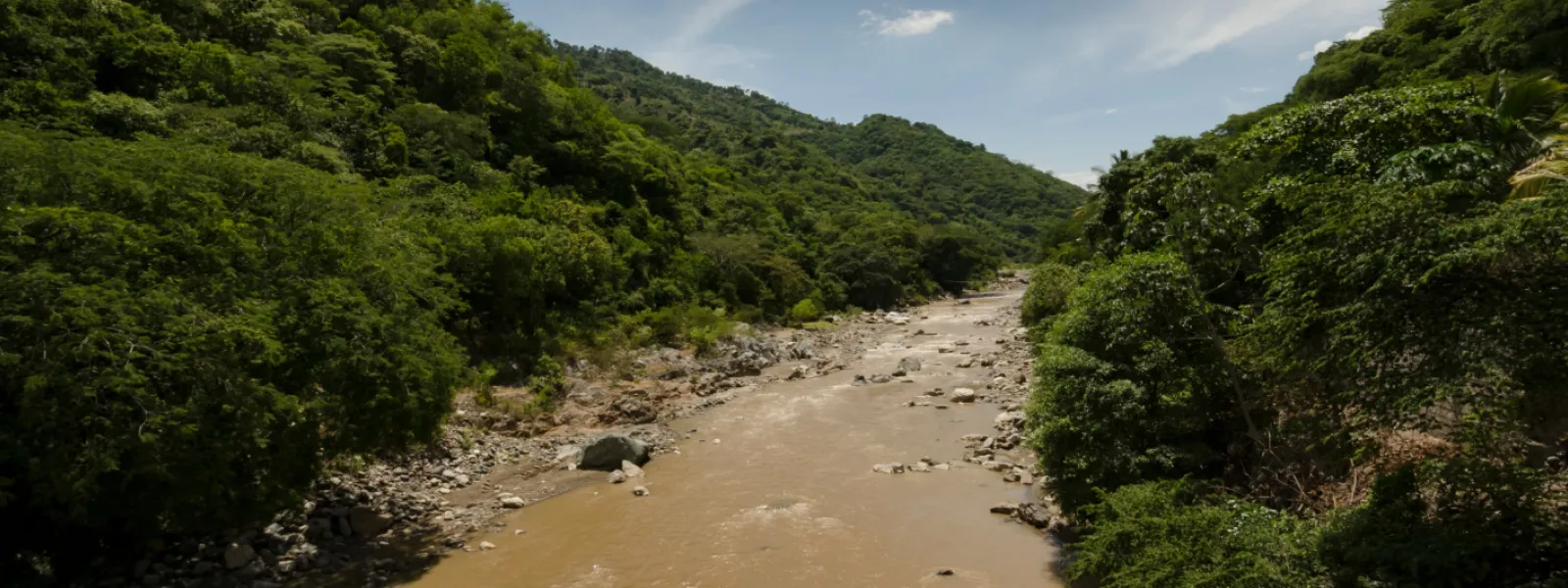
The Motagua River basin—Guatemala’s largest and most important river—is severely polluted with wastewater, solid waste, and other types of debris.
This is a cross-border issue because the Motagua’s polluted waters flow into the Caribbean Sea, reach the coast of Honduras, and threaten the Mesoamerican Reef System.
For decades, this has violated the rights to health, water, development, and a healthy environment of all the people living in the river basin.
In June 2025, the Poqomam Maya community of Santa Cruz Chinautla—supported by AIDA, the Indigenous Peoples’ Law Firm, and allied organizations—achieved an unprecedented legal victory to halt degradation in the basin. In response to the lawsuit it filed, a Guatemalan court ordered the municipality of Chinautla to comply with a series of obligations to curb the pollution of the area’s rivers and soil.
The government's response to the ruling has so far been limited to technical working group meetings. Meanwhile, the community continues to work toward the proper implementation of the ruling and to take other actions to defend its territory and its rights.
Background
The Motagua River, which is 486 km long, flows through 96 municipalities and 14 departments in Guatemala. It originates in Quiché, a department located in the northwest, and empties into the Caribbean Sea.
Polluting activities occur throughout the entire basin, including sub-basins and micro-basins. The largest volume of pollution comes from Guatemala City, the country’s capital, and is carried by the waters of the Las Vacas River, which in turn receives a large amount of waste from the Chinautla River.
The Chinautla River, which flows through the municipality of the same name, carries solid waste from a landfill located in Zone 3 of the capital—where trash from at least 14 municipalities in the department of Guatemala is dumped—as well as sewage generated by some 500,000 people living in the northern part of the capital, which undergoes no prior treatment.
Other sources of pollution include the numerous illegal dumps in the municipality of Chinautla, the waste that private vehicles and garbage trucks dump along the banks of its rivers, as well as the sand-mining companies—which began setting up operations in the area between 1996 and 1997—whose activities weaken the rivers' basins, causing solid waste to be more easily carried away by the river currents.
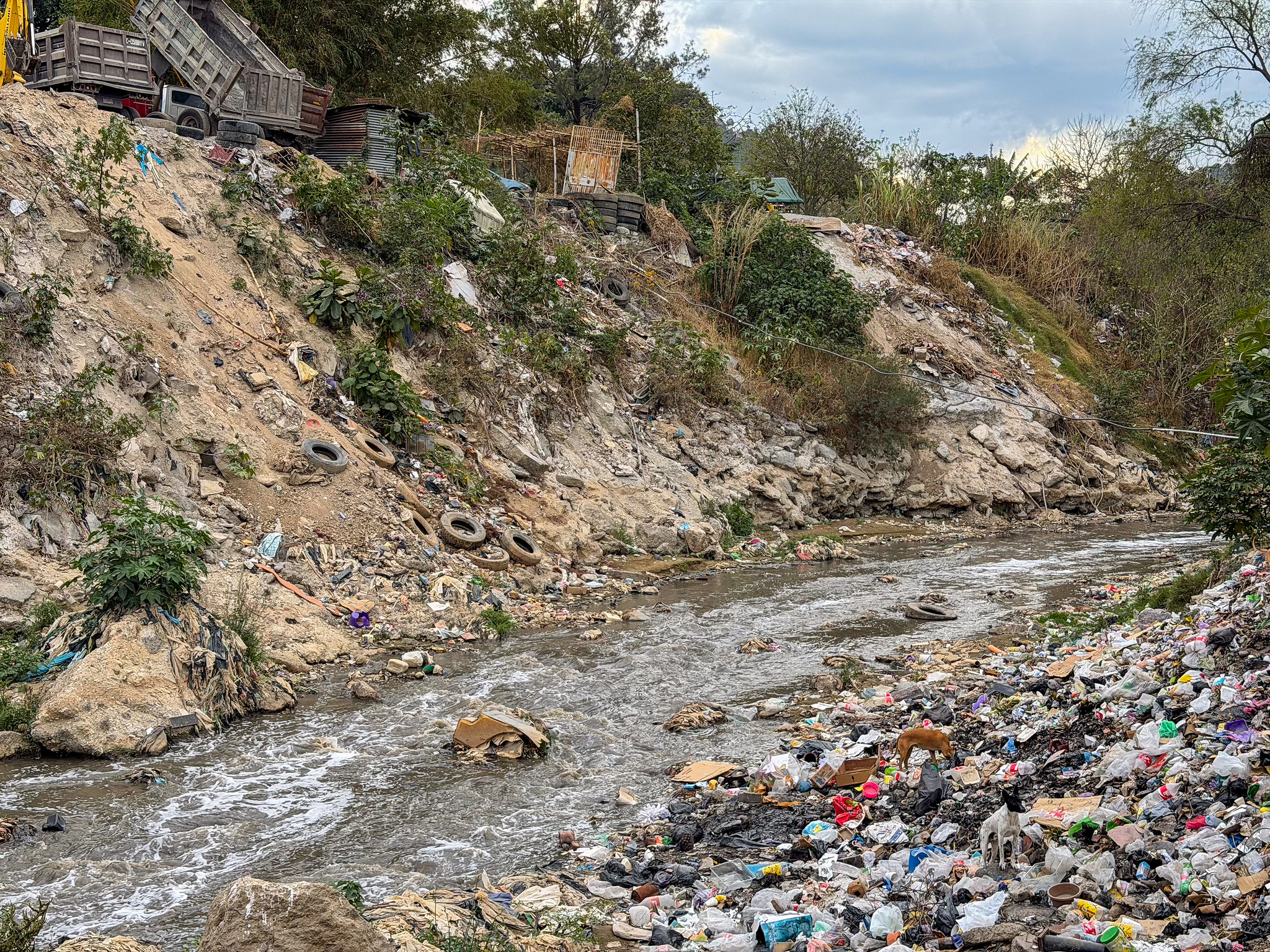
Photo: Mayela Sánchez García.
The situation extends beyond national borders. Every year, the Motagua River discharges some 20,000 metric tons of plastic into the Caribbean Sea, making it one of the rivers that contributes the most plastic pollution to the ocean worldwide, according to estimates contained in a 2025 report by the Inter-American Commission on Human Rights (IACHR).
The river flows into the Mesoamerican Reef at its mouth, so pollution also threatens to degrade one of the largest and most biodiverse transboundary reefs on the planet, which spans the territorial waters of Belize, Guatemala, Honduras, and Mexico.
In addition, the contaminated water reaches the coast of Honduras and spreads into Amatique Bay, located along the eastern coast of Guatemala, affecting the Caribbean Sea.
The roots of this chronic, cross-border problem are structural. Data from the Integrated Environmental Management of the Motagua River Basin project, funded by the United Nations Development Program (UNDP), show that in Guatemala, 66% of municipal solid waste is not collected, and there is no guarantee that the remaining 34% is disposed of properly. Furthermore, of all landfills nationwide, 88.32% are illegal or lack municipal authorization.
In other words, the core issues that need to be addressed are the mismanagement of solid waste and water resources in Guatemala; noncompliance with existing regulations on wastewater discharge and the disposal and treatment of solid waste and residues; and the lack of a water law.
The Poqomam Maya people's quest for justice
The rivers of Santa Cruz Chinautla, a community of the Poqomam Maya people located just twelve kilometers from Guatemala City, have become conduits of pollution that are degrading the Motagua River.
For decades, the local population has seen its health and livelihoods—including pottery, one of the main economic activities and a source of identity—damaged due to the lack of waste management in the municipality of Chinautla and the urban area of the country’s capital, as well as the activities of sand-mining companies.
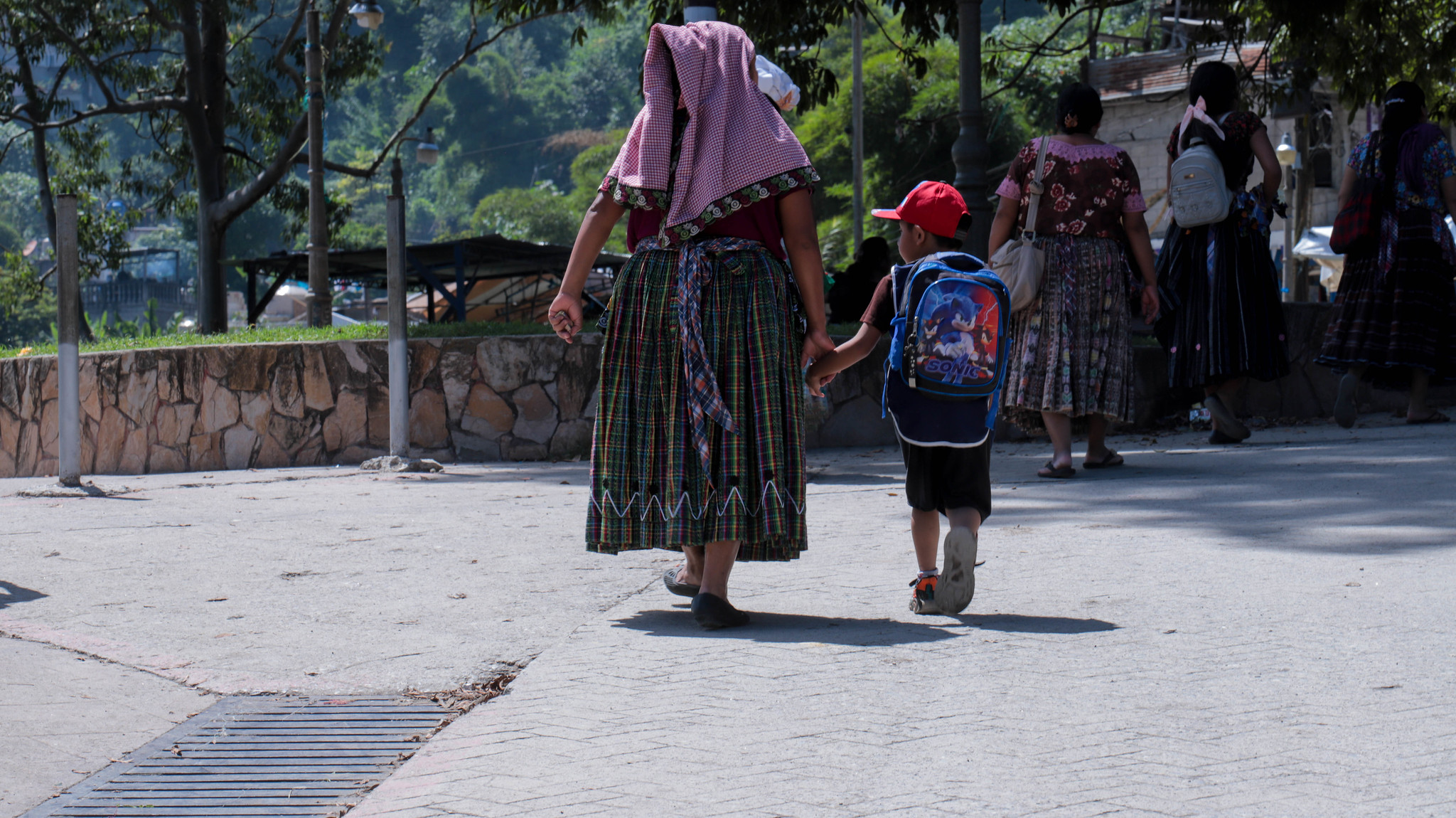
Photo: Mario Winter.
Voices for the Motagua River: Olga Vázquez.
Voices for the Motagua River: Nazario Pascual.
In early 2000, the Maya community organized to stop sand mining on their territory. At that time, the companies held mining permits that remained valid through 2021 and 2022. And although the permits expired, some companies continued to operate after requesting extensions. In June 2022, the indigenous authorities of the Poqomam people began a sit-in protest in front of the Piedrinera San Luis company, which they maintained for four years.
In July 2024, the Special Rapporteur on Economic, Social, Cultural, and Environmental Rights of the IACHR visited Santa Cruz Chinautla. During his visit, traditional authorities and community members spoke about the environmental, water-related, health, economic, and cultural impacts of the pollution in their rivers.
That same year, in October, the community—with support from AIDA, the Indigenous Peoples’ Law Firm, and partner organizations—filed a lawsuit (petition for amparo) against the municipality of Chinautla over its failure to take measures to address the contamination of its rivers and soil caused by improper solid waste management and the existence of illegal landfills.
AIDA’s scientific team, together with local residents and community authorities, collected key information on illegal landfills in the area. This community science initiative supported the litigation by highlighting the severity of the pollution, demonstrating the ongoing use of such practices, and providing evidence of the municipal authorities’ failure to fulfill their legal obligations regarding waste management.
Learn more about this community science initiative.
In June 2025, the Poqomam community won the support of the Guatemalan justice system when a constitutional court ordered the municipality of Chinautla to effectively address the claims in the lawsuit aimed at stopping the pollution of the rivers and soil in Santa Cruz Chinautla.
This is the first time a Guatemalan court has recognized a community's right to a healthy environment and its central role in finding solutions.
Find out the details of the legal victory.
Current situation
Since the ruling was issued, the municipality of Chinautla has held a series of “technical working groups” with representatives from the central government, civil society, and the community. A smaller group of technical experts was later created to develop a work plan with clear goals. Several months have passed without the municipality convening these working groups.
Furthermore, in December 2025, the IACHR noted in its report Human Rights Situation in Guatemala that the Motagua River basin is facing a severe pollution crisis that has had profound impacts on biodiversity and has resulted in systematic violations of the human rights of local communities, including the Maya Poqomam people.
And in May 2026, the Ministry of the Environment and Natural Resources revoked the license of the sand mining company Piedrinera San Luis for "failure to comply with environmental commitments."
AIDA continues to monitor the implementation of the court ruling to ensure the right to a healthy environment for the Poqomam Maya community and all those living in the Motagua River basin. Meanwhile, the residents of Santa Cruz Chinautla remain organized and mobilized to improve their environment and defend their rights.
Related projects
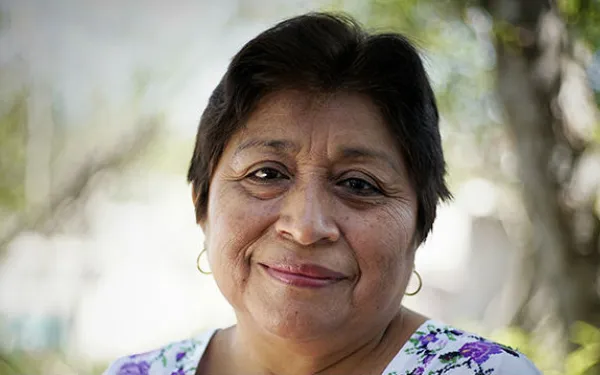
Leydy Pech, the guardian of the bees
“They’re part of my very being,” Leydy Araceli Pech Martin says of her bees. She feeds them pumpkin candy, and she identifies with them. Seeing how they organize and work together to produce honey reaffirms her confidence in collective action. In her native town of Ich Eq, a name that in Maya means “Star Eye,” families live in the same way: united and supporting each other. Of all the objectives that Leydy shares with her community, perhaps the most vital is the defense of their territory and traditional ways of life—threatened now by growing deforestation and the toxic contamination of industrial agriculture. The expansion of soy cultivation in Leydy’s town—located in the municipality of Hopelchén, in the Mexican State of Campeche—is killing large areas of tropical forest and indiscriminately spreading toxic pesticides through the land and water. It is harmful to both human health and the natural environment, particularly those ecosystems that depend on bees and, thus, beekeepers. Knocking down obstacles With a sweet look and a soft voice, Leydy is an agile woman. She does many things in a day, dividing her time between beekeeping, housework, caring for her mother and uncle, and keeping an eye on her son Diego Alberto, 17. She also manages the shop of Koolel-Kab (“women who work with bees”), an organization she founded with other women from Hopelchén in 1995. Together they breed and work for the preservation of melipona beecheii, a wild bee species that has been domesticated by the Maya people for hundred of years. Using what the bees produce, the women make and sell honeys, soaps and creams in the organization’s store. For Leydy, dedicating herself to beekeeping, a trade she learned from grandfather, which in the area is done mostly by men, has not been easy. She’s had to break down barriers. “We live in a world where only men have been able to speak and make decisions,” Leydy explained. “I’ve broken with that and they’ve questioned me.” At the beginning, the community underestimated the women’s potential. “They told us we wouldn’t achieve anything,” she said. “But little by little we demonstrated our abilities. The men saw the results of our work and publically recognized that the organization is an example of struggle, and success.” The women of Koolel-Kab work for the recognition of and respect for indigenous rights in the region. Leydy says their struggle began when they realized that other people were making decisions about the territory and natural resources of their town, about job opportunities and quality of life for their youngest members. Mennonites and industrial agribusiness have been cultivating genetically modified soybeans in Hopelchén, leading to mass deforestation and public health risks. The Mexican government authorized the cultivation without consulting affected communities. Although Mexico’s Supreme Court has recognized this human rights violation, the illegal planting of GMO soy has not stopped and the sowing of traditional soy has expanded. In addition, the aerial fumigation of crops is causing a harmful mixture of chemicals to reach houses, water sources, and the flowers the bees rely on. “I cannot sit idly by when I know what is happening,” explained Leydy, with the firmness that characterizes her. “It has become my responsibility. Not doing anything would be like betraying my own identity.” Leydy is motivated by the search for justice. Her organization of Maya women is part of the Collective of Maya Communities of los Chenes, which has presented national and international legal actions to stop the damages of agroindustry. AIDA, together with partner organizations, supports their efforts and has taken the case, on behalf of the communities, before the Inter-American Commission on Human Rights. The strength of unity Leydy is convinced that the strength of the Collective is its unity. Those in the Collective work for the needs of their own communities, but are also in the process of seeing themselves as one—something that applies not only to the people of Campeche, but also to those of the nearby States of Yucatan and Quintana Roo. “The Maya people are many, and everything that we’ve achieved is not for only one person, it is for all.” Leydy shares her leadership and her natural ability for teamwork. Her son, Diego Alberto, is part of that effort. “He’s happy, he understands a lot about bees and has his own projects,” she says. Like Diego Albert, other young members of Leydy’s family are choosing to dedicate themselves to beekeeping. “That tells me I’m doing something right,” she says, proudly.
Read more
Open Letter to States and Development Financiers
On the anniversaries of the United Nations Declaration on the Right to Development (December 4th), the Declaration on Human Rights Defenders (December 9th), and the Universal Declaration of Human Rights (December 10th), civil society groups around the world are drawing attention to the unique threats faced by human rights defenders in the context of megaprojects and other development interventions. Human rights defenders are a critical force for the protection of human rights and integral to the achievement of sustainable development. They are vital to protecting the land and the environment, securing just and safe conditions of work, combating corruption, respecting traditional cultures, and holding governments accountable. Yet those who voice their opinions or seek to shape development and investments are routinely stigmatized as “anti-development,” and subjected to judicial harassment, threats, and violent attacks. Since the adoption of the Declaration on Human Rights Defenders 20 years ago, an estimated 3,500 human rights defenders have been killed because of their peaceful work defending the rights of others. In 2017 alone, at least 312 human rights defenders were murdered, 67 percent of whom were working in defense of land and territory in the context of large investments, extractive industries and big business. Today, the same governments who adopted these important human rights instruments may actually be undermining those efforts through the actions of their national development banks or bilateral and multilateral development cooperation. Where development interventions ignore human rights, or are imposed upon communities without their consent or participation, they often fail to deliver development or alleviate poverty, and instead end up contributing to rights abuses and putting defenders at risk. That is why the Defenders in Development Campaign is calling on development banks, States, and other development actors to honor these human rights anniversaries by highlighting the important role that defenders play in sustainable development and making a public commitment to: Ensure that development interventions support the realization of human rights and avoid abuses, Promote an enabling environment for public participation within development processes, and Take necessary measures to safeguard defenders in the context of development activities. Read the Open Letter signed by over 200 groups Find more information here
Read more
The first time fracking was discussed before the Inter-American Commission
We heard the news at an exceptional moment. The Latin American Alliance on Fracking had organized a conference; activists, lawyers, NGOs, community organizers, and scientists from seven Latin American countries were meeting face to face in Colombia to work against hydraulic fracturing in the region. It was there we learned that the Inter-American Commission on Human Rights had accepted our request for a hearing. We erupted in collective joy! Not only would we have a new audience, but also fracking would be discussed for the first time before the Commission. Immediately, we channeled our excitement into hard work. We had just 20 days to prepare a 20-minute case that would summarize every negative impact fracking has had in the Americas. We worked day and night to prepare our case for the October 3 hearing in Boulder, Colorado. It was so little time that Gabriel Cherqui, spokesperson for Mapuche communities affected by the Vaca Muerta mega-project in Neuquén, Argentina, couldn’t obtain a visa in time to travel to the United States. Years of work, converted into minutes Perhaps the most difficult aspect of preparing our case was summarizing thousands of documents and stories into such a short amount of time. It had taken years to systematize our specialized research on fracking in the region and to have our case before the Commission—requested with more than 120 supporting signatures—accepted. Another challenge was to demonstrate the solid connection between fracking and human rights violations, an argument we knew the Commission would be interested in addressing, given the scale and complexity of the problem. So we developed a strategy: Roberto Ochandio, a geographer and former petroleum engineer, presented the technical details necessary to understand how fracking works; AIDA attorney Liliana Ávila explained how the technique has violated the rights to a healthy environment, to life, health, and the informed consent of the affected communities; Alejandra Jiménez from the Mexican Alliance Against Fracking presented case studies from Mexico, where communities’ access to water had been compromised by fracking operations; Santiago Cané, from Argentina’s Environmental and Natural Resources Foundation (FARN), exposed the pollution, direct harms, lack of consultation with, and persecution of the communities of Neuquén; and Doris Estela Gutiérrez, president of the Corporation for the Defense of Water, Territory, and Ecosystems (CORDATEC), spoke about the promotion of public consultations in Colombia, as well as the criminalization of and threats to environmental defenders in the country. We emphasized that betting on hydrocarbons and promoting fracking undermines the fight against climate change, since fracking emits methane and other greenhouse gases that accelerate global warming. It was a challenge, to be sure. But we wanted to ensure everyone’s voice was heard. To listen, and learn: a window of hope Based on the response of the Commissioners, it was clear that our case had opened a window of hope. The multifaceted character of fracking—including aspects of development, pollution, climate change and human rights—had captured their interest. Not only was this the first time that fracking had been discussed before of the Commission, it’s worth noting that five speakers had summarized the concerns of more than 120 petitioners, all of whom shared one common cause. What came next was a dialogue in which we responded to the Commissioners’ questions about the technique, their concerns about development in the region, water quality, harms to public health, and concerns about fracking moving nations further away from their climate goals. We requested that the Commission urge States to: adopt measures to avoid human rights violations caused by fracking; generate public, truthful and impartial information based on scientific evidence; and protect human rights protections in cases where the technique is advancing blindly. Going forward, we asked that the Commission follow up on the issue, particularly on the negative impacts fracking has on economic, social and cultural rights; on the lives of women, children and adolescents; and on the lives and territories of indigenous peoples. We requested that the Commission follow up on the attacks against human rights defenders and seek protective measures for those at risk. Of course, questions remain, and at the Alliance we’ve identified many more concerns for the region. But this moment has strengthened us. The hearing set regional precedents and made use of the arguments of Advisory Opinion 23, which the Inter-American Court of Human Rights issued on human rights and the environment. It is clear that this moment was a small, but vital, step forward, and that there are ears willing to listen. For our part, we will continue doing everything in our power—making use of all available international legal tools—to protect the communities of the Americas that are and could be affected by fracking.
Read more