
Project
Shutterstock.
Pollution of the Motagua River in Guatemala: The Poqomam Maya people’s quest for environmental justice
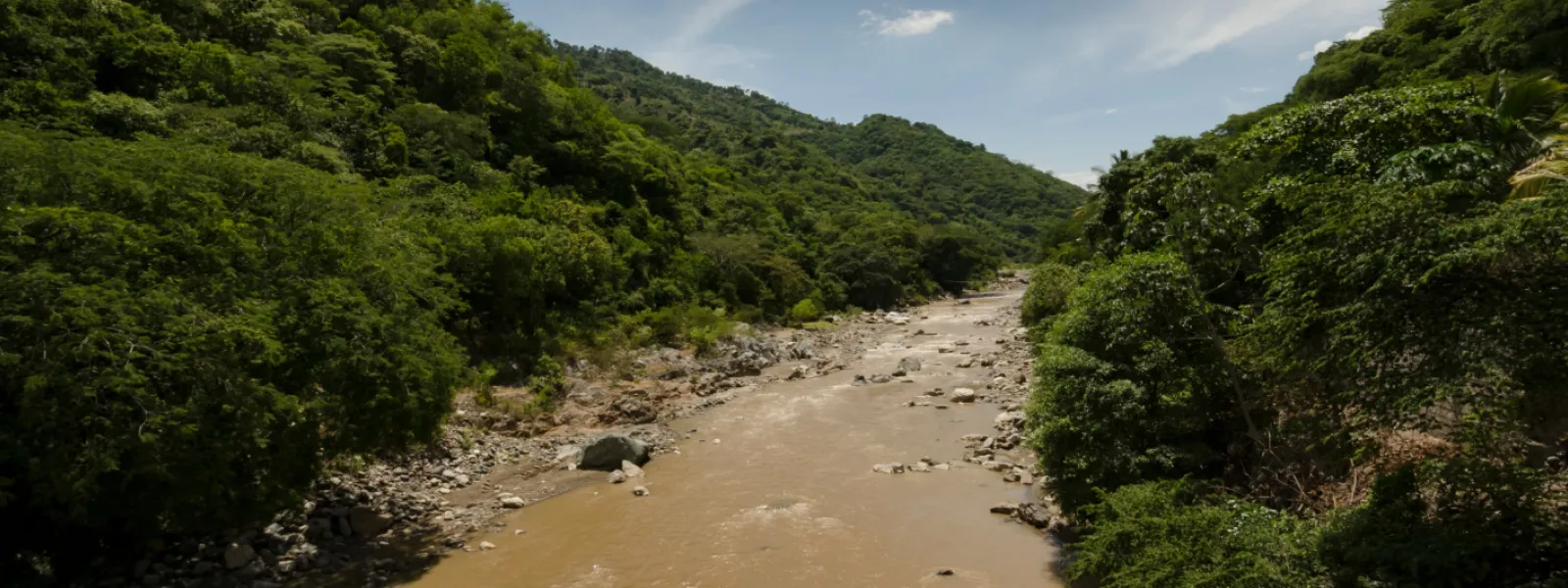
The Motagua River basin—Guatemala’s largest and most important river—is severely polluted with wastewater, solid waste, and other types of debris.
This is a cross-border issue because the Motagua’s polluted waters flow into the Caribbean Sea, reach the coast of Honduras, and threaten the Mesoamerican Reef System.
For decades, this has violated the rights to health, water, development, and a healthy environment of all the people living in the river basin.
In June 2025, the Poqomam Maya community of Santa Cruz Chinautla—supported by AIDA, the Indigenous Peoples’ Law Firm, and allied organizations—achieved an unprecedented legal victory to halt degradation in the basin. In response to the lawsuit it filed, a Guatemalan court ordered the municipality of Chinautla to comply with a series of obligations to curb the pollution of the area’s rivers and soil.
The government's response to the ruling has so far been limited to technical working group meetings. Meanwhile, the community continues to work toward the proper implementation of the ruling and to take other actions to defend its territory and its rights.
Background
The Motagua River, which is 486 km long, flows through 96 municipalities and 14 departments in Guatemala. It originates in Quiché, a department located in the northwest, and empties into the Caribbean Sea.
Polluting activities occur throughout the entire basin, including sub-basins and micro-basins. The largest volume of pollution comes from Guatemala City, the country’s capital, and is carried by the waters of the Las Vacas River, which in turn receives a large amount of waste from the Chinautla River.
The Chinautla River, which flows through the municipality of the same name, carries solid waste from a landfill located in Zone 3 of the capital—where trash from at least 14 municipalities in the department of Guatemala is dumped—as well as sewage generated by some 500,000 people living in the northern part of the capital, which undergoes no prior treatment.
Other sources of pollution include the numerous illegal dumps in the municipality of Chinautla, the waste that private vehicles and garbage trucks dump along the banks of its rivers, as well as the sand-mining companies—which began setting up operations in the area between 1996 and 1997—whose activities weaken the rivers' basins, causing solid waste to be more easily carried away by the river currents.
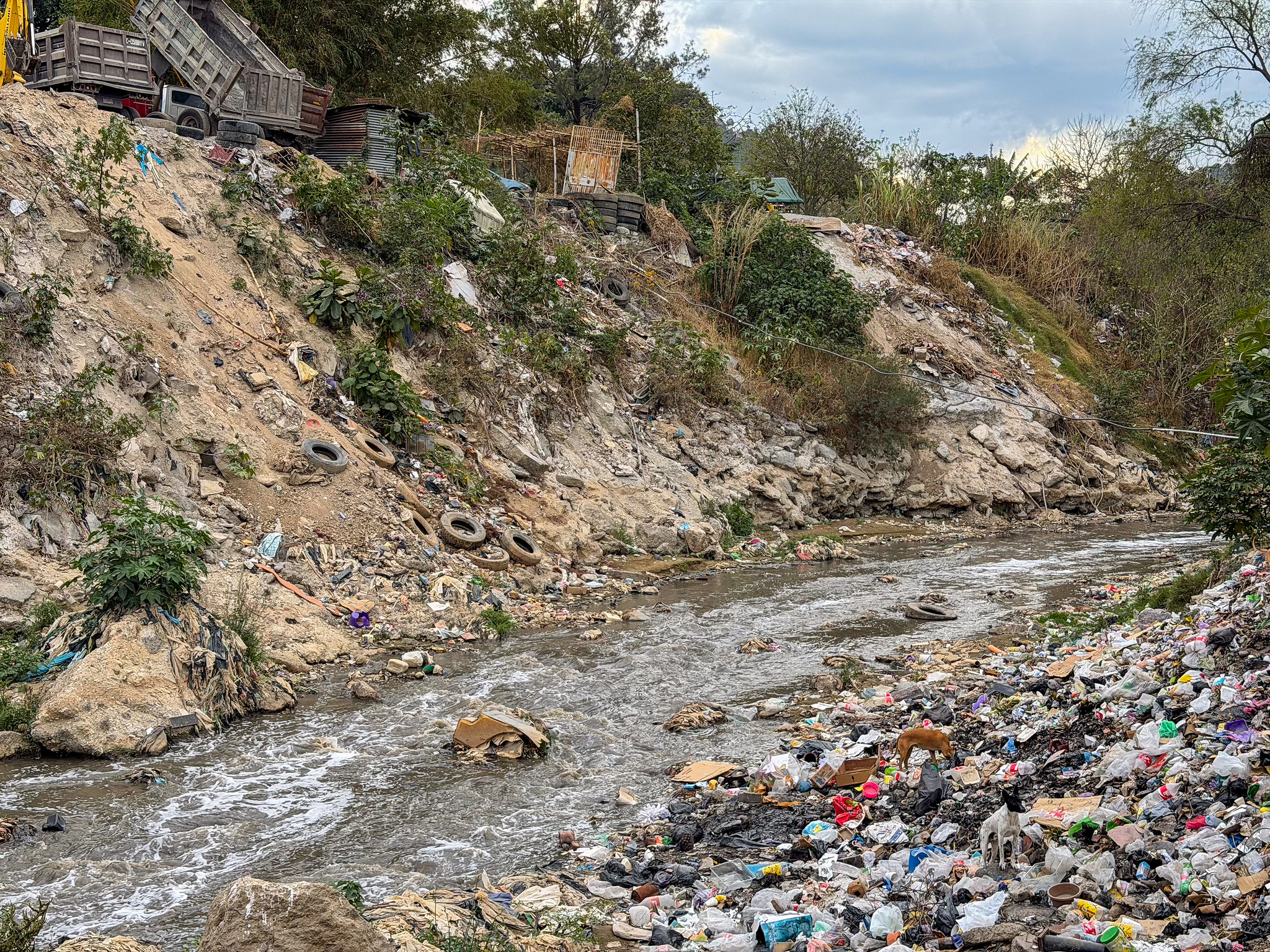
Photo: Mayela Sánchez García.
The situation extends beyond national borders. Every year, the Motagua River discharges some 20,000 metric tons of plastic into the Caribbean Sea, making it one of the rivers that contributes the most plastic pollution to the ocean worldwide, according to estimates contained in a 2025 report by the Inter-American Commission on Human Rights (IACHR).
The river flows into the Mesoamerican Reef at its mouth, so pollution also threatens to degrade one of the largest and most biodiverse transboundary reefs on the planet, which spans the territorial waters of Belize, Guatemala, Honduras, and Mexico.
In addition, the contaminated water reaches the coast of Honduras and spreads into Amatique Bay, located along the eastern coast of Guatemala, affecting the Caribbean Sea.
The roots of this chronic, cross-border problem are structural. Data from the Integrated Environmental Management of the Motagua River Basin project, funded by the United Nations Development Program (UNDP), show that in Guatemala, 66% of municipal solid waste is not collected, and there is no guarantee that the remaining 34% is disposed of properly. Furthermore, of all landfills nationwide, 88.32% are illegal or lack municipal authorization.
In other words, the core issues that need to be addressed are the mismanagement of solid waste and water resources in Guatemala; noncompliance with existing regulations on wastewater discharge and the disposal and treatment of solid waste and residues; and the lack of a water law.
The Poqomam Maya people's quest for justice
The rivers of Santa Cruz Chinautla, a community of the Poqomam Maya people located just twelve kilometers from Guatemala City, have become conduits of pollution that are degrading the Motagua River.
For decades, the local population has seen its health and livelihoods—including pottery, one of the main economic activities and a source of identity—damaged due to the lack of waste management in the municipality of Chinautla and the urban area of the country’s capital, as well as the activities of sand-mining companies.
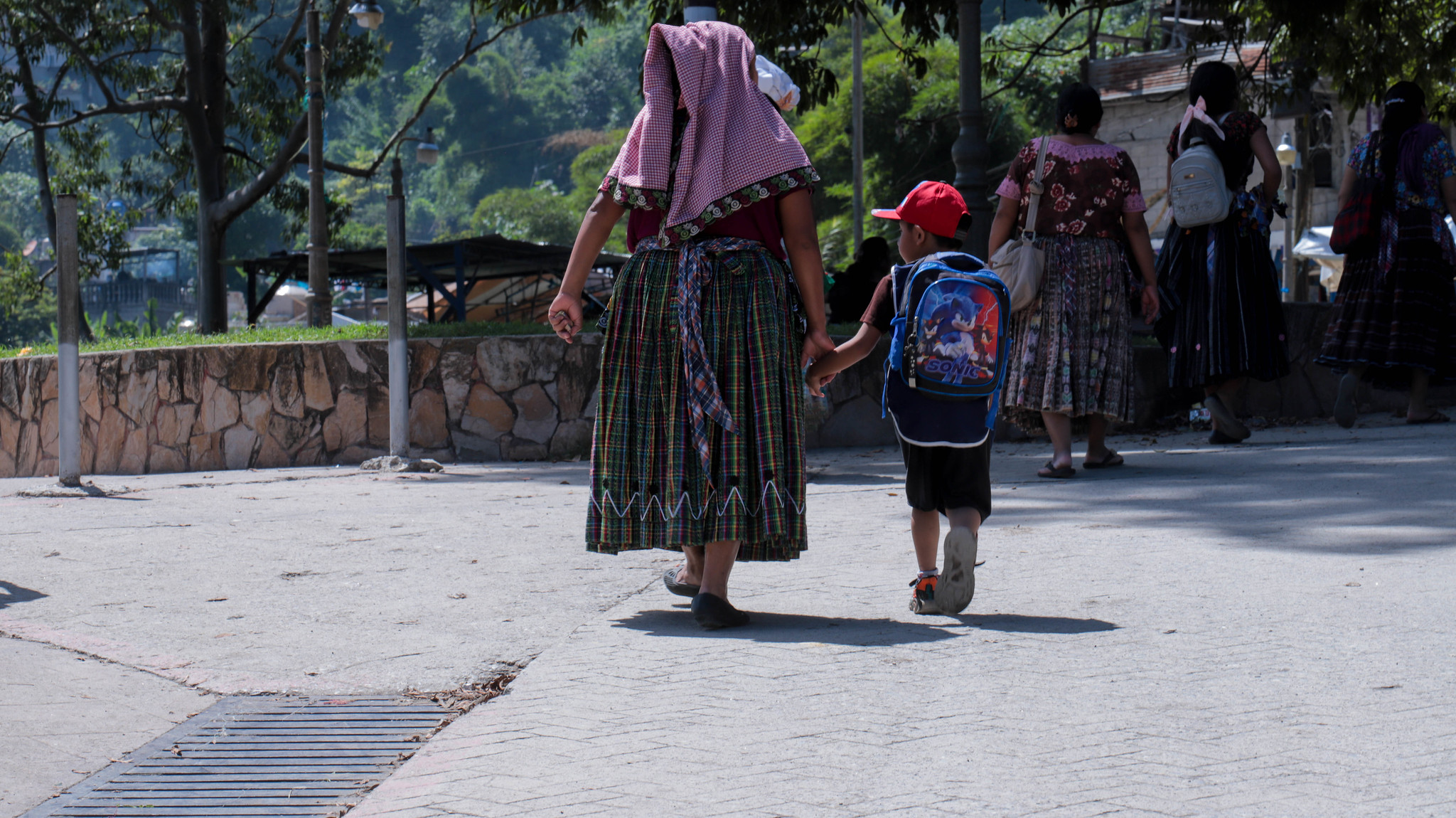
Photo: Mario Winter.
Voices for the Motagua River: Olga Vázquez.
Voices for the Motagua River: Nazario Pascual.
In early 2000, the Maya community organized to stop sand mining on their territory. At that time, the companies held mining permits that remained valid through 2021 and 2022. And although the permits expired, some companies continued to operate after requesting extensions. In June 2022, the indigenous authorities of the Poqomam people began a sit-in protest in front of the Piedrinera San Luis company, which they maintained for four years.
In July 2024, the Special Rapporteur on Economic, Social, Cultural, and Environmental Rights of the IACHR visited Santa Cruz Chinautla. During his visit, traditional authorities and community members spoke about the environmental, water-related, health, economic, and cultural impacts of the pollution in their rivers.
That same year, in October, the community—with support from AIDA, the Indigenous Peoples’ Law Firm, and partner organizations—filed a lawsuit (petition for amparo) against the municipality of Chinautla over its failure to take measures to address the contamination of its rivers and soil caused by improper solid waste management and the existence of illegal landfills.
AIDA’s scientific team, together with local residents and community authorities, collected key information on illegal landfills in the area. This community science initiative supported the litigation by highlighting the severity of the pollution, demonstrating the ongoing use of such practices, and providing evidence of the municipal authorities’ failure to fulfill their legal obligations regarding waste management.
Learn more about this community science initiative.
In June 2025, the Poqomam community won the support of the Guatemalan justice system when a constitutional court ordered the municipality of Chinautla to effectively address the claims in the lawsuit aimed at stopping the pollution of the rivers and soil in Santa Cruz Chinautla.
This is the first time a Guatemalan court has recognized a community's right to a healthy environment and its central role in finding solutions.
Find out the details of the legal victory.
Current situation
Since the ruling was issued, the municipality of Chinautla has held a series of “technical working groups” with representatives from the central government, civil society, and the community. A smaller group of technical experts was later created to develop a work plan with clear goals. Several months have passed without the municipality convening these working groups.
Furthermore, in December 2025, the IACHR noted in its report Human Rights Situation in Guatemala that the Motagua River basin is facing a severe pollution crisis that has had profound impacts on biodiversity and has resulted in systematic violations of the human rights of local communities, including the Maya Poqomam people.
And in May 2026, the Ministry of the Environment and Natural Resources revoked the license of the sand mining company Piedrinera San Luis for "failure to comply with environmental commitments."
AIDA continues to monitor the implementation of the court ruling to ensure the right to a healthy environment for the Poqomam Maya community and all those living in the Motagua River basin. Meanwhile, the residents of Santa Cruz Chinautla remain organized and mobilized to improve their environment and defend their rights.
Related projects

Civil society organizations denounce assassination of member of Movimiento Ríos Vivos in Colombia
We stand in solidarity with the Movimiento, and we request that the Colombian State investigate this act and punish those responsible. Furthermore, we ask that Colombia adopt urgent and effective measures to stop ongoing violence against environmental defenders. The undersigned national and international organizations categorically condemn the assassination in Colombia of Mr. Hugo Albeiro George Pérez, member of Movimiento Ríos Vivos. Movimiento Ríos Vivos denounced the murder of Mr. George, who is a member of the Asociación de Víctimas y Afectados por Megaproyectos (ASVAM) El Aro—part of Movimiento Ríos Vivos Antioquia—and who, along with his family, was affected by the construction of the Hidroituango dam. The incident, in which his nephew Domar Egidio Zapata George was also killed, occurred on May 2, 2018, in Puerto Valdivia, Antioquia, in the context of regional community mobilizations against the social and environmental risks of the damming of the Cauca River. Hidroituango would be the largest dam in Colombia, with a height of 225 meters and a storage capacity of 20 million cubic meters of water. The project will affect 12 municipalities and impact thousands of families who depend on the river. The project is being financed by a loan package from IDB Invest, the private-sector arm of the Inter-American Development Bank. For defending the land and the Cauca River, Movimiento Ríos Vivos has been the target of threats, intimidation, and human rights violations. The owners of the Hidroituango project must respect human rights and act with due diligence in assessing the impacts of the dam’s construction. In response to the incident, we express our solidarity with Movimiento Ríos Vivos and with the family of Hugo Albeiro George Pérez. We request that the Office of the Attorney General of Colombia investigate this act in an expedited manner and that the appropriate court penalize those responsible. Likewise, and in the context of worsening violence against environmental defenders in the region, we demand that the government guarantee a safe setting for the work of Movimiento Ríos Vivos and to take all necessary precautions to stop the threats, intimidation, and murders against those who defend the environment and their territory. Finally, we request that environmental authorities investigate the impacts communities suffer due to the damming of the Cauca River and that the government provide assistance to the families affected by the project. Accion Ecologica, RedLar Ecuador. Afro-Colombian Solidarity Network. Alianza Internacional de Habitantes. Alianza para la Conservación y el Desarrollo, Panamá. Asamblea Veracruzana de Iniciativas y Defensa Ambiental, Lavida, México. Interamerican Association for Environmental Defense. Bank Information Center. Bretton Woods Project, Londres. CEE Bankwatch Network, Hungría Center for International Environmental Law, Estados Unidos. Centro de Derechos Económicos y Sociales, Ecuador. Coordinadora de Afectados por Grandes Embalses y Trasvases, Coagret. Colombia Grasssrooots Support, New Jersey, Estados Unidos. Colombia Human Rights Committee, Washington, DC, Estados Unidos. Colombia Land Rights Monitor. Consejo de los Pueblos Wuxtaj/CPO, Guatemala. Convergencia por los Derechos Humanos, Guatemala. Derecho, Ambiente y Recursos Naturales, Perú. Due Process of Law Foundation, Estados Unidos. Earthrights International. Ecosistemas Chile, Chile. Environmental Investigation Agency, Estados Unidos. Fundación Ambiente y Recursos Naturales, Argentina. Fundación Chile Sustentable, Chile. Fundar, Mexico. Front Line Defenders, Reino Unido. Global Witness, Reino Unido. IISCAL, Estados Unidos. International Accountability Project, Estados Unidos. International Labor Rights Forum. International Rivers. Latin America Working Group, Estados Unidos. Movement for Peace in Colombia, New York, Estados Unidos. Movimiento Mexicano de Afectados por las Presas y en Defensa de los Ríos, México. Movimiento Victoriano Lorenzo. Not1More. Oxfam. Plataforma Continental Somos una América. Pueblos Unidos de la Cuenca Antigua. Servicios para una Educación Alternativa, México. Taller de Comunicación Ambiental, Rosario. Washington Office on Latin America, Estados Unidos. Press contact: Víctor Quintanilla, AIDA, +521 5570522107, [email protected]
Read more
Brazil must respond to human rights violations caused by the Belo Monte Dam
In representation of communities affected by the Belo Monte Dam, we have submitted final arguments in the case against Brazil before the Inter-American Commission on Human Rights. The report presents scientific evidence of the forced displacement of indigenous and traditional communities, the mass die-off of fish, differentiated harms to men and women, and threats to the survival of local communities in the Brazilian Amazon. Washington, DC, United States and Altamira, Brazil. Furthering the formal complaint against the State of Brazil for human rights violations caused by the construction of the Belo Monte Dam, organizations representing affected communities presented their final arguments before the Inter-American Commission on Human Rights. They demonstrate the damages Belo Monte has caused to indigenous and traditional communities, and residents of Altamira, the city closest to the dam. “Human rights violations are a daily occurence for those affected by the dam, so it’s urgent that our petition before the Commission advance to sanction the government and guarantee our rights,” proclaimed Antônia Melo, coordinator of the Movimiento Xingu Vivo para Siempre, a citizens’ collective formed in the face of the dam’s implementation. The report presented before the Commission shows that the damages resulted from a severe lack of foresight and inadequate evaluation, as well as from failure to comply with the conditions for operation established by the government. The many risks denounced prior to the dam’s construction have since become long-term damages—many of which have affected men and women, and youth and the elderly, in different ways. “This report is a vital step forward for the people of the Xingu River basin, who are now closer than ever to achieving justice, forcing Brazil to respond to the violations committed, and ensuring that what happened on the Xingu never happens again,” said Astrid Puentes Riaño, co-director of the Inter-American Association for Environmental Defense (AIDA). Together with the Paraense Society for Human Rights (SDDH) and Justiça Global, AIDA represents the affected communities before the Commission. The report also documents the displacement of indigenous and traditional communities forced to leave their territories without adequate alternatives, placing their cultural survival at risk. Among the affected populations are communities dedicated to fishing, who have not yet been compensated for the loss of livelihood. The dam has caused mass die-offs of fish and, although authorities have imposed millions in fines, the report demonstrates that the underlying problem has not been resolved. Local communities now have limited use of the Xingu River as a source of food, sustenance, transportation and entertainment. The report also documents—among other serious harms—the disappearance of traditional trades, such as brickmakers and cart drivers, and of traditional cultural practices. Women, for example, have stopped giving birth in their homes and must now go to a hospital, a reality that has drastically worsened due to the oversaturation of health and education services in Altamira caused by the recent population surge. The complaint against Brazil was presented before the Commission in 2011, the year the international organism granted protective measures to indigenous people affected by the dam’s construction. The case against Brazil officially opened in December 2015. Then, last October, in a rare move designed to speed up the processing of the case, the Commission decided to unite two stages that, as a rule, are normally processed separately. Under this framework, the organizations and the State are required to present their final arguments, after which the Commission will make a decision. “We hope the Commission refers the case to the Inter-American Court of Human Rights as soon as possible, and that it recommends Brazil adopt the measures necessary to protect the life, integrity, and right to property of the indigenous and traditional communities affected by the dam,” said Raphaela Lopes, attorney at Justiça Global. “After being subject to all forms of rights violations, starting from the very beginning of this project, these communities need integral reparation; their right to free, prior and informed consent was not honored.” The Commission must now prepare a report to conclude whether or not human rights violations occurred as a result of the Belo Monte Dam, in which it may issue recommendations for remediation. If those recommendations are unfulfilled, the case may be referred to the Inter-American Court on Human Rights, which has the power to issue a ruling condemning Brazil. Belo Monte has been in operation since early 2015, though a series of judicial suspensions resulting from non-compliance with its permits means that construction has yet to be completed. Although Belo Monte has caused great harm to the people of the Xingu, Brazil now has an opportunity to avoid inflicting more damage and begin making efforts to better their quality of life. For that to happen, a prompt decision by the Commission is vital. Find more information about the case here. Press contacts: Víctor Quintanilla (México), AIDA, [email protected], +521 5570522107 Raphaela Lopes (Brasil), Justiça Global, [email protected], + 55 21 99592-7017
Read more
Defending communities from fracking’s advance in Argentina
In a country highly dependent on hydrocarbons, human rights and those of nature are often overlooked. That's why in Argentina, AIDA and our allies are supporting the efforts of communities and organizations to avoid the damages caused by fracking.In Neuquén province in Argentine Patagonia, a large metal structure rises high above the apple trees. It’s one of many fracking wells that have been installed in this rich natural area. A single well like this one requires roughly 11 million liters of water for operation, the equivalent to 18 years of water consumption for an average family. Despite being internationally recognized as an experimental, risky and contaminating process, fracking is spreading rapidly through Argentina, affecting the land and water of the Mapuche people and other local communities. Much of the nation’s exploration is taking place at Vaca Muerta, the largest unconventional gas reserve in Latin America. Roughly 30 thousand square kilometers, the site covers four Argentine provinces: Neuquén, Rio Negro, La Pampa and Mendoza. The expansion of fracking has brought with it problems like pollution and great harm to the livelihoods of local communities, including the Mapuche, who are forced to find new ways of living on their land in order to avoid migration to urban centers. Oil companies generate unstable and short-term employment. And, due to the increase in the price of land, the residents of the area must earn more money to maintain their standard of living. In a country that gets 90 percent of its energy from hydrocarbons, the government has failed to prioritize the rights of indigenous peoples, of children and of nature. Instead, it has favored the economic income of a highly unsustainable activity. That’s why the efforts of communities and civil society organizations to resist the blind advance of fracking are fundamental. “What motivates me is caring for our land and water; nature is not ours, we belong to it,” stated Santiago Cane, member of the Environment and Natural Resources Foundation (FARN), an organization that is using the courts to stop fracking. FARN filed a writ of amparo to invalidate the authorizations granted for the exploitation of four fracking wells in Mendoza. The environmental authority granted the permits in July 2017, in a record time of six days, without requiring an Environmental Impact Assessment. The lawsuit, which AIDA is supporting from our experience in international environmental law, remains in process. “In Mendoza, fracking is advancing at a rapid pace,” Santiago explained. “The national and provincial governments are not taking into account the potentially irreversible pollution of water sources that serve several cities.” In fact, Mendoza is a province that has suffered from water scarcity for years, a problem aggravated by climate change. Those who promote fracking in Mendoza also overlook the fact that, by contaminating both surface and ground water supplies, the toxic chemicals used in fracking will likely reach the Llancanelo lagoon, a wetland of international importance located in the foothills of the Andes Mountains. The lagoon is a mandatory passage and rest area for more than 130 species of resident and migratory birds. Additionally, the region is home to the Mapuche people. According to international law, indigenous peoples like the Mapuche must give their free, prior and informed consent to any activity that affects their territory. That right is not being respected in this case. “I am motivated by the idea of a different economy that does not deprecate nature and that does not generate the accumulation of wealth within small groups of society,” Santiago adds. FARN, together with AIDA, is part of the Latin American Alliance on Fracking, a coalition of organizations that work to slow fracking’s advance in the region. Together we will continue our work to avoid fracking’s damages to our land and water. We are convinced that the power to stop fracking lies with the people.
Read more