
Project
Shutterstock.
Pollution of the Motagua River in Guatemala: The Poqomam Maya people’s quest for environmental justice
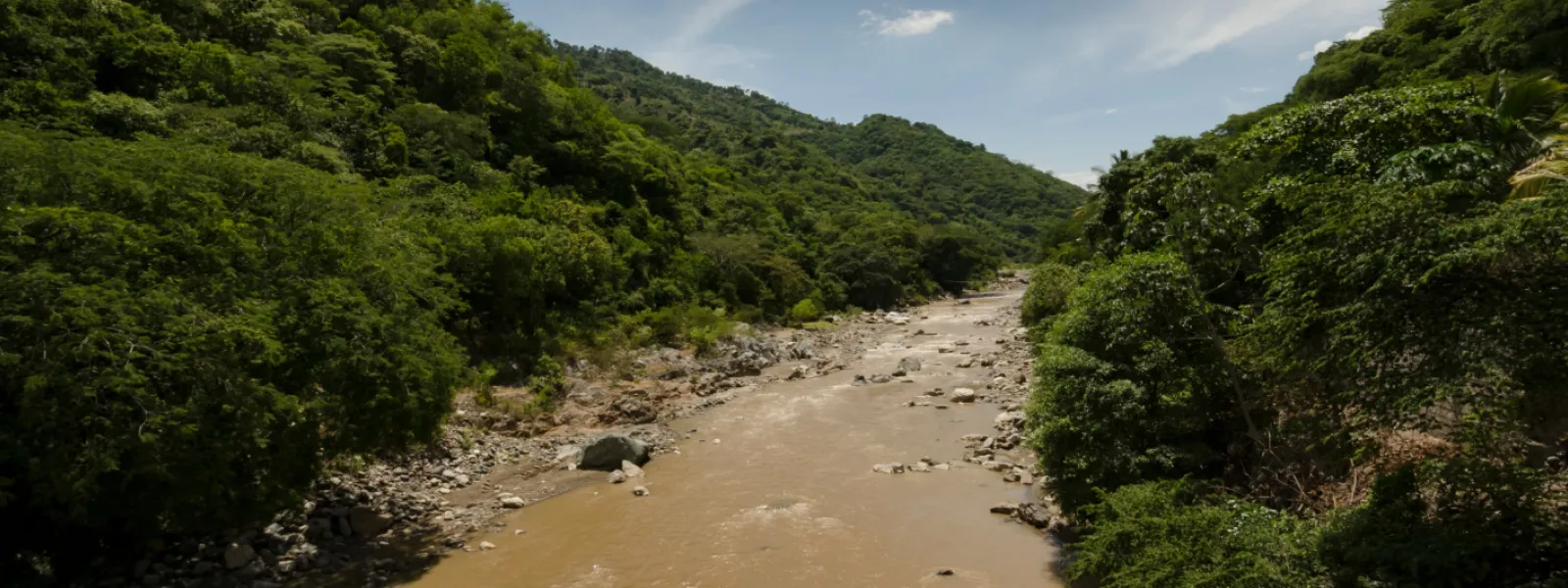
The Motagua River basin—Guatemala’s largest and most important river—is severely polluted with wastewater, solid waste, and other types of debris.
This is a cross-border issue because the Motagua’s polluted waters flow into the Caribbean Sea, reach the coast of Honduras, and threaten the Mesoamerican Reef System.
For decades, this has violated the rights to health, water, development, and a healthy environment of all the people living in the river basin.
In June 2025, the Poqomam Maya community of Santa Cruz Chinautla—supported by AIDA, the Indigenous Peoples’ Law Firm, and allied organizations—achieved an unprecedented legal victory to halt degradation in the basin. In response to the lawsuit it filed, a Guatemalan court ordered the municipality of Chinautla to comply with a series of obligations to curb the pollution of the area’s rivers and soil.
The government's response to the ruling has so far been limited to technical working group meetings. Meanwhile, the community continues to work toward the proper implementation of the ruling and to take other actions to defend its territory and its rights.
Background
The Motagua River, which is 486 km long, flows through 96 municipalities and 14 departments in Guatemala. It originates in Quiché, a department located in the northwest, and empties into the Caribbean Sea.
Polluting activities occur throughout the entire basin, including sub-basins and micro-basins. The largest volume of pollution comes from Guatemala City, the country’s capital, and is carried by the waters of the Las Vacas River, which in turn receives a large amount of waste from the Chinautla River.
The Chinautla River, which flows through the municipality of the same name, carries solid waste from a landfill located in Zone 3 of the capital—where trash from at least 14 municipalities in the department of Guatemala is dumped—as well as sewage generated by some 500,000 people living in the northern part of the capital, which undergoes no prior treatment.
Other sources of pollution include the numerous illegal dumps in the municipality of Chinautla, the waste that private vehicles and garbage trucks dump along the banks of its rivers, as well as the sand-mining companies—which began setting up operations in the area between 1996 and 1997—whose activities weaken the rivers' basins, causing solid waste to be more easily carried away by the river currents.
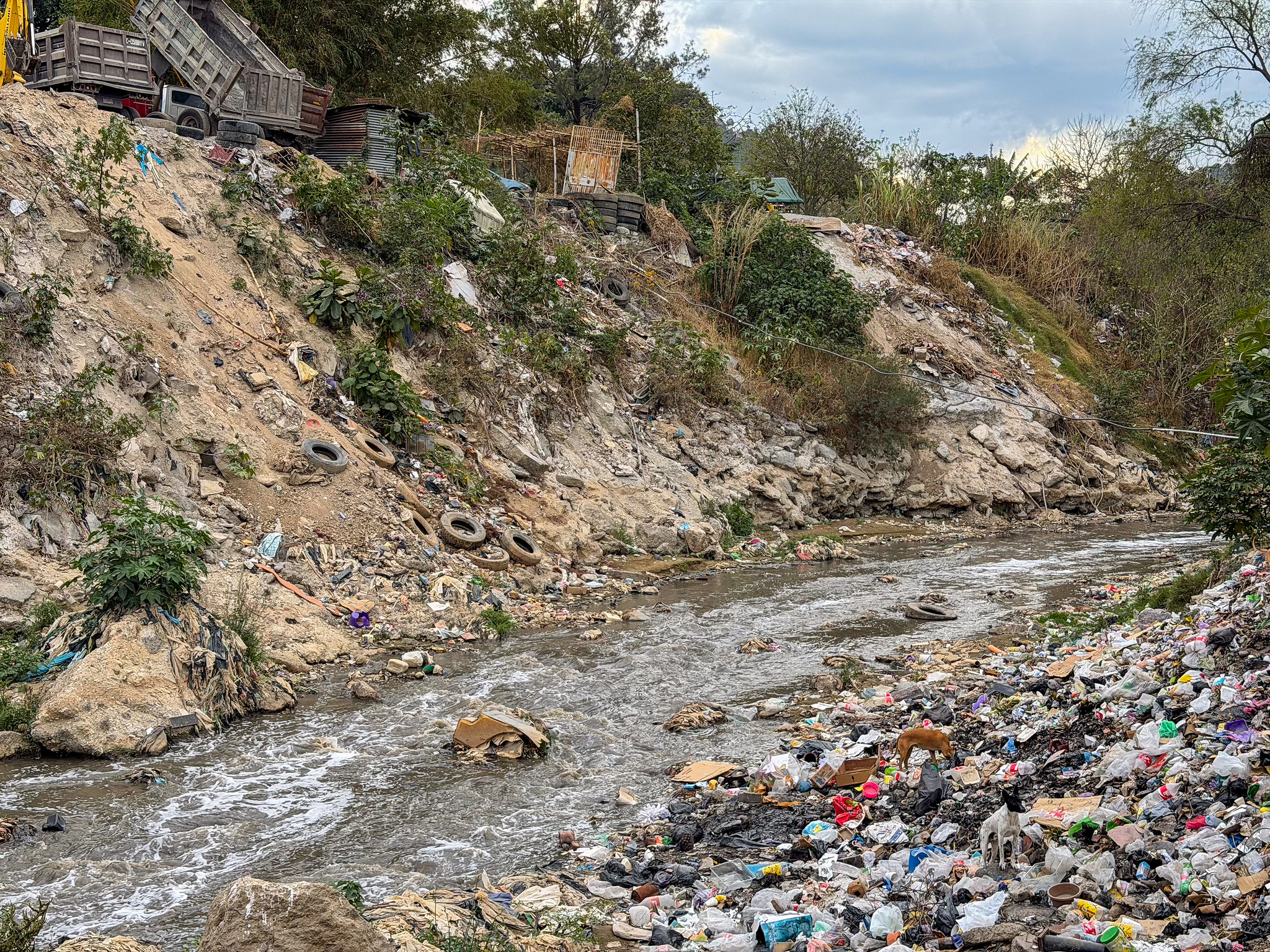
Photo: Mayela Sánchez García.
The situation extends beyond national borders. Every year, the Motagua River discharges some 20,000 metric tons of plastic into the Caribbean Sea, making it one of the rivers that contributes the most plastic pollution to the ocean worldwide, according to estimates contained in a 2025 report by the Inter-American Commission on Human Rights (IACHR).
The river flows into the Mesoamerican Reef at its mouth, so pollution also threatens to degrade one of the largest and most biodiverse transboundary reefs on the planet, which spans the territorial waters of Belize, Guatemala, Honduras, and Mexico.
In addition, the contaminated water reaches the coast of Honduras and spreads into Amatique Bay, located along the eastern coast of Guatemala, affecting the Caribbean Sea.
The roots of this chronic, cross-border problem are structural. Data from the Integrated Environmental Management of the Motagua River Basin project, funded by the United Nations Development Program (UNDP), show that in Guatemala, 66% of municipal solid waste is not collected, and there is no guarantee that the remaining 34% is disposed of properly. Furthermore, of all landfills nationwide, 88.32% are illegal or lack municipal authorization.
In other words, the core issues that need to be addressed are the mismanagement of solid waste and water resources in Guatemala; noncompliance with existing regulations on wastewater discharge and the disposal and treatment of solid waste and residues; and the lack of a water law.
The Poqomam Maya people's quest for justice
The rivers of Santa Cruz Chinautla, a community of the Poqomam Maya people located just twelve kilometers from Guatemala City, have become conduits of pollution that are degrading the Motagua River.
For decades, the local population has seen its health and livelihoods—including pottery, one of the main economic activities and a source of identity—damaged due to the lack of waste management in the municipality of Chinautla and the urban area of the country’s capital, as well as the activities of sand-mining companies.
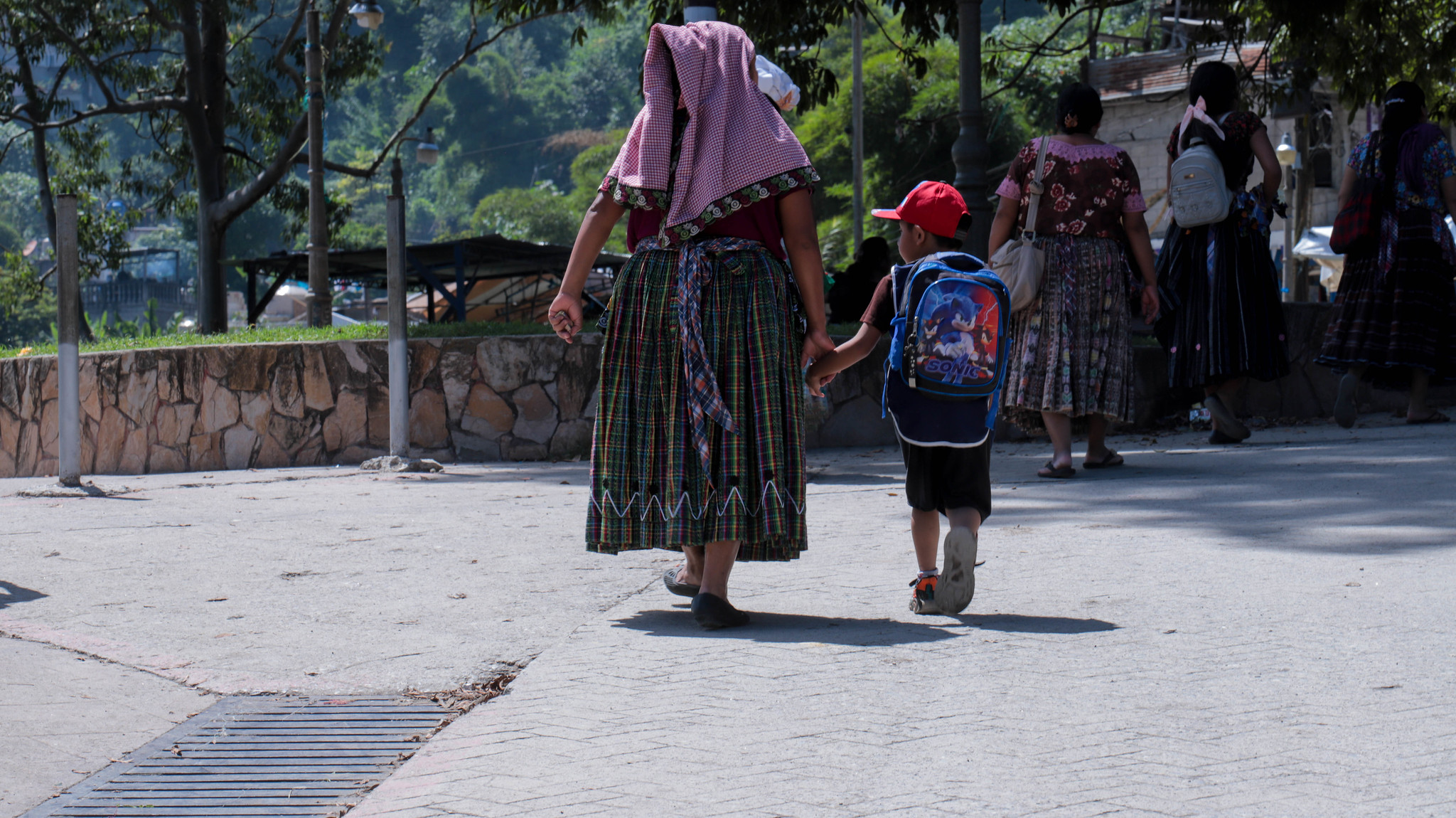
Photo: Mario Winter.
Voices for the Motagua River: Olga Vázquez.
Voices for the Motagua River: Nazario Pascual.
In early 2000, the Maya community organized to stop sand mining on their territory. At that time, the companies held mining permits that remained valid through 2021 and 2022. And although the permits expired, some companies continued to operate after requesting extensions. In June 2022, the indigenous authorities of the Poqomam people began a sit-in protest in front of the Piedrinera San Luis company, which they maintained for four years.
In July 2024, the Special Rapporteur on Economic, Social, Cultural, and Environmental Rights of the IACHR visited Santa Cruz Chinautla. During his visit, traditional authorities and community members spoke about the environmental, water-related, health, economic, and cultural impacts of the pollution in their rivers.
That same year, in October, the community—with support from AIDA, the Indigenous Peoples’ Law Firm, and partner organizations—filed a lawsuit (petition for amparo) against the municipality of Chinautla over its failure to take measures to address the contamination of its rivers and soil caused by improper solid waste management and the existence of illegal landfills.
AIDA’s scientific team, together with local residents and community authorities, collected key information on illegal landfills in the area. This community science initiative supported the litigation by highlighting the severity of the pollution, demonstrating the ongoing use of such practices, and providing evidence of the municipal authorities’ failure to fulfill their legal obligations regarding waste management.
Learn more about this community science initiative.
In June 2025, the Poqomam community won the support of the Guatemalan justice system when a constitutional court ordered the municipality of Chinautla to effectively address the claims in the lawsuit aimed at stopping the pollution of the rivers and soil in Santa Cruz Chinautla.
This is the first time a Guatemalan court has recognized a community's right to a healthy environment and its central role in finding solutions.
Find out the details of the legal victory.
Current situation
Since the ruling was issued, the municipality of Chinautla has held a series of “technical working groups” with representatives from the central government, civil society, and the community. A smaller group of technical experts was later created to develop a work plan with clear goals. Several months have passed without the municipality convening these working groups.
Furthermore, in December 2025, the IACHR noted in its report Human Rights Situation in Guatemala that the Motagua River basin is facing a severe pollution crisis that has had profound impacts on biodiversity and has resulted in systematic violations of the human rights of local communities, including the Maya Poqomam people.
And in May 2026, the Ministry of the Environment and Natural Resources revoked the license of the sand mining company Piedrinera San Luis for "failure to comply with environmental commitments."
AIDA continues to monitor the implementation of the court ruling to ensure the right to a healthy environment for the Poqomam Maya community and all those living in the Motagua River basin. Meanwhile, the residents of Santa Cruz Chinautla remain organized and mobilized to improve their environment and defend their rights.
Related projects
Brazil and the example that should be followed
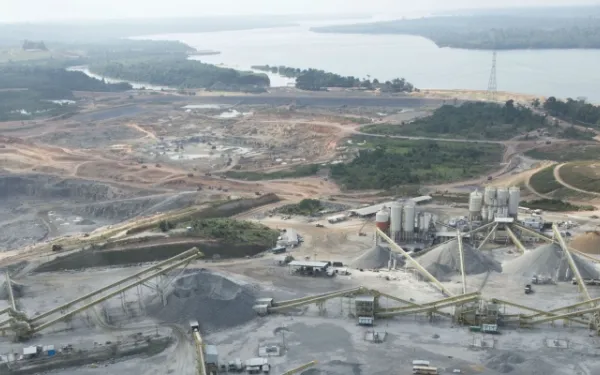
In an apparent turnaround, the Brazilian government has signaled an end to the construction of large dams in the Amazon. If materialized, it will be a step worthy of imitation. Then the region, and the world, can move towards truly sustainable energy generation that respects the environment and human rights. 2018 began with encouraging news for the energy sector, and for rivers and human rights in Latin America. A senior official with the Brazilian government signaled, in an interview with the newspaper O Globo, the beginning of the end of large dams in the Amazon nation. That statement is backed up by the notable absence of several of these projects in Brazil’s new Ten-Year Plan for Energy Expansion. The about-face is particularly significant since Brazil is a world leader in the construction of large hydroelectric projects, which until a few months ago were relied on to meet the nation’s rising energy demands. Between corruption and lack of financing The decision is a response to various factors, including the social conflicts and environmental impacts that large dams have caused in the Amazon, and major opposition from indigenous communities and civil society organizations. In addition, these projects have involved high costs from the start and, as Edvaldo Santana, former director of the National Electric Energy Agency (ANEEL) told O Globo, they “end up costing much more, despite the licenses.” Large dams have also been at the center of the largest corruption scandal in the history of Brazil, uncovered by the Lava Jato investigation, which went beyond borders to involve politicians and businessmen from 11 Latin American nations. The evidence gathered then prompted the initiation of Leviathan, a special investigation into the Belo Monte Dam due to the signs of high payments of bribes related to its construction. All of the above is in addition to the requirements for environment licenses with which several projects have failed to comply. This is the case of Belo Monte, whose license has been suspended for months, and of the Tapajós Dam, who license was denied last year. On the other hand, the Brazilian government announced the privatization of Electrobras, a public company with a fundamental role in the construction of these large infrastructure projects. With this and the economic crisis that has affected the ability of the Brazilian National Bank for Economic Development (BNDES) to support these mega-projects, the large dams have lost their primary sources of funding. Therefore—and in the face of technological advances and clean energy alternatives—Brazil is beginning to leave behind large dams and take and important step towards truly sustainable energy, and development that respects human rights. This advance could have an important impact on the entire American continent. It could begin a wave of change toward a more modern energy matrix, further removed from the increasingly obsolete large dams. A necessary change In the Amazon basin alone, more than 275 new large dams are planned, the majority in the Andean region. And hundreds more are lined up in Central America and Mexico. To echo Brazil’s announcement, these initiatives could incorporate adequate and comprehensive energy planning with serious cost and risk assessments. In these terms, Pablo Pedrosa, Executive Secretary of Brazil’s Ministry of Mines and Energy, told O Globo, “We are not willing to make moves to disguise the costs and the risks.” Even global entities such as the International Finance Corporation (IFC), part of the World Bank Group, have experienced first-hand the financial, reputational and socio-environmental costs of inadequately evaluating large dam projects. In 2012, the IFC, through the Latin American Fund for Renewable Infrastructure, provided $15 million USD to fund the Santa Rita Dam, which was to be built on the Ictobay River in Alta Verapaz, Guatemala. At the end of last year, the entity’s accountability mechanism concluded that the investment had breached the IFC’s operational policies. The project had failed to comply with the affected community’s right to free, prior and informed consent. Although IFC management denied the findings of its accountability mechanism, the project has been suspended since 2013 and the indigenous communities of the area maintain their opposition to it. Brazil’s recent decision reinforces the global trend of moving away from large dams. Over the last several years in the United States, large dams have been removed to rescue rivers and the benefits they provide, like wild salmon runs on the Snake River in Washington State. Given this good start to the year, it will be essential to ensure the effective implementation of Brazil’s decision. And, following that example, perhaps other Andean-Amazonian countries will also move towards modernity, consider the real costs of large dams, and begin to promote better, cheaper energy alternatives that don’t sacrifice natural ecosystems and the communities that depend on them.
Read more
Salmon farms in Chilean Patagonia approved without adequate environmental evaluation
A study commissioned by the Interamerican Association for Environmental Defense found that more than half of the salmon farms currently operating in the Magallanes region of Southern Patagonia have generated a partial or total lack of oxygen in the water. Nine of those are located in naturally protected areas. Santiago, Chile. A recent study, commissioned by the Interamerican Association for Environmental Defense (AIDA), concluded that salmon farms located in the Magallanes region of southern Patagonia were authorized without the scientific assessments needed to ensure they would do no harm to marine life. “After twenty years of development in other regions, the salmon industry now seeks to expand to the country’s last virgin coasts, without the necessary precautions,” explained Gladys Martínez, senior attorney of AIDA’s Marine Program. “This study demonstrates that neither the companies nor that State have done enough to avoid in Magallanes the severe environmental damage already perpetuated in other regions of the country.” Chilean biologist Héctor Kol produced the report for AIDA, with the support of the Waitt Foundation, analyzing 261 salmon farm projects. Of them, a little less than half have already been authorized and the rest could receive their permits in the short- and medium-term. Of the 126 authorized projects, only 35 are currently in operation. The information produced on each project includes location maps and estimations of the amount of waste being discharged into the waters. The research shows that there are large differences in the quantity of waste that the government authorized for different subsectors of the same geographic areas, without any available explanation as to why. “This demonstrates a clear lack of scientific evaluation, necessary to guarantee the aquatic environment will be able to receive and process the authorized quantity of waste,” said Florencia Ortúzar, AIDA attorney. “More than half of the projects that are currently in operation have already generated a total or partial lack of oxygen in the waters, which seriously impacts marine life. In addition, at least nine of these oxygen-depriving projects are located in natural protected areas.” On May 22, 2017, AIDA filed a complaint before the Superintendency of the Environment requesting the investigation of damages caused by salmon farms in Magallanes, and the sanctioning of the companies responsible. Consult the report here. Interactive Map of Salmon Farms here. More information on salmon farms in Patagonia is available here. Press contact: Florencia Ortúzar, AIDA attorney, +56973353135, [email protected]
Read more
The Risks of the Salmon Industry’s Expansion in Chilean Patagonia
In Chile, the salmon industry has grown rapidly over the last 20 years, often at the expense of the environment, as has been made evident in the regions of Los Lagos and Aysén, where salmon farms have been firmly established. In search of more pristine waters, the industry is now settling into the country’s last virgin coasts, in the region of Magallanes, in Southern Patagonia. The expansion is taking place without scientific evidence or serious studies to establish the limits of production in terms of water capacity. This could have catastrophic consequences for local ecosystems, a fact that has sparked concern among environmental organizations. The purpose of this report, written for AIDA by the biologist Héctor Kol, with the support of the Waitt Foundation, is to contribute to the understanding of the current and potential damages that the industrial production of salmon implies for Magallanes. With this, it also seeks to contribute to the effective protection of the aquatic-marine environment of Patagonia, through the use of existing legal tools. The document presents a detailed analysis of the situation of salmon farms in Magallanes, responding to the following questions: How many exist? Where are they? How much do they produce and in what conditions do they do so? The study includes the farms already authorized by the government and those whose permits are in process. These were divided by geographical sectors to facilitate the analysis. The information on each project includes a location map and estimates of the amount of waste left in the waters, a key aspect to determining their impact on marine life. In this way, the author illustrates the magnitude of the problem. The report also contains basic information on the authorization process for this type of project and on the regulations that exist for the sector, as well as an annex with scientific and legal documents related to each project. The analysis leads to several important conclusions, including the following: Of the 261 projects analyzed, a little less than half have been authorized and the rest could receive their authorizations in the short- and medium- term. This demonstrates the rapid growth of the industry in the region and alerts to the need for constant monitoring, above all of the environmental and sanitary conditions in which they operate. Of the authorized projects only 35 (equivalent to 25 percent of the total) are effectively in operation. There exist, in a same geographic sector and without explanation, large differences in the production and quantity of waste that the government has authorized for different subsectors. This demonstrates the lack of a scientific evaluation that would guarantee the water’s capacity to safely receive the authorized amounts of waste. More than half of the projects currently in operation have generated a total or partial lack of oxygen in the water, which gravely affects marine life. Even more serious is that at least nine of them are located in protected natural areas. This demonstrates that, before operating permits were authorized, adequate studies were not conducted to ensure that the capacity of the waters would not be exceeded by the quantity of fish authorized for breeding. It also means that projects are not subject to appropriate environmental impact assessments. There is not environmental information available for all the authorized projects, which makes it impossible to determine with greater precision the potential damages that the salmon industry could cause in Magallanes. In short, the study concludes that neither the State nor the salmon companies have done enough to prevent the damages already caused by the industry in other regions of Chile, which may now be repeated in one of the country’s most pristine natural areas. Consult and download the complete report (in Spanish) MAP - Salmon farms by geographic area Red icons and polygons: projects with authorized aquaculture concession, approved Technical Project and available environmental assessment (104 in total). White icons and red polygons: projects with authorized aquaculture concession and approved Technical Project, but without RCA or environmental information available (22 in total). Yellow icons and polygons: pending projects, without approved aquaculture concession, but with approved Technical Project (10 in total). Icons and green polygons: pending projects, without approved aquaculture concession and without approved Technical Project, but considered viable by the SUBPESCA (124 in total). View larger map
Read more