
Project
Shutterstock.
Pollution of the Motagua River in Guatemala: The Poqomam Maya people’s quest for environmental justice
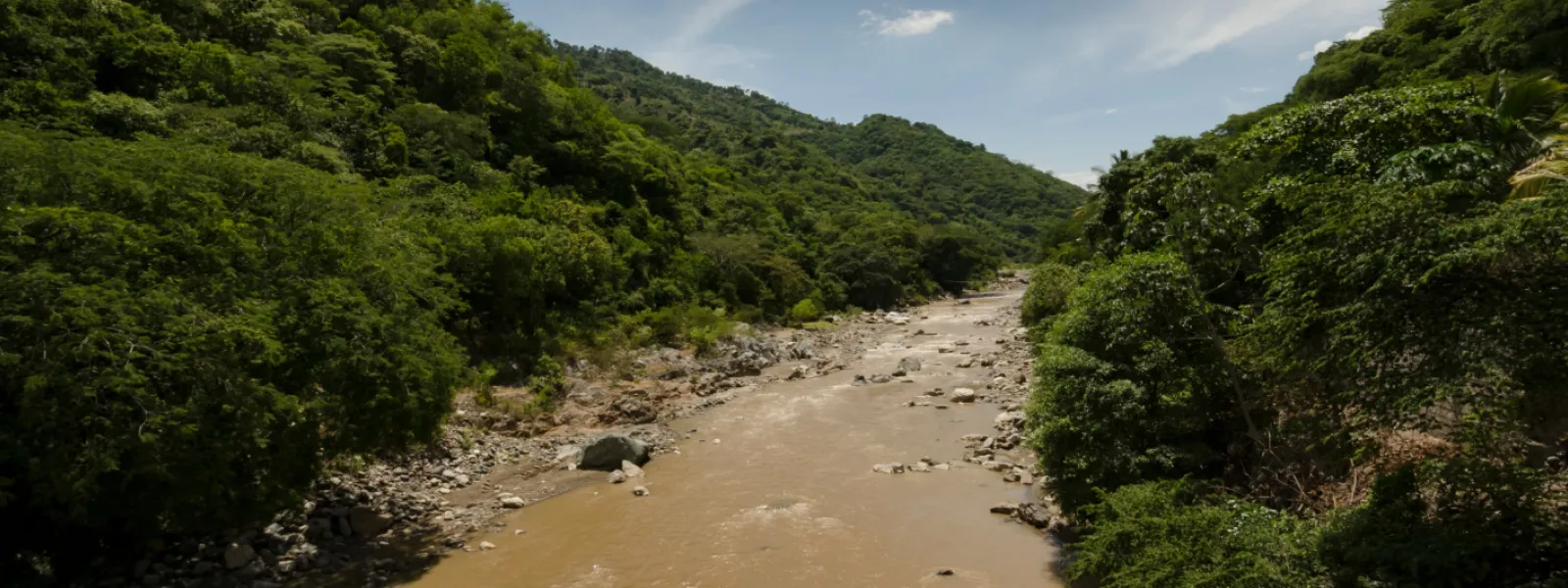
The Motagua River basin—Guatemala’s largest and most important river—is severely polluted with wastewater, solid waste, and other types of debris.
This is a cross-border issue because the Motagua’s polluted waters flow into the Caribbean Sea, reach the coast of Honduras, and threaten the Mesoamerican Reef System.
For decades, this has violated the rights to health, water, development, and a healthy environment of all the people living in the river basin.
In June 2025, the Poqomam Maya community of Santa Cruz Chinautla—supported by AIDA, the Indigenous Peoples’ Law Firm, and allied organizations—achieved an unprecedented legal victory to halt degradation in the basin. In response to the lawsuit it filed, a Guatemalan court ordered the municipality of Chinautla to comply with a series of obligations to curb the pollution of the area’s rivers and soil.
The government's response to the ruling has so far been limited to technical working group meetings. Meanwhile, the community continues to work toward the proper implementation of the ruling and to take other actions to defend its territory and its rights.
Background
The Motagua River, which is 486 km long, flows through 96 municipalities and 14 departments in Guatemala. It originates in Quiché, a department located in the northwest, and empties into the Caribbean Sea.
Polluting activities occur throughout the entire basin, including sub-basins and micro-basins. The largest volume of pollution comes from Guatemala City, the country’s capital, and is carried by the waters of the Las Vacas River, which in turn receives a large amount of waste from the Chinautla River.
The Chinautla River, which flows through the municipality of the same name, carries solid waste from a landfill located in Zone 3 of the capital—where trash from at least 14 municipalities in the department of Guatemala is dumped—as well as sewage generated by some 500,000 people living in the northern part of the capital, which undergoes no prior treatment.
Other sources of pollution include the numerous illegal dumps in the municipality of Chinautla, the waste that private vehicles and garbage trucks dump along the banks of its rivers, as well as the sand-mining companies—which began setting up operations in the area between 1996 and 1997—whose activities weaken the rivers' basins, causing solid waste to be more easily carried away by the river currents.
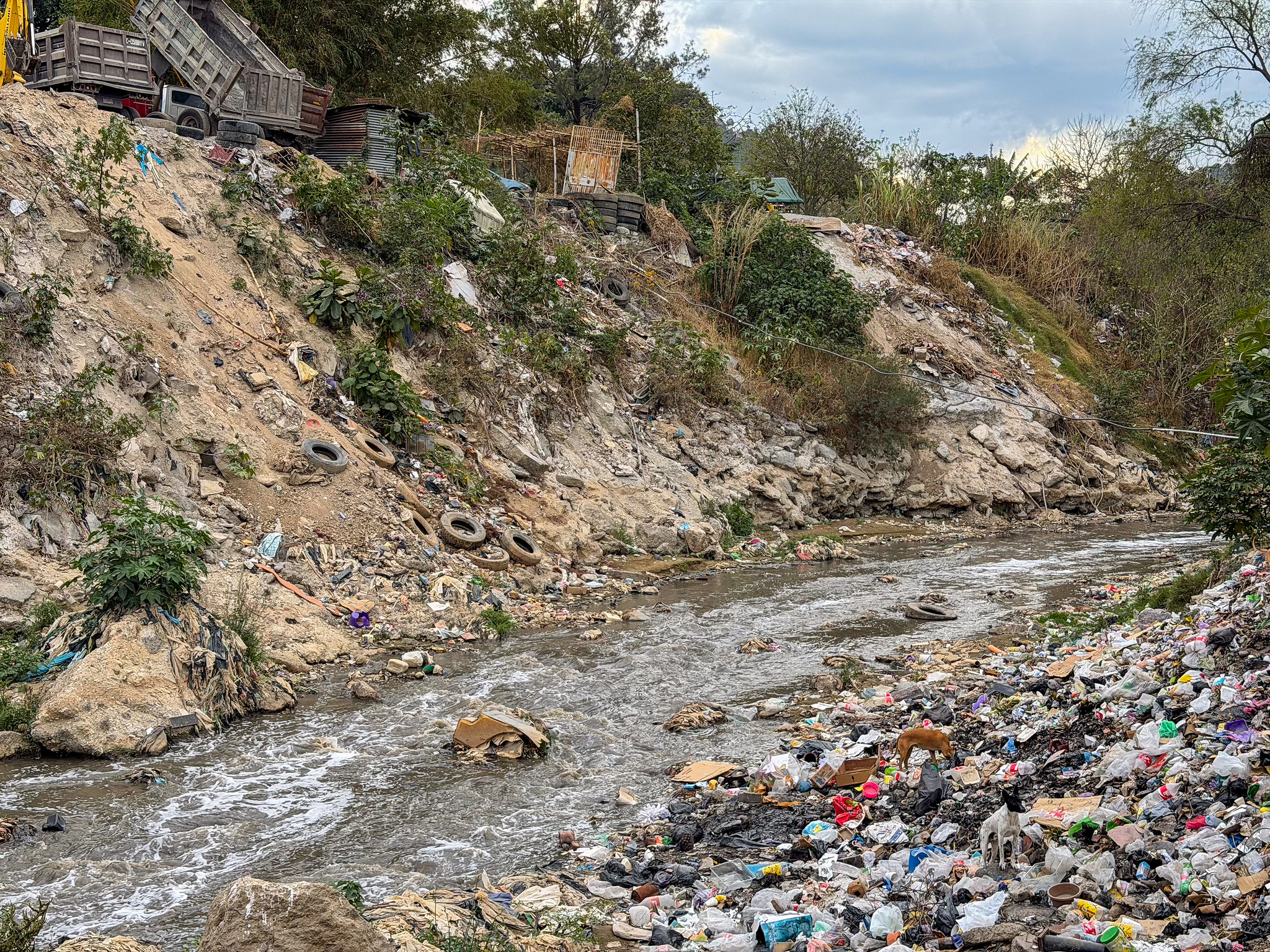
Photo: Mayela Sánchez García.
The situation extends beyond national borders. Every year, the Motagua River discharges some 20,000 metric tons of plastic into the Caribbean Sea, making it one of the rivers that contributes the most plastic pollution to the ocean worldwide, according to estimates contained in a 2025 report by the Inter-American Commission on Human Rights (IACHR).
The river flows into the Mesoamerican Reef at its mouth, so pollution also threatens to degrade one of the largest and most biodiverse transboundary reefs on the planet, which spans the territorial waters of Belize, Guatemala, Honduras, and Mexico.
In addition, the contaminated water reaches the coast of Honduras and spreads into Amatique Bay, located along the eastern coast of Guatemala, affecting the Caribbean Sea.
The roots of this chronic, cross-border problem are structural. Data from the Integrated Environmental Management of the Motagua River Basin project, funded by the United Nations Development Program (UNDP), show that in Guatemala, 66% of municipal solid waste is not collected, and there is no guarantee that the remaining 34% is disposed of properly. Furthermore, of all landfills nationwide, 88.32% are illegal or lack municipal authorization.
In other words, the core issues that need to be addressed are the mismanagement of solid waste and water resources in Guatemala; noncompliance with existing regulations on wastewater discharge and the disposal and treatment of solid waste and residues; and the lack of a water law.
The Poqomam Maya people's quest for justice
The rivers of Santa Cruz Chinautla, a community of the Poqomam Maya people located just twelve kilometers from Guatemala City, have become conduits of pollution that are degrading the Motagua River.
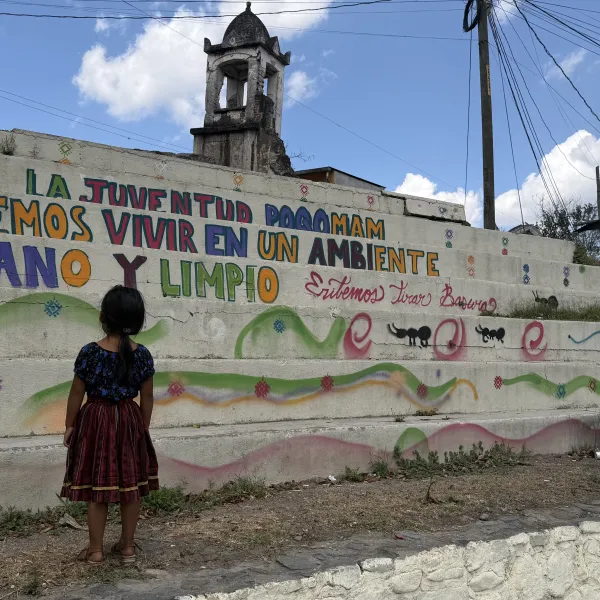
For decades, the local population has seen its health and livelihoods—including pottery, one of the main economic activities and a source of identity—damaged due to the lack of waste management in the municipality of Chinautla and the urban area of the country’s capital, as well as the activities of sand-mining companies.
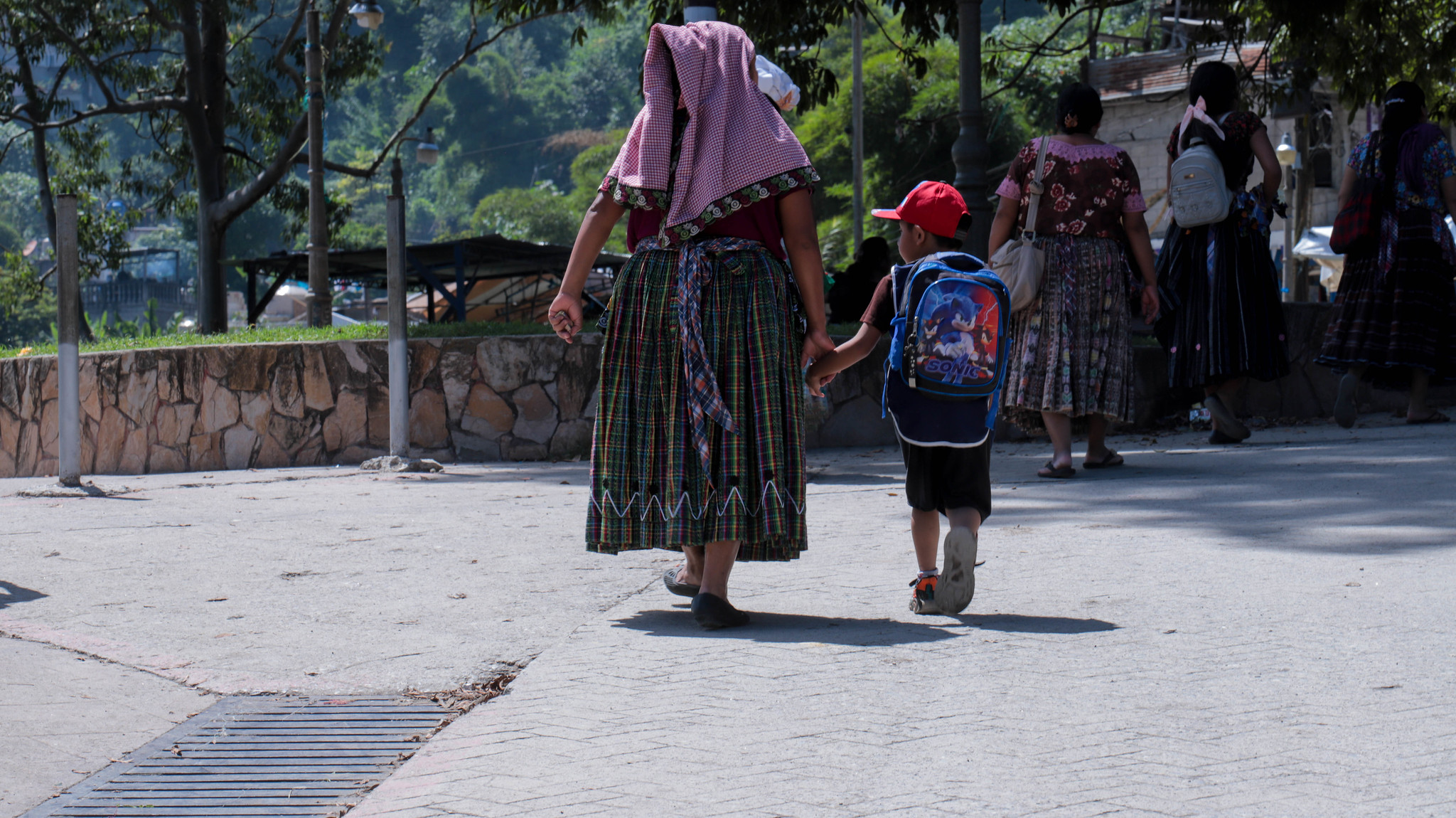
Photo: Mario Winter.
Voices for the Motagua River: Olga Vázquez.
Voices for the Motagua River: Nazario Pascual.
In early 2000, the Maya community organized to stop sand mining on their territory. At that time, the companies held mining permits that remained valid through 2021 and 2022. And although the permits expired, some companies continued to operate after requesting extensions. In June 2022, the indigenous authorities of the Poqomam people began a sit-in protest in front of the Piedrinera San Luis company, which they maintained for four years.
In July 2024, the Special Rapporteur on Economic, Social, Cultural, and Environmental Rights of the IACHR visited Santa Cruz Chinautla. During his visit, traditional authorities and community members spoke about the environmental, water-related, health, economic, and cultural impacts of the pollution in their rivers.
That same year, in October, the community—with support from AIDA, the Indigenous Peoples’ Law Firm, and partner organizations—filed a lawsuit (petition for amparo) against the municipality of Chinautla over its failure to take measures to address the contamination of its rivers and soil caused by improper solid waste management and the existence of illegal landfills.
AIDA’s scientific team, together with local residents and community authorities, collected key information on illegal landfills in the area. This community science initiative supported the litigation by highlighting the severity of the pollution, demonstrating the ongoing use of such practices, and providing evidence of the municipal authorities’ failure to fulfill their legal obligations regarding waste management.
Learn more about this community science initiative.
In June 2025, the Poqomam community won the support of the Guatemalan justice system when a constitutional court ordered the municipality of Chinautla to effectively address the claims in the lawsuit aimed at stopping the pollution of the rivers and soil in Santa Cruz Chinautla.
This is the first time a Guatemalan court has recognized a community's right to a healthy environment and its central role in finding solutions.
Find out the details of the legal victory.
Current situation
Since the ruling was issued, the municipality of Chinautla has held a series of “technical working groups” with representatives from the central government, civil society, and the community. A smaller group of technical experts was later created to develop a work plan with clear goals. Several months have passed without the municipality convening these working groups.
Furthermore, in December 2025, the IACHR noted in its report Human Rights Situation in Guatemala that the Motagua River basin is facing a severe pollution crisis that has had profound impacts on biodiversity and has resulted in systematic violations of the human rights of local communities, including the Maya Poqomam people.
And in May 2026, the Ministry of the Environment and Natural Resources revoked the license of the sand mining company Piedrinera San Luis for "failure to comply with environmental commitments."
AIDA continues to monitor the implementation of the court ruling to ensure the right to a healthy environment for the Poqomam Maya community and all those living in the Motagua River basin. Meanwhile, the residents of Santa Cruz Chinautla remain organized and mobilized to improve their environment and defend their rights.
Related projects
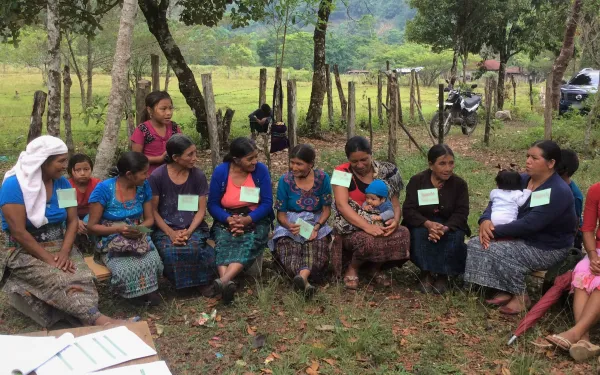
The women defending Guatemala’s rivers from large dams
When Maria gets up each morning, the first thing she does is open the tap in her house to see if there’s any water. If there is, she prepares coffee and, within a few hours, food for her family. Her house is alive with plants and animals. Dogs, cats and chickens surround her as she lights the wood stove, carrying her young son on her back. Maria lives in Ixquisis, a region of northwestern Guatemala near the Mexican border, in the department of Huehuetenango. There, water springs from the earth and large rivers like the Pojom and the Negro flow through the mountains. For Maria, the river is a special place. There, she meets with other women and washes clothes, a traditional activity for women in her community, most of whom are indigenous. Each afternoon, as the water flows steadily downstream, they talk about their families, their to-do lists, their joys and their worries. Last month, Maria joined with the other women of Ixquisis to speak about the threats the dams pose to their way of life. They were part of a workshop AIDA organized in collaboration with Protection International and the International Platform Against Impunity. Maria’s life has changed a lot since they started building the Pojom II and San Andrés dams, and she’s been losing sleep. Before the construction of the dams began, Maria used to fish. By submerging a basket in the river, she gathered—as if by magic—snails, shrimp and small fish. These are riches the river no longer provides. Instead, the once pristine river has become filled with garbage, rubble and other debris. The workers use its water to wash cars and machinery. “One day we will run out of water and we won’t be able to live,” Maria said, echoing the primary fear of the women of Ixquisis. “Our children will suffer.” Their fear is well founded. Many families like Maria’s already suffer from stomach and skin diseases that they associate with water pollution. Before the workshop, the women of Ixquisis hadn’t had the opportunity to speak publicly about the importance of water and the rivers in their lives. They hadn’t been able to explain how their rivers had changed since the dams’ construction began. They had also never been provided with information about the projects. But even without knowing the details of the dams, Maria and her neighbors understood that the water in their homes no longer arrived as cleanly or as regularly as before. Time and again, they have peacefully expressed their opposition to the dams. But their voices have been stigmatized and shaken by fear of reprisal. Before Maria walked calmly through her community, even at night. She now leaves the house in fear. But the people of Ixquisis have the support of people and organizations that work to protect the environment and human rights. The international organization Front Line Defenders, for example, recently awarded them the 2018 Award for Human Rights Defenders at Risk. One day after the women’s workshop, we organized a second meeting attended by the men of the region. The lack of water has affected their main subsistence activity: the cultivation of bananas, cardamom, vegetables and other products they take to market. Because their harvests have decreased, they must now work more hours to obtain the same profit. I learned a lot from Maria. Her strength, as well as that of all the residents of Ixquisis, comes from her respect for nature and all it offers them. I share that feeling and channel it into my work as an AIDA attorney, legally advising the men and women of Ixquisis on how to defend their territory. I work so that water will continue to flow from their taps, and so that they can one day walk again without fear, in search of a healthier future for their children.
Read moreThe women defending Guatemala’s rivers from large dams
When Maria gets up each morning, the first thing she does is open the tap in her house to see if there’s any water. If there is, she prepares coffee and, within a few hours, food for her family. Her house is alive with plants and animals. Dogs, cats and chickens surround her as she lights the wood stove, carrying her young son on her back. Maria lives in Ixquisis, a region of northwestern Guatemala near the Mexican border, in the department of Huehuetenango. There, water springs from the earth and large rivers like the Pojom and the Negro flow through the mountains. For Maria, the river is a special place. There, she meets with other women and washes clothes, a traditional activity for women in her community, most of whom are indigenous. Each afternoon, as the water flows steadily downstream, they talk about their families, their to-do lists, their joys and their worries. Last month, Maria joined with the other women of Ixquisis to speak about the threats the dams pose to their way of life. They were part of a workshop AIDA organized in collaboration with Protection International and the International Platform Against Impunity. Maria’s life has changed a lot since they started building the Pojom II and San Andrés dams, and she’s been losing sleep. Before the construction of the dams began, Maria used to fish. By submerging a basket in the river, she gathered—as if by magic—snails, shrimp and small fish. These are riches the river no longer provides. Instead, the once pristine river has become filled with garbage, rubble and other debris. The workers use its water to wash cars and machinery. “One day we will run out of water and we won’t be able to live,” Maria said, echoing the primary fear of the women of Ixquisis. “Our children will suffer.” Their fear is well founded. Many families like Maria’s already suffer from stomach and skin diseases that they associate with water pollution. Before the workshop, the women of Ixquisis hadn’t had the opportunity to speak publicly about the importance of water and the rivers in their lives. They hadn’t been able to explain how their rivers had changed since the dams’ construction began. They had also never been provided with information about the projects. But even without knowing the details of the dams, Maria and her neighbors understood that the water in their homes no longer arrived as cleanly or as regularly as before. Time and again, they have peacefully expressed their opposition to the dams. But their voices have been stigmatized and shaken by fear of reprisal. Before Maria walked calmly through her community, even at night. She now leaves the house in fear. But the people of Ixquisis have the support of people and organizations that work to protect the environment and human rights. The international organization Front Line Defenders, for example, recently awarded them the 2018 Award for Human Rights Defenders at Risk. One day after the women’s workshop, we organized a second meeting attended by the men of the region. The lack of water has affected their main subsistence activity: the cultivation of bananas, cardamom, vegetables and other products they take to market. Because their harvests have decreased, they must now work more hours to obtain the same profit. I learned a lot from Maria. Her strength, as well as that of all the residents of Ixquisis, comes from her respect for nature and all it offers them. I share that feeling and channel it into my work as an AIDA attorney, legally advising the men and women of Ixquisis on how to defend their territory. I work so that water will continue to flow from their taps, and so that they can one day walk again without fear, in search of a healthier future for their children.
Read more
The many reasons we care for our oceans
At AIDA, we work to protect our oceans. It’s not an easy task, especially considering the serious threats facing our vast seas—from warming waters to tons of plastic waste. But the members of our marine team believe it’s a valuable one. And they’re committed to conserving our region’s marine ecosystems, no matter what. Learn what motivates them. "Any effort I make to protect the oceans will benefit my children." Gladys Martinez, Senior Attorney "My greatest motivation is the thought that any work I do to protect the oceans will benefit my children and the other boys and girls on our planet, both present and future generations. To care for our oceans is to guarantee life, because our oceans truly are the lungs of our planet.” Playing in the sand, swimming, searching for fish among the rocks or walking on the beach at sunset… in all the most beautiful memories of Gladys' childhood, there is the sea. "It motivates me to know that we have the opportunity to change." Camilo Thompson, Legal Advisor "It motivates me to know that we have the opportunity to change, that respecting nature and caring for our ocean will bring a smile to our faces. The ocean brings us equilibrium. We cannot continue to destroy our corals, overexploit fish stocks or damage the coastal environments so closely linked to the sea. The opportunity for change is here and now. " Camilo currently lives very close to the sea, in La Paz, a coastal city of Baja California Sur, Mexico. He enjoys it very much. “I like to think I can help us understand all that our oceans provide us, and help to conserve the life within.” Magie Rodríguez, Legal Assistant “I’ve always been intrigued by the immensity of the oceans, and the relatively little we know about them. I like to think I can help us understand all that our oceans provide us, and help to conserve the life within. Although they make up the majority of our planet, for years we have neglected them, filling them with garbage and stripping them of their resources. Many fight to protect our terrestrial treasures, but few have turned their eyes to the seas.” When she was in grade school, Magie visited the beach where the Tarcoles River meets the sea. There she saw all that the most contaminated river in Central America carried to the sea. It was rght then she decided she had to do something to protect her country’s beaches from pollution and degradation. “I want future generations to enjoy the majesty of the oceans.” Maria José Gonzalez-Bernat, Scientific Advisor “I want future generations to enjoy the majesty of the oceans. It’s my greatest motivation. The oceans are one of the primary reserves of biodiversity on our planet, essential to maintaining its health. They’re a source of food and income for millions of people. Their social, environmental and economic importance motivates me to continue researching the oceans and finding new ways to promote their conservation and sustainable use. I will continue this work with governments, organizations and fishing communities alike.” One of Maria José’s most treasured memories is her first scuba diving trip. She can still see the different shades of blue and the many-hued plants and animals she visited below the surface.
Read more