
Project
Shutterstock.
Pollution of the Motagua River in Guatemala: The Poqomam Maya people’s quest for environmental justice
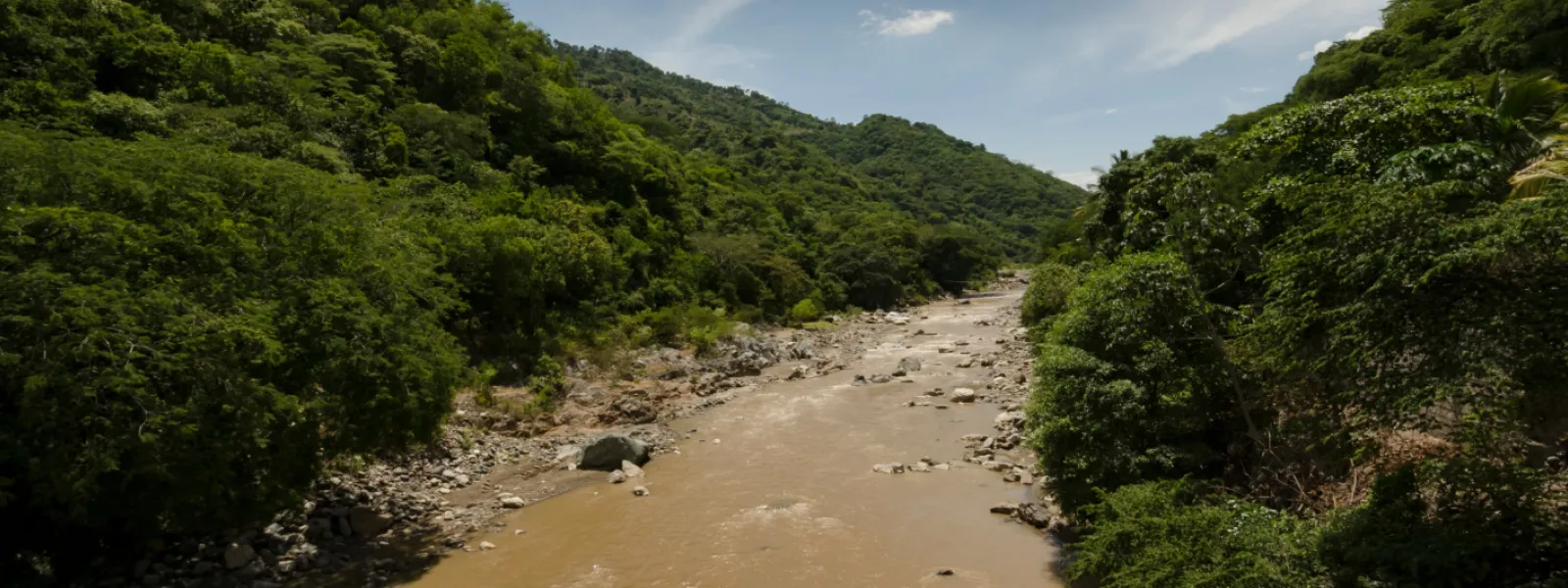
The Motagua River basin—Guatemala’s largest and most important river—is severely polluted with wastewater, solid waste, and other types of debris.
This is a cross-border issue because the Motagua’s polluted waters flow into the Caribbean Sea, reach the coast of Honduras, and threaten the Mesoamerican Reef System.
For decades, this has violated the rights to health, water, development, and a healthy environment of all the people living in the river basin.
In June 2025, the Poqomam Maya community of Santa Cruz Chinautla—supported by AIDA, the Indigenous Peoples’ Law Firm, and allied organizations—achieved an unprecedented legal victory to halt degradation in the basin. In response to the lawsuit it filed, a Guatemalan court ordered the municipality of Chinautla to comply with a series of obligations to curb the pollution of the area’s rivers and soil.
The government's response to the ruling has so far been limited to technical working group meetings. Meanwhile, the community continues to work toward the proper implementation of the ruling and to take other actions to defend its territory and its rights.
Background
The Motagua River, which is 486 km long, flows through 96 municipalities and 14 departments in Guatemala. It originates in Quiché, a department located in the northwest, and empties into the Caribbean Sea.
Polluting activities occur throughout the entire basin, including sub-basins and micro-basins. The largest volume of pollution comes from Guatemala City, the country’s capital, and is carried by the waters of the Las Vacas River, which in turn receives a large amount of waste from the Chinautla River.
The Chinautla River, which flows through the municipality of the same name, carries solid waste from a landfill located in Zone 3 of the capital—where trash from at least 14 municipalities in the department of Guatemala is dumped—as well as sewage generated by some 500,000 people living in the northern part of the capital, which undergoes no prior treatment.
Other sources of pollution include the numerous illegal dumps in the municipality of Chinautla, the waste that private vehicles and garbage trucks dump along the banks of its rivers, as well as the sand-mining companies—which began setting up operations in the area between 1996 and 1997—whose activities weaken the rivers' basins, causing solid waste to be more easily carried away by the river currents.
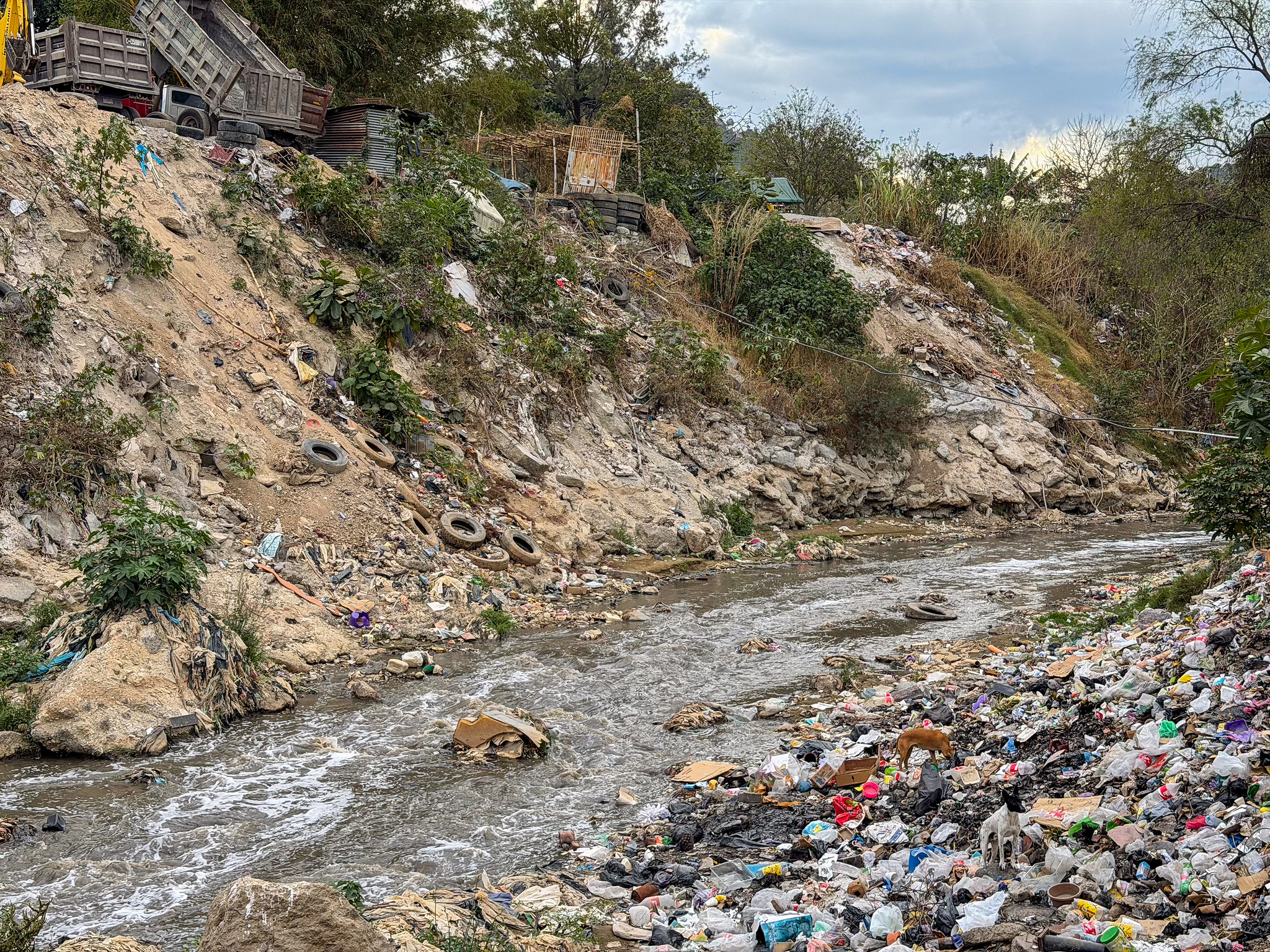
Photo: Mayela Sánchez García.
The situation extends beyond national borders. Every year, the Motagua River discharges some 20,000 metric tons of plastic into the Caribbean Sea, making it one of the rivers that contributes the most plastic pollution to the ocean worldwide, according to estimates contained in a 2025 report by the Inter-American Commission on Human Rights (IACHR).
The river flows into the Mesoamerican Reef at its mouth, so pollution also threatens to degrade one of the largest and most biodiverse transboundary reefs on the planet, which spans the territorial waters of Belize, Guatemala, Honduras, and Mexico.
In addition, the contaminated water reaches the coast of Honduras and spreads into Amatique Bay, located along the eastern coast of Guatemala, affecting the Caribbean Sea.
The roots of this chronic, cross-border problem are structural. Data from the Integrated Environmental Management of the Motagua River Basin project, funded by the United Nations Development Program (UNDP), show that in Guatemala, 66% of municipal solid waste is not collected, and there is no guarantee that the remaining 34% is disposed of properly. Furthermore, of all landfills nationwide, 88.32% are illegal or lack municipal authorization.
In other words, the core issues that need to be addressed are the mismanagement of solid waste and water resources in Guatemala; noncompliance with existing regulations on wastewater discharge and the disposal and treatment of solid waste and residues; and the lack of a water law.
The Poqomam Maya people's quest for justice
The rivers of Santa Cruz Chinautla, a community of the Poqomam Maya people located just twelve kilometers from Guatemala City, have become conduits of pollution that are degrading the Motagua River.
For decades, the local population has seen its health and livelihoods—including pottery, one of the main economic activities and a source of identity—damaged due to the lack of waste management in the municipality of Chinautla and the urban area of the country’s capital, as well as the activities of sand-mining companies.
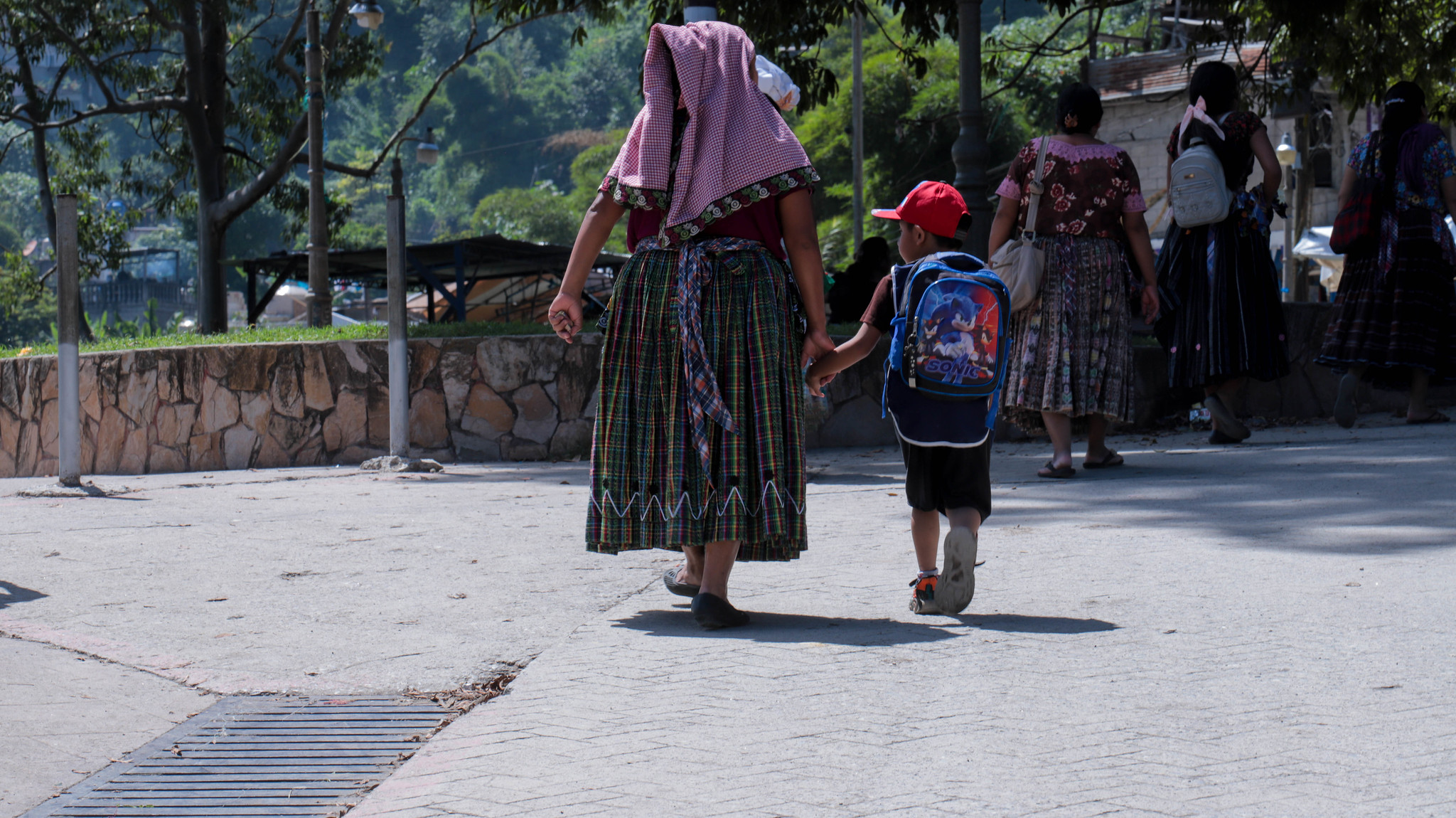
Photo: Mario Winter.
Voices for the Motagua River: Olga Vázquez.
Voices for the Motagua River: Nazario Pascual.
In early 2000, the Maya community organized to stop sand mining on their territory. At that time, the companies held mining permits that remained valid through 2021 and 2022. And although the permits expired, some companies continued to operate after requesting extensions. In June 2022, the indigenous authorities of the Poqomam people began a sit-in protest in front of the Piedrinera San Luis company, which they maintained for four years.
In July 2024, the Special Rapporteur on Economic, Social, Cultural, and Environmental Rights of the IACHR visited Santa Cruz Chinautla. During his visit, traditional authorities and community members spoke about the environmental, water-related, health, economic, and cultural impacts of the pollution in their rivers.
That same year, in October, the community—with support from AIDA, the Indigenous Peoples’ Law Firm, and partner organizations—filed a lawsuit (petition for amparo) against the municipality of Chinautla over its failure to take measures to address the contamination of its rivers and soil caused by improper solid waste management and the existence of illegal landfills.
AIDA’s scientific team, together with local residents and community authorities, collected key information on illegal landfills in the area. This community science initiative supported the litigation by highlighting the severity of the pollution, demonstrating the ongoing use of such practices, and providing evidence of the municipal authorities’ failure to fulfill their legal obligations regarding waste management.
Learn more about this community science initiative.
In June 2025, the Poqomam community won the support of the Guatemalan justice system when a constitutional court ordered the municipality of Chinautla to effectively address the claims in the lawsuit aimed at stopping the pollution of the rivers and soil in Santa Cruz Chinautla.
This is the first time a Guatemalan court has recognized a community's right to a healthy environment and its central role in finding solutions.
Find out the details of the legal victory.
Current situation
Since the ruling was issued, the municipality of Chinautla has held a series of “technical working groups” with representatives from the central government, civil society, and the community. A smaller group of technical experts was later created to develop a work plan with clear goals. Several months have passed without the municipality convening these working groups.
Furthermore, in December 2025, the IACHR noted in its report Human Rights Situation in Guatemala that the Motagua River basin is facing a severe pollution crisis that has had profound impacts on biodiversity and has resulted in systematic violations of the human rights of local communities, including the Maya Poqomam people.
And in May 2026, the Ministry of the Environment and Natural Resources revoked the license of the sand mining company Piedrinera San Luis for "failure to comply with environmental commitments."
AIDA continues to monitor the implementation of the court ruling to ensure the right to a healthy environment for the Poqomam Maya community and all those living in the Motagua River basin. Meanwhile, the residents of Santa Cruz Chinautla remain organized and mobilized to improve their environment and defend their rights.
Related projects
Water in Mexico: a human right, bottled
Mexico consumes 12 percent of the global volume of bottled water, highlighting the failures of the country’s water supply system and the violation of a basic human right. Nobody should be denied a glass of water. Serving your guests water is polite; it shows you have good manners and empathy for others. It is also, though not quite as obvious, an issue of human rights. In Mexico’s capital, until only recently, restaurants could deny a glass of water to their customers and require them to drink only bottled water. On one occasion, the owner of a gourmet pizzeria reacted furiously when she saw my boyfriend take out his own water bottle to take a pill. She told him it was prohibited to bring outside food and drink into her restaurant. Then, when we asked for a glass of water, she responded angrily: “We don’t give water away here, we sell it in bottles.” A circular business What you find being sold in supermarkets is not the water, but the bottle. In Mexico, the cost of the extraction and supply of water is relatively low, since almost the entire service is subsidized. According to the highest available rate, a glass of water costs seven cents (.007 Mexican pesos). For a bottle with the same quantity of water, the pizzeria charged $1.50 (28 pesos), seven times the supermarket price. The incident in the pizzeria occurred after the Legislative Assembly of Mexico City required food establishments to provide free glasses of water to customers who ask for it. But even after the legislative provision, I have often had to clarify that I want a glass of water, not a bottle. The waiters often warn me, “It’s filtered water,” reminding me of its unreliability. The dynamic behind this type of business has changed: they now buy large jugs of bottled water or spend money on filters, because in Mexico it’s well known that you never drink water directly from the tap. It’s an unspoken secret, almost popular belief, that tap water is dirty water. It’s common that even those of us who don’t buy bottled water have a filter in our homes. This belief emerged from the 1985 earthquake, when various pipes broke and drinking water mixed with sewage. Later, during a cholera epidemic in the 1990’s, the government promoted chlorinating or boiling the tap water. Yet no authority was responsible for the quality of the pipes through which the drinking water ran; water which, by definition, should be fit for human consumption. In contrast, Chile promotes three reliable water sources: chlorinated, boiled or taken from the tap. In Mexico, the health threat coincided with the arrival of bottled water. What the companies promoted in those early years was confidence and security in the quality of their water. So, little by little, we went from boiling and chlorinating our water, to buying it in 20-liter jugs, to buying small plastic bottles that hold less than 250 ml of water. According to the International Bottled Water Association (IBWA), in 2014 Mexicans consumed 253 liters of bottled water per person. This compares to 94.3 liters per person in Europe (where public drinking fountains are commonplace) and 37 liters per person globally. Mexico consumes 12 percent of the world’s total volume of bottled water. The World Bank cites 80 percent of the Mexican population as distrustful of the water supply system. Bottled water companies, then, have nothing but room to grow, especially considering the majority of the population doesn’t yet consume the recommended two liters of water per day. And a large quantity of bottled water is used on daily tasks such as cooking and washing dishes, even on bathing newborn babies. Can you or can’t you drink tap water? The answer is: It depends. The responsibility for water supply in Mexico is so fractioned that it’s impossible to get a convincing response. In the capital city, water quality is disclosed each year and in only two neighborhoods does it not meet standards for human consumption. Unfortunately, those with the worst water quality also have the lowest standard of living. Information on the subject doesn’t arrive to our homes, it’s difficult to access and – in some cases – the information is non-existent, hidden or disguised. No government authority is responsible for water quality: not the National Water Commission, not state or city governments. Violating a human right Without convincing responses about the reliability of the water supply system, Mexicans are opting to buy bottled water. By doing so, we’re demonstrating that something is wrong with the country’s water system, and the human right to water is not guaranteed. According to the UN, drinking water must be safe, clean accessible and affordable for all. The human right to water was included in the Mexican Constitution four years ago, but its implementation, and the party responsible for guaranteeing it, remains under discussion. While the debate continues, millions of Mexicans are, understandably, buying bottled water to protect their health. The lack of information about or accountability for the water supply system makes the guarantee of this human right nothing more than a dream. The UN established that people shouldn’t spend more than three percent of their income on water services. In Mexico, only those with incomes greater than $1,200 a month (21,000 pesos) spend three percent or less of their income on bottled water. The other 80 percent of households in the country spend as much as eight percent, a staggering figure, especially considering it doesn’t include what they pay for water used for other domestic activities. People are buying bottled water because they don’t trust the country’s water supply system. By denying a glass of water to its population, the Mexican government is denying a fundamental human right.
Read more
Belo Monte: the river may be dying but the search for justice never will
“The river is dead!” exclaimed Raimundo as we navigated in his motorboat from Altamira toward the big bend of the Xingu River. From my perch in Raimundo’s boat, it was easy to see how bleak the landscape surrounding Altamira—the northern Brazilian city closest to the construction of the Belo Monte Dam—has become. The big island of Arapujá, located across from Altamira, has been completely deforested, causing a radical change in the currents of the river. Many of the smaller islands, previously inhabited by fishermen, are now completely submerged, only the tops of trees visible above the rising water. I visited Altamira, and the indigenous and riverine communities nearby, with colleagues from Justiça Global. We came to update our case, and to inform those affected by Belo Monte of a new hope for justice: in December, the Inter-American Commission on Human Rights opened the case against Brazil for human rights violations caused by the dam. In January, Norte Energía, the company charged with the construction and operation of Belo Monte, opened the dam’s floodgates without warning communities living downstream. They say the Xingu grew seven meters in just an hour. In some communities, the rising water flooded their riverside land, taking with it canoes, boats and items of clothing. Destroying lives The boat took us to a spot in the river where a large island once stood with a house in the middle. Raimundo Nonato had lived there. He raised animals and dedicated his life to fishing. It had been the perfect place to bathe in the river. It was there, in 2013, that Antonia Melo, leader of Movimento Xingu Vivo Para Siempre, baptized me as a defender of these waters. Now the island is under water, and all that remains to be seen are the tops of some fruit trees. Leoncio Arara, an indigenous man from the community Arara da Volta Grande, says his community lives in fear of the river’s expected growth, the loss of their culture and way of life, and from the recent death of 16 tons of fish. They have seen cracks in the dike of the dam’s bypass channel and fear it will break, as the Fundão mining waste dam did in Minas Gerais. On our tour of the area, we also noticed discolored patches on the dike, which should certainly be a sign of alarm. Leoncio said the fear keeps him up at night. On the indigenous lands of the Arara da Volta Grande and Paquiçamba, the life of inhabitants has changed radically. They must now travel to the city (Altamira) to sell their harvest and to buy food. The changing environment has drastrically reduced opportunities for fishing and hunting, rendering their traditional subsistence lifestyle inadequate. Leoncio says that his peoples’ traditional knowledge and community life are being lost. Their homes are different, as is the formation of their village. Norte Energía has carelessly constructed houses that conflict with their culture, because of the location and materials used. Their community lacks even a well from which to retrieve drinking water, a condition that should have been met more than five years ago. Pain, injustice and struggle On our trip, we spent nine days in the area around the Belo Monte dam. We listened to so many stories of pain and injustice: of indigenous children that died from bad medical care in villages without access to the city; of indigenous people who left their villages to seek shelter in the city and now live in the overcrowded Casa del Indio, surrounded by filth and, often, conflicting ethnic groups. We relived the stories of tireless struggle, like that of Socorro Arara, an indigenous woman whose home was destroyed, along with those of her relatives. Socorro and her family all had to haggle with the company, as if their basic human rights were negotiable. Some received very little money in compensation, others the option of a prefabricated house in a neighborhood far from the river. Socorro’s parents live in one of those neighborhoods. Behind their new cement house, they built a small home with the wood they were able to save from their destroyed home. It is there that they really live, by the light of small kerosene lamps, sleeping in hammocks. Electricity is not part of their lives. Residents of Altamira live surrounded by the ironies of the third largest dam in the world. On February 28, Altamira and various cities in the state of Para were left without electricity. The cutoff, described by the receptionist at our hotel as routine, was due to testing on one of the dam’s turbines. There’s not much time now until the Belo Monte begins operation. If, for the countries of the region, Belo Monte represents the cherished dream of development, for me it represents a nightmare from which I’m dying to awake. It’s a nightmare of pain and human rights violations, in which a beautiful, living river is quickly fading away. Going with it are the lives and the dreams of those who have long depended upon its clean and healthy waters. Human rights are not negotiable. The victims of Belo Monte need justice now! It is that dream of justice that I hope, one day soon, becomes reality. -- I wrote these lines in honor of all the people who have dedicated their lives to defending our rivers and our life.
Read more
Remembering Berta Cáceres before the Green Climate Fund
On March 3, Berta Cáceres, an indigenous rights defender in Honduras, was assassinated. As a leader of COPINH, Berta was fighting against the implementation of an internationally funded large dam project. She was fighting for the health of the Gualarque River, and for the lives and livelihoods of the indigenous communities that depend upon it. Her death is a glimpse at the real life impacts that megaprojects may have. That’s why, at the closing of the 12th Meeting of the Board of the Green Climate Fund, I presented a message to the Board on behalf of the civil society organizations monitoring the development and decision making process of the mechanism. The message was intended as a reminder of the care with which financing decisions must be made, as the board prepares to review and approve more projects: “We would like to ask for a moment to remember Berta Cáceres, the indigenous environmental justice and human rights defender brutally murdered last week in Honduras. She was leading a fight against an internationally financed large dam that threatened her water, her land, and her people. We would like to ask all of you to do whatever you can to secure justice for Berta, and the immediate safe return of Gustavo Castro, head of Friends of the Earth Mexico, who was injured during the assassination and whose life is now in danger. Berta’s murder serves as a tragic reminder to the GCF of the incredible risks faced by rights defenders, and the deep need to safeguard their rights and the rights of the people and land they fight for. The GCF must not support questionable projects like the one that claimed her life and must obtain in all of its projects and programmes the free, prior and informed consent of people and communities to protect their livelihoods and survival.”
Read more