
Project
Shutterstock.
Pollution of the Motagua River in Guatemala: The Poqomam Maya people’s quest for environmental justice
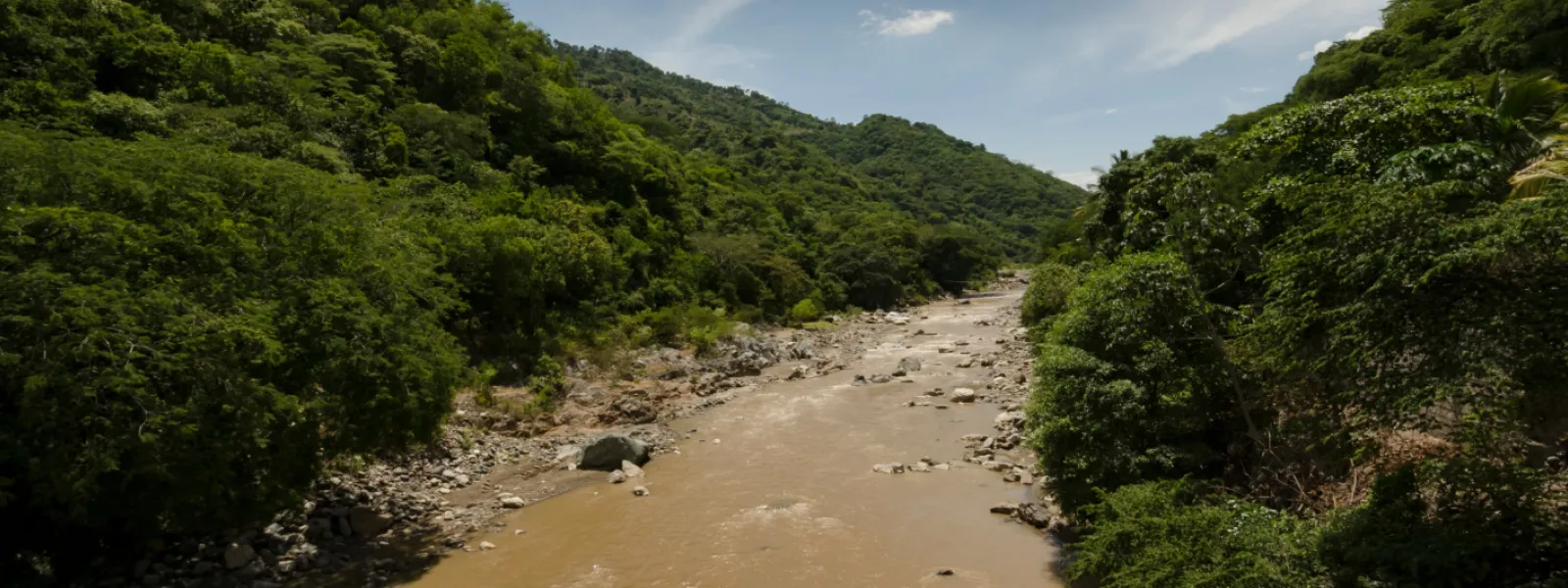
The Motagua River basin—Guatemala’s largest and most important river—is severely polluted with wastewater, solid waste, and other types of debris.
This is a cross-border issue because the Motagua’s polluted waters flow into the Caribbean Sea, reach the coast of Honduras, and threaten the Mesoamerican Reef System.
For decades, this has violated the rights to health, water, development, and a healthy environment of all the people living in the river basin.
In June 2025, the Poqomam Maya community of Santa Cruz Chinautla—supported by AIDA, the Indigenous Peoples’ Law Firm, and allied organizations—achieved an unprecedented legal victory to halt degradation in the basin. In response to the lawsuit it filed, a Guatemalan court ordered the municipality of Chinautla to comply with a series of obligations to curb the pollution of the area’s rivers and soil.
The government's response to the ruling has so far been limited to technical working group meetings. Meanwhile, the community continues to work toward the proper implementation of the ruling and to take other actions to defend its territory and its rights.
Background
The Motagua River, which is 486 km long, flows through 96 municipalities and 14 departments in Guatemala. It originates in Quiché, a department located in the northwest, and empties into the Caribbean Sea.
Polluting activities occur throughout the entire basin, including sub-basins and micro-basins. The largest volume of pollution comes from Guatemala City, the country’s capital, and is carried by the waters of the Las Vacas River, which in turn receives a large amount of waste from the Chinautla River.
The Chinautla River, which flows through the municipality of the same name, carries solid waste from a landfill located in Zone 3 of the capital—where trash from at least 14 municipalities in the department of Guatemala is dumped—as well as sewage generated by some 500,000 people living in the northern part of the capital, which undergoes no prior treatment.
Other sources of pollution include the numerous illegal dumps in the municipality of Chinautla, the waste that private vehicles and garbage trucks dump along the banks of its rivers, as well as the sand-mining companies—which began setting up operations in the area between 1996 and 1997—whose activities weaken the rivers' basins, causing solid waste to be more easily carried away by the river currents.
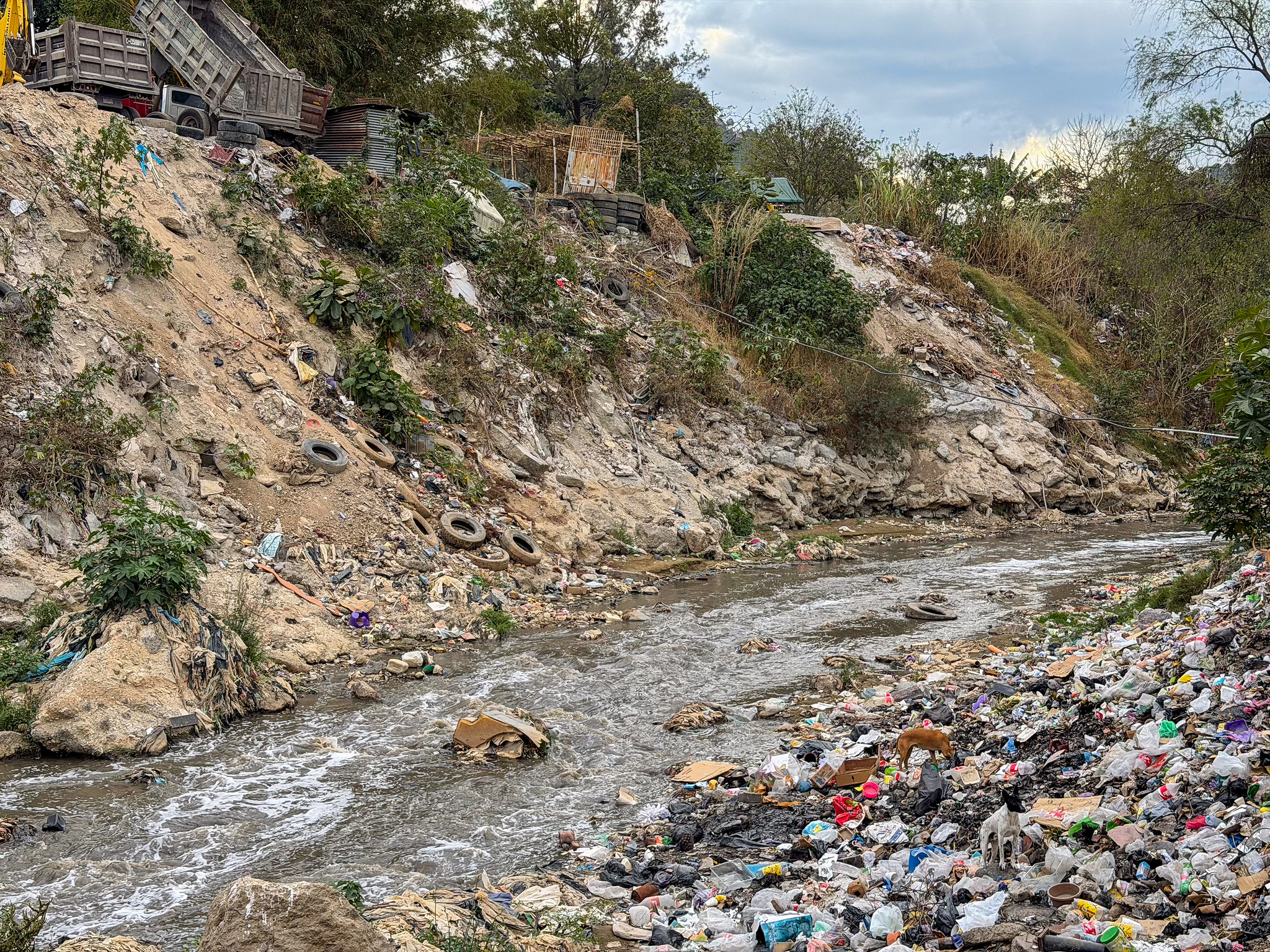
Photo: Mayela Sánchez García.
The situation extends beyond national borders. Every year, the Motagua River discharges some 20,000 metric tons of plastic into the Caribbean Sea, making it one of the rivers that contributes the most plastic pollution to the ocean worldwide, according to estimates contained in a 2025 report by the Inter-American Commission on Human Rights (IACHR).
The river flows into the Mesoamerican Reef at its mouth, so pollution also threatens to degrade one of the largest and most biodiverse transboundary reefs on the planet, which spans the territorial waters of Belize, Guatemala, Honduras, and Mexico.
In addition, the contaminated water reaches the coast of Honduras and spreads into Amatique Bay, located along the eastern coast of Guatemala, affecting the Caribbean Sea.
The roots of this chronic, cross-border problem are structural. Data from the Integrated Environmental Management of the Motagua River Basin project, funded by the United Nations Development Program (UNDP), show that in Guatemala, 66% of municipal solid waste is not collected, and there is no guarantee that the remaining 34% is disposed of properly. Furthermore, of all landfills nationwide, 88.32% are illegal or lack municipal authorization.
In other words, the core issues that need to be addressed are the mismanagement of solid waste and water resources in Guatemala; noncompliance with existing regulations on wastewater discharge and the disposal and treatment of solid waste and residues; and the lack of a water law.
The Poqomam Maya people's quest for justice
The rivers of Santa Cruz Chinautla, a community of the Poqomam Maya people located just twelve kilometers from Guatemala City, have become conduits of pollution that are degrading the Motagua River.
For decades, the local population has seen its health and livelihoods—including pottery, one of the main economic activities and a source of identity—damaged due to the lack of waste management in the municipality of Chinautla and the urban area of the country’s capital, as well as the activities of sand-mining companies.
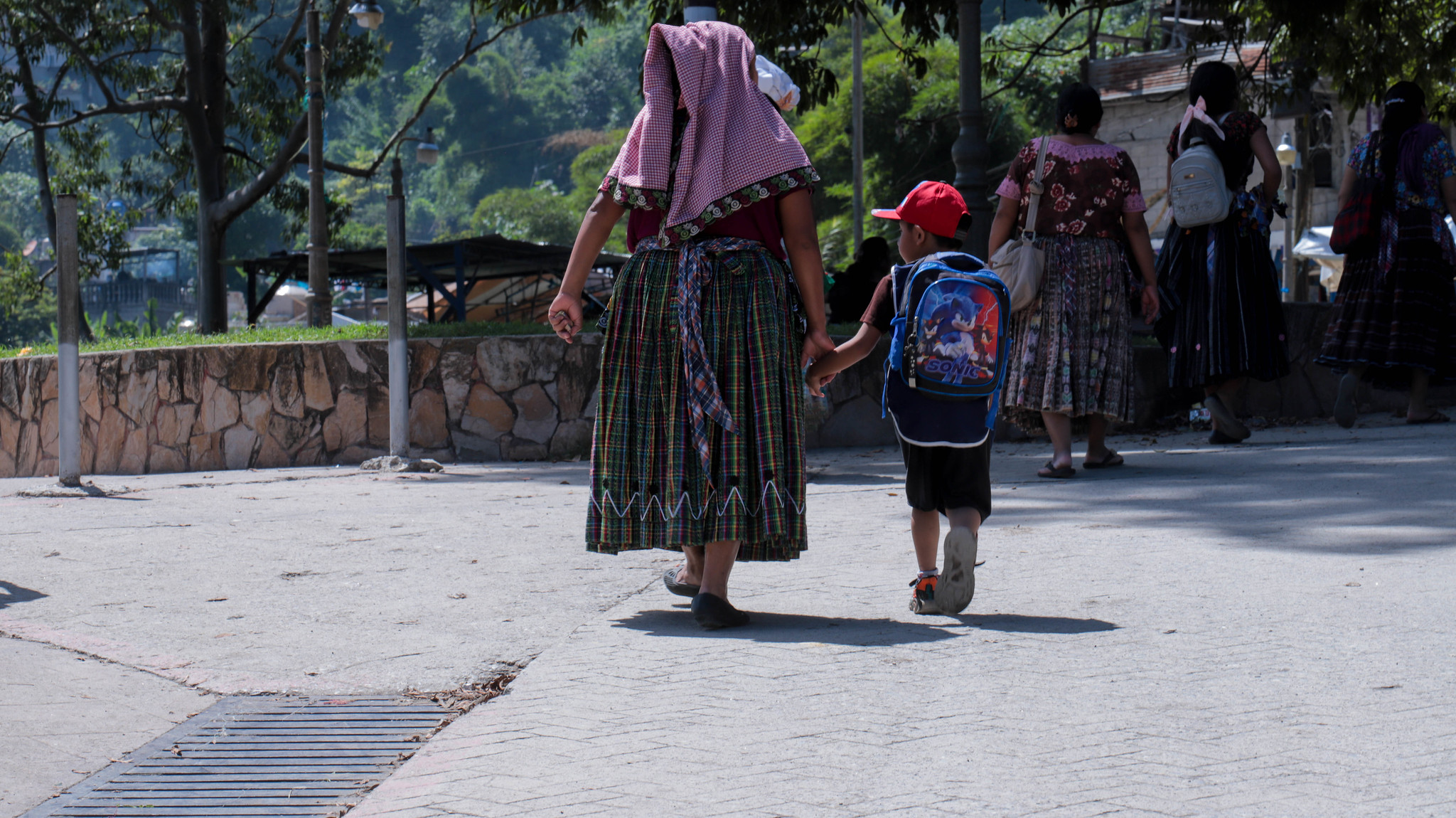
Photo: Mario Winter.
Voices for the Motagua River: Olga Vázquez.
Voices for the Motagua River: Nazario Pascual.
In early 2000, the Maya community organized to stop sand mining on their territory. At that time, the companies held mining permits that remained valid through 2021 and 2022. And although the permits expired, some companies continued to operate after requesting extensions. In June 2022, the indigenous authorities of the Poqomam people began a sit-in protest in front of the Piedrinera San Luis company, which they maintained for four years.
In July 2024, the Special Rapporteur on Economic, Social, Cultural, and Environmental Rights of the IACHR visited Santa Cruz Chinautla. During his visit, traditional authorities and community members spoke about the environmental, water-related, health, economic, and cultural impacts of the pollution in their rivers.
That same year, in October, the community—with support from AIDA, the Indigenous Peoples’ Law Firm, and partner organizations—filed a lawsuit (petition for amparo) against the municipality of Chinautla over its failure to take measures to address the contamination of its rivers and soil caused by improper solid waste management and the existence of illegal landfills.
AIDA’s scientific team, together with local residents and community authorities, collected key information on illegal landfills in the area. This community science initiative supported the litigation by highlighting the severity of the pollution, demonstrating the ongoing use of such practices, and providing evidence of the municipal authorities’ failure to fulfill their legal obligations regarding waste management.
Learn more about this community science initiative.
In June 2025, the Poqomam community won the support of the Guatemalan justice system when a constitutional court ordered the municipality of Chinautla to effectively address the claims in the lawsuit aimed at stopping the pollution of the rivers and soil in Santa Cruz Chinautla.
This is the first time a Guatemalan court has recognized a community's right to a healthy environment and its central role in finding solutions.
Find out the details of the legal victory.
Current situation
Since the ruling was issued, the municipality of Chinautla has held a series of “technical working groups” with representatives from the central government, civil society, and the community. A smaller group of technical experts was later created to develop a work plan with clear goals. Several months have passed without the municipality convening these working groups.
Furthermore, in December 2025, the IACHR noted in its report Human Rights Situation in Guatemala that the Motagua River basin is facing a severe pollution crisis that has had profound impacts on biodiversity and has resulted in systematic violations of the human rights of local communities, including the Maya Poqomam people.
And in May 2026, the Ministry of the Environment and Natural Resources revoked the license of the sand mining company Piedrinera San Luis for "failure to comply with environmental commitments."
AIDA continues to monitor the implementation of the court ruling to ensure the right to a healthy environment for the Poqomam Maya community and all those living in the Motagua River basin. Meanwhile, the residents of Santa Cruz Chinautla remain organized and mobilized to improve their environment and defend their rights.
Related projects
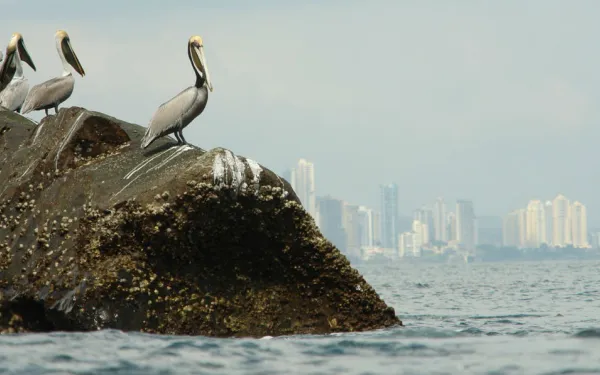
New law protects Panama Bay Wetland Wildlife Refuge
On the occasion of World Wetlands Day, the President of Panama will approve a national law that bestows protected-area status on Panama Bay Wetland Wildlife Refuge. CIAM and AIDA applaud the decision to strengthen protection of an ecosystem key to biodiversity, freshwater supplies, and the fight against climate change. Panama City, Panama. In an official ceremony on World Wetlands Day, President Juan Carlos Varela will approve a law that bestows protected-area status on Panama Bay Wetland Wildlife Refuge, which was initially established by Administrative Resolution. The government is strengthening legal protection of an ecosystem key to fresh water supplies, reproduction of species of high commercial and nutritional value, biodiversity conservation, and climate change mitigation. "We welcome a law that demonstrates the importance that this place has on the environment and surrounding populations. It is everyone’s responsibility to protect the 85,652 hectares of coastal marine wetlands in Panama Bay," said Brooke Alfaro, President of the Board of the Environmental Advocacy Center (CIAM). The Bay is one of the world’s most important nesting and resting sites for migratory birds and a home to endangered species. Mangroves help to fight climate change by capturing carbon from the atmosphere, and mitigate its effects by serving as a buffer against coastal storms and hurricanes. In 2003, it was declared a site of international importance under the Ramsar Convention, an international treaty for the conservation of wetlands. "We congratulate the Panamanian government because this law is a breakthrough for wetland protection and for fulfillment of the country’s international obligations. It serves as an example for other countries in the region. The law emphasizes the concepts of rational use, ecosystem approach, and ecological character contained in the Ramsar Convention," said Haydée Rodríguez, attorney for the Interamerican Association for Environmental Defense (AIDA). During the law’s approval process, CIAM’s legal and scientific team, supported by AIDA, helped strengthen the bill to ensure that it guarantees sound management of wetland resources. Both organizations will assist and support the Government of Panama in implementing the law. "We must establish an appropriate management plan to ensure the protection of the wetland for present and future generations," added Rodríguez. "Thanks to the support of citizens, civil society, the Supreme Court, deputies and government, the law ensures protection of the Panama Bay Wetland," Alfaro said. In recent years, the site has been affected by the expansion of real estate projects, with consequent channeling of rivers, drainage, and filling of natural areas. Under the new law, activities that threaten the ecological integrity of the refuge and of its boundaries are prohibited. Only another law may permit them.
Read moreHuman rights in the new climate agreement: Tomorrow will be too late
Observing the UN Climate Negotiations is like entering another world. Governments, organizations and individuals advance their agendas, and all are discussed simultaneously: mitigation, adaptation, financing, Intended Nationally Determined Contributions (INDCs), loss and damages, common but differentiated responsibilities, and many other matters. The common objective is making binding commitments to tackle climate change. As a member of AIDA’s team, together with my colleagues Andrea Rodríguez and Víctor Quintanilla, I participated last December in the 20th session of the Conference of Parties of the United Nationals Framework Convention on Climate Change (COP 20) in Lima, Peru. Being there was an incredible learning experience. The Conference was two weeks of intense negotiations, even more so in the final days, intended to pave the way for the new binding climate agreement that will be adopted at the UN Climate Conference in Paris later this year. The result was the Lima Call for Climate Action, a document approved in overtime hours as an emergency measure so that the meeting did not conclude without an agreement. The document has been much written about, touted by some as a great success and by others as a failure. I would simply like to point out that a key point is missing from the Lima appeal: the recognition that climate change interferes with the enjoyment of human rights. Not for lack of trying. Mary Robinson, the former United Nations High Commissioner on Human Rights, who is now the Secretary General’s Special Envoy for Climate Change, warned that climate change is "the greatest human rights issue of the 21st Century." Photo: Máximo Ba Tiul presents the case of the Santa Rita hydroelectric project in an event during the COP20. Credit: AIDA. Experts and UN rapporteurs have asked States that are part of the Framework Convention to include in the coming agreement specific language stating that all parties must, in all climate change related actions, promote, protect, respect and fulfill with the human rights of all people. These are the words written by 28 experts and special rapporteurs to the UN in an open letter sent on October 17, 2014. Also, more than 70 independent experts and UN special rapporteurs also called for this recognition on December 10, International Human Rights Day. AIDA and colleague organizations have been insisting not only that the new climate agreement should incorporate comprehensive and operative language on human rights, but also that the actions taken to mitigate climate change respect human rights. Amidst the technicalities and the negotiations, I saw the human face of climate change. During the Lima Conference, I met Máximo Ba Tiul, an indigenous Maya Poqomchi from Guatemala and the representative of the Tezulutlán Peoples Council. Máximo participated in a variety of activities during the Conference, carrying with him the message of the indigenous peoples affected by the Santa Rita dam, a project registered under the Clean Development Mechanism (CDM) of the Convention. Through the Mechanism, industrialized countries may obtain carbon credits by implementing emission-reduction projects in developing countries. The problem is that many of these projects have caused human rights violations. For example, the Guatemalan government neither consulted with nor obtained the free, prior, and informed consent of the affected indigenous communities before authorizing Santa Rita. Furthermore, security forces have harassed communities that oppose the dam and charged opposition leaders as criminals. Violence and repression have escalated: a worker from the company murdered two children, David, 11, and Ageo, 13, in August 2013. In August 2014, the violence flared. More than a thousand state agents raided the area and attacked community members, among them pregnant women, the elderly, and children, who were all forced to flee. Photo: Machinery beginning the dredging of the Dolores River for the construction of the Santa Rita Dam at the end of 2011. Credit: Community Archive. The Santa Rita hydroelectric project has clearly led to human rights violations, which continue to this day. Crime, violence, and harassment remain unpunished. The project continues to hold its certification from the Clean Development Mechanism. Going public at one of the Conference events, Máximo asked: Why do you have to violate human rights to mitigate the effects of climate change? The only response: silence. Cases like Guatemala’s Santa Rita dam, emblematic of many projects registered under the Clean Development Mechanism, remind us of the urgent need to incorporate human rights protection into all climate actions. Human rights protection must be binding in the new climate agreement to be approved in Paris. Otherwise, the defense of communities’ rights will be another fight lost in the fight against climate change. The time is NOW. Tomorrow will be too late!
Read more
Working to protect coral reefs in Mexico and throughout Latin America
In the Gulf of Mexico, 27 coral reefs form a submarine mountain range that runs between six islands in an area stretching for miles. Hundreds of colorful fish species, sea urchins, starfish, and sea grasses share the reef with an abundance of other life forms. This is the magnificent Veracruz Reef, the largest coral ecosystem in the Gulf. Unfortunately, planned expansion of the Port of Veracruz, recently approved by the Mexican government, will damage the reef and harm the creatures that depend on it for survival. The project will also harm the nearby Los Tuxtlas Biosphere Reserve, a jewel of Mexico’s Emerald Coast, because developers will mine it for rock to use in port construction. The environmental authority approved the port development in 2013, even though Mexico declared the Veracruz Reef System a National Protected Area in 1992. What’s more, Mexico is a party to the Ramsar Convention, an international treaty for the protection of wetlands of international importance—which includes the Veracruz Reef. Despite the reef’s recognized significance, the government has officially reduced the size of the protected area to make way for the larger port. "Now is a good time to call the attention of world leaders and diplomats to Mexico’s unsustainable actions," said AIDA legal advisor Sandra Moguel. Mexico is preparing to host the December 2016 Conference of Parties to the Convention on Biological Diversity, an international treaty to sustain the rich diversity of life on Earth. AIDA and the Mexican Center for Environmental Law (CEMDA), representing 13 organizations and individuals, have sent a letter (in Spanish) to the Secretariat of the Convention on Biological Diversity. (The Secretariat is a neutral organization staffed by international civil servants, accountable to the Conference of Parties and its subsidiary bodies, and linked to the United Nations Environment Program.) The letter requests two things of the Secretariat: assess the harms that the expansion will cause, and ask Mexico to revoke project authorization because of the serious impact it will have on the diversity of life on the reef. "The manner in which the government has authorized this development project worries us," Moguel said. "Mexico has breached their international commitment to protect the rich biodiversity within its borders, particularly when it falls within natural protected areas." AIDA’s marine team has been working on similar cases in Mexico and throughout the region, gaining expertise in national and international laws that enable the protection of coral reefs. They have produced a report that synthesizes knowledge gained through years of such work, The Protection of Coral Reefs in Mexico: Rescuing Biodiversity and its Benefits to Mankind (in Spanish). "We want to interest and inform people working in wetlands protection," Moguel said. "There is a diverse array of legal tools at their disposal, which they may not be aware of," Moguel said. "In addition to describing our own legal work on this issue, we discuss the power of international treaties and commitments that nations must abide by." The report outlines the importance of coral reefs in the world—in Mexico in particular—explores case studies, outlines relevant international treaties and obligations, and looks to best practices from nations around the region for inspiration. AIDA Marine Senior Attorney Gladys Martínez said that reports such as these are intended to raise awareness of the legal means available to protect wetlands and to highlight the different methods that decision-makers can use. "AIDA selects emblematic cases like these of Mexico, to illustrate environmental problems that recur throughout the hemisphere," said Gladys Martínez. "The threats to the Veracruz Reef System are a sign of the urgent need for nations to take effective measures to protect coral reefs and comply with their international obligations." AIDA has launched a campaign to fund the marine program’s continued efforts to protect corals in the region. Our work will provide advocates and decision-makers with the practical resources, recommendations, and tools needed to improve coral reef protection. Your donation will directly support this work, and provide a brighter future for the brilliant array of life on the coral reefs of Latin America.
Read more