
Project
Shutterstock.
Pollution of the Motagua River in Guatemala: The Poqomam Maya people’s quest for environmental justice
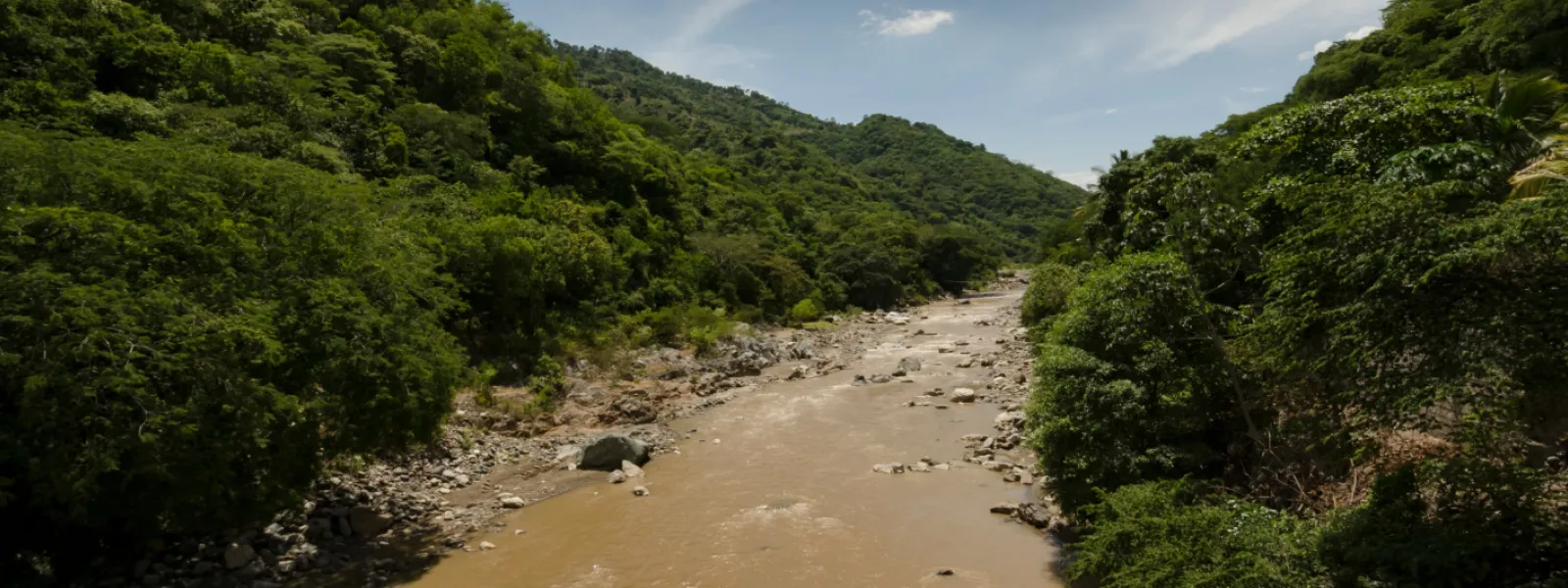
The Motagua River basin—Guatemala’s largest and most important river—is severely polluted with wastewater, solid waste, and other types of debris.
This is a cross-border issue because the Motagua’s polluted waters flow into the Caribbean Sea, reach the coast of Honduras, and threaten the Mesoamerican Reef System.
For decades, this has violated the rights to health, water, development, and a healthy environment of all the people living in the river basin.
In June 2025, the Poqomam Maya community of Santa Cruz Chinautla—supported by AIDA, the Indigenous Peoples’ Law Firm, and allied organizations—achieved an unprecedented legal victory to halt degradation in the basin. In response to the lawsuit it filed, a Guatemalan court ordered the municipality of Chinautla to comply with a series of obligations to curb the pollution of the area’s rivers and soil.
The government's response to the ruling has so far been limited to technical working group meetings. Meanwhile, the community continues to work toward the proper implementation of the ruling and to take other actions to defend its territory and its rights.
Background
The Motagua River, which is 486 km long, flows through 96 municipalities and 14 departments in Guatemala. It originates in Quiché, a department located in the northwest, and empties into the Caribbean Sea.
Polluting activities occur throughout the entire basin, including sub-basins and micro-basins. The largest volume of pollution comes from Guatemala City, the country’s capital, and is carried by the waters of the Las Vacas River, which in turn receives a large amount of waste from the Chinautla River.
The Chinautla River, which flows through the municipality of the same name, carries solid waste from a landfill located in Zone 3 of the capital—where trash from at least 14 municipalities in the department of Guatemala is dumped—as well as sewage generated by some 500,000 people living in the northern part of the capital, which undergoes no prior treatment.
Other sources of pollution include the numerous illegal dumps in the municipality of Chinautla, the waste that private vehicles and garbage trucks dump along the banks of its rivers, as well as the sand-mining companies—which began setting up operations in the area between 1996 and 1997—whose activities weaken the rivers' basins, causing solid waste to be more easily carried away by the river currents.
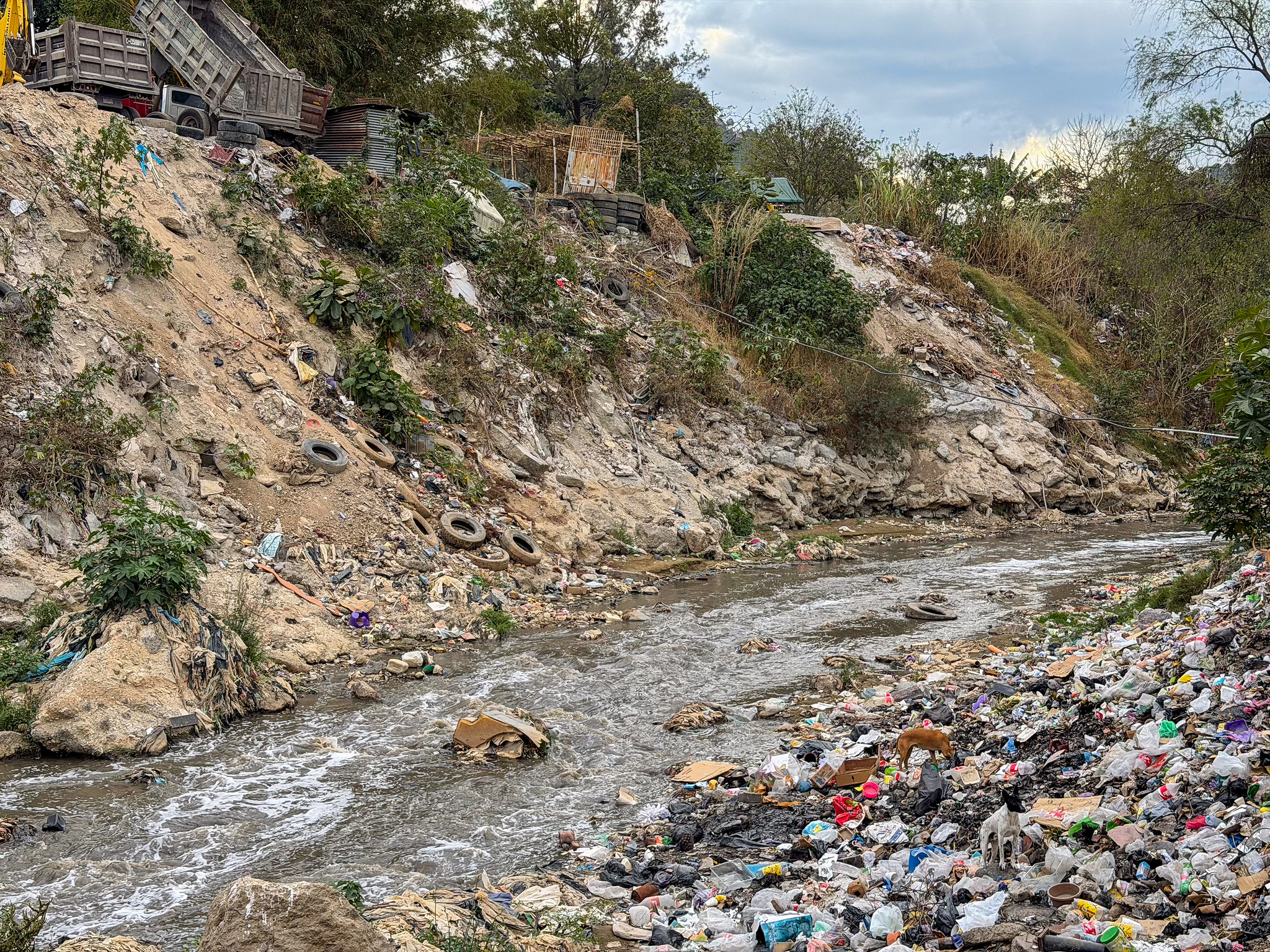
Photo: Mayela Sánchez García.
The situation extends beyond national borders. Every year, the Motagua River discharges some 20,000 metric tons of plastic into the Caribbean Sea, making it one of the rivers that contributes the most plastic pollution to the ocean worldwide, according to estimates contained in a 2025 report by the Inter-American Commission on Human Rights (IACHR).
The river flows into the Mesoamerican Reef at its mouth, so pollution also threatens to degrade one of the largest and most biodiverse transboundary reefs on the planet, which spans the territorial waters of Belize, Guatemala, Honduras, and Mexico.
In addition, the contaminated water reaches the coast of Honduras and spreads into Amatique Bay, located along the eastern coast of Guatemala, affecting the Caribbean Sea.
The roots of this chronic, cross-border problem are structural. Data from the Integrated Environmental Management of the Motagua River Basin project, funded by the United Nations Development Program (UNDP), show that in Guatemala, 66% of municipal solid waste is not collected, and there is no guarantee that the remaining 34% is disposed of properly. Furthermore, of all landfills nationwide, 88.32% are illegal or lack municipal authorization.
In other words, the core issues that need to be addressed are the mismanagement of solid waste and water resources in Guatemala; noncompliance with existing regulations on wastewater discharge and the disposal and treatment of solid waste and residues; and the lack of a water law.
The Poqomam Maya people's quest for justice
The rivers of Santa Cruz Chinautla, a community of the Poqomam Maya people located just twelve kilometers from Guatemala City, have become conduits of pollution that are degrading the Motagua River.
For decades, the local population has seen its health and livelihoods—including pottery, one of the main economic activities and a source of identity—damaged due to the lack of waste management in the municipality of Chinautla and the urban area of the country’s capital, as well as the activities of sand-mining companies.
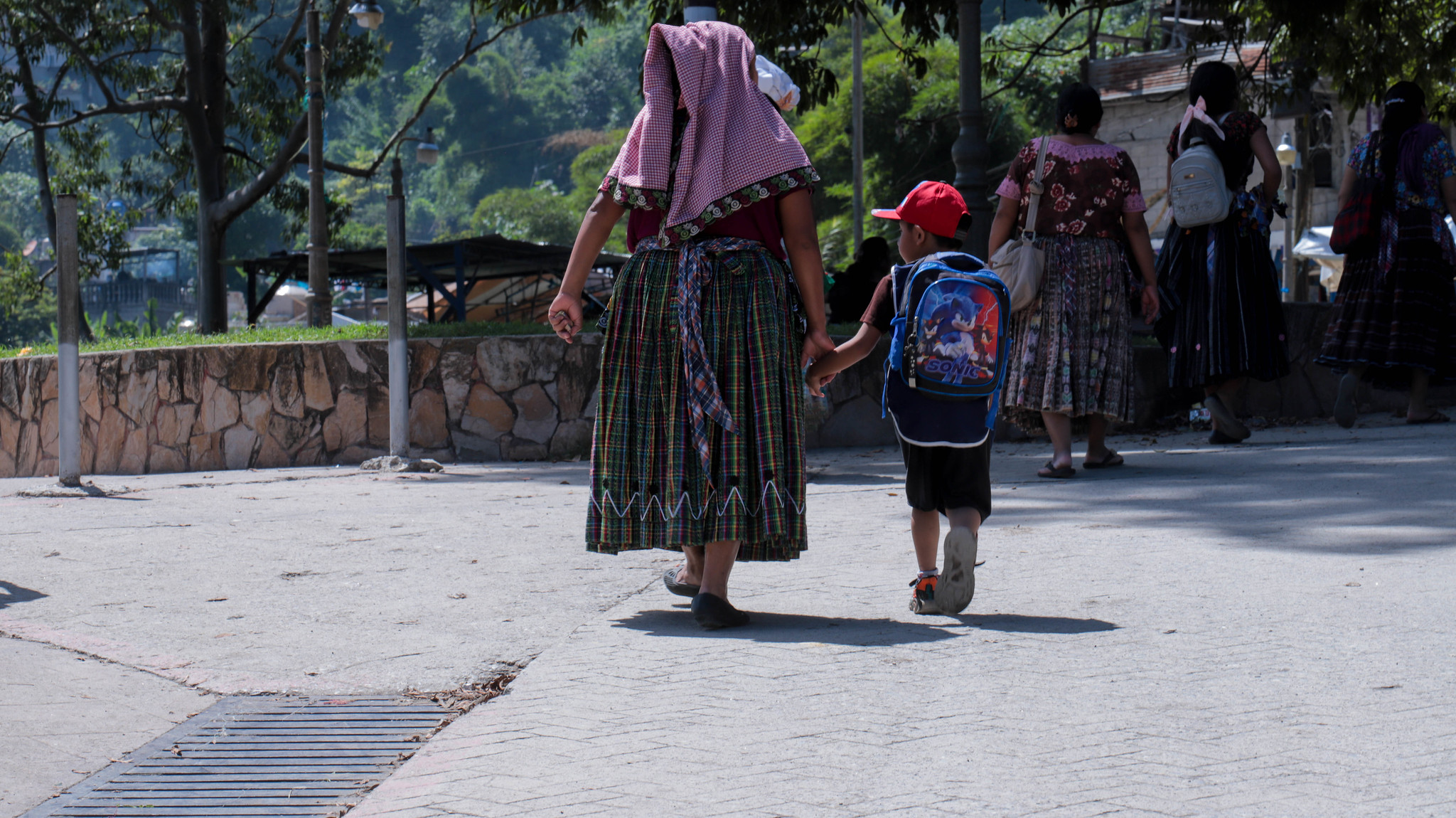
Photo: Mario Winter.
Voices for the Motagua River: Olga Vázquez.
Voices for the Motagua River: Nazario Pascual.
In early 2000, the Maya community organized to stop sand mining on their territory. At that time, the companies held mining permits that remained valid through 2021 and 2022. And although the permits expired, some companies continued to operate after requesting extensions. In June 2022, the indigenous authorities of the Poqomam people began a sit-in protest in front of the Piedrinera San Luis company, which they maintained for four years.
In July 2024, the Special Rapporteur on Economic, Social, Cultural, and Environmental Rights of the IACHR visited Santa Cruz Chinautla. During his visit, traditional authorities and community members spoke about the environmental, water-related, health, economic, and cultural impacts of the pollution in their rivers.
That same year, in October, the community—with support from AIDA, the Indigenous Peoples’ Law Firm, and partner organizations—filed a lawsuit (petition for amparo) against the municipality of Chinautla over its failure to take measures to address the contamination of its rivers and soil caused by improper solid waste management and the existence of illegal landfills.
AIDA’s scientific team, together with local residents and community authorities, collected key information on illegal landfills in the area. This community science initiative supported the litigation by highlighting the severity of the pollution, demonstrating the ongoing use of such practices, and providing evidence of the municipal authorities’ failure to fulfill their legal obligations regarding waste management.
Learn more about this community science initiative.
In June 2025, the Poqomam community won the support of the Guatemalan justice system when a constitutional court ordered the municipality of Chinautla to effectively address the claims in the lawsuit aimed at stopping the pollution of the rivers and soil in Santa Cruz Chinautla.
This is the first time a Guatemalan court has recognized a community's right to a healthy environment and its central role in finding solutions.
Find out the details of the legal victory.
Current situation
Since the ruling was issued, the municipality of Chinautla has held a series of “technical working groups” with representatives from the central government, civil society, and the community. A smaller group of technical experts was later created to develop a work plan with clear goals. Several months have passed without the municipality convening these working groups.
Furthermore, in December 2025, the IACHR noted in its report Human Rights Situation in Guatemala that the Motagua River basin is facing a severe pollution crisis that has had profound impacts on biodiversity and has resulted in systematic violations of the human rights of local communities, including the Maya Poqomam people.
And in May 2026, the Ministry of the Environment and Natural Resources revoked the license of the sand mining company Piedrinera San Luis for "failure to comply with environmental commitments."
AIDA continues to monitor the implementation of the court ruling to ensure the right to a healthy environment for the Poqomam Maya community and all those living in the Motagua River basin. Meanwhile, the residents of Santa Cruz Chinautla remain organized and mobilized to improve their environment and defend their rights.
Related projects

Internationally Advocating for Accountability for Human Rights Abuses
Juana[1] is suffering from respiratory problems and her sister has asthma. They live in La Oroya, a small city in Peru’s central Andes. It was years before Juana had access to the information she needed to understand the source of their illnesses: toxic contamination from the Doe Run metal smelter. Although there has been some progress, Juana and the rest of the people affected by the contaminated air in La Oroya still do not receive the specialized and comprehensive medical care they need. In cases like La Oroya, victims don’t always find justice in their own countries and must raise their demands to an international level. One space to do so is the Inter-American Commission on Human Rights public hearings, held twice a year in March and October. AIDA has actively participated in case hearings on specific human rights violations, such as in La Oroya. But we have also requested and received thematic hearings on problems facing Latin American countries or the region as a whole. We have participated alongside and in collaboration with other civil society organizations. "By providing information and arguments, we encourage the Commission to make visible worrisome situations of human rights violations caused by environmental degradation, and to take actions to stop them: develop standards, monitor cases, and make recommendations to States," explained María José Veramendi Villa, senior attorney at AIDA. Last October AIDA and partner organizations called the Commission’s attention to mining and energy projects that force displacement of people and communities in Colombia. We also requested that the Commission develop standards governing displacement caused by large infrastructure projects, and insisted that the Colombian government properly respond to the victims. "These hearings are the most comprehensive and flexible tool to ensure the Commission receives information about the issues that are troubling to the region. There are so many worries, and so many organizations wanting to be heard, that there is not enough time. The hearings are an indicator of the most relevant issues of the times and, through them, civil society develops an agenda of work," said Ana María Mondragón, attorney at AIDA. AIDA returned this month to Washington, D.C., seat of the Commission, to participate in a thematic hearing that brings to the table a current and deepening concern: the predominant role corporations are playing in the violation of human rights in Latin America. One example is the case of Máxima Acuña Chaupe in Cajamarca, Peru. The Yanacocha mining company is interested in developing a project on her territory and, in order to do so, accused her of usurping land. Although a judicial court ruling established Máxima’s innocence, she and her family live in fear that the company may again try to take away their home. The case of the Chaupe family, and many others in the region, demonstrates the importance of bringing this issue before the Commission. "During the hearing, we presented information to fuel debate about opportunities for the Commission to create, implement and strengthen international standards on business and human rights," explained Veramendi Villa. "By doing so, the Commission can urge States to control and/or sanction corporations – like Doe Run Peru and Yanacocha – whose activities harm the environment and violate human rights and ensure access to justice for its victims." [1] Name has been changed to protect confidentiality.
Read more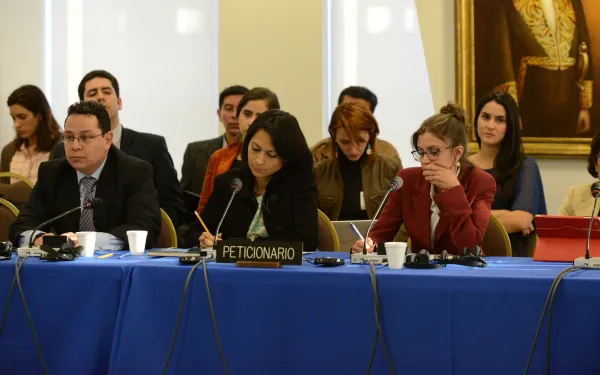
Organizations request that the IACHR strengthen State obligations to supervise corporate activities that violate human rights
In a hearing before the Inter-American Commission on Human Rights, they highlighted the opportunities that the Commission has to address the problem through the creation, implementation and strengthening of international standards on business and human rights. Washington D.C. In a hearing before the Inter-American Commission on Human Rights, civil society organizations requested that the Commission provide renewed attention to the problem, increasingly experienced in the hemisphere, of human rights violations committed by corporations. The hearing was jointly requested by the Interamerican Association for Environmental Defense (AIDA), a regional organization; the Association for Human Rights (APRODEH) of Peru; the Center for Human Rights and Environment (CEDHA) of Argentina; and Justiça Global of Brazil. The organizations applauded the Commission’s openness to directly addressing, for the first time, the theme of business and human rights in a public hearing. “Through various mechanisms in recent years, the Commission has received a large amount of information about cases of human rights violations in which corporations have played a central role, but the problem has worsened because of a lack of effective solutions. In this sense, one of the biggest challenges the Commission has is to find ways to address the issue properly and to help both the States and the corporations to fulfill their human rights obligations,” explained Astrid Puentes, co-executive director of AIDA. Through their work, the organizations have seen that most recurrent aspects of the problem include: the impacts of megaprojects and extractive industries on human rights and the environment; difficulties in guaranteeing the right to participation and access to information for affected people and communities; the absence of Human Rights Impact Assessments; systematic violations of labor rights and forced labor practices; the privatization of public security forces to protect business activities; and aggression towards and criminalization of people who defend the environment, their territory and human rights. At the hearing, the organizations reminded that progress has been made in the development international standards on business and human rights. One such example, they explained, is the United Nations Guiding Principles on Business and Human Rights. "However, because compliance is voluntary and there are various legal loopholes, this instrument has not been effective enough to prevent the continuation of human rights abuses. Also, effective regulation of territorial and extraterritorial State obligations regarding the responsibilities of transnational corporations on national, regional and international levels does not exist. This sort of vacuum prevents both the safeguarding of people’s rights, and access to appropriate compensation and justice for victims,” said Alexandra Montgomery of Justiça Global. Looking forward, the organizations presented information about the opportunities the Commission has to strengthen the implementation of existing standards. They emphasized the following points: The Commission should promote corporations’ respect for human rights. This includes promoting State responsibility for adequate supervision of business activities and for establishment of binding obligations for them, since the voluntary nature of the Guiding Principles compromises and puts at risk the protection of human rights. Based on the jurisprudence of the Inter-American Human Rights System in relation to the obligations of States to respect and guarantee human rights, the Commission can develop specific measures for States to supervise business activities to ensure that they do not violate human rights. Respect for human rights by States and companies must not be subject to economic or political considerations. It is necessary to strengthen access to justice for victims of human rights abuses by business actors through recommendations for improvement and implementation of accountability mechanisms and international forums, such as the Commission and the Inter-American Court of Human Rights. “We hope that as a result of the hearing, the Commission initiates dialogues that incorporate the experience of civil society organizations and of United Nations agencies to strengthen the respect of and guarantees for human rights in the region,” concluded Gloria Cano, of APRODEH.
Read moreWetlands: Vital and At Risk
Temporarily or permanently flooded extensions of land create wetlands— oxygen-deprived, hybrid ecosystems that combine the characteristics of both aquatic and terrestrial systems. Wetlands include marshes, páramos, bogs, peatlands, swamps, mangroves and coral reefs. Wetlands provide people with a host of benefits: Wetlands are natural supermarkets that contain an incredible amount of biodiversity: they are home to more than 100,000 known freshwater species. Our allies in the fight against climate change, wetlands capture and store carbon from the atmosphere. It is estimated that over long periods of time, a hectare of mangroves captures 50 times more carbon dioxide than a tropical forest. Wetlands help to reduce the risk of natural disasters . An example of this happened in 2011, when the Veracruz Reef System in the Gulf of Mexico protected the city of Veracruz from the category four Hurricane Karl. Wetlands are a source of livelihood and employment for millions of people. In Panama alone, 90 percent of incomefrom fishing comes from catching species that, at some stage in their life, depend on the wetlands of the Panama Bay. What’s more, water to irrigate the country’s 570 million agricultural crops comes from these ecosystems. By forming beautiful landscapes, wetlands are a center of recreational and tourist activities, such as bird watching. Under threat Even though they are one of the most productive ecosystems in the world, more than 64% of the world’s wetlands have disappeared. The causes of their degradation include: Activities like agriculture that promote changes in land use , and contribute to the loss of coverage of wetlands. An example is the Ciénaga Grande de Santa Marta in Colombia, which is at risk from agricultural practices that have affected its water supply. Poorly planned urban development like that which threatened Panama Bay, where the mangroves were filled in and cut down to construct roads and houses. Obstruction of the water flow that feeds wetlands, as in the construction of the Las Cruces hydroelectric project in Mexico on the San Pedro Mezquital river, on which Marismas Nacionales, one of the most important mangrove forests in the country, depends. Contamination of subterranean water sources by activities like mining. What can we do for them? At AIDA we work to protect wetlands in the Americas . We’ve advocated for the preservation of the Colombian páramosand the Mexican wetlands, such as Cabo Pulmo, Marismas Nacionales and the Veracruz Reef System. We’ve also created rigorous reports about the international legal obligations that Costa Rica must meet to protect its corals, and about the standards of protection of corals in Mexico. And we’re ready to do more! We are currently preparing for the 12th Conference of Parties (COP12) for the Ramsar Convention , an intergovernmental treaty that has since 1971 promoted the protection of wetlands and established principles for their conservation and sustainable use through national action and international cooperation. The countries that sign and ratify the Convention are home to wetlands on the Ramsar List. They commit to taking steps necessary to maintain the ecological characteristics of these sites , which hold such significant value for their country and for all of humanity. The Conference will put to the test the promises that Latin American countries have made to protect their wetlands. The Parties will release Strategic Plan 2016-2021 , which will lay the foundation for the conservation of these ecosystems in the region. We’ll be at the Conference alongside partner organizations and decision markers to advocate for the best possible preservation of these beacons of health and biodiversity for the region.
Read more