
Project
Shutterstock.
Pollution of the Motagua River in Guatemala: The Poqomam Maya people’s quest for environmental justice
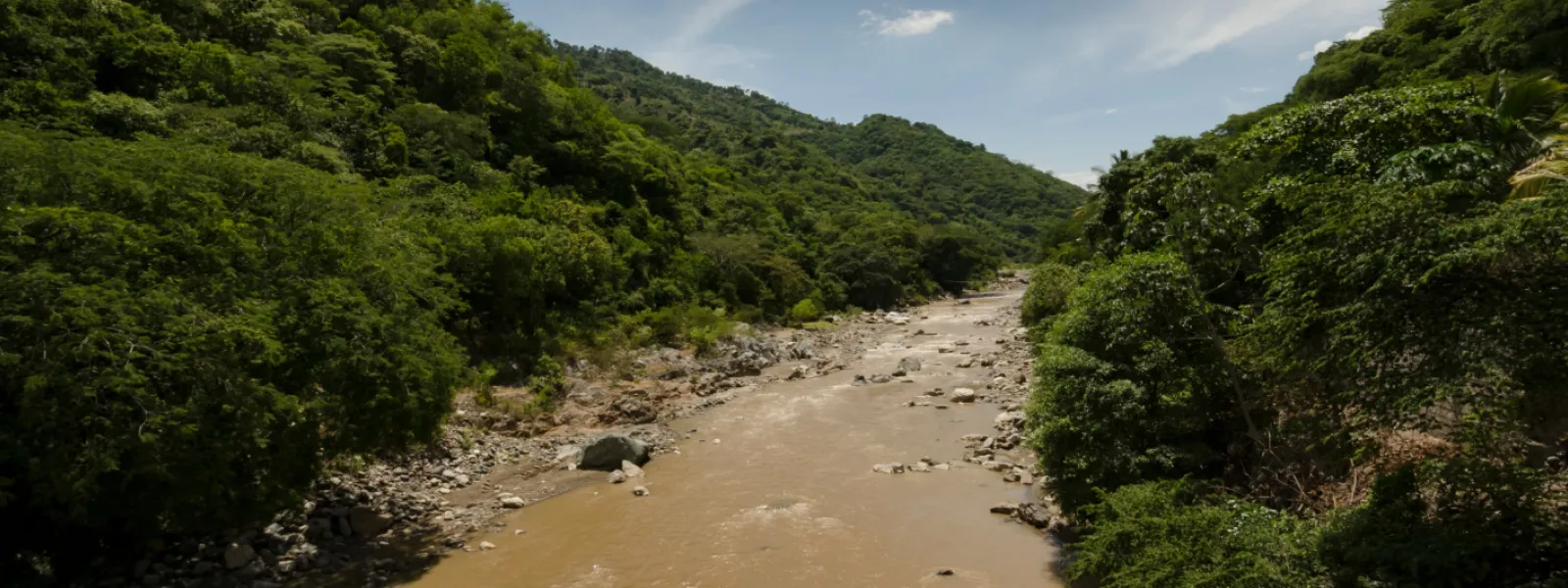
The Motagua River basin—Guatemala’s largest and most important river—is severely polluted with wastewater, solid waste, and other types of debris.
This is a cross-border issue because the Motagua’s polluted waters flow into the Caribbean Sea, reach the coast of Honduras, and threaten the Mesoamerican Reef System.
For decades, this has violated the rights to health, water, development, and a healthy environment of all the people living in the river basin.
In June 2025, the Poqomam Maya community of Santa Cruz Chinautla—supported by AIDA, the Indigenous Peoples’ Law Firm, and allied organizations—achieved an unprecedented legal victory to halt degradation in the basin. In response to the lawsuit it filed, a Guatemalan court ordered the municipality of Chinautla to comply with a series of obligations to curb the pollution of the area’s rivers and soil.
The government's response to the ruling has so far been limited to technical working group meetings. Meanwhile, the community continues to work toward the proper implementation of the ruling and to take other actions to defend its territory and its rights.
Background
The Motagua River, which is 486 km long, flows through 96 municipalities and 14 departments in Guatemala. It originates in Quiché, a department located in the northwest, and empties into the Caribbean Sea.
Polluting activities occur throughout the entire basin, including sub-basins and micro-basins. The largest volume of pollution comes from Guatemala City, the country’s capital, and is carried by the waters of the Las Vacas River, which in turn receives a large amount of waste from the Chinautla River.
The Chinautla River, which flows through the municipality of the same name, carries solid waste from a landfill located in Zone 3 of the capital—where trash from at least 14 municipalities in the department of Guatemala is dumped—as well as sewage generated by some 500,000 people living in the northern part of the capital, which undergoes no prior treatment.
Other sources of pollution include the numerous illegal dumps in the municipality of Chinautla, the waste that private vehicles and garbage trucks dump along the banks of its rivers, as well as the sand-mining companies—which began setting up operations in the area between 1996 and 1997—whose activities weaken the rivers' basins, causing solid waste to be more easily carried away by the river currents.
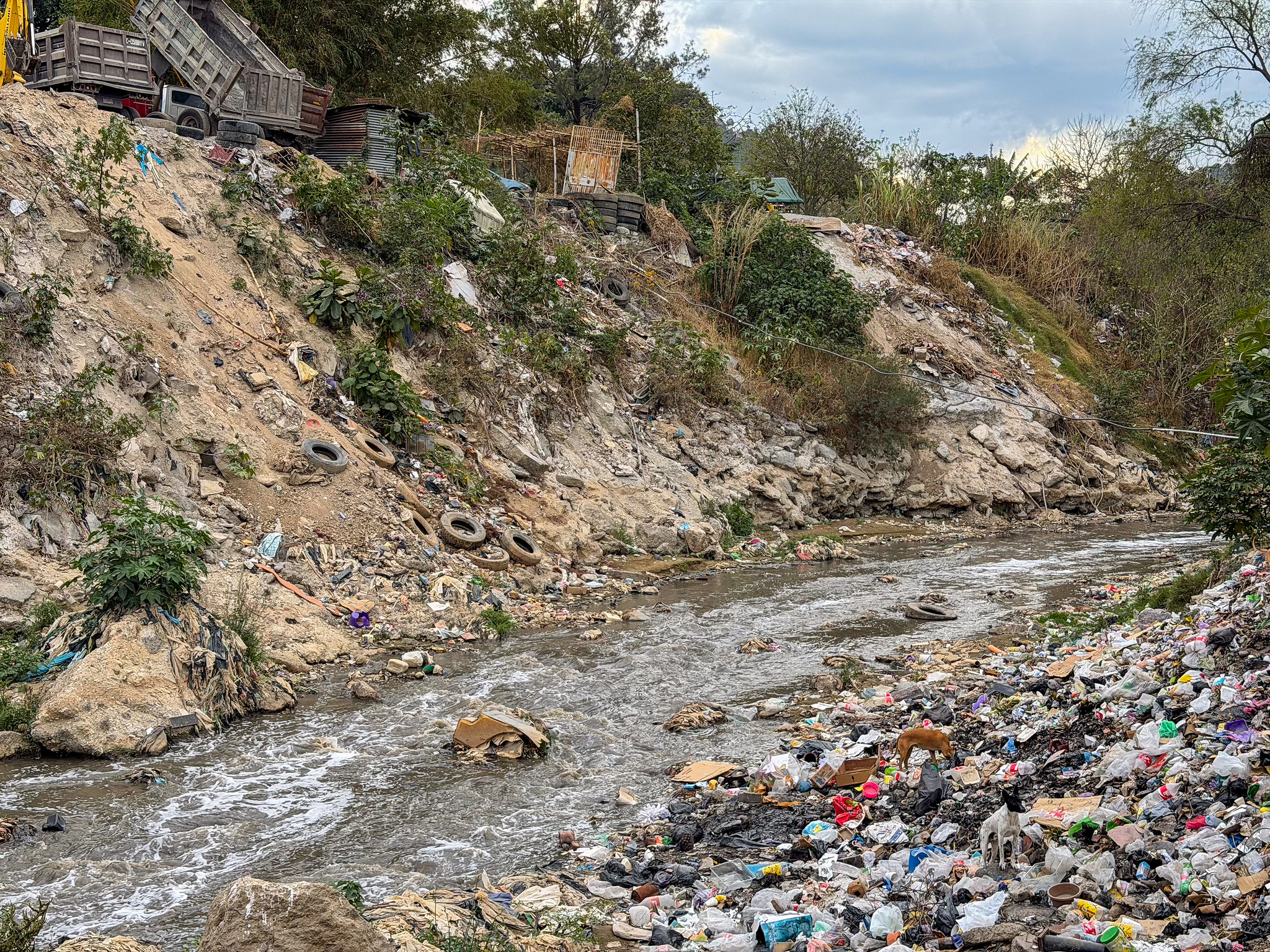
Photo: Mayela Sánchez García.
The situation extends beyond national borders. Every year, the Motagua River discharges some 20,000 metric tons of plastic into the Caribbean Sea, making it one of the rivers that contributes the most plastic pollution to the ocean worldwide, according to estimates contained in a 2025 report by the Inter-American Commission on Human Rights (IACHR).
The river flows into the Mesoamerican Reef at its mouth, so pollution also threatens to degrade one of the largest and most biodiverse transboundary reefs on the planet, which spans the territorial waters of Belize, Guatemala, Honduras, and Mexico.
In addition, the contaminated water reaches the coast of Honduras and spreads into Amatique Bay, located along the eastern coast of Guatemala, affecting the Caribbean Sea.
The roots of this chronic, cross-border problem are structural. Data from the Integrated Environmental Management of the Motagua River Basin project, funded by the United Nations Development Program (UNDP), show that in Guatemala, 66% of municipal solid waste is not collected, and there is no guarantee that the remaining 34% is disposed of properly. Furthermore, of all landfills nationwide, 88.32% are illegal or lack municipal authorization.
In other words, the core issues that need to be addressed are the mismanagement of solid waste and water resources in Guatemala; noncompliance with existing regulations on wastewater discharge and the disposal and treatment of solid waste and residues; and the lack of a water law.
The Poqomam Maya people's quest for justice
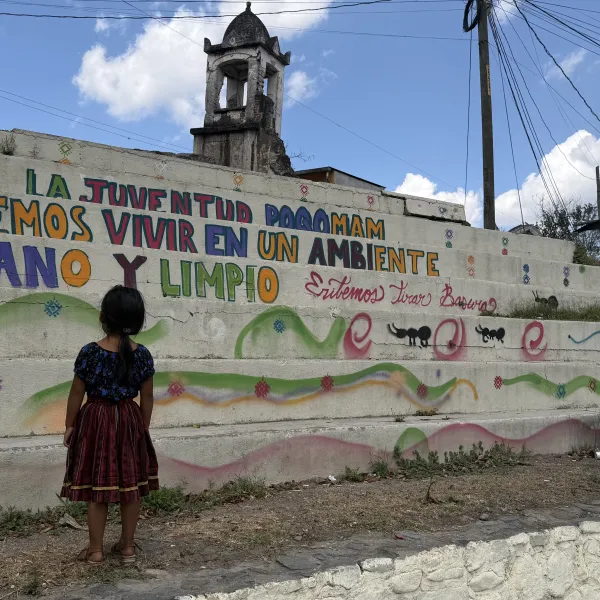
The rivers of Santa Cruz Chinautla, a community of the Poqomam Maya people located just twelve kilometers from Guatemala City, have become conduits of pollution that are degrading the Motagua River.
For decades, the local population has seen its health and livelihoods—including pottery, one of the main economic activities and a source of identity—damaged due to the lack of waste management in the municipality of Chinautla and the urban area of the country’s capital, as well as the activities of sand-mining companies.
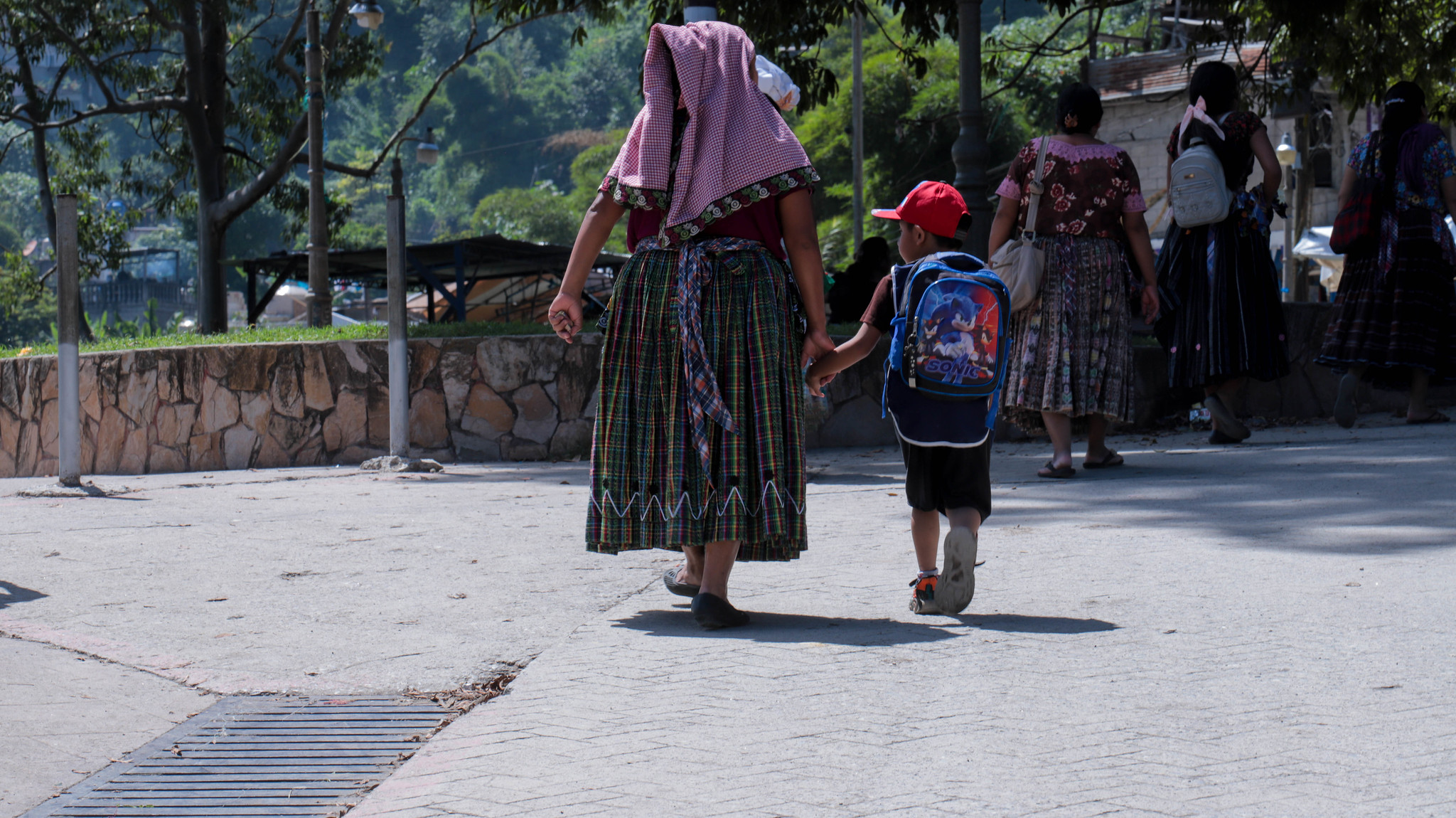
Photo: Mario Winter.
Voices for the Motagua River: Olga Vázquez.
Voices for the Motagua River: Nazario Pascual.
In early 2000, the Maya community organized to stop sand mining on their territory. At that time, the companies held mining permits that remained valid through 2021 and 2022. And although the permits expired, some companies continued to operate after requesting extensions. In June 2022, the indigenous authorities of the Poqomam people began a sit-in protest in front of the Piedrinera San Luis company, which they maintained for four years.
In July 2024, the Special Rapporteur on Economic, Social, Cultural, and Environmental Rights of the IACHR visited Santa Cruz Chinautla. During his visit, traditional authorities and community members spoke about the environmental, water-related, health, economic, and cultural impacts of the pollution in their rivers.
That same year, in October, the community—with support from AIDA, the Indigenous Peoples’ Law Firm, and partner organizations—filed a lawsuit (petition for amparo) against the municipality of Chinautla over its failure to take measures to address the contamination of its rivers and soil caused by improper solid waste management and the existence of illegal landfills.
AIDA’s scientific team, together with local residents and community authorities, collected key information on illegal landfills in the area. This community science initiative supported the litigation by highlighting the severity of the pollution, demonstrating the ongoing use of such practices, and providing evidence of the municipal authorities’ failure to fulfill their legal obligations regarding waste management.
Learn more about this community science initiative.
In June 2025, the Poqomam community won the support of the Guatemalan justice system when a constitutional court ordered the municipality of Chinautla to effectively address the claims in the lawsuit aimed at stopping the pollution of the rivers and soil in Santa Cruz Chinautla.
This is the first time a Guatemalan court has recognized a community's right to a healthy environment and its central role in finding solutions.
Find out the details of the legal victory.
Current situation
Since the ruling was issued, the municipality of Chinautla has held a series of “technical working groups” with representatives from the central government, civil society, and the community. A smaller group of technical experts was later created to develop a work plan with clear goals. Several months have passed without the municipality convening these working groups.
Furthermore, in December 2025, the IACHR noted in its report Human Rights Situation in Guatemala that the Motagua River basin is facing a severe pollution crisis that has had profound impacts on biodiversity and has resulted in systematic violations of the human rights of local communities, including the Maya Poqomam people.
And in May 2026, the Ministry of the Environment and Natural Resources revoked the license of the sand mining company Piedrinera San Luis for "failure to comply with environmental commitments."
AIDA continues to monitor the implementation of the court ruling to ensure the right to a healthy environment for the Poqomam Maya community and all those living in the Motagua River basin. Meanwhile, the residents of Santa Cruz Chinautla remain organized and mobilized to improve their environment and defend their rights.
Related projects

5 Reasons to Donate to AIDA
We all must leave a legacy, my grandfather said. For him – beyond being loving husbands and wives, committed parents, responsible children, faithful friends and fulfilled workers – that means contributing something to the benefit of humankind. The wise words of my grandfather guide my professional life. In nine years of working with AIDA, I have had the great pleasure of seeing progress made on cases we’ve worked on throughout Latin America. These successes give me the energy to go the extra mile whenever necessary. Many times, however, I’ve felt the frustration of seeing so many people and places that need our help, and not having the financial or human resources to do so. If you agree that there is nothing more valuable than contributing to building a better world, and a more habitable place for future generations, then I have a suggestion for you: Please support AIDA’s work by making a donation! 5 Reasons to Support Our Work To enable you to make an informed decision, here are five reasons why supporting our work is an excellent idea: We are an international nonprofit organization with more than 15 years of experience in service to one fundamental mission: to use the law to protect the environment of the Americas, with a focus on Latin America. "Protecting our right to a healthy environment" is the motto that guides our actions. We are a group of Latin American attorneys who work with commitment. Our experience enables us to develop strategies before international bodies and organizations to ensure that the States comply with their environmental and human rights obligations. We work in partnership with national organizations, strengthening and complimenting their efforts. We firmly believe in public participation and capacity building to achieve greater impact and results over the long term. We share our knowledge with the partners and communities with whom we closely work. We take the great care when investing our funds. We work efficiently and effectively. We carefully select cases that will set a legal precedent and serve as an example for environmental defense in the countries of the region. Our work has a global impact, today and in the future. We work for the common good of all people: protecting vital resources like clean air and clean water. We consider our donors an integral part of our team. Without your contribution, it would not be possible for us to provide free legal assistance to communities fighting to defend their natural environment and protect their basic rights. With your support We will continue ensuring the protection of marine and coastal resources, the preservation of fresh water, effective responses to climate change, and the human right to a healthy environment. Helping us is simple and safe: You can do it right here! THANK YOU for believing in our work!
Read more
UN registered Barro Blanco Hydroelectric Dam temporarily suspended over non-compliance with Environmental Impact Assessment
Panama City, Panama and Geneva, Switzerland. In a landmark decision, Panama’s National Environmental Authority (ANAM) temporarily suspended the construction of the Barro Blanco hydroelectric dam yesterday over non-compliance with its Environmental Impact Assessment (EIA). The dam was approved by the UN Clean Development Mechanism (CDM) despite risks of flooding to the territory of the indigenous Ngäbe Bugle communities. With delegates currently meeting in Geneva to draft negotiating text for a new global climate agreement, ANAM’s decision illustrates why the agreement must include human rights protections, including the rights of indigenous peoples. In Geneva, several nations have already insisted on the need for climate measures to respect, protect, promote, and fulfil human rights for all. "Panama has taken a critical first step toward protecting the rights of the Ngäbe communities, which have not been adequately consulted on the Barro Blanco CDM project. But much more work is needed," said Alyssa Johl, Senior Attorney at the Center for International Environmental Law (CIEL). "As an urgent matter, Panama should recognize its obligations to protect human rights in climate actions, such as Barro Blanco, by supporting the call for human rights protections in the UN climate regime." Current climate mechanisms, such as the UN’s Clean Development Mechanism, neither provide incentives for the sustainable implementation of climate actions nor offer recourse in the case of adverse impacts. "The CDM Board approved Barro Blanco when it was clear that the dam would flood the homes of numerous indigenous families. This decision is a warning signal that safeguards must be introduced to protect human rights, including robust stakeholder consultations and a grievance mechanism," said Eva Filzmoser, Director of Carbon Market Watch. ANAM’s decision was triggered by an administrative investigation that found non-compliance with the project’s environmental impact assessment, including shortcomings in the agreements with affected indigenous communities, deficiencies in negotiation processes, the absence of an archaeological management plan for the protection of petroglyphs and other archaeological findings, repeated failures to manage sedimentation and erosion, poor management of solid and hazardous waste, and logging without permission. The Environmental Advocacy Center of Panamá (CIAM) considers it appropriate for ANAM to have taken effective and immediate measures to suspend the project. "This suspension reflects inadequate environmental management on the part of the company that requires an investigation and an exemplary sanction". "During 15 years of opposition to the Barro Blanco project, we have exposed violations of our human rights and irregularities in the environmental proceedings. Those claims were never heard," said Weni Bagama from the Movimiento 10 de Abril (M-10). "Today we are satisfied to see that the national authorities have recognized them and have suspended the project, as a first step towards dialogue. Nevertheless, we continue to uphold the communities’ position that the cancelation of this project is the only way to protect our human rights and our territory. We hope that this sets an example for the international community and for other hydroelectric projects, not only in Panama but worldwide." "Any dialogue between the affected communities, the Government and the company has to be transparent, in good faith, respectful of the communities’ rights, and include guarantees so that the communities can participate equally and the agreements are fully respected," explained María José Veramendi Villa, Senior Attorney at the Interamerican Association for Environmental Defense (AIDA). "In this dialogue, the State must take into account all human rights violations that have been denounced by the communities since the project was approved." Environmental groups around the world are celebrating the suspension of the Barro Blanco Dam, following years of efforts in support of the indigenous populations in the Ngäbe Bugle comarca, which have been faced with oppression and numerous rights violations. Eyes are now watching for the reactions of the banks involved in financing the Barro Blanco project, including the German development bank, DEG, and the Dutch development bank, FMO, against whom the M10 movement, which represents the indigenous communities, had filed a complaint. "We urge the banks to halt disbursement of any remaining funds until all problems are solved and the affected indigenous communities agree to the project," said Kathrin Petz of Urgewald.
Read more
Five Reasons to Protect the Peruvian Anchoveta
The anchoveta (Engraulis ringens), a wide-eyed fish 12 to 15 centimeters long, is prevalent in the Pacific coastal waters of Peru. When I first heard of this little fish, I had no idea how important it was for both the environment and the Peruvian population. Commercially, the anchoveta is used to produce fishmeal for animal feed and, to a lesser extent, for human consumption. But it’s also an important source of nutrition for the fish, mammals and birds of the Humboldt Current, one of the most biodiverse cold-water ocean currents in the world. Two years ago, AIDA began collaborating with the Peruvian Society for Environmental Law and Earthjustice to recommend changes to Peruvian law that would ensure sustainable management of the anchoveta fishery. We’ve recently released a report in which we stress the importance of ecosystem management. Decisions about how much anchoveta to catch, and when, should take into account both the commercial fishing industry and the health of the Humboldt Current ecosystem. Here are the five most important reasons to promote ecosystem management of the Peruvian anchoveta fishery: 1. Species of mammals, fish and birds depend on the anchoveta for nourishment. Most marine predators of the Humboldt Current depend, to some extent, on the anchoveta. The small fish is food to Humboldt Penguins and other birds, marine mammals like sea lions, and other commercial fish, such as hake, horse mackerel and mackerel. Fishery management that considers the ecosystem as a whole will help to save not just the anchoveta, but the many species that depend on it as well. 2. The anchoveta population is at risk. The Peruvian anchoveta fishery has been on the verge of collapse. It has had to be closed twice: once in the early-1970s and once in the late-1990s. The lack of an adequate ecosystem management plan creates fluctuations in the anchoveta population. Continuing this way in a year with reduced populations could mean the collapse of the fishery. 3. More and better controls over what can be fished are needed. The demand for fish implies, increasingly, that more juvenile anchoveta are being captured before they have reached the age of reproduction. As a result, the anchoveta cannot replenish its population fast enough to keep up with harvests. 4. Comprehensive fisheries management plans do not exist. The laws that regulate the anchoveta fishery differ depending on whether the fish is for human consumption or will be used to produce by-products such as fishmeal and fish oils. A management plan that integrates both uses must be established to create a truly sustainable fishery that also takes into account the anchoveta’s relationship with other species. 5. Ecosystem management of the Peruvian anchoveta would set an example for other countries. The Peruvian anchoveta fishery is the largest in the world. Implementing institutional and regulatory reform to promote ecosystem management of the species would set a precedent for other countries in the region to improve their standards. Learn more I invite you to review the report (in Spanish). Now is the time to care for the little species that do a big job in our seas! The ocean knows no bounds and its relationships are complex. Ecosystem management of the anchoveta fishery will ensure that there will be enough fish to feed the needs of industry and maintain the ecological balance of the Humboldt Current.
Read more