
Project
Shutterstock.
Pollution of the Motagua River in Guatemala: The Poqomam Maya people’s quest for environmental justice
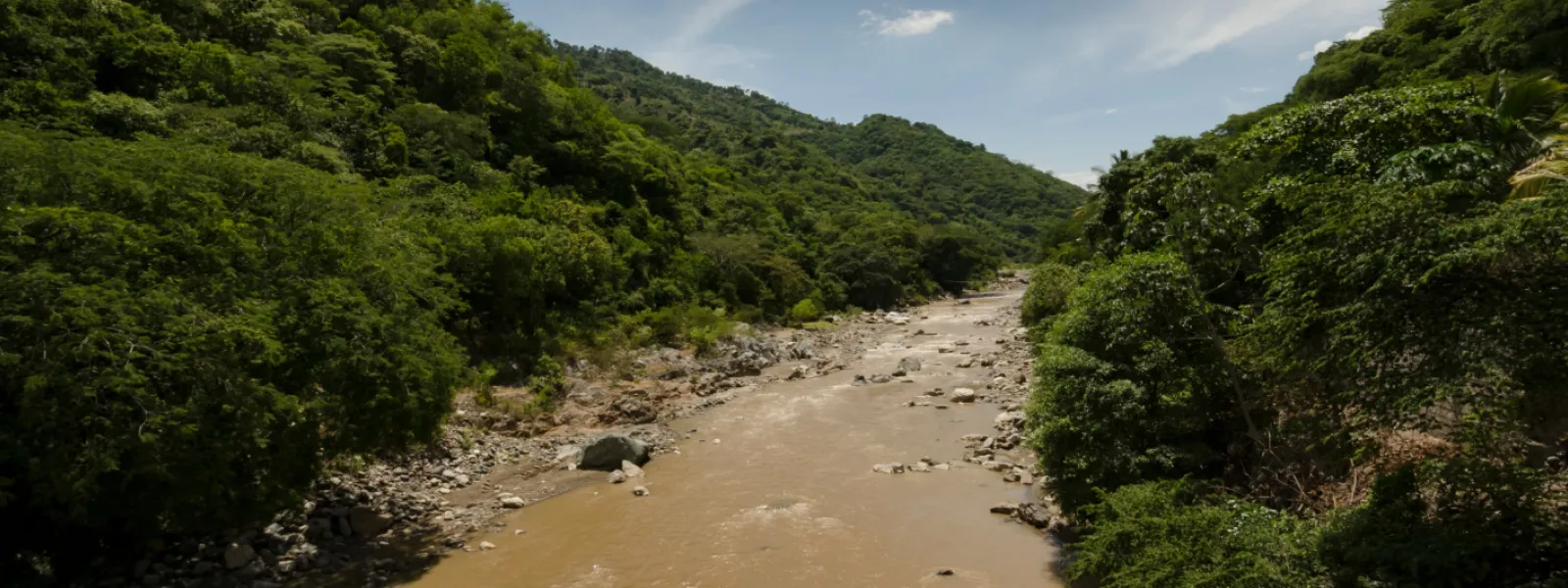
The Motagua River basin—Guatemala’s largest and most important river—is severely polluted with wastewater, solid waste, and other types of debris.
This is a cross-border issue because the Motagua’s polluted waters flow into the Caribbean Sea, reach the coast of Honduras, and threaten the Mesoamerican Reef System.
For decades, this has violated the rights to health, water, development, and a healthy environment of all the people living in the river basin.
In June 2025, the Poqomam Maya community of Santa Cruz Chinautla—supported by AIDA, the Indigenous Peoples’ Law Firm, and allied organizations—achieved an unprecedented legal victory to halt degradation in the basin. In response to the lawsuit it filed, a Guatemalan court ordered the municipality of Chinautla to comply with a series of obligations to curb the pollution of the area’s rivers and soil.
The government's response to the ruling has so far been limited to technical working group meetings. Meanwhile, the community continues to work toward the proper implementation of the ruling and to take other actions to defend its territory and its rights.
Background
The Motagua River, which is 486 km long, flows through 96 municipalities and 14 departments in Guatemala. It originates in Quiché, a department located in the northwest, and empties into the Caribbean Sea.
Polluting activities occur throughout the entire basin, including sub-basins and micro-basins. The largest volume of pollution comes from Guatemala City, the country’s capital, and is carried by the waters of the Las Vacas River, which in turn receives a large amount of waste from the Chinautla River.
The Chinautla River, which flows through the municipality of the same name, carries solid waste from a landfill located in Zone 3 of the capital—where trash from at least 14 municipalities in the department of Guatemala is dumped—as well as sewage generated by some 500,000 people living in the northern part of the capital, which undergoes no prior treatment.
Other sources of pollution include the numerous illegal dumps in the municipality of Chinautla, the waste that private vehicles and garbage trucks dump along the banks of its rivers, as well as the sand-mining companies—which began setting up operations in the area between 1996 and 1997—whose activities weaken the rivers' basins, causing solid waste to be more easily carried away by the river currents.
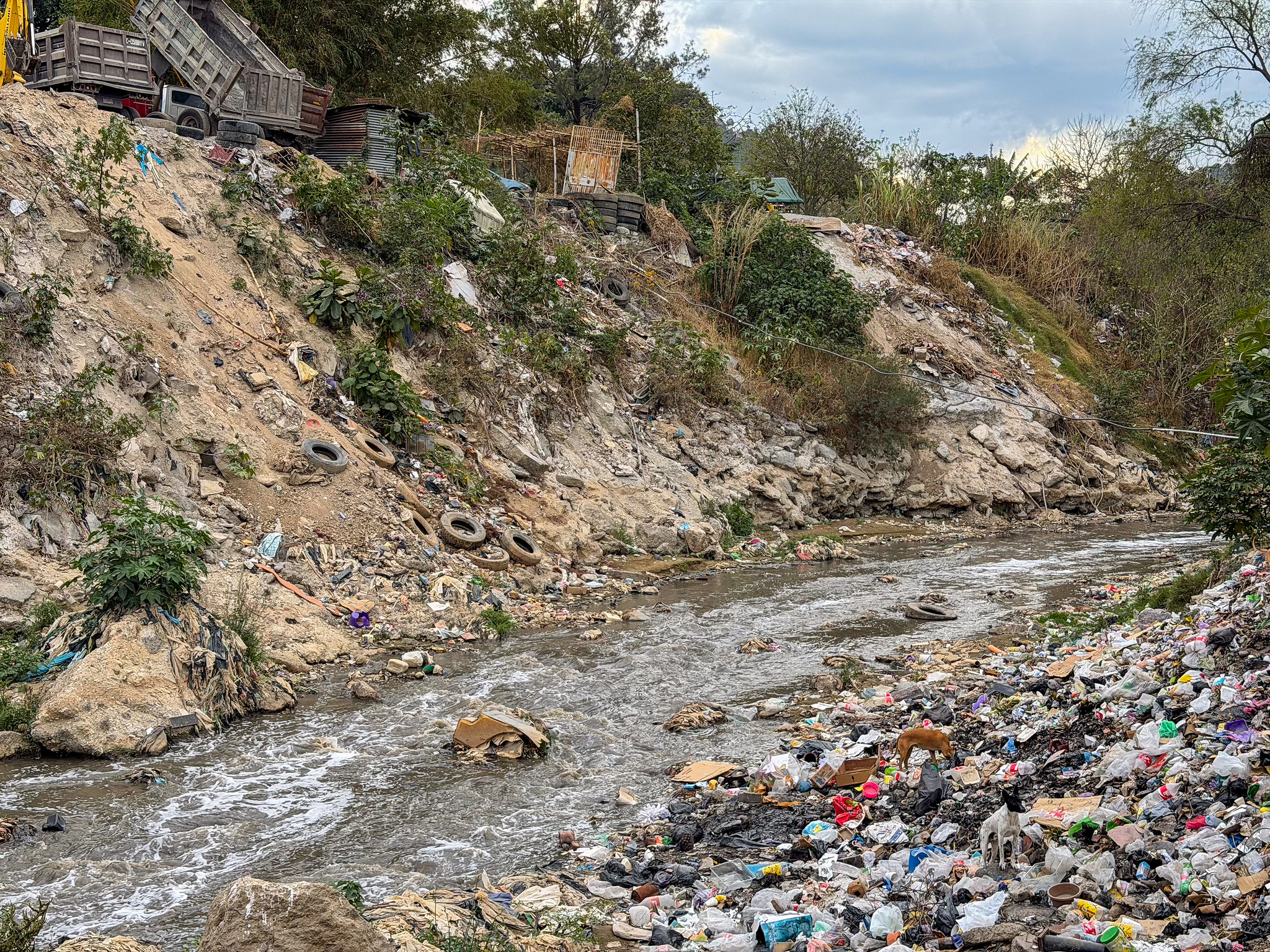
Photo: Mayela Sánchez García.
The situation extends beyond national borders. Every year, the Motagua River discharges some 20,000 metric tons of plastic into the Caribbean Sea, making it one of the rivers that contributes the most plastic pollution to the ocean worldwide, according to estimates contained in a 2025 report by the Inter-American Commission on Human Rights (IACHR).
The river flows into the Mesoamerican Reef at its mouth, so pollution also threatens to degrade one of the largest and most biodiverse transboundary reefs on the planet, which spans the territorial waters of Belize, Guatemala, Honduras, and Mexico.
In addition, the contaminated water reaches the coast of Honduras and spreads into Amatique Bay, located along the eastern coast of Guatemala, affecting the Caribbean Sea.
The roots of this chronic, cross-border problem are structural. Data from the Integrated Environmental Management of the Motagua River Basin project, funded by the United Nations Development Program (UNDP), show that in Guatemala, 66% of municipal solid waste is not collected, and there is no guarantee that the remaining 34% is disposed of properly. Furthermore, of all landfills nationwide, 88.32% are illegal or lack municipal authorization.
In other words, the core issues that need to be addressed are the mismanagement of solid waste and water resources in Guatemala; noncompliance with existing regulations on wastewater discharge and the disposal and treatment of solid waste and residues; and the lack of a water law.
The Poqomam Maya people's quest for justice
The rivers of Santa Cruz Chinautla, a community of the Poqomam Maya people located just twelve kilometers from Guatemala City, have become conduits of pollution that are degrading the Motagua River.
For decades, the local population has seen its health and livelihoods—including pottery, one of the main economic activities and a source of identity—damaged due to the lack of waste management in the municipality of Chinautla and the urban area of the country’s capital, as well as the activities of sand-mining companies.
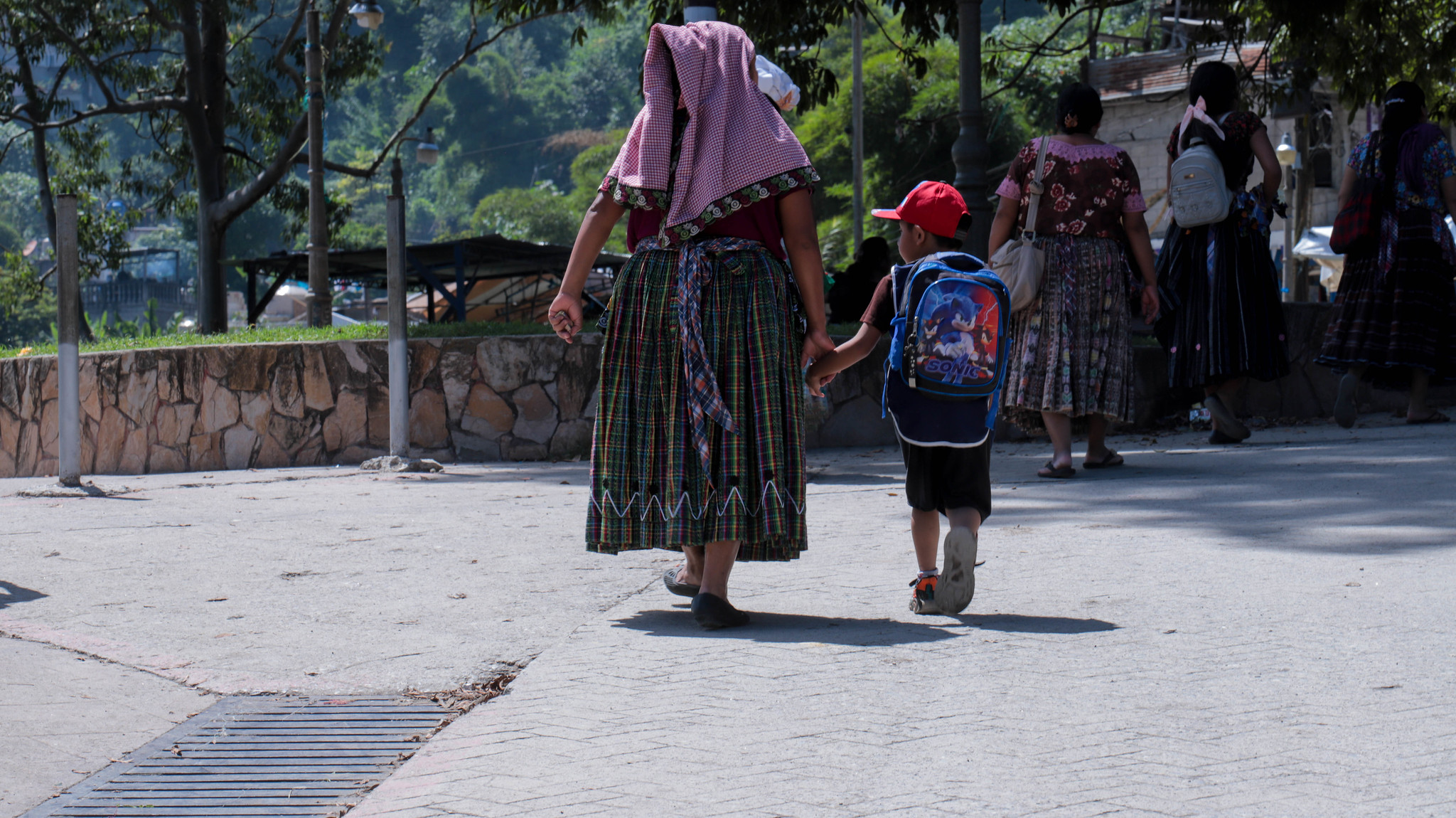
Photo: Mario Winter.
Voices for the Motagua River: Olga Vázquez.
Voices for the Motagua River: Nazario Pascual.
In early 2000, the Maya community organized to stop sand mining on their territory. At that time, the companies held mining permits that remained valid through 2021 and 2022. And although the permits expired, some companies continued to operate after requesting extensions. In June 2022, the indigenous authorities of the Poqomam people began a sit-in protest in front of the Piedrinera San Luis company, which they maintained for four years.
In July 2024, the Special Rapporteur on Economic, Social, Cultural, and Environmental Rights of the IACHR visited Santa Cruz Chinautla. During his visit, traditional authorities and community members spoke about the environmental, water-related, health, economic, and cultural impacts of the pollution in their rivers.
That same year, in October, the community—with support from AIDA, the Indigenous Peoples’ Law Firm, and partner organizations—filed a lawsuit (petition for amparo) against the municipality of Chinautla over its failure to take measures to address the contamination of its rivers and soil caused by improper solid waste management and the existence of illegal landfills.
AIDA’s scientific team, together with local residents and community authorities, collected key information on illegal landfills in the area. This community science initiative supported the litigation by highlighting the severity of the pollution, demonstrating the ongoing use of such practices, and providing evidence of the municipal authorities’ failure to fulfill their legal obligations regarding waste management.
Learn more about this community science initiative.
In June 2025, the Poqomam community won the support of the Guatemalan justice system when a constitutional court ordered the municipality of Chinautla to effectively address the claims in the lawsuit aimed at stopping the pollution of the rivers and soil in Santa Cruz Chinautla.
This is the first time a Guatemalan court has recognized a community's right to a healthy environment and its central role in finding solutions.
Find out the details of the legal victory.
Current situation
Since the ruling was issued, the municipality of Chinautla has held a series of “technical working groups” with representatives from the central government, civil society, and the community. A smaller group of technical experts was later created to develop a work plan with clear goals. Several months have passed without the municipality convening these working groups.
Furthermore, in December 2025, the IACHR noted in its report Human Rights Situation in Guatemala that the Motagua River basin is facing a severe pollution crisis that has had profound impacts on biodiversity and has resulted in systematic violations of the human rights of local communities, including the Maya Poqomam people.
And in May 2026, the Ministry of the Environment and Natural Resources revoked the license of the sand mining company Piedrinera San Luis for "failure to comply with environmental commitments."
AIDA continues to monitor the implementation of the court ruling to ensure the right to a healthy environment for the Poqomam Maya community and all those living in the Motagua River basin. Meanwhile, the residents of Santa Cruz Chinautla remain organized and mobilized to improve their environment and defend their rights.
Related projects

"A full belly makes a happy heart": How does food waste affect the environment?
By Gladys Martínez, legal advisor, AIDA It’s the weekend and we’re at the beach in Costa Rica. The sun is shining, we’re surrounded by nature and listening to the sound of the sea as we enjoy a delicious traditional breakfast of tropical fruit, gallopinto (rice and beans), eggs, home-made tortillas and coffee brewed in a cloth filter. I wish I could say, “And we lived happily ever after". But I can’t. I get upfrom the table to see a heapof leftovers... The problem of food waste and its impacts On World Environment Day this past June 5, the Food and Agriculture Organization of the United Nations (FAO) presented alarming data about the impact of food waste on the environment. In the report Food wastage footprint: Impacts on natural resources, the FAO states that food production accounts for: - 25% of the earth’s surface, - 70% of water consumption, - 80% of deforestation, - and 30% of the greenhouse gas emissions that contribute to climate change. The report notes that producing one liter of milk requires 1,000 liters of water! This means that pouring a glass of milk down the sink is equivalent to dumping 250 liters of water. Throwing out one hamburger is like tossing more than 60,000 liters of water. In terms of total food wastage, 54% is generated during the production, handling and storage at harvests. The remaining 46% is generated during the processing, distribution and consumption of food. The direct economic cost of food wastage is estimated at more than USD $750 billion annually. This figure seems unthinkable on a planet where one in every seven people go hungry and more than 20,000 children under the age of five die from hunger every day. A lot can done inpidually and as a country Costa Rica has campaigns aimed at motivating people to consume responsibly and raise awareness about sensible eating to preserve the environment and other people’s right to food. Working together with the United Nations Environment Programme (UNEp) and the FAO on the campaign Think.Eat.Save, Costa Rican singers Debi Nova, José Cañas (in Spanish) and Manuel Obregón (in Spanish), who doubles as the country’s minister of culture and youth, composed a song against food wastage called “Alimento para el alma” (“Food for the Soul”). ”Food for the Soul" video (in Spanish). Source: YouTube The Food Bank (Banco de Alimentos) is another Costa Rican initiative. Fourteen private companies have agreed to donate products unfit for sale because of damaged labels or packaging. The social and environmental awareness of these companies has made it possible for 15,169 poor people to receive about two plates of food every day over the past year and a half. What can I do at home? Everyone can helpreduce food waste. The campaign Think.Eat.Save offers these helpful tips: ▪ Purchase wisely: Don’t buy more than you need and choose products withless packaging. ▪ Better planning: Cook what you can eat and freeze the leftovers to eat later. ▪ Support distributors of organic and “wonky” fruits and vegetables. Eating organic food has a minimal impact on your health and the environment, and misshapen fruits and vegetables still taste delicious even if they do not look perfect. ▪ Read food labels carefully so as not to throw away perfectly good food. Nine out of 10 people throw out food because they don’t understand what the labels mean.Did you know that if you put an egg in a bowl of water and it floats, that means the egg is bad? If it sinks, it’s still edible. Find out more at FixFoodDates.com ▪ Reduce your food waste and compost what you don’t eat. You can find more useful advice at thinkeatsave.org. Bon appétit!
Read more
What are the páramos and what can you do to protect them?
By Carlos Lozano, legal advisor, AIDA, @CLozanoAcosta What are páramos? The answers to this question are the very reasons why we must support their conservation. They are rare and unique ecosystems. The páramos provide an environmental service to more than 100 million people. They possess the greatest botanical biopersity of all high-altitude ecosystems: 60% of their plant species are endemic (that is, they are found only in the páramos). Their formation is a slow and steady process that has taken hundreds of thousands of years. Although the Colombian páramo is considered tropical because it is situated near the equator, the climate is not hot. It is rather cool due to its high altitude of 3,000 meters (9,842 feet) above sea level. The páramo is a geographical paradox: a frosty ecosystem found in a tropical zone. It alsois an incredible beauty. They form a major part of Latin American history. The páramo was dubbed “the land of the mist” by the conquistadores. The indigenous inhabitants incorporated the páramo in traditional ceremonies as it was considered to be a sacred area. The Muisca people of Colombia’s central highlands believed that the páramo gave birth to their primordial mother, the mythological Bachué. The famous legend of El Dorado also originated in the páramo; A Muisca chief was said to have covered himself in gold and thrown himself into Lake Guatavita, prompting the conquistadores to go on a great gold rush in the search of his treasures. During the Colombian War of Independence, Simón Bolívar crossed the Pisba páramo to elude Spanish army sentinels stationed on the main roads. They are a vital water source and a carbon sink that combats climate change. The páramos feed streams, rivers, aquifers and water catchment areas. These in turn supply water to major South American cities including Bogotá and Quito. The páramo also have a remarkable ability to store water through its vegetation and unique geological and ecological features. It also acts as a carbon sink, accumulating carbon through organic matter in the soil. Invasive activities like mining have a detrimental impact on this process by releasing carbon stored in the soil, contributing to global warming. These points demonstrate how the páramos play an important role as a vital source of water and an ally in combating climate change. Their protection is crucial for our future. In Colombia, where more than half of the world’s páramos are located, the government is making a decision on the future of these valuable and fragile ecosystems through a process of officially demarcating their territorial boundaries. Despite the ecological and environmental importance, the boundaries of the Colombian páramos still have not been defined. This poses a serious risk to the area as it is left vulnerable to harmful activities that could destroy it. To truly protect the páramos from irreparable damage it is essential to clearly define its territorial boundaries. The Santurbán páramo, located between the departments of Santander and North Santander, will soon become the first area to be officially demarcated, according to government plans. Mining interestsalready pose a threat to the area. What is urgent now is for Colombia’s minister of environment to demarcate the Santurbán páramo territory based on scientific criteria. AIDA is taking online action to call for this proposal. With YOUR SIGNATURE, you can support the cause and pressure the government to protect the páramos. Join us to protect the páramos!YOU CAN SIGN too (in Spanish)!ASK Colombia’s president and minister of environment to properly delineate the Santurbán páramo NOW! #SaveSanturbán
Read more
Letter to the Board of the Green Climate Fund
Organizations, movements and civil society groups from developing countries -with decades of experience working for the rights and aspirations of peoples and communities- express their unified call for the adoption of the most robust environmental and social protections at the Green Climate Fund.
Read more