
Project
Shutterstock.
Pollution of the Motagua River in Guatemala: The Poqomam Maya people’s quest for environmental justice
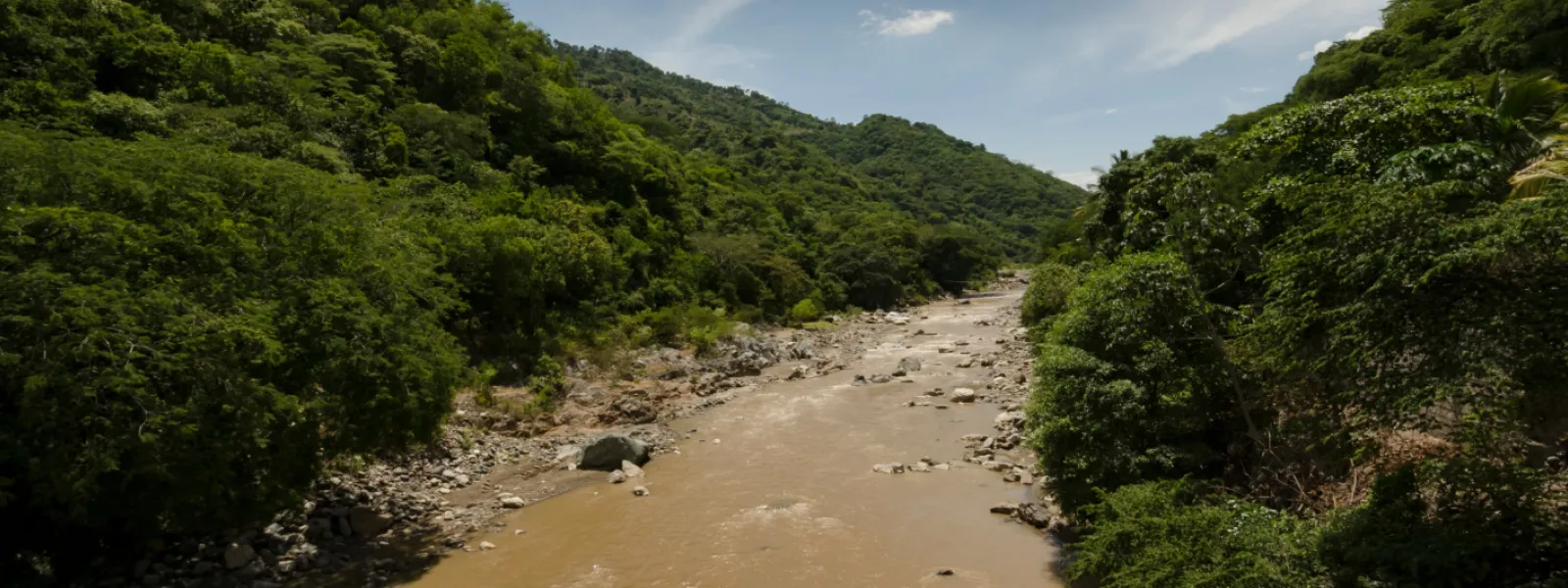
The Motagua River basin—Guatemala’s largest and most important river—is severely polluted with wastewater, solid waste, and other types of debris.
This is a cross-border issue because the Motagua’s polluted waters flow into the Caribbean Sea, reach the coast of Honduras, and threaten the Mesoamerican Reef System.
For decades, this has violated the rights to health, water, development, and a healthy environment of all the people living in the river basin.
In June 2025, the Poqomam Maya community of Santa Cruz Chinautla—supported by AIDA, the Indigenous Peoples’ Law Firm, and allied organizations—achieved an unprecedented legal victory to halt degradation in the basin. In response to the lawsuit it filed, a Guatemalan court ordered the municipality of Chinautla to comply with a series of obligations to curb the pollution of the area’s rivers and soil.
The government's response to the ruling has so far been limited to technical working group meetings. Meanwhile, the community continues to work toward the proper implementation of the ruling and to take other actions to defend its territory and its rights.
Background
The Motagua River, which is 486 km long, flows through 96 municipalities and 14 departments in Guatemala. It originates in Quiché, a department located in the northwest, and empties into the Caribbean Sea.
Polluting activities occur throughout the entire basin, including sub-basins and micro-basins. The largest volume of pollution comes from Guatemala City, the country’s capital, and is carried by the waters of the Las Vacas River, which in turn receives a large amount of waste from the Chinautla River.
The Chinautla River, which flows through the municipality of the same name, carries solid waste from a landfill located in Zone 3 of the capital—where trash from at least 14 municipalities in the department of Guatemala is dumped—as well as sewage generated by some 500,000 people living in the northern part of the capital, which undergoes no prior treatment.
Other sources of pollution include the numerous illegal dumps in the municipality of Chinautla, the waste that private vehicles and garbage trucks dump along the banks of its rivers, as well as the sand-mining companies—which began setting up operations in the area between 1996 and 1997—whose activities weaken the rivers' basins, causing solid waste to be more easily carried away by the river currents.
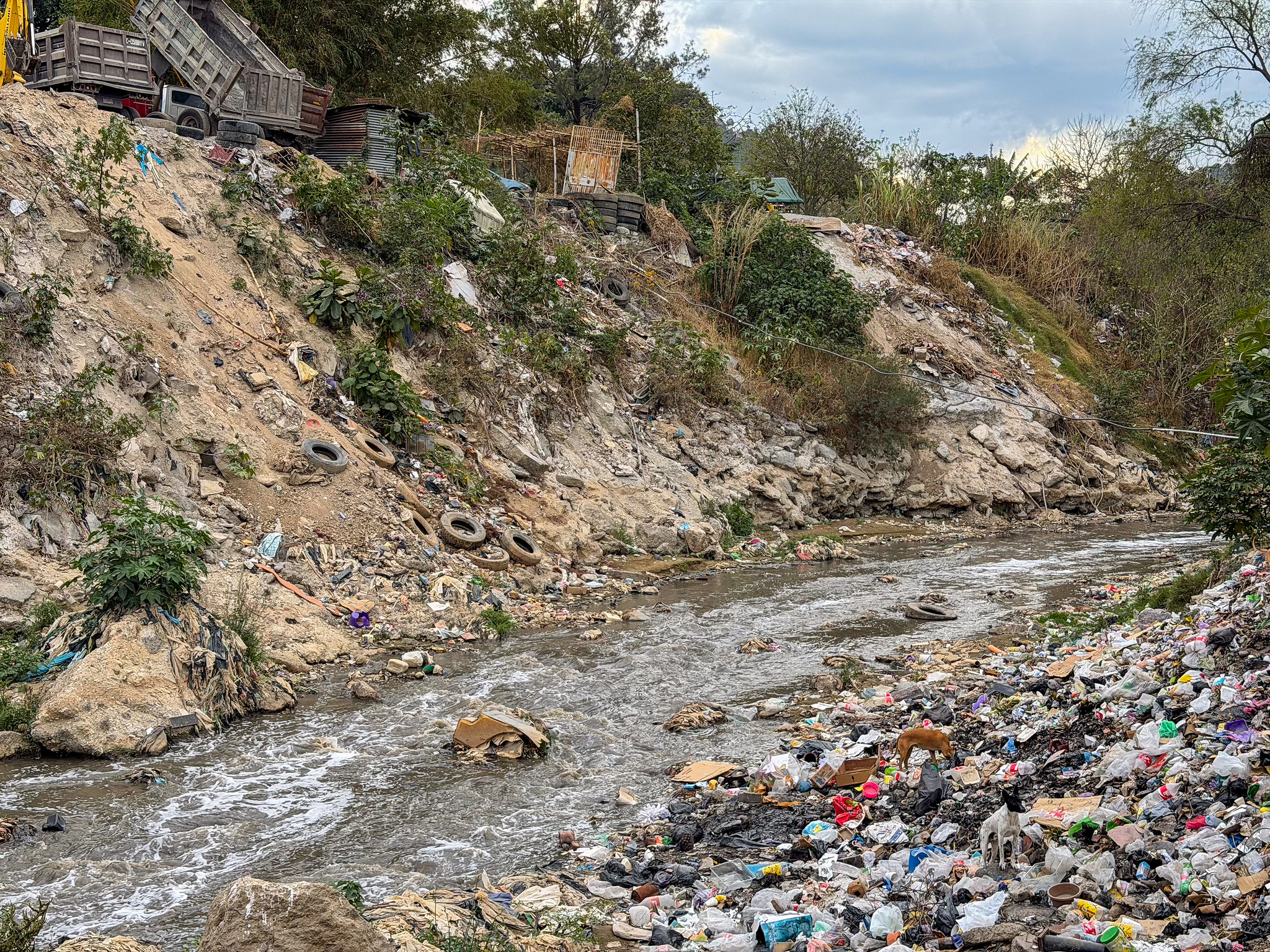
Photo: Mayela Sánchez García.
The situation extends beyond national borders. Every year, the Motagua River discharges some 20,000 metric tons of plastic into the Caribbean Sea, making it one of the rivers that contributes the most plastic pollution to the ocean worldwide, according to estimates contained in a 2025 report by the Inter-American Commission on Human Rights (IACHR).
The river flows into the Mesoamerican Reef at its mouth, so pollution also threatens to degrade one of the largest and most biodiverse transboundary reefs on the planet, which spans the territorial waters of Belize, Guatemala, Honduras, and Mexico.
In addition, the contaminated water reaches the coast of Honduras and spreads into Amatique Bay, located along the eastern coast of Guatemala, affecting the Caribbean Sea.
The roots of this chronic, cross-border problem are structural. Data from the Integrated Environmental Management of the Motagua River Basin project, funded by the United Nations Development Program (UNDP), show that in Guatemala, 66% of municipal solid waste is not collected, and there is no guarantee that the remaining 34% is disposed of properly. Furthermore, of all landfills nationwide, 88.32% are illegal or lack municipal authorization.
In other words, the core issues that need to be addressed are the mismanagement of solid waste and water resources in Guatemala; noncompliance with existing regulations on wastewater discharge and the disposal and treatment of solid waste and residues; and the lack of a water law.
The Poqomam Maya people's quest for justice
The rivers of Santa Cruz Chinautla, a community of the Poqomam Maya people located just twelve kilometers from Guatemala City, have become conduits of pollution that are degrading the Motagua River.
For decades, the local population has seen its health and livelihoods—including pottery, one of the main economic activities and a source of identity—damaged due to the lack of waste management in the municipality of Chinautla and the urban area of the country’s capital, as well as the activities of sand-mining companies.
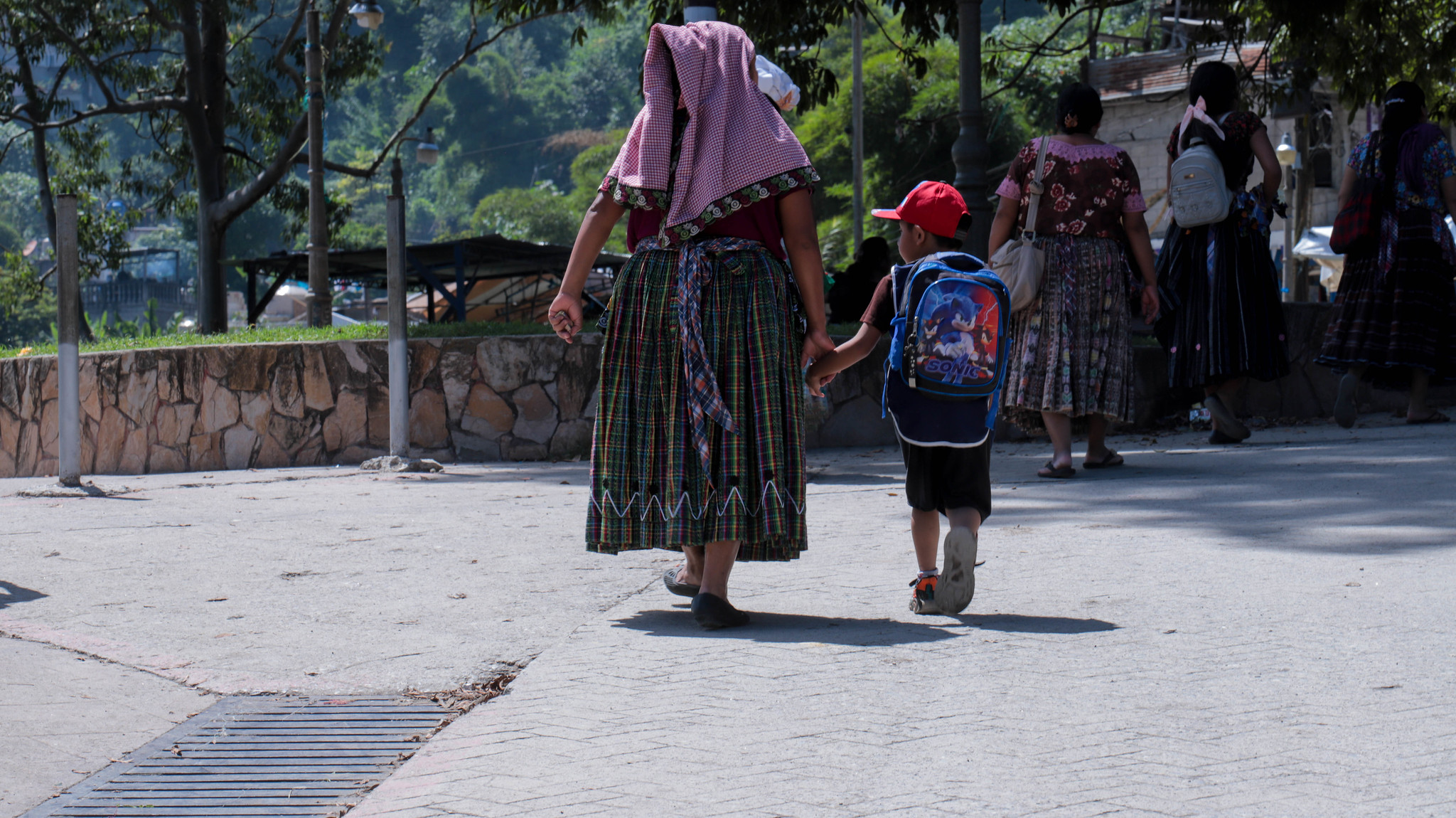
Photo: Mario Winter.
Voices for the Motagua River: Olga Vázquez.
Voices for the Motagua River: Nazario Pascual.
In early 2000, the Maya community organized to stop sand mining on their territory. At that time, the companies held mining permits that remained valid through 2021 and 2022. And although the permits expired, some companies continued to operate after requesting extensions. In June 2022, the indigenous authorities of the Poqomam people began a sit-in protest in front of the Piedrinera San Luis company, which they maintained for four years.
In July 2024, the Special Rapporteur on Economic, Social, Cultural, and Environmental Rights of the IACHR visited Santa Cruz Chinautla. During his visit, traditional authorities and community members spoke about the environmental, water-related, health, economic, and cultural impacts of the pollution in their rivers.
That same year, in October, the community—with support from AIDA, the Indigenous Peoples’ Law Firm, and partner organizations—filed a lawsuit (petition for amparo) against the municipality of Chinautla over its failure to take measures to address the contamination of its rivers and soil caused by improper solid waste management and the existence of illegal landfills.
AIDA’s scientific team, together with local residents and community authorities, collected key information on illegal landfills in the area. This community science initiative supported the litigation by highlighting the severity of the pollution, demonstrating the ongoing use of such practices, and providing evidence of the municipal authorities’ failure to fulfill their legal obligations regarding waste management.
Learn more about this community science initiative.
In June 2025, the Poqomam community won the support of the Guatemalan justice system when a constitutional court ordered the municipality of Chinautla to effectively address the claims in the lawsuit aimed at stopping the pollution of the rivers and soil in Santa Cruz Chinautla.
This is the first time a Guatemalan court has recognized a community's right to a healthy environment and its central role in finding solutions.
Find out the details of the legal victory.
Current situation
Since the ruling was issued, the municipality of Chinautla has held a series of “technical working groups” with representatives from the central government, civil society, and the community. A smaller group of technical experts was later created to develop a work plan with clear goals. Several months have passed without the municipality convening these working groups.
Furthermore, in December 2025, the IACHR noted in its report Human Rights Situation in Guatemala that the Motagua River basin is facing a severe pollution crisis that has had profound impacts on biodiversity and has resulted in systematic violations of the human rights of local communities, including the Maya Poqomam people.
And in May 2026, the Ministry of the Environment and Natural Resources revoked the license of the sand mining company Piedrinera San Luis for "failure to comply with environmental commitments."
AIDA continues to monitor the implementation of the court ruling to ensure the right to a healthy environment for the Poqomam Maya community and all those living in the Motagua River basin. Meanwhile, the residents of Santa Cruz Chinautla remain organized and mobilized to improve their environment and defend their rights.
Related projects
Climate change funding: Needs and expectations
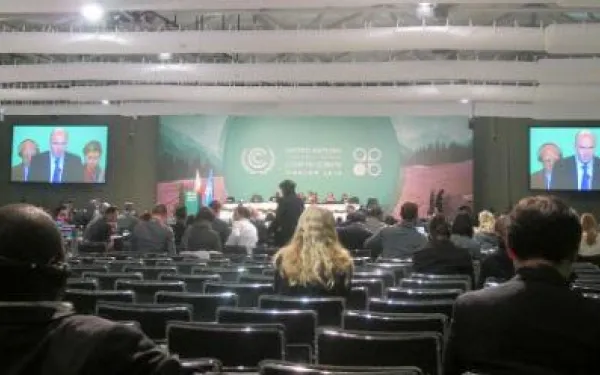
By Andrea Rodríguez, legal advisor, AIDA, @arodriguezosuna, and Mónica Valtierra, AIDA volunteer Warsaw, Poland. In the discussions about the financial resources needed to tackle climate change, the plenary session of the Conference of the Parties (COP 19) in Warsaw focused on three topics: long-term financing, a report by the Standing Committee on Finance, and another report of the Green Climate Fund (GCF) of the COP. Long-term financing The Philippines. The Philippine representative said long-term financing is crucialfor developing countries and that the outcome of the agreements reached in 2015 will depend on how far those countries are willing to go to see them through. He said: “There needs to be clarity on the specific amount [of resources required] and which projects will receive the finances. But until now the situation can only be described as disastrous.” Egypt. The Egyptian delegate, on behalf of an African group of nations, said: “The agreements will depend on the climate fund’s progress in realizing its goals, the ability of countries to keep the global temperature from rising at less than 2°C this century, and mobilizing US$100 billion. These are the urgent issues. European Union. The EU reaffirmed its commitment to mobilize climate change finances with the expectation that the Green Climate Fund will increase its funding in the area of adaptation. Malpes. The Malpes’ delegate spoke about the need to strike a balance between the funding granted for global warming mitigation and what is put toward climate change adaptation. It is an essential issue for developing countries, he said. Colombia. Colombia’s delegate called for continued efforts to secure climate change funding because up until now there has been very little action taken in this regard. The commitment of US$100 billion in funding for climate change mitigation and adaptation is another a pressing task, he added. The Standing Committee report The Philippines. The Standing Committee has a great deal of work to do, especially with regard to the issues of transparency and access to information, the delegate said on behalf of the G77. “We need to strengthen the mechanisms in place for monitoring, verification and reporting purposes before 2015,” and fully address the issue of additional financing, he said. Egypt. Along the same vein of the Philippines, this delegation emphasized the urgent need to provide support for the verification, monitoring and reporting mechanisms. Bolivia. The Bolivian delegate spoke about access to funds, which he said is “the cornerstone of addressing the impact of climate change.” It requires the support of all countries, he added. Green Climate Fund (GCF) report to the COP The co-chairs of the GCF said the organization must be ambitious and have ever-increasing efforts. They repeated earlier calls to strike a balance between the funds put toward mitigation and adaptation to climate change, and to mobilize financial resources before mid-2014. On this topic, the countries said the following: The Philippines. There are high expectations for the GCF, said the delegate. But three years after the COP meeting in Cancun, Mexico, it is time to start moving the money. Egypt. The mobilization of funds should be optimized as soon as possible and the Fund must concentrate on sustainable financing for climate change, this delegation said. India. According to this delegation, the agreements to be reached in 2015 depend on the climate funding that exists at that time. He reiterated the idea of finding an equilibrium between the resources for mitigation and adaptation of the Fund. Zambia. “Fifty percent of the funds should be put toward adaptation measures,” which will also support programs set up to reduce poverty in vulnerable groups, said the Zambian delegate. Malpes. On the importance of mobilizing financial resources promptly, this delegate called for the funds to be available before the COP 20 in Lima. Uganda. This delegate reminded the audience that climate change is not waiting for the mobilization of resources to begin.
Read moreAlmost 16,000 people urge Colombian President Santos to demarcate the Santurbán páramo
In a petition to the Presidency and the Ministry of Environment, thousands of people are calling on the government to define the boundaries of this fragile ecosystem at a scale of 1:25,000 as required by Colombian legislation. Bogota, Colombia—The Interamerican Association for Environmental Defense (AIDA) sent to Colombian President Juan Manuel Santos and his minister of environment and sustainable development, Luz Helena Sarmiento, the signatures of 15,901 individuals calling for the demarcation of the Santurbán páramo to be based on proper scientific criteria at a scale of 1:25,000. The Santurbán páramo, located in the Colombian departments of Santander and Norte de Santander, provides water to nearly two million people, mainly in the cities of Bucaramanga and Cúcuta. The signatures collected over Change.org, the world’s largest petition platform, follow a previous request (in Spanish) by AIDA and prestigious Colombian environmentalists for the government to properly define the borders of the páramo in compliance with national legislation and international standards. This would prevent harmful activities such as large-scale mining from irreversibly damaging this fragile high-altitude wetland ecosystem. Páramos are "water factories" that contain a unique biodiversity and help mitigate climate change. In Colombia, home to the greatest number of páramos in the world, delimitation of this ecosystem is required under national law. That makes this petition even more important because the delimitation of the rest of the country’s páramos could depend on the outcome of the Santurbán decision. The petition promoted by AIDA includes a letter to President Santos and Minister Sarmiento. In the letter, the signatories call on the minister to recognize the entire páramo (more than 82,000 hectares) in the definition of its borders, not just the fraction (11,000 hectares) declared as a Regional Natural Park. For this to happen, the petition calls on the government to apply the parameters already established by Colombian scientists and provides legal arguments to support this requirement. Together with the signatures, AIDA has included a document that analyzes the legal reasons why the government should fully delimit this area (Available in Spanish, here). “Heeding the call of the thousands of signatories in the hemisphere is urgently needed because the risk to the páramos from mining is imminent," said Astrid Puentes Riaño, AIDA co-executive director. "Delineating Santurbán to a scale other than the ratio of 1:25,000 prescribed by the National Development Plan goes against the law. If the minister delimits the moor at a less detailed scale, the decision could be challenged in court.” AIDA's action comes as the Committee for the Defense of Santurbán Páramo holds a protest to protect this valuable ecosystem on November 15 in Bucaramanga. The petition and letter can be read at Change.org.
Read more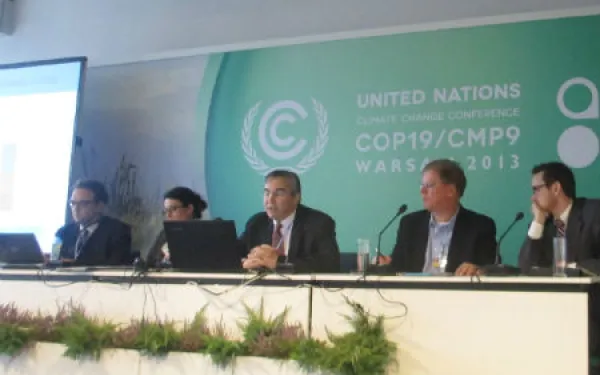
The reduction of HFCs and methane emissions
By Andrea Rodríguez, legal advisor, AIDA, @arodriguezosuna, and Mónica Valtierra, AIDA volunteer Warsaw, Poland - The reduction of hydrofluorocarbons (HFCs) and methane gas emissions has enormous potential to help in the fight against climate change under the framework of the Montreal Protocol and through the development of clean technologies designed to reduce greenhouse gas emissions from refrigerants, air conditioners and vehicles. Mark W. Roberts, a senior counsel and international policy advisor at the Environmental Investigation Agency (EIA), made this point during Catalyzing Pre-2020 Mitigation Action – Phasing down HFCs and Reducing Methane Emissions event at the 19th Conference of the Parties (C0P19) to the United Nations Framework Convention on Climate Change (UNFCCC) in Warsaw, Poland. He reminded listeners that short-lived climate pollutants (SLCPs), which include HFCs and methane, may have a relatively short lifespan in the atmosphere but they have a global-warming potential (GWP)much greater than CO2. This means that action to reduce these particular pollutants will have substantial short-term climate benefits. Among the activities to reduce of HFCs we have the use of ammoniums, hydrocarbons, methyl formats and other technologies that involve the sustainable use of CO2. He also suggested the implementation of alternative manufacturing processes for aerosols and fiber materials, the use of dry powder for asthma inhalers and the use of solar energy for refrigeration and air conditioners. Roberts said the scope of the Montreal Protocol includes the reduction of 8 billion tonnes of CO2 since 1980, five times more than the goal established in the Kyoto Protocol between 2008 and 2012. The United States and Canada have proposed amendments to the Montreal Protocol that would help to dramatically reduce the consumption of HFCs, he added. Along the same vein, the representative of the United Nations Industrial Development Organization (UNIDO) mentioned the importance of implementing the Montreal Protocol for the global reduction of HFCs. With regard to financing mechanisms, he said the Global Environment Facility (GEF) could be an alternative for developing countries without access to the Multilateral Fund for the Implementation of the Montreal Protocol. He also highlighted UNIDO’s role in promoting new technologies based on ozone-friendly chemicals and improvements in manufacturing processes in developing countries. As an example of the latter, he cited a project in which 10 companies in the Philippines had reduced their use of HFCs by 10%. He also mentioned the recent launch of the Climate and Clean Air Coalition, which seeks to reduce HFCs emissions and put the reduction of SLCPs on the agenda. At the same time, Markus Kurdziel, a consultant for BMZ in Germany, spoke about projects the German government is working on with public agencies and the private sector for refrigerants, air conditioning and foam production. These projects are part of Proklima, a program supported by 40 countries with the following areas of action: political consulting, technology transfer, research, subsidies development, technological adaptation, emissions reduction and the implementation of bilateral strategies. As an example, Kurdziel mentioned projects in China and India where the governments there helped private companies in the manufacturing of air conditioners with 15% greater efficiency. In Brazil, the initiative implemented a program to recover and recycle refrigerators. Also at the event, representatives of the International United Steelworkers Union said U.S. natural gas networks were leaking a combined total of around 6 million cubic feet of gas because of old and deteriorated pipes. In response, David Foster of the Blue Green Alliance called for greater efforts to repair the pipes to prevent methane gas from escaping into the atmosphere, a project that he said would create millions of jobs in the United States. The event closed with a message. We must take action to reduce methane and HFCs emissions -- and we must do it now. For more information, see the document (in Spanish) about short-lived climate pollutants that AIDA, CEDHA, CEMDA and RedRacc presented at COP19.
Read more