
Project
Shutterstock.
Pollution of the Motagua River in Guatemala: The Poqomam Maya people’s quest for environmental justice
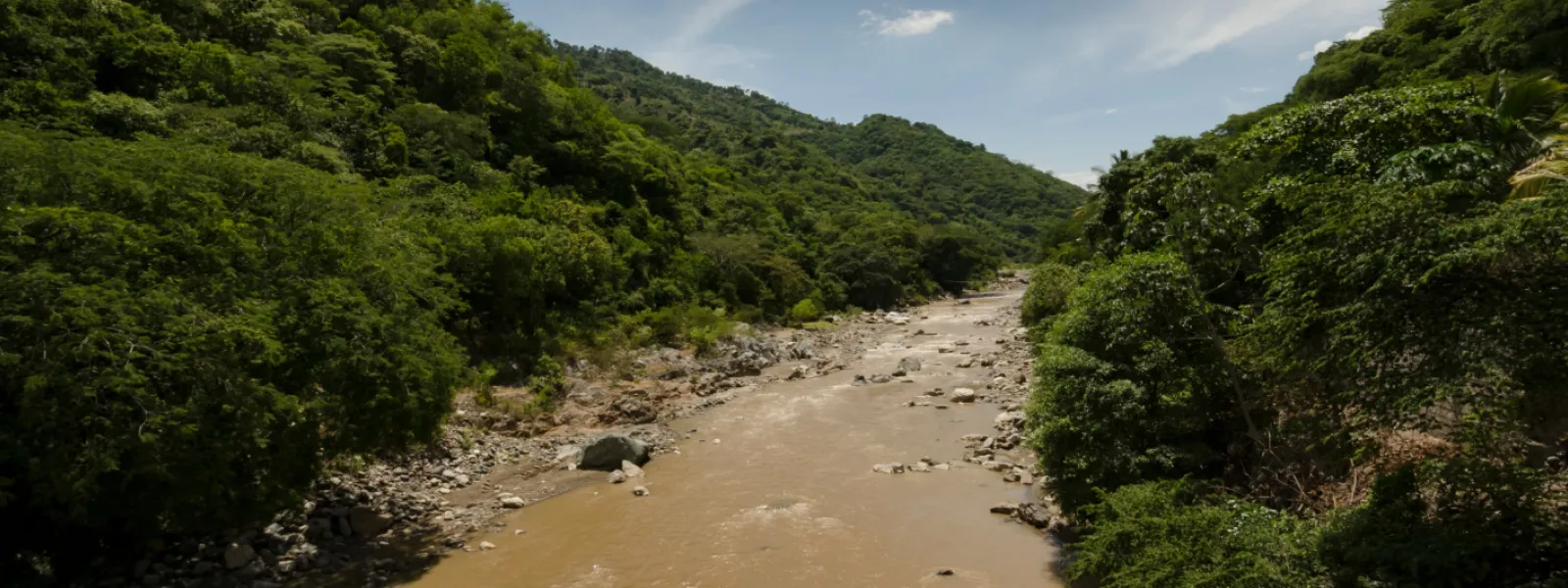
The Motagua River basin—Guatemala’s largest and most important river—is severely polluted with wastewater, solid waste, and other types of debris.
This is a cross-border issue because the Motagua’s polluted waters flow into the Caribbean Sea, reach the coast of Honduras, and threaten the Mesoamerican Reef System.
For decades, this has violated the rights to health, water, development, and a healthy environment of all the people living in the river basin.
In June 2025, the Poqomam Maya community of Santa Cruz Chinautla—supported by AIDA, the Indigenous Peoples’ Law Firm, and allied organizations—achieved an unprecedented legal victory to halt degradation in the basin. In response to the lawsuit it filed, a Guatemalan court ordered the municipality of Chinautla to comply with a series of obligations to curb the pollution of the area’s rivers and soil.
The government's response to the ruling has so far been limited to technical working group meetings. Meanwhile, the community continues to work toward the proper implementation of the ruling and to take other actions to defend its territory and its rights.
Background
The Motagua River, which is 486 km long, flows through 96 municipalities and 14 departments in Guatemala. It originates in Quiché, a department located in the northwest, and empties into the Caribbean Sea.
Polluting activities occur throughout the entire basin, including sub-basins and micro-basins. The largest volume of pollution comes from Guatemala City, the country’s capital, and is carried by the waters of the Las Vacas River, which in turn receives a large amount of waste from the Chinautla River.
The Chinautla River, which flows through the municipality of the same name, carries solid waste from a landfill located in Zone 3 of the capital—where trash from at least 14 municipalities in the department of Guatemala is dumped—as well as sewage generated by some 500,000 people living in the northern part of the capital, which undergoes no prior treatment.
Other sources of pollution include the numerous illegal dumps in the municipality of Chinautla, the waste that private vehicles and garbage trucks dump along the banks of its rivers, as well as the sand-mining companies—which began setting up operations in the area between 1996 and 1997—whose activities weaken the rivers' basins, causing solid waste to be more easily carried away by the river currents.
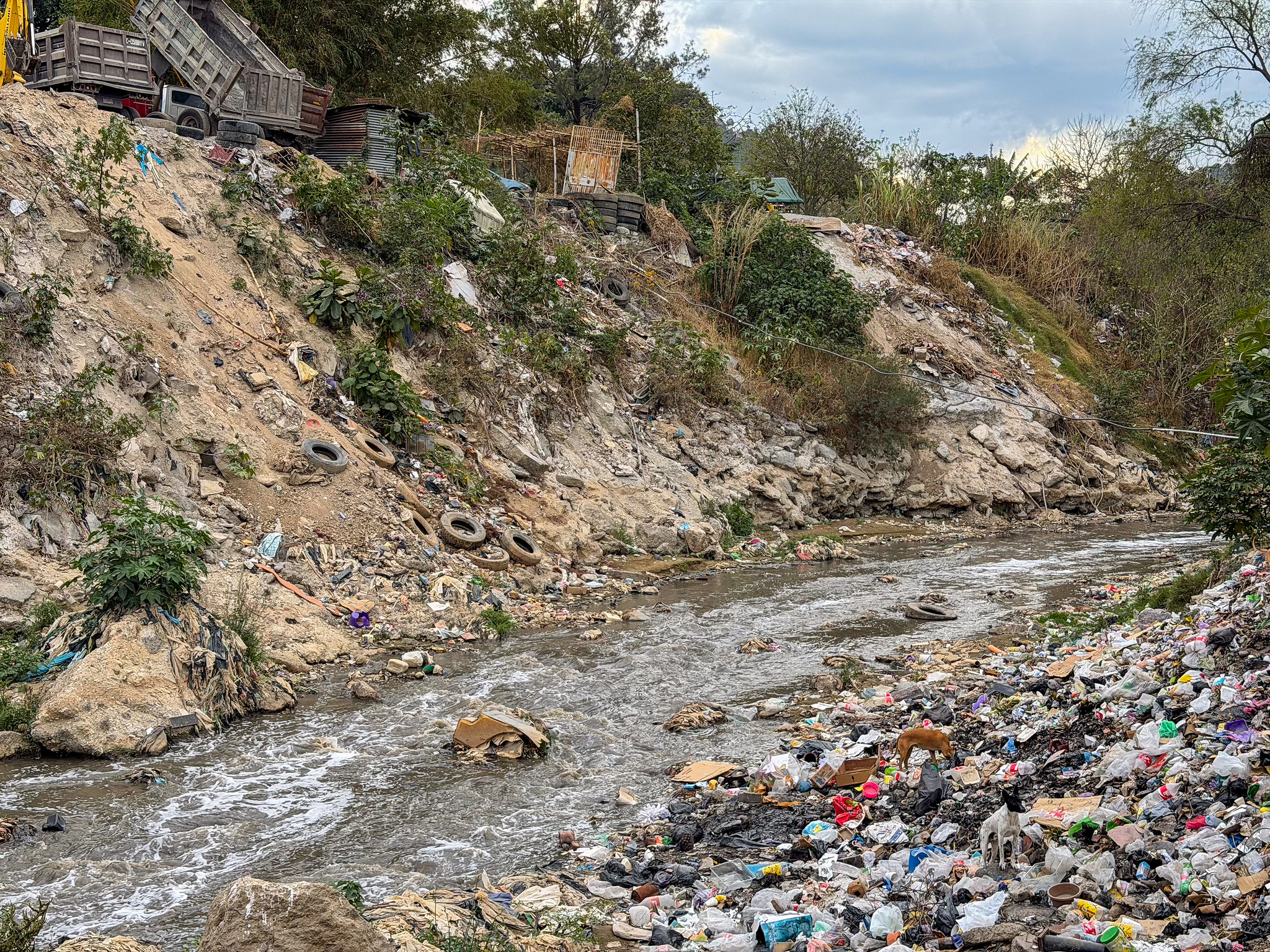
Photo: Mayela Sánchez García.
The situation extends beyond national borders. Every year, the Motagua River discharges some 20,000 metric tons of plastic into the Caribbean Sea, making it one of the rivers that contributes the most plastic pollution to the ocean worldwide, according to estimates contained in a 2025 report by the Inter-American Commission on Human Rights (IACHR).
The river flows into the Mesoamerican Reef at its mouth, so pollution also threatens to degrade one of the largest and most biodiverse transboundary reefs on the planet, which spans the territorial waters of Belize, Guatemala, Honduras, and Mexico.
In addition, the contaminated water reaches the coast of Honduras and spreads into Amatique Bay, located along the eastern coast of Guatemala, affecting the Caribbean Sea.
The roots of this chronic, cross-border problem are structural. Data from the Integrated Environmental Management of the Motagua River Basin project, funded by the United Nations Development Program (UNDP), show that in Guatemala, 66% of municipal solid waste is not collected, and there is no guarantee that the remaining 34% is disposed of properly. Furthermore, of all landfills nationwide, 88.32% are illegal or lack municipal authorization.
In other words, the core issues that need to be addressed are the mismanagement of solid waste and water resources in Guatemala; noncompliance with existing regulations on wastewater discharge and the disposal and treatment of solid waste and residues; and the lack of a water law.
The Poqomam Maya people's quest for justice
The rivers of Santa Cruz Chinautla, a community of the Poqomam Maya people located just twelve kilometers from Guatemala City, have become conduits of pollution that are degrading the Motagua River.
For decades, the local population has seen its health and livelihoods—including pottery, one of the main economic activities and a source of identity—damaged due to the lack of waste management in the municipality of Chinautla and the urban area of the country’s capital, as well as the activities of sand-mining companies.
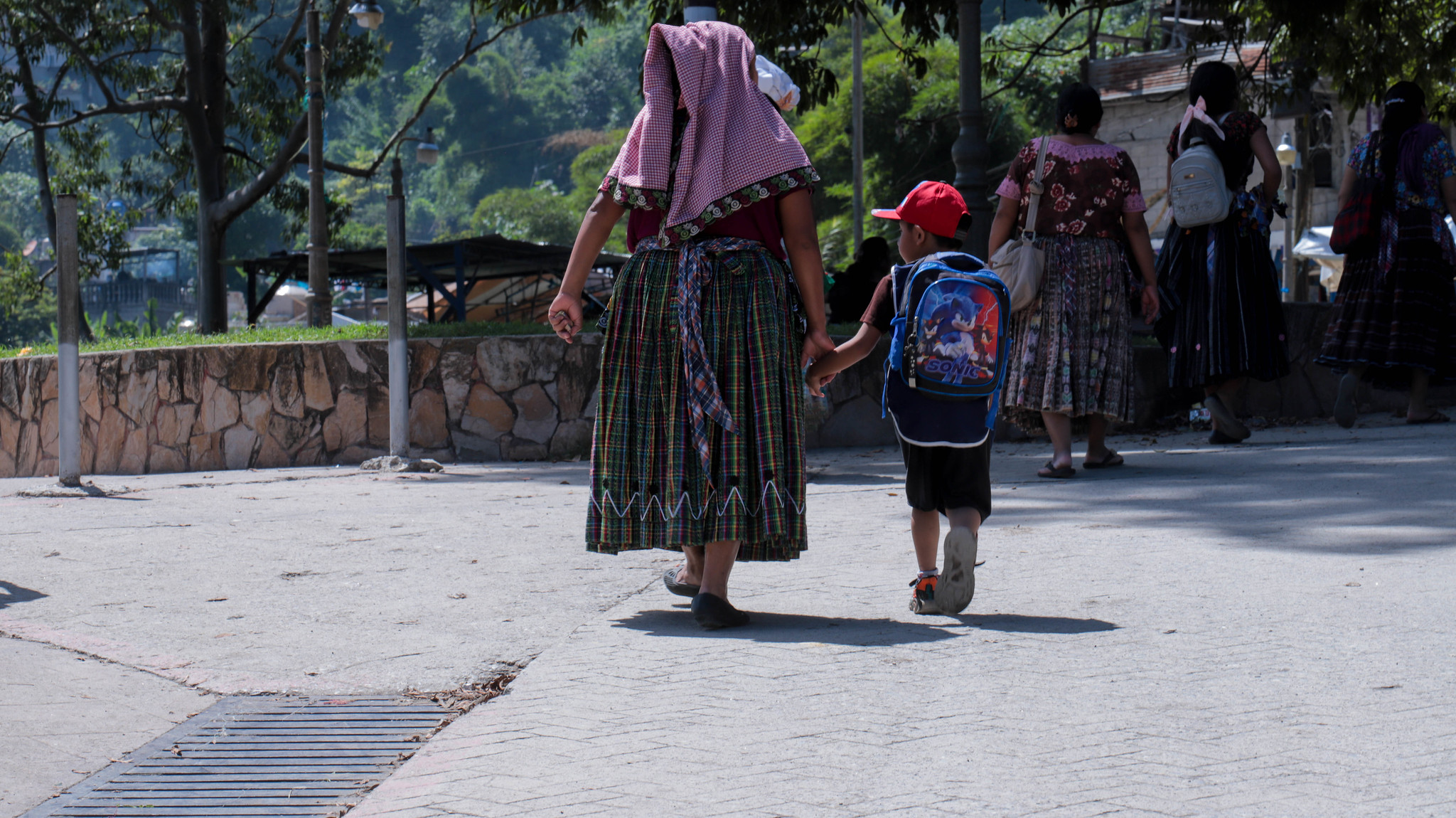
Photo: Mario Winter.
Voices for the Motagua River: Olga Vázquez.
Voices for the Motagua River: Nazario Pascual.
In early 2000, the Maya community organized to stop sand mining on their territory. At that time, the companies held mining permits that remained valid through 2021 and 2022. And although the permits expired, some companies continued to operate after requesting extensions. In June 2022, the indigenous authorities of the Poqomam people began a sit-in protest in front of the Piedrinera San Luis company, which they maintained for four years.
In July 2024, the Special Rapporteur on Economic, Social, Cultural, and Environmental Rights of the IACHR visited Santa Cruz Chinautla. During his visit, traditional authorities and community members spoke about the environmental, water-related, health, economic, and cultural impacts of the pollution in their rivers.
That same year, in October, the community—with support from AIDA, the Indigenous Peoples’ Law Firm, and partner organizations—filed a lawsuit (petition for amparo) against the municipality of Chinautla over its failure to take measures to address the contamination of its rivers and soil caused by improper solid waste management and the existence of illegal landfills.
AIDA’s scientific team, together with local residents and community authorities, collected key information on illegal landfills in the area. This community science initiative supported the litigation by highlighting the severity of the pollution, demonstrating the ongoing use of such practices, and providing evidence of the municipal authorities’ failure to fulfill their legal obligations regarding waste management.
Learn more about this community science initiative.
In June 2025, the Poqomam community won the support of the Guatemalan justice system when a constitutional court ordered the municipality of Chinautla to effectively address the claims in the lawsuit aimed at stopping the pollution of the rivers and soil in Santa Cruz Chinautla.
This is the first time a Guatemalan court has recognized a community's right to a healthy environment and its central role in finding solutions.
Find out the details of the legal victory.
Current situation
Since the ruling was issued, the municipality of Chinautla has held a series of “technical working groups” with representatives from the central government, civil society, and the community. A smaller group of technical experts was later created to develop a work plan with clear goals. Several months have passed without the municipality convening these working groups.
Furthermore, in December 2025, the IACHR noted in its report Human Rights Situation in Guatemala that the Motagua River basin is facing a severe pollution crisis that has had profound impacts on biodiversity and has resulted in systematic violations of the human rights of local communities, including the Maya Poqomam people.
And in May 2026, the Ministry of the Environment and Natural Resources revoked the license of the sand mining company Piedrinera San Luis for "failure to comply with environmental commitments."
AIDA continues to monitor the implementation of the court ruling to ensure the right to a healthy environment for the Poqomam Maya community and all those living in the Motagua River basin. Meanwhile, the residents of Santa Cruz Chinautla remain organized and mobilized to improve their environment and defend their rights.
Related projects
Mexican government breaches international commitments to put Veracruz Reef System at risk
Organizations denounce the incident to the Ramsar Convention, an international treaty for the protection of wetlands. By modifying the boundaries of the coral reef national park, the federal government is seeking to expand the Port of Veracruz. Mexico City, Mexico. Civil society organizations have denounced to international bodies that Mexico’s government intends to modify the boundaries of the Veracruz Coral Reef System National Park, known as PNSAV in its Spanish acronym, in order to expand the Port of Veracruz. This violates the government’s commitment to preserve and protect a wetland of global importance. Mexico’s Secretariat of Environment and Natural Resources (Semarnat) authorized the port expansion project on December 19, 2013. In response, the Interamerican Association for Environmental Defense (AIDA) and the Mexican Center for Environmental Law (CEMDA) – with support from the Veracruz Assembly of Environmental Initiatives and Defense (LAVIDA), Pobladores A.C., Paths and Meetings for Sustainable Development (SENDAS), Litiga OLE, Pronatura Veracruz and the doctor and researcher Leonardo Ortíz Lozano – filed with the Ramsar Secretariat a report on the federal government’s failure to comply with that international treaty. The Veracruz Reef System was declared a Protected Natural Area (PNA) in 1992 with the aim of protecting the human right to a healthy environment. In 2004, it was registered as a wetland of international importance on the Ramsar List. While Mexico can modify the boundaries of sites on the Ramsar List, this must be done in accordance with the grounds and procedures identified in the Ramsar Convention. However, the federal government intends to modify the area of the PNSAV, contradicting to its own actions and acting in breach of the principle of law. [1] According to public information secured from the National Commission of Natural Protected Areas (Conanp) [2], the Mexican government based its decision to amend the boundaries of the PNSAV on a so-called error clause contained in Resolution VIII.22. This clause can only be invoked when there are changes in the ecological characteristics stemming from the degradation of part of a wetland. The federal government has yet to scientifically prove that there have been any ecological changes to the detriment of the wetland. Of note, it is questionable that the Conanp decided to notify the Ramsar Convention Secretariat of the alleged error on the eve of the Semarnat’s authorization of the Port of Veracruz expansion. Another legal way to change the boundaries of Ramsar sites is if there is "urgent national interest," as contained in Resolution VIII.20. This requires a prior environmental assessment and a consultation with all stakeholders, something that has not yet happened. "The federal government is determined to illegally change the polygonal of the PNSAV every time that it is not legally possible to proceed according to the procedures established by the Ramsar Convention," said Sandra Moguel, an AIDA legal adviser. "The polygonal change and the environmental impact authorization of the proposed expansion of the Port of Veracruz are unilateral decisions by the federal government in which the arguments of the affected peoples were not taken into account," she added. The Mexican government is violating the Ramsar Convention, and hence its international obligations on the conservation of a wetland of international importance. If the amendment to the PNSAV goes through, the government will hurt the right of Mexicans – and the people of Veracruz, in particular – to a healthy environment. Because of this, AIDA and the other civil society organizations requested the Ramsar Convention Secretariat to consider as unacceptable the proposed reduction of the PNSAV’s boundaries. We also requested that these proposed changes be discussed at Ramsar’s next Conference of the Contracting Parties to be held in Uruguay in 2015. Editor's notes: 1. According to this general principle of law, the authority can only do what is expressly mandated by law. 2. Information request 1615100033713.
Read more
Environmental Impact Assessments Necessary for Informed Consent
In January 2009, Muriel Mining Corporation moved into the department of Chocó, Colombia to launch Mandé Norte, a project for the exploration and development of copper, gold, molybdenum and other minerals. The US-based company began the project without proper consultation, and without the free, prior and informed consent of the local ethnic groups that would be directly affected by the mines. Consultation with the affected communities did not begin until 2006, a year after the company was awarded the mining contract. What's more, several of the affected communities were not invited to participate in the consultation process, and those that participated were not represented by traditional authorities. Then, despite serious objections raised by Afro-Colombian and indigenous communities, the consultation process was concluded in August 2008. This project took place during a difficult period of Colombia’s armed conflict.The Inter-Church Commission for Justice and Peace, a Colombian human rights group, filed a legal action for protection against the mining project. AIDA contributed to the action by submitting an argument (in Spanish) demonstrating that without an adequate environmental impact assessment to analyze the project's social and environmental impacts, the affected communities would have no basis to give or deny consent, as required by international law. The Colombian Constitutional Court ruled on the case in the T-769 Sentence of 2009 (in Spanish), ordering the suspension of exploration and production activities and the awarding of licenses for the project. It also ordered a new consultation to meet both national and international standards, and required the completion of accurate environmental impact studies. AIDA has prepared a summary sheet (in Spanish) to make it easier to understand the sentence. The ruling in this case set a key precedent by incorporating and recognizing, for the first time, the right of ethnic groups to free, prior and informed consent. It was a breakthrough in the recognition of the rights of ethnic groups in Colombia. Both the Ministry of the Interior and the mining company sought an annulment of the constitutional sentence. But AIDA intervened (in Spanish) to defend the sentence against the annulment requests, as did the Colombian Commission of Jurists (in Spanish), Dejusticia (in Spanish), Harvard and Diego Portales (in Spanish). These efforts paid off. On March 12, 2012, the Constitutional Court upheld its decision (in Spanish) on Mandé Norte. Without this ruling, the mining project would have had serious social and environmental impacts on the biodiverse region of Chocó, damaging crop animals, rivers and the mountain of Caraperro, long considered by indigenous peoples to be a sacred site. The project would have both physically and culturally harmed the local indigenous peoples, and would have caused the deterioration of traditional economies. At AIDA, we work to defend the right to a healthy environment and the protect human rights of communities and ethnic groups against powerful interests. Follow us on Twitter: @AIDAorg "Like" our page on Facebook: www.facebook.com/AIDAorg
Read moreLives of no return: Stories behind the construction of Belo Monte
By María José Veramendi Villa, senior attorney, AIDA, @MaJoVeramendi When you start the descent by plane to the city of Altamira in Pará, Brazil, the darkness of the night is interrupted by the bright lights of worksites a few kilometers outside the city where construction of the Belo Monte dam is underway. That’s when things turn bleak. On a recent trip to the area I was able to see how the situation of thousands of residents – the indigenous, riverine and city dwellers of Altamira - continues to deteriorate. Their communities and livelihoods are being irreversibly affected and their human rights systematically violated by the construction of the hydropower plant. When night becomes day From the plane, the lights from the worksites are just momentary flashes. But for the indigenous and riverine communities closest to them, those lights have brought a radical change to their lifestyles. José Alexandre lives with his family in Arroz Cru, a waterfront community located on the left bank of the Volta Grande, or Big Bend, of the Xingu River in the municipality of Vitória do Xingu. The community is in front of the Pimental worksite. His entire life has been spent in the area, where hunting and fishing are major activities. But everything changed when construction of the dam started.
Read more