
Project
Shutterstock.
Pollution of the Motagua River in Guatemala: The Poqomam Maya people’s quest for environmental justice
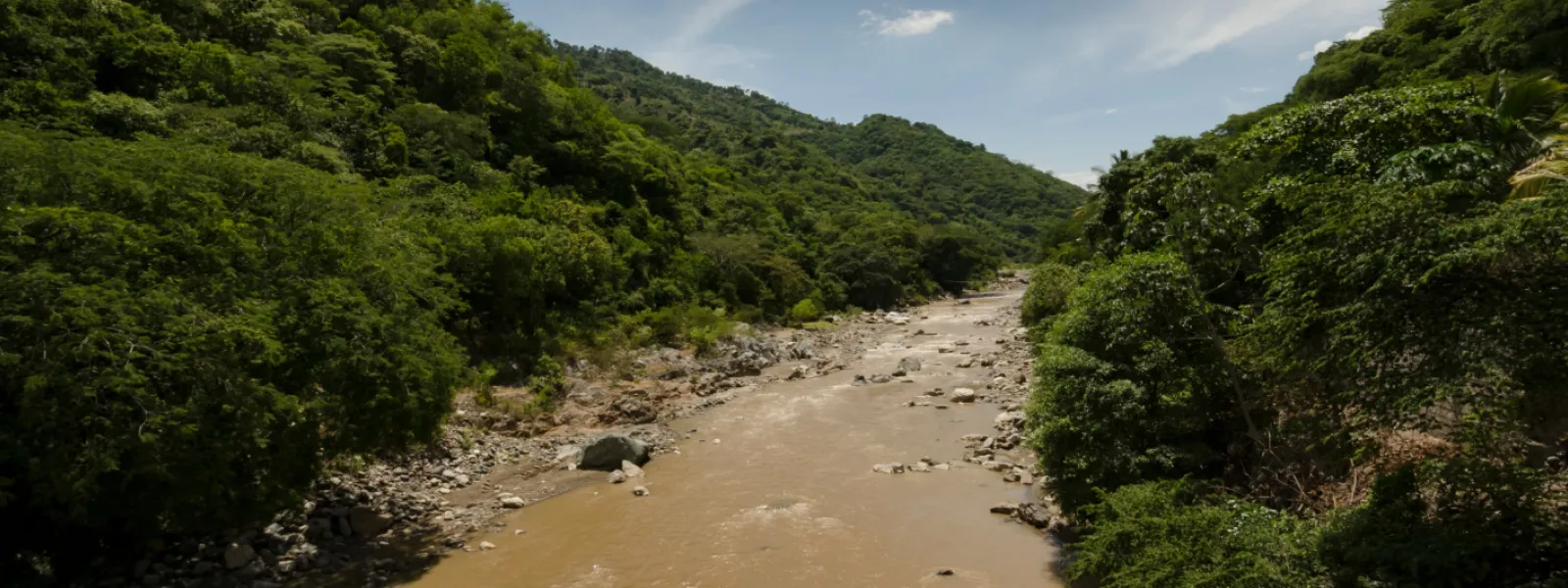
The Motagua River basin—Guatemala’s largest and most important river—is severely polluted with wastewater, solid waste, and other types of debris.
This is a cross-border issue because the Motagua’s polluted waters flow into the Caribbean Sea, reach the coast of Honduras, and threaten the Mesoamerican Reef System.
For decades, this has violated the rights to health, water, development, and a healthy environment of all the people living in the river basin.
In June 2025, the Poqomam Maya community of Santa Cruz Chinautla—supported by AIDA, the Indigenous Peoples’ Law Firm, and allied organizations—achieved an unprecedented legal victory to halt degradation in the basin. In response to the lawsuit it filed, a Guatemalan court ordered the municipality of Chinautla to comply with a series of obligations to curb the pollution of the area’s rivers and soil.
The government's response to the ruling has so far been limited to technical working group meetings. Meanwhile, the community continues to work toward the proper implementation of the ruling and to take other actions to defend its territory and its rights.
Background
The Motagua River, which is 486 km long, flows through 96 municipalities and 14 departments in Guatemala. It originates in Quiché, a department located in the northwest, and empties into the Caribbean Sea.
Polluting activities occur throughout the entire basin, including sub-basins and micro-basins. The largest volume of pollution comes from Guatemala City, the country’s capital, and is carried by the waters of the Las Vacas River, which in turn receives a large amount of waste from the Chinautla River.
The Chinautla River, which flows through the municipality of the same name, carries solid waste from a landfill located in Zone 3 of the capital—where trash from at least 14 municipalities in the department of Guatemala is dumped—as well as sewage generated by some 500,000 people living in the northern part of the capital, which undergoes no prior treatment.
Other sources of pollution include the numerous illegal dumps in the municipality of Chinautla, the waste that private vehicles and garbage trucks dump along the banks of its rivers, as well as the sand-mining companies—which began setting up operations in the area between 1996 and 1997—whose activities weaken the rivers' basins, causing solid waste to be more easily carried away by the river currents.
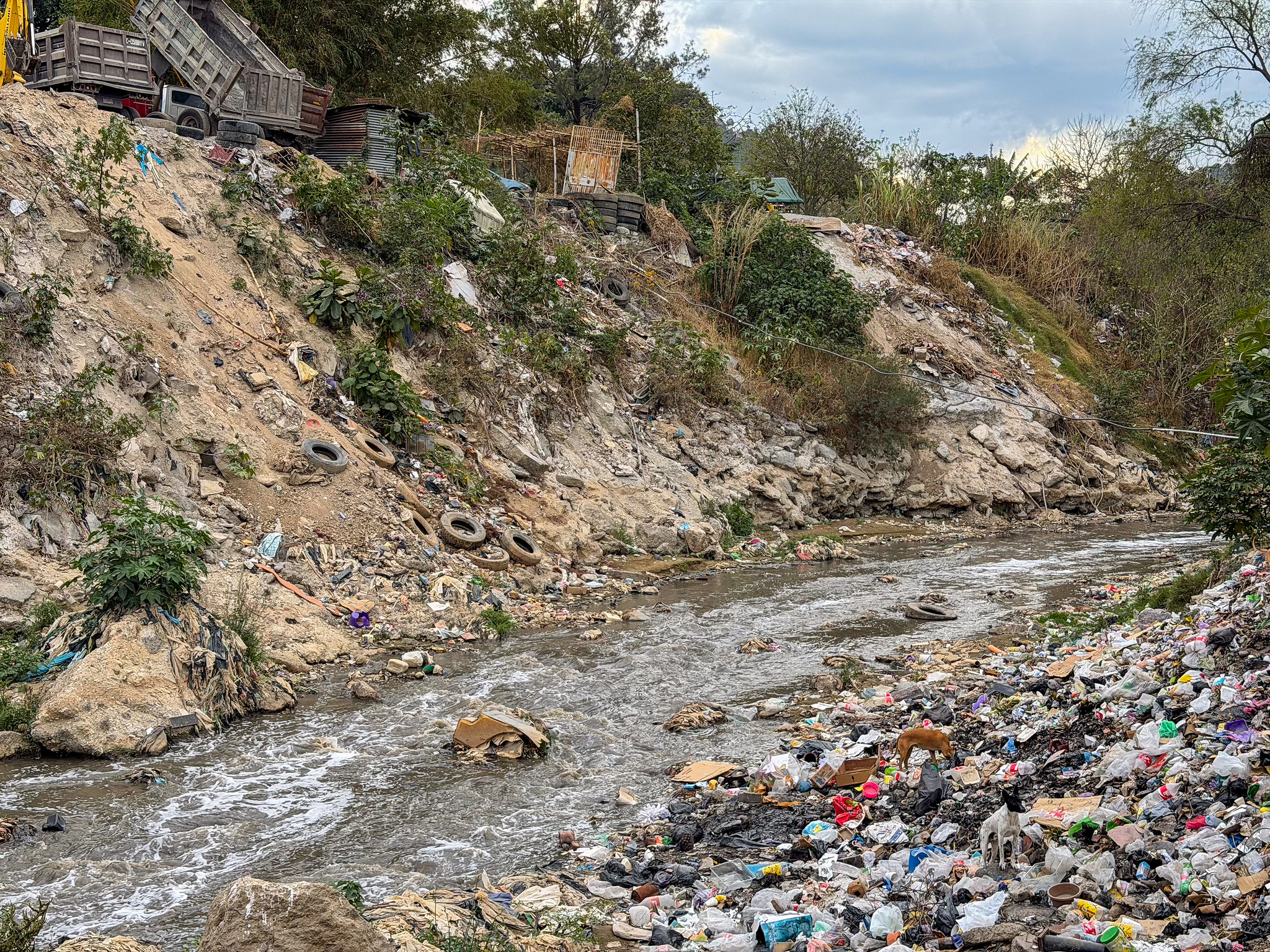
Photo: Mayela Sánchez García.
The situation extends beyond national borders. Every year, the Motagua River discharges some 20,000 metric tons of plastic into the Caribbean Sea, making it one of the rivers that contributes the most plastic pollution to the ocean worldwide, according to estimates contained in a 2025 report by the Inter-American Commission on Human Rights (IACHR).
The river flows into the Mesoamerican Reef at its mouth, so pollution also threatens to degrade one of the largest and most biodiverse transboundary reefs on the planet, which spans the territorial waters of Belize, Guatemala, Honduras, and Mexico.
In addition, the contaminated water reaches the coast of Honduras and spreads into Amatique Bay, located along the eastern coast of Guatemala, affecting the Caribbean Sea.
The roots of this chronic, cross-border problem are structural. Data from the Integrated Environmental Management of the Motagua River Basin project, funded by the United Nations Development Program (UNDP), show that in Guatemala, 66% of municipal solid waste is not collected, and there is no guarantee that the remaining 34% is disposed of properly. Furthermore, of all landfills nationwide, 88.32% are illegal or lack municipal authorization.
In other words, the core issues that need to be addressed are the mismanagement of solid waste and water resources in Guatemala; noncompliance with existing regulations on wastewater discharge and the disposal and treatment of solid waste and residues; and the lack of a water law.
The Poqomam Maya people's quest for justice
The rivers of Santa Cruz Chinautla, a community of the Poqomam Maya people located just twelve kilometers from Guatemala City, have become conduits of pollution that are degrading the Motagua River.
For decades, the local population has seen its health and livelihoods—including pottery, one of the main economic activities and a source of identity—damaged due to the lack of waste management in the municipality of Chinautla and the urban area of the country’s capital, as well as the activities of sand-mining companies.
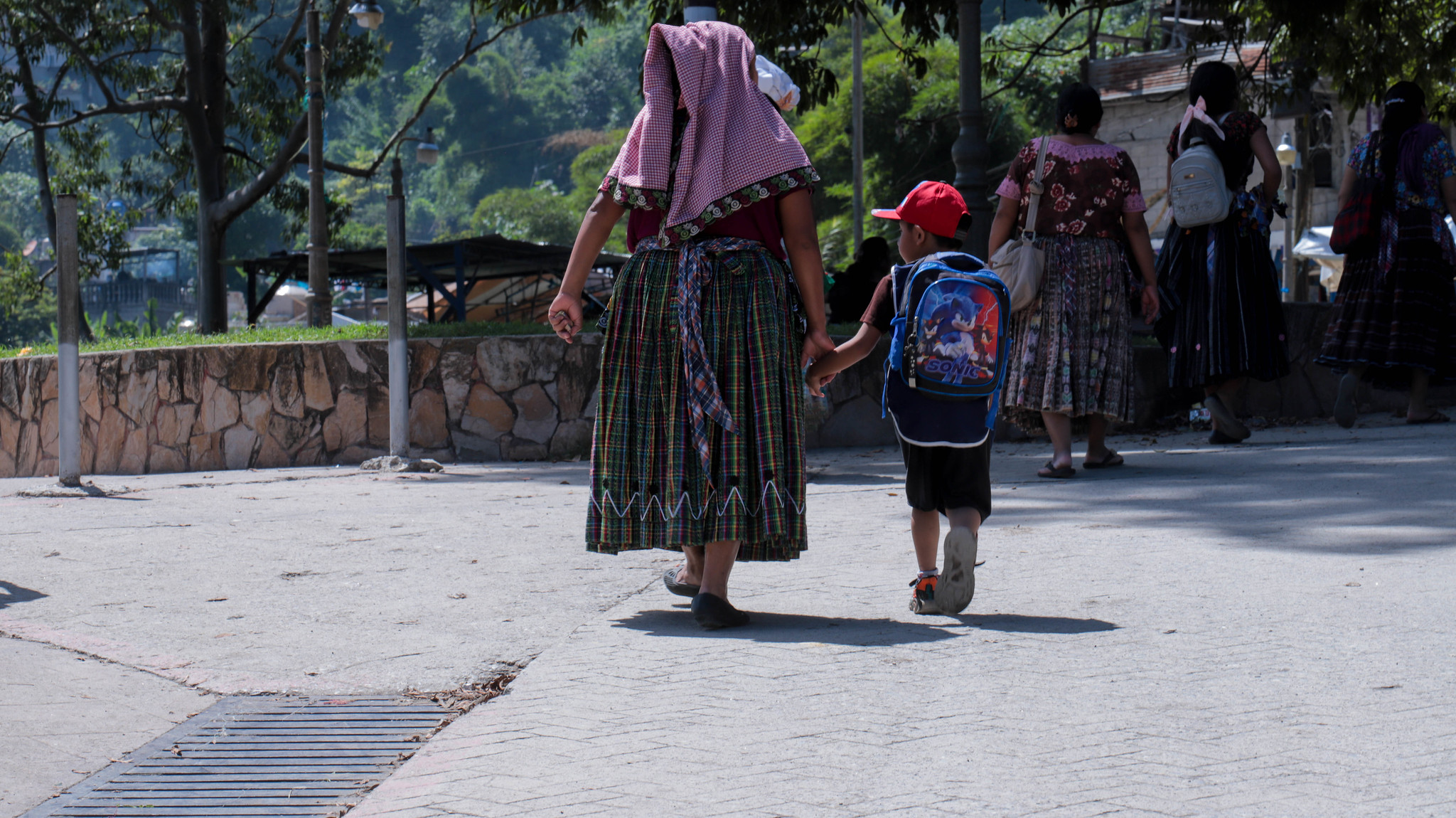
Photo: Mario Winter.
Voices for the Motagua River: Olga Vázquez.
Voices for the Motagua River: Nazario Pascual.
In early 2000, the Maya community organized to stop sand mining on their territory. At that time, the companies held mining permits that remained valid through 2021 and 2022. And although the permits expired, some companies continued to operate after requesting extensions. In June 2022, the indigenous authorities of the Poqomam people began a sit-in protest in front of the Piedrinera San Luis company, which they maintained for four years.
In July 2024, the Special Rapporteur on Economic, Social, Cultural, and Environmental Rights of the IACHR visited Santa Cruz Chinautla. During his visit, traditional authorities and community members spoke about the environmental, water-related, health, economic, and cultural impacts of the pollution in their rivers.
That same year, in October, the community—with support from AIDA, the Indigenous Peoples’ Law Firm, and partner organizations—filed a lawsuit (petition for amparo) against the municipality of Chinautla over its failure to take measures to address the contamination of its rivers and soil caused by improper solid waste management and the existence of illegal landfills.
AIDA’s scientific team, together with local residents and community authorities, collected key information on illegal landfills in the area. This community science initiative supported the litigation by highlighting the severity of the pollution, demonstrating the ongoing use of such practices, and providing evidence of the municipal authorities’ failure to fulfill their legal obligations regarding waste management.
Learn more about this community science initiative.
In June 2025, the Poqomam community won the support of the Guatemalan justice system when a constitutional court ordered the municipality of Chinautla to effectively address the claims in the lawsuit aimed at stopping the pollution of the rivers and soil in Santa Cruz Chinautla.
This is the first time a Guatemalan court has recognized a community's right to a healthy environment and its central role in finding solutions.
Find out the details of the legal victory.
Current situation
Since the ruling was issued, the municipality of Chinautla has held a series of “technical working groups” with representatives from the central government, civil society, and the community. A smaller group of technical experts was later created to develop a work plan with clear goals. Several months have passed without the municipality convening these working groups.
Furthermore, in December 2025, the IACHR noted in its report Human Rights Situation in Guatemala that the Motagua River basin is facing a severe pollution crisis that has had profound impacts on biodiversity and has resulted in systematic violations of the human rights of local communities, including the Maya Poqomam people.
And in May 2026, the Ministry of the Environment and Natural Resources revoked the license of the sand mining company Piedrinera San Luis for "failure to comply with environmental commitments."
AIDA continues to monitor the implementation of the court ruling to ensure the right to a healthy environment for the Poqomam Maya community and all those living in the Motagua River basin. Meanwhile, the residents of Santa Cruz Chinautla remain organized and mobilized to improve their environment and defend their rights.
Related projects
Air pollution in Latin America and its effect on our health and climate
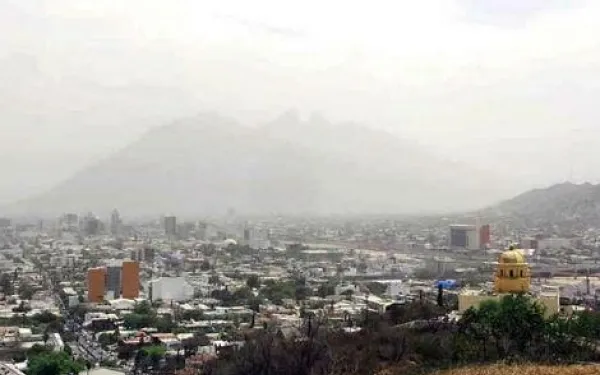
By Héctor Herrera, AIDA legal advisor and coordinator of the Network for Environmental Justice in Colombia, @RJAColombia According to the latest report from the Clean Air Institute, Monterrey, Guadalajara and Mexico City (Mexico), Cochabamba (Bolivia), Santiago (Chile), Lima (Peru), Bogota and Medellin (Colombia), Montevideo (Uruguay) and San Salvador (El Salvador) are 10 most polluted cities in Latin America. In all of them, the level of air pollution exceeds World Health Organization recommendations. The scene is similar in big cities across the region: buses and trucks spew out black smoke as people walk under grey skies. This is the backdrop in The Sound of Things Falling, an award-winning novel by Colombia’s Juan Gabriel Vásquez in which descriptions like this abound: “On the corner of Carrera Cuarta, the heavy afternoon traffic was moving slowly, in single file, toward the exit on to Avenida Jiménez. I found the gap in the traffic I needed to cross in front of a small bus whose recently illuminated headlights were catching the dust from the street, the smoke from exhaust pipes and the beginnings of a light drizzle.” Vásquez is writing about Bogota. But he could just as easily have been describing Monterrey or San Salvador. Residents of Latin America’s big cities live enveloped in smog. They breathe in the microparticles of black carbon, ozone, nitrogen dioxide and sulphur dioxide that comes with the air polluted by urban transport, industry and power plants. We can get riled up when a passing truck spits a cloud of smoke in our face. But our outrage fades almost as soon when we think that making these vehicles more environmentally friendly is not our responsibility. Those decisions lie out of our reach in the hands of politicians and bureaucrats. Even so, we must understand that air pollution is a problem that affects all of us and so it is important to be aware of the associated health risks. THE Clean Air Institute's report explains how breathing in air containing a high concentration of pollutants can reduce our quality of life and lead to illness or premature death. Thankfully, the report also makes recommendations on how to avoid this. Worryingly, public health is not the only casualty of air pollution. Another is a faster pace of climate change Black carbon and ozone are short-lived climate pollutants (SLCPs) that remain in the atmosphere from days to decades. While that is nothing compared with carbon dioxide, which remains in the atmosphere for more than a century, SLCPs contribute more to climate change than carbon dioxide. This means that if we were to significantly reduce SLCP emissions, we would get quick results in slowing climate change. You can find more information on AIDA’s page on SLCPs, including descriptions of the main pollutants and the steps being taken to encourage a reduction in their emission. All of what has been said here becomes particularly pertinent when you consider that the population and number of vehicles in Latin America is growing steadily, which unfortunately is not the case for the number of measures being introduced to reduce the level of air pollutants. Whatever our motives – whether this is to improve public health, slow climate change, protect our lungs or those of future generations, or even to simply enjoy a picturesque sunset without a wall of harmful gases blocking our view of the sea or the mountains, one thing is imperative. We must work so that the air in our cities across the Americas is clean and fresh.
Read moreGroups appeal to UN to halt imminent forced evictions of indigenous Ngöbe families
Appeal to the UN seeks to stop eviction of Panamanian community. Panama, Washington D.C., San Francisco, Lima. Environmental and human rights organizations submitted an urgent appeal to United Nations Special Rapporteurs on behalf of members of the indigenous Ngöbe community - the community faces imminent forced eviction from their land for the Barro Blanco hydroelectric dam project in western Panama. The eviction would force Ngöbe communities from their land, which provides their primary sources of food and water, means of subsistence, and culture. The urgent appeal, submitted by the Ngöbe organization Movimiento 10 de Abril para la Defensa del Rio Tabasará (M10) and three international NGOs, the Interamerican Association for Environmental Defense (AIDA), the Center for International Environmental Law (CIEL), and Earthjustice, asks the Special Rapporteurs to call upon the State of Panama to suspend the eviction process and dam construction until it complies with its obligations under international law. Given that the project is financed by the German and Dutch development banks (DEG and FMO, respectively) and the Central American Bank for Economic Integration (CABEI), the groups also urge the Special Rapporteurs to call on Germany, the Netherlands, and the member States of CABEI to suspend financing until each country has taken measures to remedy and prevent further violations of the Ngöbe's human rights. The forced evictions of the Ngöbe are the most recent threat arising from the Barro Blanco project. These evictions raise imminent violations of their human rights to adequate housing; property, including free, prior and informed consent; food, water and means of subsistence; culture; and education. "Our lands and natural resources are the most important aspects of our culture. Every day, we fear we will be forced from our home,"said Weni Bagama of the M10. The appeal highlights the fact that the Ngöbe were never consulted, nor gave consent to leave their land. "Panama must respect the rights of the Ngöbe indigenous peoples and refrain from evicting them. Executing these forced evictions will constitute a violation of international human rights law," said María José Veramendi Villa of AIDA. Also central to the appeal is the role of governments whose banks are funding the dam. "Under international law, States must ensure that their development banks do not finance projects that violate human rights, including extraterritorially. Forced eviction of the Ngöbe without their consent is reason enough to suspend financing of this project," said Abby Rubinson of Earthjustice. Barro Blanco's registration under the Kyoto Protocol's Clean Development Mechanism (CDM) is another point of concern. "Panama's failure to protect the Ngöbe from being forcibly displaced from their land without their consent casts serious doubt on the CDM's ability to ensure respect for human rights under international law," said Alyssa Johl of CIEL. "CDM projects must be designed and implemented in a manner that respects human rights obligations."
Read more
Mandela: lessons in tribal leadership to effectively protect the environment
“It always seems impossible until it becomes reality.” —Nelson Mandela Nelson Mandela died one month ago. Much has been written about him since then, and he has been globally honored like none other. Despite possible year-end amnesia and at the risk of sounding cliché, I am writing this post in his honor. I’m particularly interested in highlighting four leadership qualities Mandela possessed, and pointing out how those same qualities can help us be more effective environment defenders. Nelson Rolihlahla Mandela was born in Qunu, a Xhosa community in the state of Transkei, in the southeastern part of South Africa. Mandela’s birth name Rolihlahla means “troublemaker,” in the Xhosa language. But a schoolteacher began calling him Nelson, according to the custom of calling children by their English, rather than African, names. Another of Mandela’s names—Dalibunga (or founder of the bunga)—was given to him during a traditional initiation ceremony at the age of 16. He was also called Madiba, a name given by his tribe in honor of a Tembu chief who ruled during the 18th Century. According to tradition, Mandela was destined to be an advisor to the Tembu king. But he ended up being a leader far beyond the borders of the Transkei region, and changed the world even beyond South Africa. He was a leader of reconciliation and compromise. He had an enormous capacity for forgiveness and an ability work peacefully with, rather than seek revenge against, those who oppressed his people for centuries, and imprisoned him for 27 years. In what follows, I’d like to discuss four characteristics that Mandela exemplified. If we emulate these qualities, we can, like Mandela, help make the world a freer and more just place. 1. Values and a common cause as an absolute guide to decisions “There is no easy walk to freedom anywhere, and many of us will have to pass through the valley of the shadow of death again and again before we reach the mountaintop of our desires.” Mandela lived according to his values. He had the goal of ending apartheid and securing freedom for himself and his people. His desire for freedom guided each of his actions, including after he succeeded in ending apartheid in his country. Over the decades of his struggle, including more than a quarter century in prison, there were undoubtedly moments of despair and fear in which other people would have given up hope. Mandela and his colleagues, however, persisted. The cause that united them was greater than their individual will, and stronger than even Mandela himself. Although we cannot compare our work to the struggle against apartheid, we have indeed made important progress by rallying behind a common cause. One recent victory, in 2011, was a change in the Mexican Constitution in favor human rights. It would not have been possible without the joint work of our partner organizations, academia, and the Office of the High Commissioner of Mexico. 2. Conscientious, disciplined, committed and coherent “Running taught me valuable lessons. In cross-country competitions, training counted more than intrinsic ability, and I could compensate for a lack of natural aptitude with diligence and discipline. I applied this in everything I did.” Persistence and discipline were qualities that made a big difference for Mandela in reaching his goals. His commitment to every challenge, his clarity, and even his limitless stubbornness still manage to surprise us. His success was not achieved through supernatural powers, nor was there a single moment in which everything magically changed. On the contrary, Mandela’s achievements were a consequence of a life dedicated to study, work, and learning. He was constantly listening to others, building strategies, and rethinking them in order to achieve his goals. He made mistakes and bad decisions, but also had successes that collectively helped achieve his dream of freedom. Sometimes we feel that the results are impossible. In fact, they are, if we’re trying to reach them immediately. At AIDA, we have learned this in the case of La Oroya, in which we have had to be persistent and disciplined in order to achieve lasting results. With the people of La Oroya we have worked for change for 15 years, and we will continue until we achieve it. 3. All on the same side — there is no good vs. bad “If you want to make peace with your enemy, you should work with your enemy. Then he will become your partner.” I often wonder where South Africa would be if Mandela and his colleagues had not reached small agreements, if they had not overcome their many differences and moved forward. Moreover, what would have happened in that country if they had not been able to transcend hatred toward their oppressors in order to find peaceful and coordinated solutions? Surely, the outcome would have been a civil war with unimaginable consequences. One element that avoided such a catastrophe was Mandela’s constant ability to find solutions, reach agreements, maintain dialogue, and demand concrete results toward real change. No doubt, the process was not easy, quick, or smooth. But perseverance, clear goals, a desire to reach consensus, and the ability to find interlocutors made even the most complicated situations possible. When I think of our job of protecting the environment, I realize how much we lack and the great opportunity that lies before us. For example, instead of competing with colleagues at other organizations, or trying to defeat governments or corporations, we should remember that we are all working toward solutions to a common goal. The lure of “winning” and seeing others lose is powerful. But, surely, we will gain more if we work with our “enemies” and become partners instead. 4. A step back in celebration, a step forward in times of peril “It is better to lead from behind, and put others to the front, especially in celebration when good things occur. You step forward when there is danger. Then, people will appreciate your leadership.” Leadership is very different from being a dictator or a strongman. A person who is a true leader allows and encourages others to grow, develop and evolve in order to reach a common goal, even if they shine more than their bosses. Mandela was conscious of being a symbol so that everyone in South Africa could be free and treated as equals. Many times, he put that role above his own self-interest. On more than one occasion, Mandela had the possibility of improving his prison conditions or of obtaining early release. Instead, he chose to stay imprisoned because he believed that the conditions to dismantle apartheid were not met, and that the unjust system would not change if he were released. “Real leaders must be ready to sacrifice everything for the freedom of their people.” Sadly, contrary to what Mandela said, many “leaders” jump at the chance to receive medals, but have difficulty taking responsibility for the mistakes or shortcomings of their team. We must remember that the type of leadership that Mandela embodied can accomplish miracles. It translates into actions that allow changes no one would have thought possible—the fall of apartheid, for example, or a simple handshake between President Obama and Raul Castro, a symbol of reconciliation that took place at Mandela’s funeral. So, dear leaders, have a happy 2014! I invite you to consider these leadership skills and put them into practice. For your success, and for the survival of our planet!
Read more