
Project
Shutterstock.
Pollution of the Motagua River in Guatemala: The Poqomam Maya people’s quest for environmental justice
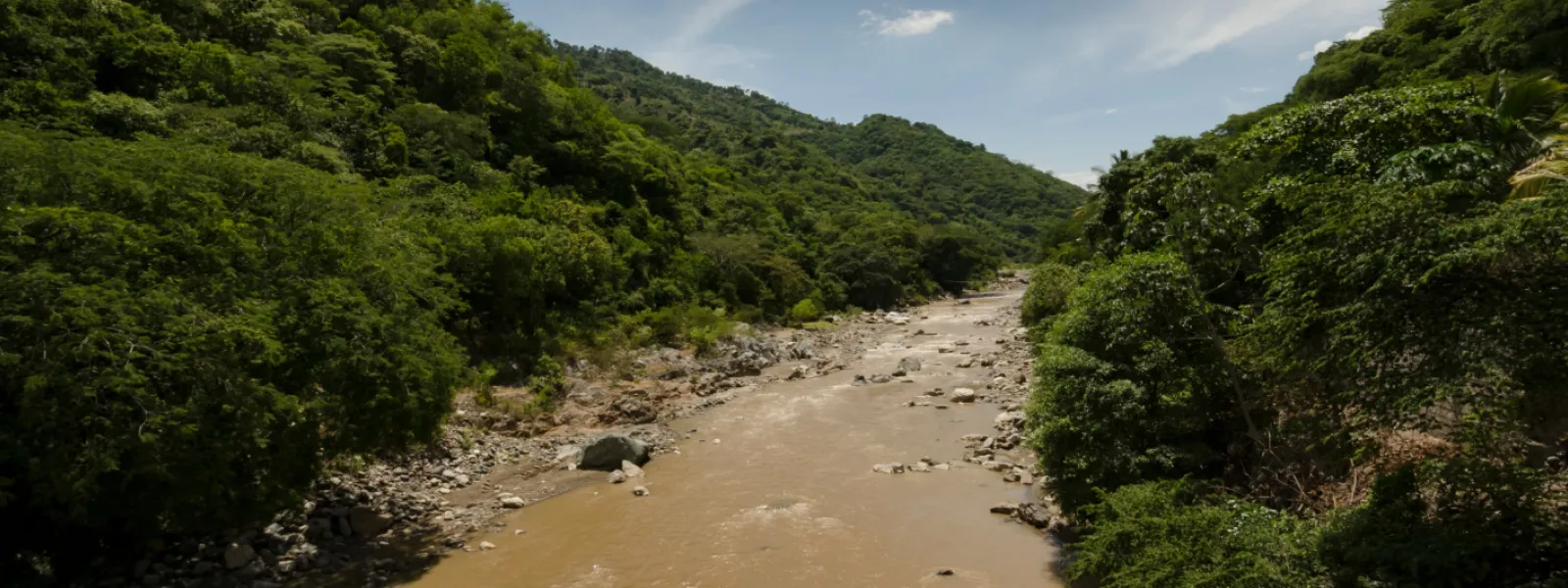
The Motagua River basin—Guatemala’s largest and most important river—is severely polluted with wastewater, solid waste, and other types of debris.
This is a cross-border issue because the Motagua’s polluted waters flow into the Caribbean Sea, reach the coast of Honduras, and threaten the Mesoamerican Reef System.
For decades, this has violated the rights to health, water, development, and a healthy environment of all the people living in the river basin.
In June 2025, the Poqomam Maya community of Santa Cruz Chinautla—supported by AIDA, the Indigenous Peoples’ Law Firm, and allied organizations—achieved an unprecedented legal victory to halt degradation in the basin. In response to the lawsuit it filed, a Guatemalan court ordered the municipality of Chinautla to comply with a series of obligations to curb the pollution of the area’s rivers and soil.
The government's response to the ruling has so far been limited to technical working group meetings. Meanwhile, the community continues to work toward the proper implementation of the ruling and to take other actions to defend its territory and its rights.
Background
The Motagua River, which is 486 km long, flows through 96 municipalities and 14 departments in Guatemala. It originates in Quiché, a department located in the northwest, and empties into the Caribbean Sea.
Polluting activities occur throughout the entire basin, including sub-basins and micro-basins. The largest volume of pollution comes from Guatemala City, the country’s capital, and is carried by the waters of the Las Vacas River, which in turn receives a large amount of waste from the Chinautla River.
The Chinautla River, which flows through the municipality of the same name, carries solid waste from a landfill located in Zone 3 of the capital—where trash from at least 14 municipalities in the department of Guatemala is dumped—as well as sewage generated by some 500,000 people living in the northern part of the capital, which undergoes no prior treatment.
Other sources of pollution include the numerous illegal dumps in the municipality of Chinautla, the waste that private vehicles and garbage trucks dump along the banks of its rivers, as well as the sand-mining companies—which began setting up operations in the area between 1996 and 1997—whose activities weaken the rivers' basins, causing solid waste to be more easily carried away by the river currents.
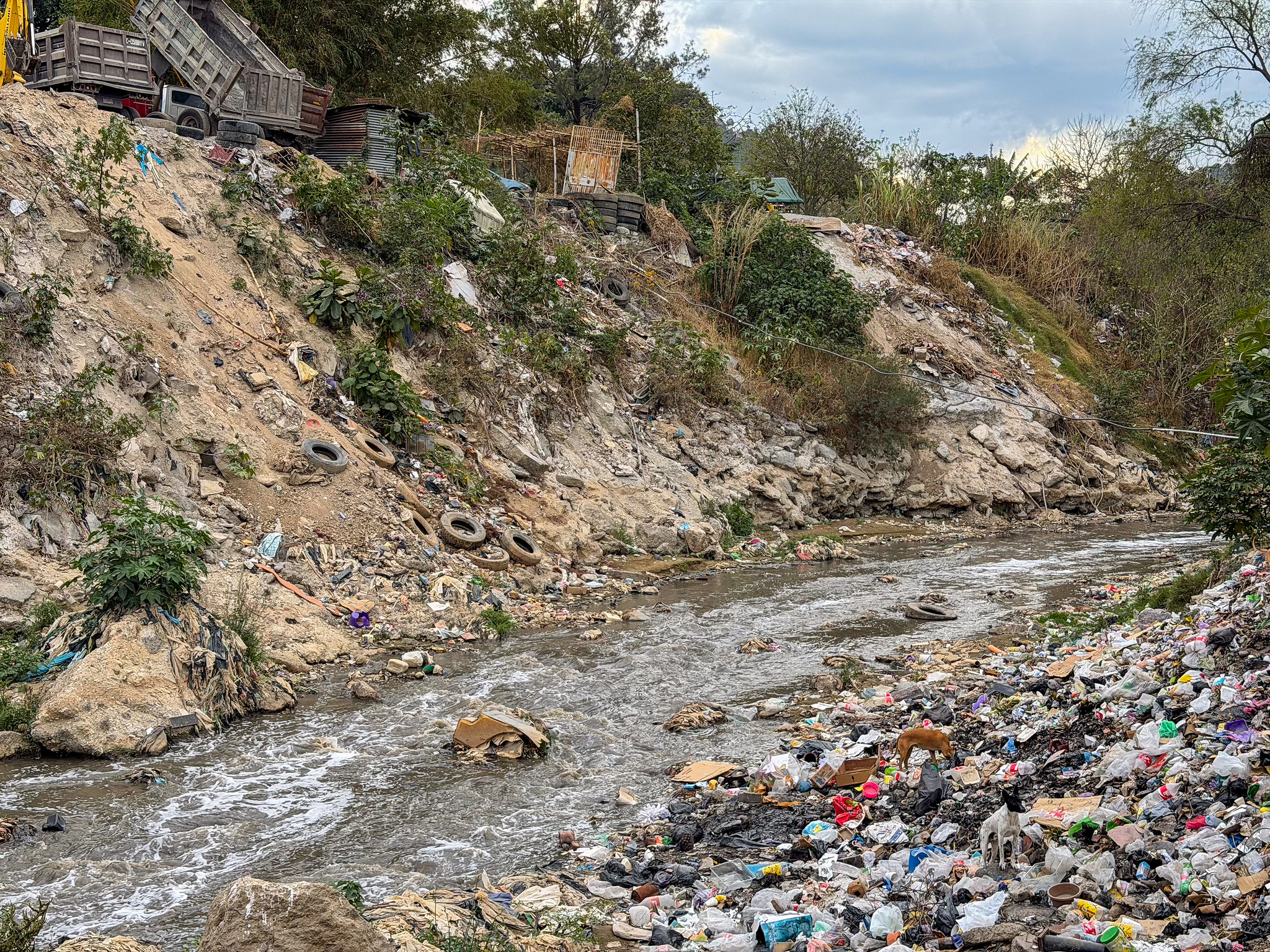
Photo: Mayela Sánchez García.
The situation extends beyond national borders. Every year, the Motagua River discharges some 20,000 metric tons of plastic into the Caribbean Sea, making it one of the rivers that contributes the most plastic pollution to the ocean worldwide, according to estimates contained in a 2025 report by the Inter-American Commission on Human Rights (IACHR).
The river flows into the Mesoamerican Reef at its mouth, so pollution also threatens to degrade one of the largest and most biodiverse transboundary reefs on the planet, which spans the territorial waters of Belize, Guatemala, Honduras, and Mexico.
In addition, the contaminated water reaches the coast of Honduras and spreads into Amatique Bay, located along the eastern coast of Guatemala, affecting the Caribbean Sea.
The roots of this chronic, cross-border problem are structural. Data from the Integrated Environmental Management of the Motagua River Basin project, funded by the United Nations Development Program (UNDP), show that in Guatemala, 66% of municipal solid waste is not collected, and there is no guarantee that the remaining 34% is disposed of properly. Furthermore, of all landfills nationwide, 88.32% are illegal or lack municipal authorization.
In other words, the core issues that need to be addressed are the mismanagement of solid waste and water resources in Guatemala; noncompliance with existing regulations on wastewater discharge and the disposal and treatment of solid waste and residues; and the lack of a water law.
The Poqomam Maya people's quest for justice
The rivers of Santa Cruz Chinautla, a community of the Poqomam Maya people located just twelve kilometers from Guatemala City, have become conduits of pollution that are degrading the Motagua River.
For decades, the local population has seen its health and livelihoods—including pottery, one of the main economic activities and a source of identity—damaged due to the lack of waste management in the municipality of Chinautla and the urban area of the country’s capital, as well as the activities of sand-mining companies.
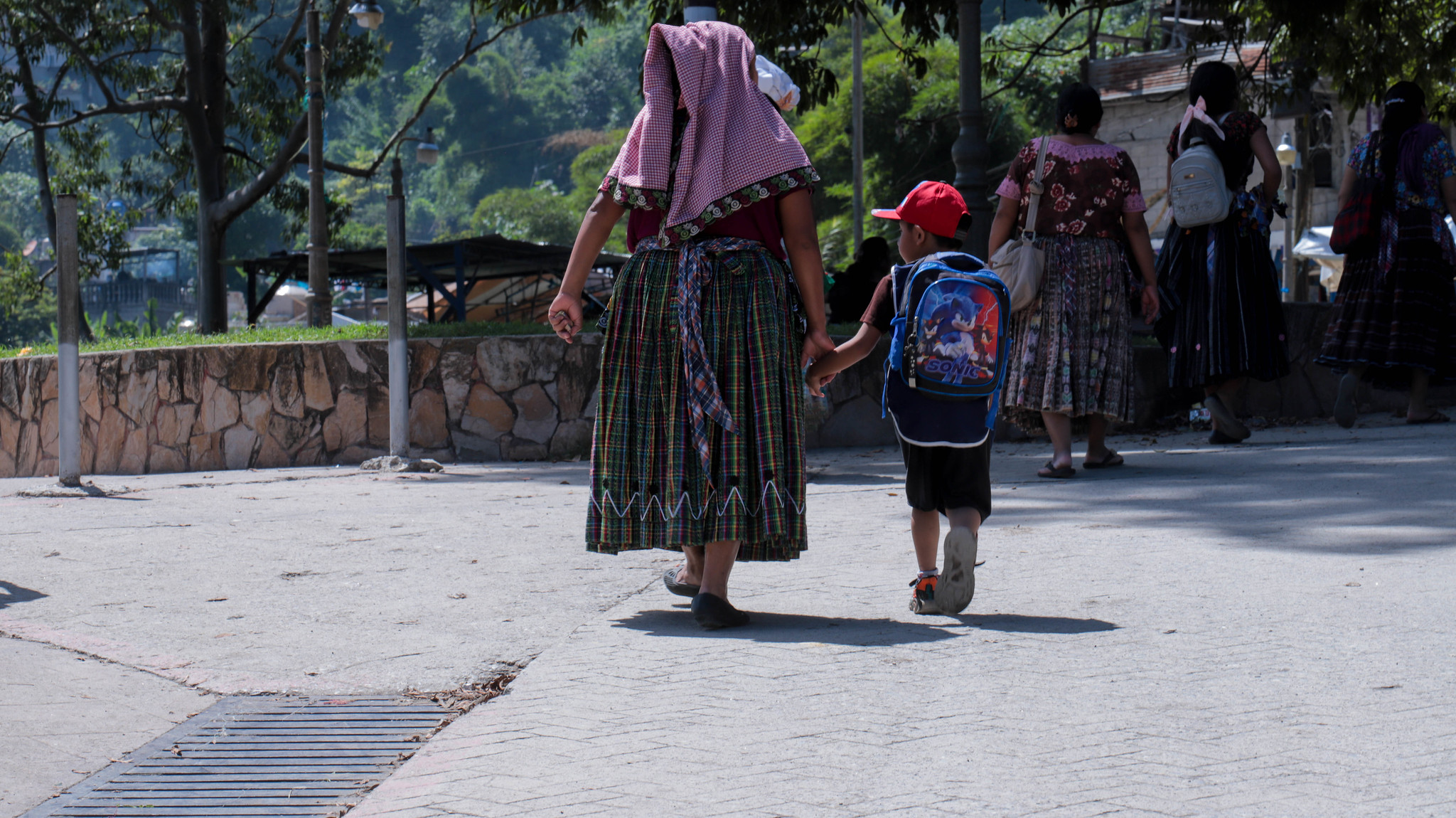
Photo: Mario Winter.
Voices for the Motagua River: Olga Vázquez.
Voices for the Motagua River: Nazario Pascual.
In early 2000, the Maya community organized to stop sand mining on their territory. At that time, the companies held mining permits that remained valid through 2021 and 2022. And although the permits expired, some companies continued to operate after requesting extensions. In June 2022, the indigenous authorities of the Poqomam people began a sit-in protest in front of the Piedrinera San Luis company, which they maintained for four years.
In July 2024, the Special Rapporteur on Economic, Social, Cultural, and Environmental Rights of the IACHR visited Santa Cruz Chinautla. During his visit, traditional authorities and community members spoke about the environmental, water-related, health, economic, and cultural impacts of the pollution in their rivers.
That same year, in October, the community—with support from AIDA, the Indigenous Peoples’ Law Firm, and partner organizations—filed a lawsuit (petition for amparo) against the municipality of Chinautla over its failure to take measures to address the contamination of its rivers and soil caused by improper solid waste management and the existence of illegal landfills.
AIDA’s scientific team, together with local residents and community authorities, collected key information on illegal landfills in the area. This community science initiative supported the litigation by highlighting the severity of the pollution, demonstrating the ongoing use of such practices, and providing evidence of the municipal authorities’ failure to fulfill their legal obligations regarding waste management.
Learn more about this community science initiative.
In June 2025, the Poqomam community won the support of the Guatemalan justice system when a constitutional court ordered the municipality of Chinautla to effectively address the claims in the lawsuit aimed at stopping the pollution of the rivers and soil in Santa Cruz Chinautla.
This is the first time a Guatemalan court has recognized a community's right to a healthy environment and its central role in finding solutions.
Find out the details of the legal victory.
Current situation
Since the ruling was issued, the municipality of Chinautla has held a series of “technical working groups” with representatives from the central government, civil society, and the community. A smaller group of technical experts was later created to develop a work plan with clear goals. Several months have passed without the municipality convening these working groups.
Furthermore, in December 2025, the IACHR noted in its report Human Rights Situation in Guatemala that the Motagua River basin is facing a severe pollution crisis that has had profound impacts on biodiversity and has resulted in systematic violations of the human rights of local communities, including the Maya Poqomam people.
And in May 2026, the Ministry of the Environment and Natural Resources revoked the license of the sand mining company Piedrinera San Luis for "failure to comply with environmental commitments."
AIDA continues to monitor the implementation of the court ruling to ensure the right to a healthy environment for the Poqomam Maya community and all those living in the Motagua River basin. Meanwhile, the residents of Santa Cruz Chinautla remain organized and mobilized to improve their environment and defend their rights.
Related projects
Short-lived climate pollutants: An opportunity to reduce emissions
AIDA together with CEDHA, CEMDA and RedRacc have produced a briefing paper on short-lived climate pollutants (SLCPs) for presentation at the 19th Conference of the Parties (COP19) on climate change, which is running November 11 to 22 in Warsaw, Poland. SLCPs are agents that contribute to global warming and have a relatively short lifetime in the atmosphere, from a few days to a few decades. That’s different from CO2, which remains in the atmosphere for centuries or millennia after emission. CO2 contributes an estimated 55% to 60% to global warming, while the remaining 40-45% comes from the emission of SLCPs. The latter seriously affect human health and ecosystems, meaning that any reduction in their emissions also brings significant social benefits. The fact that these contaminants remain so little time in the atmosphere means that their mitigation brings short-term benefits, in particular to the most vulnerable regions of the world already suffering the impacts of climate change. We must seize the opportunity to reduce SLCPs in the fight against the effects of this global challenge. Our paper explains what SLCPs are, which are the most relevant ones, and what are the reasons we should work to regulate and reduce their emissions. The paper also provides recommendations for taking on the challenge. Read the Fact Sheet (in Spanish)
Read more
Can COP19 move the Green Climate Fund closer to reality?
By Andrea Rodríguez, AIDA's legal advisor, and Marcus Pearson, AIDA's volunteer (article published in Respond/RTCC Magazine) The Green Climate Fund was created as an effective response to the impacts of climate change by channeling financial resources from developed to developing countries. Will this happen? The Conference of the Parties in November will provide an opportunity for developing countries to lobby for significant financial commitments from the developed world to ensure the long-term viability of the GCF. The Green Climate Fund (GCF) was created in 2010 at the 16th Conference of the Parties (COP16) to the United Nations Framework Convention on Climate Change (UNFCCC). Its mission is to channel public and private financial resources to developing countries to help them mitigate and adapt to the impacts of climate change through low-emission and climate-resilient programs. But nearly four years later, the GCF has yet to disburse any funds. The GCF board has held four meetings with only limited results. At the first meeting in Geneva in August 2012, the board selected two interim co-chairs: Mr. Zaheer Fakir of South Africa and Mr. Ewen McDonald of Australia. It also formed committees, designated the World Bank as Interim Trustee, and agreed to invite observer organizations to participate, albeit in a restricted capacity. A lack of consensus stalled decisions at the October 2012 meeting in South Korea, where the only notable motion was making Songdo, South Korea the GCF’s headquarters. More advances came at the February 2013 meeting in Berlin. The board adopted procedural rules to govern its actions, regulate board member selection and define the participation and role of civil society observers. This laid the groundwork for the GCF to carry out its mission. At the June 2013 meeting in South Korea, the board then discussed the GCF’s business model framework (BMF) and the policies, guidelines and organizational structures needed to commence operations. The board also chose the governance structure of the private sector facility (PSF) [i] and appointed Ms. Hela Cheikhrouhou of Tunisia as executive director of the GCF Secretariat. The fifth meeting in Paris could address the many outstanding issues still needed to bring the GCF into effective operation. To do so, the Board must overcome its perceived ineffectiveness. Civil society concerns Civil society organizations (CSOs) are concerned about the GCF’s decision-making process and future. Perhaps the greatest issue is the uncertainty of funding. The GCF board has started to identify project areas and define criteria to allocate resources, but developed countries have yet to pledge meaningful funds. Concrete commitments are essential to ensuring the availability of predictable resources needed to achieve long-term results to mitigate and protect against the impacts of climate change. CSOs also fear that a lack of transparency and accountability will hamstring the GCF. Transparency does not seem to be a priority for the board. For example, the board has decided against webcasting its meetings even though the UNFCCC commonly does so, helping to cut costs and carbon emissions associated with travel. If the GCF already broadcasts meetings to observers in an overflow room, why not webcast? CSOs fear the board does not want to make its meetings open to the public. Lack of public accountability remains a concern particularly because of the small opportunity given to civil society to participate in the decision- making process. The GCF will mobilize financial resources from both public and private sectors, and civil society oversight is needed to ensure that policies do not respond to the investment interests of the private sector but to the needs of the most vulnerable. Moreover, the board is not granting CSOs meaningful opportunities for participation. The GCF publishes documents before meetings without sufficient time for many CSOs to review and comment on proposals[ii]. Meanwhile, only two CSO representatives may actively participate at board meetings in person and even so may not be allowed to talk or approach board members[iii]. These practices call into question the GCF’s legitimacy. Globally, CSOs play a vital role in developing climate change policy by informing decision makers about local issues and needs, and by providing examples of best practices for resource allocation. Given that the GCF stresses accountability in its mandate, CSOs should have access to government representatives and information in open and transparent meetings. COP19: An opportunity for the GCF? The COP19 this November in Warsaw will show the world whether the GCF can become an effective engine for climate change funding in developing countries. At this conference, developing countries must seek firm financial commitments for climate adaptation and mitigation. Only guaranteed funding will enable the board to make effective decisions regarding resource distribution or provide developing nations with a clear picture of how much funding is available. The GCF Board must also seek -- and receive -- guidance because many COP attendees will benefit from GCF resources. Countries can use the COP to provide advice on GCF policies, share their priority needs for funding, and recommend criteria to guarantee access to resources. The COP will also give CSO representatives a chance to raise questions and highlight counterproductive practices. Conclusions The COP presents a prime opportunity for developed nations to commit to the GCF’s stated goals and pledge desperately needed financing. Parties and CSOs must use the COP – GCF’s monitoring body – as a tool to improve GCF accountability, inclusivity and transparency so that the GCF can truly work to benefit vulnerable populations in developing countries. The COP should be a benchmark for advancing the GCF rather than just another event for developed countries to congratulate themselves on timorous steps forward. [i] The PSF will enable the GCF to directly and indirectly finance private sector mitigation and adaptation activities at the national, regional and international level. [ii] For the June meeting in South Korea, documents were published less than two weeks before the meeting, rather than 21 days as outlined in the additional rules of procedure decision taken in Berlin. [iii] As was the case on the last day of the meeting in Songdo.
Read moreCan COP19 move the Green Climate Fund closer to reality?
By Andrea Rodríguez, AIDA's legal advisor, and Marcus Pearson, AIDA's volunteer (article published in Respond/RTCC Magazine) The Green Climate Fund was created as an effective response to the impacts of climate change by channeling financial resources from developed to developing countries. Will this happen? The Conference of the Parties in November will provide an opportunity for developing countries to lobby for significant financial commitments from the developed world to ensure the long-term viability of the GCF. The Green Climate Fund (GCF) was created in 2010 at the 16th Conference of the Parties (COP16) to the United Nations Framework Convention on Climate Change (UNFCCC). Its mission is to channel public and private financial resources to developing countries to help them mitigate and adapt to the impacts of climate change through low-emission and climate-resilient programs. But nearly four years later, the GCF has yet to disburse any funds. The GCF board has held four meetings with only limited results. At the first meeting in Geneva in August 2012, the board selected two interim co-chairs: Mr. Zaheer Fakir of South Africa and Mr. Ewen McDonald of Australia. It also formed committees, designated the World Bank as Interim Trustee, and agreed to invite observer organizations to participate, albeit in a restricted capacity. A lack of consensus stalled decisions at the October 2012 meeting in South Korea, where the only notable motion was making Songdo, South Korea the GCF’s headquarters. More advances came at the February 2013 meeting in Berlin. The board adopted procedural rules to govern its actions, regulate board member selection and define the participation and role of civil society observers. This laid the groundwork for the GCF to carry out its mission. At the June 2013 meeting in South Korea, the board then discussed the GCF’s business model framework (BMF) and the policies, guidelines and organizational structures needed to commence operations. The board also chose the governance structure of the private sector facility (PSF) [i] and appointed Ms. Hela Cheikhrouhou of Tunisia as executive director of the GCF Secretariat. The fifth meeting in Paris could address the many outstanding issues still needed to bring the GCF into effective operation. To do so, the Board must overcome its perceived ineffectiveness. Civil society concerns Civil society organizations (CSOs) are concerned about the GCF’s decision-making process and future. Perhaps the greatest issue is the uncertainty of funding. The GCF board has started to identify project areas and define criteria to allocate resources, but developed countries have yet to pledge meaningful funds. Concrete commitments are essential to ensuring the availability of predictable resources needed to achieve long-term results to mitigate and protect against the impacts of climate change. CSOs also fear that a lack of transparency and accountability will hamstring the GCF. Transparency does not seem to be a priority for the board. For example, the board has decided against webcasting its meetings even though the UNFCCC commonly does so, helping to cut costs and carbon emissions associated with travel. If the GCF already broadcasts meetings to observers in an overflow room, why not webcast? CSOs fear the board does not want to make its meetings open to the public. Lack of public accountability remains a concern particularly because of the small opportunity given to civil society to participate in the decision- making process. The GCF will mobilize financial resources from both public and private sectors, and civil society oversight is needed to ensure that policies do not respond to the investment interests of the private sector but to the needs of the most vulnerable. Moreover, the board is not granting CSOs meaningful opportunities for participation. The GCF publishes documents before meetings without sufficient time for many CSOs to review and comment on proposals[ii]. Meanwhile, only two CSO representatives may actively participate at board meetings in person and even so may not be allowed to talk or approach board members[iii]. These practices call into question the GCF’s legitimacy. Globally, CSOs play a vital role in developing climate change policy by informing decision makers about local issues and needs, and by providing examples of best practices for resource allocation. Given that the GCF stresses accountability in its mandate, CSOs should have access to government representatives and information in open and transparent meetings. COP19: An opportunity for the GCF? The COP19 this November in Warsaw will show the world whether the GCF can become an effective engine for climate change funding in developing countries. At this conference, developing countries must seek firm financial commitments for climate adaptation and mitigation. Only guaranteed funding will enable the board to make effective decisions regarding resource distribution or provide developing nations with a clear picture of how much funding is available. The GCF Board must also seek -- and receive -- guidance because many COP attendees will benefit from GCF resources. Countries can use the COP to provide advice on GCF policies, share their priority needs for funding, and recommend criteria to guarantee access to resources. The COP will also give CSO representatives a chance to raise questions and highlight counterproductive practices. Conclusions The COP presents a prime opportunity for developed nations to commit to the GCF’s stated goals and pledge desperately needed financing. Parties and CSOs must use the COP – GCF’s monitoring body – as a tool to improve GCF accountability, inclusivity and transparency so that the GCF can truly work to benefit vulnerable populations in developing countries. The COP should be a benchmark for advancing the GCF rather than just another event for developed countries to congratulate themselves on timorous steps forward. [i] The PSF will enable the GCF to directly and indirectly finance private sector mitigation and adaptation activities at the national, regional and international level. [ii] For the June meeting in South Korea, documents were published less than two weeks before the meeting, rather than 21 days as outlined in the additional rules of procedure decision taken in Berlin. [iii] As was the case on the last day of the meeting in Songdo.
Read more