
Project
Shutterstock.
Pollution of the Motagua River in Guatemala: The Poqomam Maya people’s quest for environmental justice
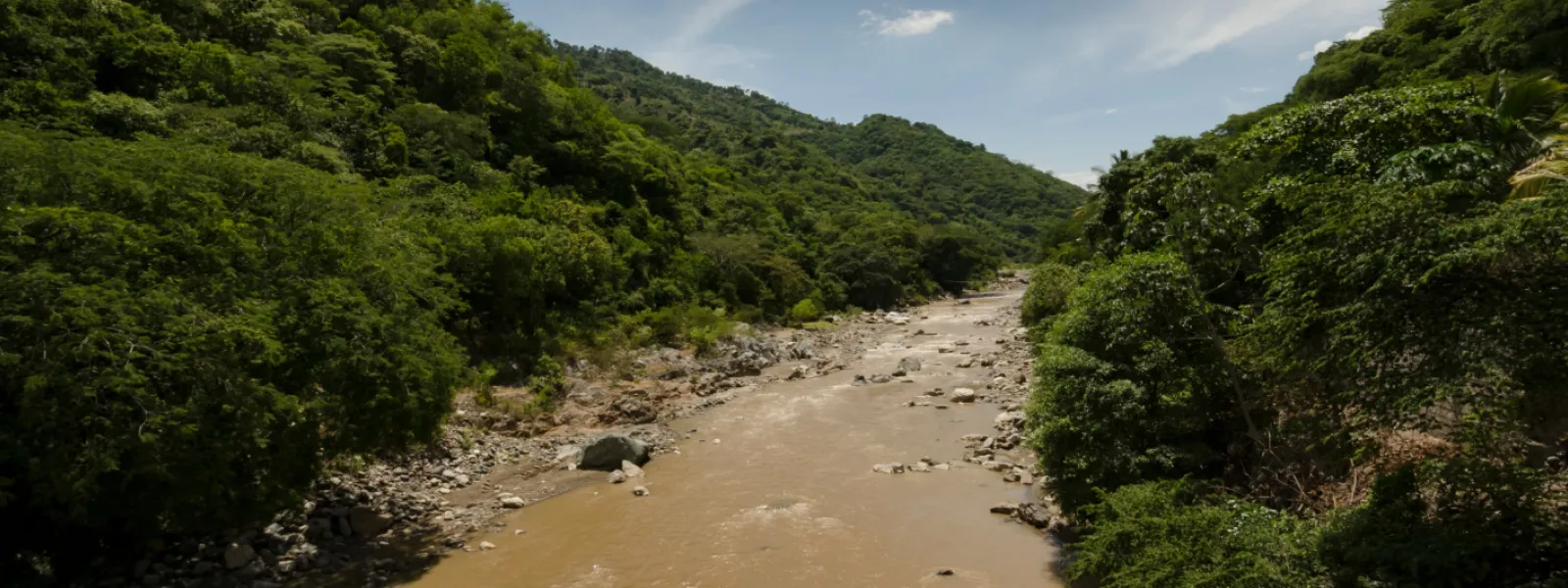
The Motagua River basin—Guatemala’s largest and most important river—is severely polluted with wastewater, solid waste, and other types of debris.
This is a cross-border issue because the Motagua’s polluted waters flow into the Caribbean Sea, reach the coast of Honduras, and threaten the Mesoamerican Reef System.
For decades, this has violated the rights to health, water, development, and a healthy environment of all the people living in the river basin.
In June 2025, the Poqomam Maya community of Santa Cruz Chinautla—supported by AIDA, the Indigenous Peoples’ Law Firm, and allied organizations—achieved an unprecedented legal victory to halt degradation in the basin. In response to the lawsuit it filed, a Guatemalan court ordered the municipality of Chinautla to comply with a series of obligations to curb the pollution of the area’s rivers and soil.
The government's response to the ruling has so far been limited to technical working group meetings. Meanwhile, the community continues to work toward the proper implementation of the ruling and to take other actions to defend its territory and its rights.
Background
The Motagua River, which is 486 km long, flows through 96 municipalities and 14 departments in Guatemala. It originates in Quiché, a department located in the northwest, and empties into the Caribbean Sea.
Polluting activities occur throughout the entire basin, including sub-basins and micro-basins. The largest volume of pollution comes from Guatemala City, the country’s capital, and is carried by the waters of the Las Vacas River, which in turn receives a large amount of waste from the Chinautla River.
The Chinautla River, which flows through the municipality of the same name, carries solid waste from a landfill located in Zone 3 of the capital—where trash from at least 14 municipalities in the department of Guatemala is dumped—as well as sewage generated by some 500,000 people living in the northern part of the capital, which undergoes no prior treatment.
Other sources of pollution include the numerous illegal dumps in the municipality of Chinautla, the waste that private vehicles and garbage trucks dump along the banks of its rivers, as well as the sand-mining companies—which began setting up operations in the area between 1996 and 1997—whose activities weaken the rivers' basins, causing solid waste to be more easily carried away by the river currents.
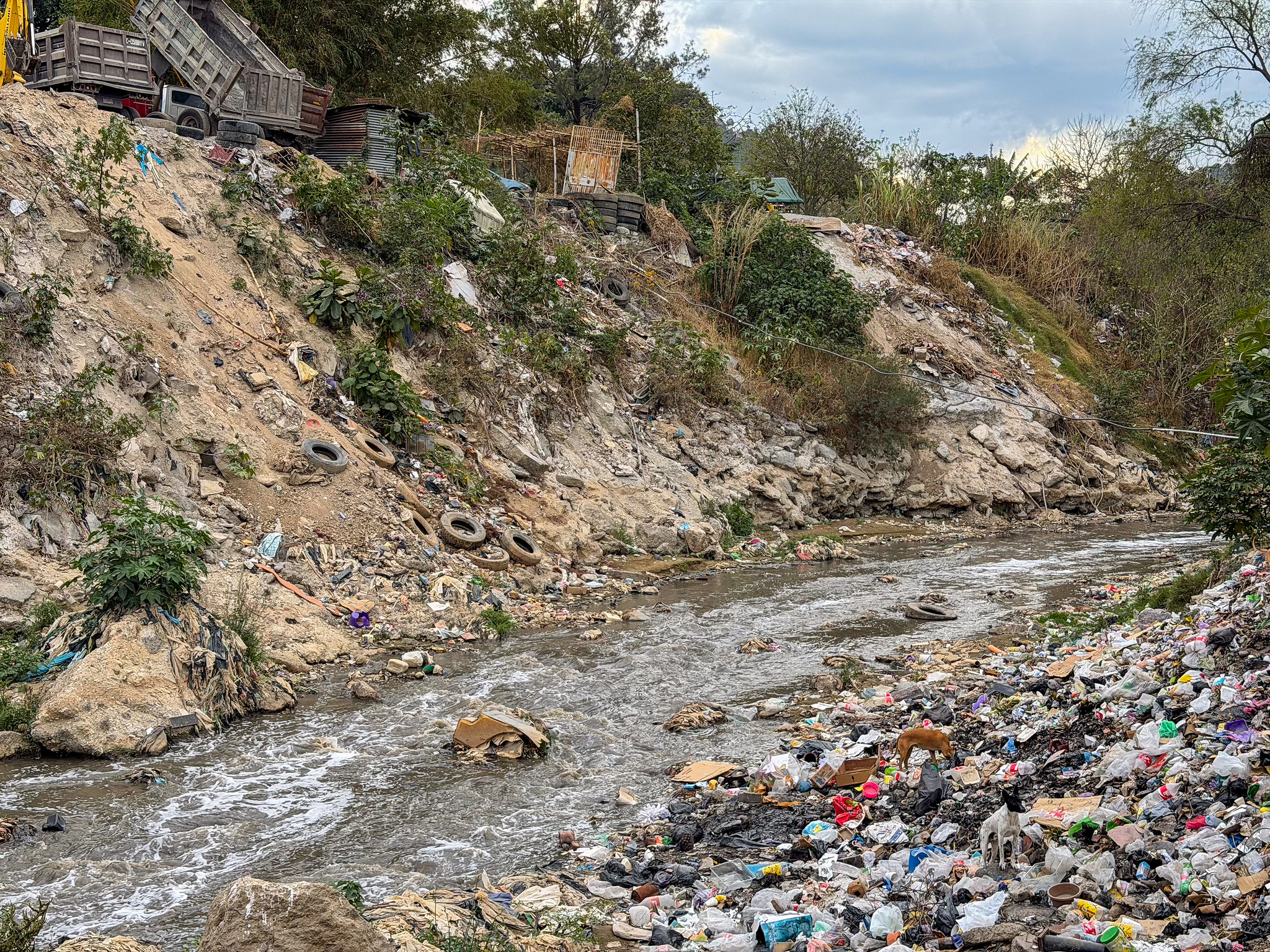
Photo: Mayela Sánchez García.
The situation extends beyond national borders. Every year, the Motagua River discharges some 20,000 metric tons of plastic into the Caribbean Sea, making it one of the rivers that contributes the most plastic pollution to the ocean worldwide, according to estimates contained in a 2025 report by the Inter-American Commission on Human Rights (IACHR).
The river flows into the Mesoamerican Reef at its mouth, so pollution also threatens to degrade one of the largest and most biodiverse transboundary reefs on the planet, which spans the territorial waters of Belize, Guatemala, Honduras, and Mexico.
In addition, the contaminated water reaches the coast of Honduras and spreads into Amatique Bay, located along the eastern coast of Guatemala, affecting the Caribbean Sea.
The roots of this chronic, cross-border problem are structural. Data from the Integrated Environmental Management of the Motagua River Basin project, funded by the United Nations Development Program (UNDP), show that in Guatemala, 66% of municipal solid waste is not collected, and there is no guarantee that the remaining 34% is disposed of properly. Furthermore, of all landfills nationwide, 88.32% are illegal or lack municipal authorization.
In other words, the core issues that need to be addressed are the mismanagement of solid waste and water resources in Guatemala; noncompliance with existing regulations on wastewater discharge and the disposal and treatment of solid waste and residues; and the lack of a water law.
The Poqomam Maya people's quest for justice
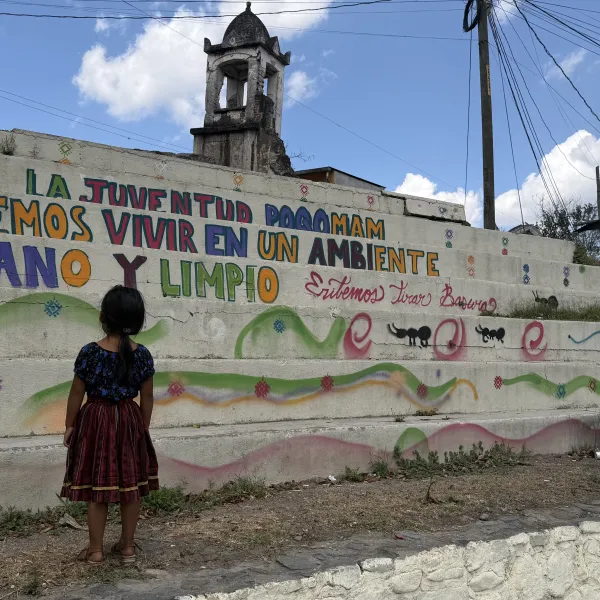
The rivers of Santa Cruz Chinautla, a community of the Poqomam Maya people located just twelve kilometers from Guatemala City, have become conduits of pollution that are degrading the Motagua River.
For decades, the local population has seen its health and livelihoods—including pottery, one of the main economic activities and a source of identity—damaged due to the lack of waste management in the municipality of Chinautla and the urban area of the country’s capital, as well as the activities of sand-mining companies.
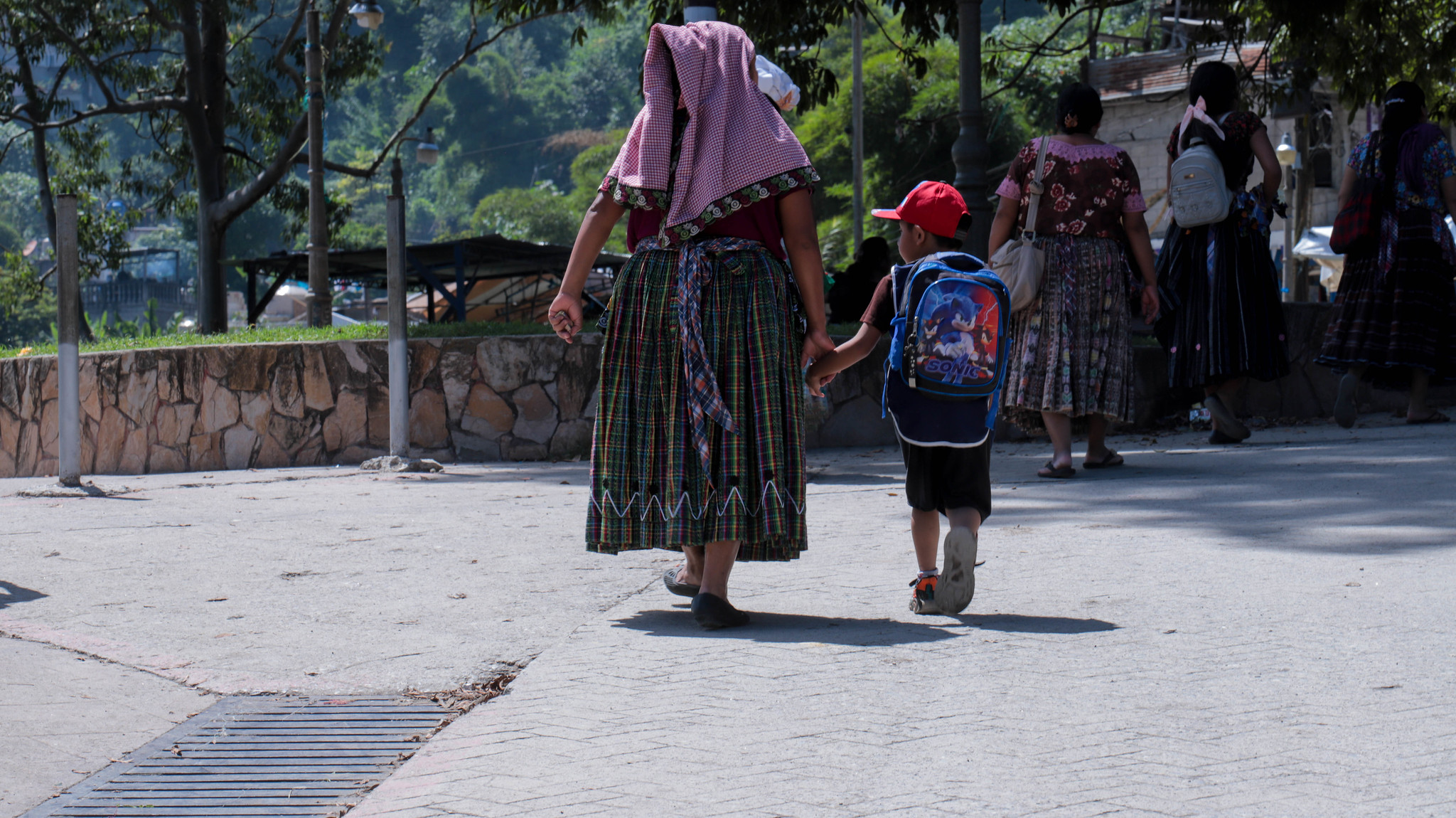
Photo: Mario Winter.
Voices for the Motagua River: Olga Vázquez.
Voices for the Motagua River: Nazario Pascual.
In early 2000, the Maya community organized to stop sand mining on their territory. At that time, the companies held mining permits that remained valid through 2021 and 2022. And although the permits expired, some companies continued to operate after requesting extensions. In June 2022, the indigenous authorities of the Poqomam people began a sit-in protest in front of the Piedrinera San Luis company, which they maintained for four years.
In July 2024, the Special Rapporteur on Economic, Social, Cultural, and Environmental Rights of the IACHR visited Santa Cruz Chinautla. During his visit, traditional authorities and community members spoke about the environmental, water-related, health, economic, and cultural impacts of the pollution in their rivers.
That same year, in October, the community—with support from AIDA, the Indigenous Peoples’ Law Firm, and partner organizations—filed a lawsuit (petition for amparo) against the municipality of Chinautla over its failure to take measures to address the contamination of its rivers and soil caused by improper solid waste management and the existence of illegal landfills.
AIDA’s scientific team, together with local residents and community authorities, collected key information on illegal landfills in the area. This community science initiative supported the litigation by highlighting the severity of the pollution, demonstrating the ongoing use of such practices, and providing evidence of the municipal authorities’ failure to fulfill their legal obligations regarding waste management.
Learn more about this community science initiative.
In June 2025, the Poqomam community won the support of the Guatemalan justice system when a constitutional court ordered the municipality of Chinautla to effectively address the claims in the lawsuit aimed at stopping the pollution of the rivers and soil in Santa Cruz Chinautla.
This is the first time a Guatemalan court has recognized a community's right to a healthy environment and its central role in finding solutions.
Find out the details of the legal victory.
Current situation
Since the ruling was issued, the municipality of Chinautla has held a series of “technical working groups” with representatives from the central government, civil society, and the community. A smaller group of technical experts was later created to develop a work plan with clear goals. Several months have passed without the municipality convening these working groups.
Furthermore, in December 2025, the IACHR noted in its report Human Rights Situation in Guatemala that the Motagua River basin is facing a severe pollution crisis that has had profound impacts on biodiversity and has resulted in systematic violations of the human rights of local communities, including the Maya Poqomam people.
And in May 2026, the Ministry of the Environment and Natural Resources revoked the license of the sand mining company Piedrinera San Luis for "failure to comply with environmental commitments."
AIDA continues to monitor the implementation of the court ruling to ensure the right to a healthy environment for the Poqomam Maya community and all those living in the Motagua River basin. Meanwhile, the residents of Santa Cruz Chinautla remain organized and mobilized to improve their environment and defend their rights.
Related projects
How to end the reign of plastic bags and learn to take care of our environment
By María José Veramendi Villa, senior attorney, AIDA, @MaJoVeramendi Some months ago my colleague at AIDA, Haydée Rodríguez, wrote an interesting post in this blog called Plastic bag? No thank you (Spanish only). I confess that it shocked me to read the post because although I had a general idea of the harmful effects of plastic bags on the environment, I didn’t realize the profound damage they can cause. This made me reflect on Peru, where plastic bags reign supreme, and where there is very little public awareness of their harmful impacts, that they poison and kill marine wildlife and pollute the environment, among other things. In most shops, almost all products are packed in plastic bags no matter how small. Some statistics An investigation entitled the Study on the Perceptions, Attitudes and Environmental Behavior regarding the Unnecessary Use of Plastic Bags was carried out in two districts of Lima. The results, published in a July 2012 article on the Ministry of the Environment's website (Spanish only), found that 94% of the businesses studied used plastic bags exclusively to package their consumer products, while 60% used between one to three plastic bags for every purchase and 36% used three to six. The article announced the launch of a campaign to reduce the use of plastic bags in the northwestern province of Piura, called “Healthy Living with Health Bags.” Other than this article, I couldn’t find any further public information on the campaign’s impact or whether it had changed people’s behavior, something that would have made it possible to gauge if the campaign had the potential to be replicated elsewhere in the country. The day to day In most Peruvian supermarket chains, plastic bag usage is exaggerated. Sometimes checkout assistants pack small items in separate plastic bags, generating a huge amount of unnecessary plastic. A few months ago I visited a well-known Lima supermarket and asked the clerk why they didn’t attempt to cut down on plastic bag usage. I suggested that the supermarket should charge money for plastic bags as an incentive for people to bring reusable bags made of cloth. He said, “Oh, if we did that people would stop coming… There are people who ask us to use more bags or double bags, and if we didn’t, they’d call us stingy.” Attitudes like this illustrate the disregard that various sectors of Peruvian society have for environmental protection. Biodegradable bags? In 2007, Peru’s largest supermarket chain, Grupo Wong, which owns the Wong and Metro supermarket chains and is now owned by Chile’s Cencosud, introduced the use of biodegradable bags, a practice then replicated by other supermarkets in the country. Wong bags come with a caption that reads, “This bag will biodegrade without leaving any contaminant residues.” The manufacture of the bags “includes a special additive that causes the bag to disintegrate into smaller pieces when it comes in contact with oxygen, sunlight and friction, a process which then allows microorganisms such as fungi or bacteria to feed on its remnants, converting the bag into water, biomass, salt minerals and carbon dioxide, just as we do when we exhale air,” Wong says on its website. A real alternative? The bags used by Wong supermarkets seem ordinary enough. The difference is the special additive ingredient that accelerates the disintegration of the bag. “This means that the plastic is broken down into smaller particles that are so small that you can’t see them. In the first phase, the waste cannot be assimilated with plants (Spanish only)”. Inapol, a Chilean maker of conventional and biodegradable plastic bags, says that while “a conventional plastic bag takes about 300 years to biodegrade, our bags that contain the special oxo-degradable additive reduces this time to approximately two years, depending on the external factors that accompany the process. Exchange of contaminants According to a European Bioplastics study, the additives in the oxo-biodegradable bags consist of chemical catalysts thatcontain transition metals like cobalt, magnesium and iron, among others. In this process the disintegration of the plastic bag is caused by a chemical oxidization of the plastic’s polymer chains, triggered by UV radiation or heat exposure. According to the study, the waste would eventually biodegrade in the second phase. The study points out that the breakdown of the biodegradable plastic bag is not a result of natural biodegradation but of a chemical reaction. The waste remnants remain in the environment, something that does not present an adequate solution to the problem. It only transforms visible waste particles into invisible contaminants. There have been significant advances and an increase in awareness in the business community on the need to take care of the environment. But doubts remain about the natural biodegradation of plastic bags such as those used by Wong supermarkets, and whether they present a real sustainable solution for the environment. As Peru is such a creative and perse country, why shouldn’t it adopt alternatives to plastic packaging such as reusable cloth bags and recycled materials, and employ their use across the country? Isn’t this something to think about? We must change our mentalities for things to improve. To paraphrase Haydée, we need to say, “No thank you” to plastic bags. We should learn to reuse and recycle so that we can take care of what we love and, above all, where we live.
Read moreThe UPOV Convention and the privatization of seeds: What’s at stake?
By Florencia Ortúzar, legal advisor, AIDA "Modern agriculture is not a system for producing food but for producing money"(Bill Mollison: Australian researcher, scientist, teacher, naturalist and the father of permaculture). Seeds are the beginning of life itself. They are the means of nature’s propagation and the building blocks of life. Patenting seeds hands their ownership rights to a select few, and this causes great resentment among many. What does all of this really mean? The UPOV: An international convention The International Union for the Protection of New Varieties of Plants (UPOV) is an intergovernmental organization whose objective is to grant intellectual property rights to “breeders.” That is, to people who have created or discovered new varieties of seeds. Some countries in the Americas have signed the UPOV Convention, which was established in Paris in 1961 and revised three times (the latest in 1991), and others are considering it. A seed needs to be considered a new variety in order to be patented. New varieties can be generated through the use of traditional techniques or genetic modification in laboratories. It is difficult to measure the possible ramifications of something so new and novel as the privatization of the life contained in a seed and, for good reason, many people are worried. The situation in Chile (and other countries): To join or not to join? Chile’s Congress is currently debating legislation known as the “Monsanto law” that, if passed, would implement the UPOV Convention and the ability to patent new seed varieties. This means that someone could alter the genetics of a native seed to become its inventor and owner. This would give them the right to sell it, charge a fee every time the seed is used, prohibit its trade in the market and draw up a contract dictating what farmers can and can’t do with the harvested product (for more information, you can listen to the interview (in Spanish) with the co-founder of the NGO Chile sin Transgénicos (Chile without Transgenics)). Proponents of the law argue that it is a necessary protection to encourage innovation in the country's agriculture sector. Concerns Making native seeds obsolete: What chance does a native seed have for survival competing against a seed that is genetically modified to be more productive and efficient? According to market rules, the “new” cultivated seeds will displace the native ones. Even worse, GM crops could easily contaminate the remaining natural varieties. Monopolies: Those with the resources to create new seeds, especially genetically modified ones, which are the most profitable, are typically the huge corporations that today dominate the production of GM foods, like Monsanto. If the seed patent system were authorized in Chile, these companies would get a free pass to take control of the country’s cropland as they have already done with great efficacy in Argentina. What is more, the most profitable companies would gain access to the country’s most arable land, expanding monoculture practices while also forcing less profitable seeds out of the market even if they are more nutritional. Seed exchange: The “Monsanto law” grants great power to the seed owner by binding the seed purchaser to a contract that controls the entire harvest and the new seeds that are generated. Traditional practices such as the propagation, sale, gift giving and exchange of seeds, customs as old as agriculture itself, would be prohibited. The law would strip farmers not only of an essential part of their job but also a key source of income: the sale of cultivated seeds. As a consequence, the farmer would lose power and identity and become a mere cog in the corporate machine. Genetically modified crops: To the benefit of big companies, we inevitably favor the entry of genetically modified foods, the products with the greatest economic return. While the adverse side effects of eating GM food are not yet officially known, it seems wise to err on the side of the precautionary principle and avoid uncontrolled testing on humans. The advent of this law would protect GM crops. Natural products, which are less economical but generally more nutritional, would be overtaken by more productive seeds. There are many reasons to treat GM foods with caution. Rather than helping to end world hunger, we have increased the use of pesticides, destroyed biopersity, caused inequality between farmers and contaminated native varieties of seeds. It also is dangerous for people’s health to live near GM crops, as has been proven in Argentina. Environmental impacts: By allowing seed monopolization, crops will become homogenized to achieve the most economic harvests. This will lead to monocultures, many of them pesticide-resistant seeds that will require the use of alarming amounts of agrochemicals. Of particular concern, a lack of persity means crops become less resilient and adaptable to environmental changes, including those associated with global warming (You can read here (in Spanish) an article about the problems Argentina is experiencing with the expansion of GM soy monoculture). Unforeseeable risks: If a country drastically changes its agricultural system, the risks are difficult to predict. It is possible that a company could incite a plague that would force desperate farmers its new seed that is resistant to the plague. Another risk is that farmers could be unfairly penalized for using patented seeds, especially if farmers have not been properly educated about the new legislation. Could farmers face lawsuits, convictions and the burning and seizure of their crops? Conclusion The implementation of the UPOV Convention threatens to drastically change an essential part of the natural cycle. The most dangerous aspect is that the global initiative is attracting more followers. It does not seem fair that a person can pay a fee for a seed that should never really be the creation of a person. Although the “breeder” could have changed a gene, it should not give him the right to copyright and control the rest of the seed’s genetic information. In Europe, only two countries have permitted the entry of GM crops. Chile has enormous potential to produce organic crops, and it could position itself successfully in the European market. But the Chilean authorities haven’t considered this as a possibility. The approval of the patent law on new seeds favors multinational seed monopolies, and this would allow the entry of GM crops that would displace and contaminate original varieties without the possibility of turning back. On the contrary, Peru recently passed a law banning the import and production of GM crops for 10 years. This is a good example to follow.
Read more
Declaration of Civil Society Organizations that Participated in the First Regional Forum on Business and Human Rights in Latin America and the Caribbean
The organizations signing the declaration regret that " the Forum was far from a plural confluence of diverse actors. In the seven panels that made up the two days of the event, 47 people participated, of which only 10% came from communities affected by business activities or human rights NGOs that work with such communities." Therefore, organizations "respectfully but emphatically call on the Working Group, the Human Rights Council, and the international community to correct the aforementioned problems and guarantee the adequate participation of civil society and groups of affected peoples, both in form as well as content, in the Second Global Forum on Business and Human Rights, which will take place in Geneva on December 2-4, 2013".
Read more