
Project
Foto: Andrés ÁngelStopping the spread of fracking in Latin America
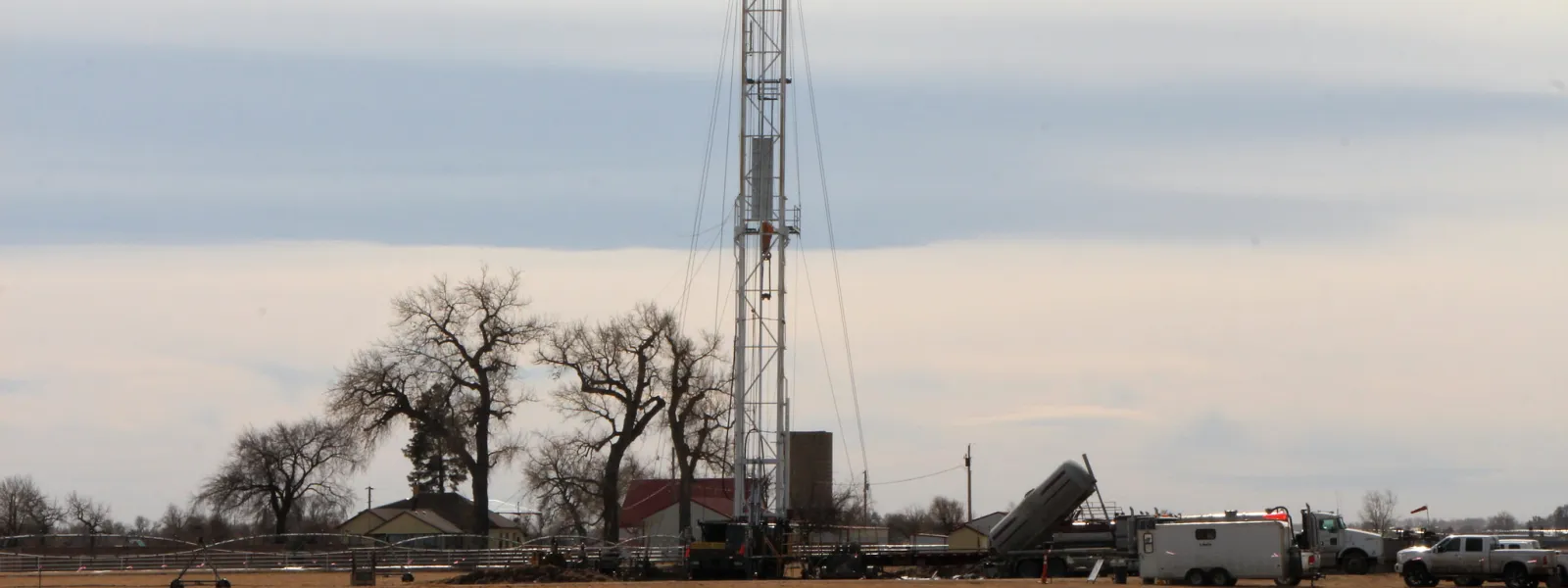
“Fracking” is short for hydraulic fracturing, a process used to extract oil and natural gas from historically inaccessible reservoirs.
Fracking is already widespread in the global North, but in Latin America, it is just beginning. Governments are opening their doors to fracking without understanding its impacts and risks, and without consulting affected communities. Many communities are organizing to prevent or stop the impacts of fracking, which affect their fundamental human rights. But in many cases they require legal and technical support.
What exactly is fracking, and what are its impacts?
A straight hole is drilled deep into the earth. Then the drill curves and bores horizontally, making an L-shaped hole. Fracking fluid—a mixture of water, chemicals, and sand—is pumped into the hole at high pressure, fracturing layers of shale rock above and below the hole. Gas or oil trapped in the rock rises to the surface along with the fracking fluid.
The chemical soup—now also contaminated with heavy metals and even radioactive elements from underground—is frequently dumped into unlined ponds. It may seep into aquifers and overflow into streams, poisoning water sources for people, agriculture, and livestock. Gas may also seep from fractured rock or from the well into aquifers; as a result, water flowing from household taps can be lit on fire. Other documented harms include exhausted freshwater supplies (for all that fracking fluid), air pollution from drill and pump rigs, large methane emissions that aggravate global warming, earthquakes, and health harms including cancer and birth defects.
AIDA’s report on fracking (available in Spanish) analyzes the viability of applying the precautionary principle as an institutional tool to prevent, avoid or stop hydraulic fracturing operations in Latin America.
Partners:

Related projects
A Guide for GCF Watch Coordinators
A publication for coordinators of GCF Watch, a civil society initiative from the global South aimed at improving monitoring of the Green Climate Fund (GCF), the world's leading multilateral climate finance institution. DOWNLOAD THE FULL GUIDEBasics of the Green Climate Fund (GCF)The Green Climate Fund (GCF) is the operating entity of the funding mechanism of the United Nations Framework Convention on Climate Change (UNFCCC). As such, it provides funding to developing countries for climate change mitigation and adaptation projects and programs.Read and downloadNational Designated Authorities and Green Climate Fund Focal PointsNational Designated Authorities (NDAs), Government institutions, and Focal Points (FPs) are responsible for all matters related to the Green Climate Fund (GCF) in developing countries. They represent the GCF and serve as a liaison or point of contact between the GCF and developing countries. Read and downloadFunding Proposals before the Green Climate FundProposals for project and program funding can be classified according to several criteria: type of access, public or private, amount of funds requested, and risk category.Read and downloadGuide to Reviewing a Funding Proposal before the Green Climate FundThe GCF Watch will consolidate all observations made by civil society before sending to the GCF Board. Your comments will be part of the message directly delivered to the Board!Read and downloadAccredited Entities before the Green Climate FundThe funding granted by the Green Climate Fund (GCF) is channeled through accredited entities (AEs), which are in charge of managing the resources and implementing the projects and programs. The AEs must ensure that projects and programs comply with GCF safeguards, as well as oversee compliance when implementation is the responsibility of executing entities.Read and downloadThe Independent Redress Mechanism (IRM)The Independent Redress Mechanism (IRM) was created to respond to complaints from individuals, groups or communities who feel that they have been adversely affected by projects or programs financed by the Green Climate Fund (GCF) due to non-compliance with its operational policies and procedures, including its environmental and social safeguards.Read and downloadGCF Watch: A Southern Civil Society-Led InitiativeThe platform aims to improve the monitoring of the operations of the GCF through collaboration between organizations working at the level of the GCF Board and organizations and communities in the region that are close to the territories where projects supported by the entity are implemented.Read and downloadGlossary of useful terms for monitoring the Green Climate FundRead and download
Read more
Reaction: IUCN Congress votes yes to a moratorium on deep-sea mining
Marseille, France - A motion calling for a moratorium on deep-sea mining was adopted with overwhelming support by the IUCN World Conservation Congress today. Among government and government agencies 81 voted for the moratorium with 18 against and 28 abstentions. Among NGOs and civil society organization the vote was 577 for, 32 against and 35 abstentions, sending a strong message to governments that there is global opposition to deep-sea mining. “We are very pleased to see so many governments, agencies and NGOs voting for a moratorium on deep-sea mining; the support has been overwhelming” said Matthew Gianni Co-Founder of the Deep Sea Conservation Coalition (DSCC). “Member countries of the ISA, including France which hosted this Congress, need to wake up and act on behalf of civil society and the environment now, and take action in support of a moratorium”. Scientists have warned that deep-sea mining will cause large-scale, irreversible biodiversity loss and ecosystem degradation if permitted to occur, particularly in the international areas of the world’s ocean. The International Seabed Authority (ISA), a multilateral regulatory body established under the UN Convention on the Law of the Sea in 1994, is debating whether to begin licensing commercial deep-sea mining in as little as two years. 167 countries plus the EU are members of the ISA. The German Environment Ministry, the government of Fiji and many other government agencies voted to support motion 069. Nauru has triggered a so-called Two Year rule at the ISA which it expects will result in the Authority issuing a commercial license to mine. 47 African countries have challenged the trigger and Sian Owen, Director of the DSCC says: "Hopefully the vote in Marseille will translate into a vote at the ISA to adopt a moratorium on deep sea mining." Motion 069 - Protection of deep-ocean ecosystems and biodiversity through a moratorium on seabed mining was sponsored by Fauna and Flora International and co-sponsored by Fundación MarViva (Costa Rica), Natural Resources Defense Council (USA), Sylvia Earle Alliance/Mission Blue (USA), Synchronicity Earth (UK), Wildlands Conservation Trust (South Africa), World Wide Fund for Nature – International. For further information Matthew Gianni, IUCN, 31 646 168 899 Sian Owen, IUCN, 31 648 502 659 Patricia Roy, 34 696 905 907
Read more
Climate change: are you part of the problem or part of the solution?
Last week, the IPCC published the first part of its sixth assessment on the global state of climate change (AR6), reflecting the latest scientific information. The existence and assessment of damage to the planet is not entirely new information for those of us who have been working in this field for decades. What’s new is the level of scientific certainty, the magnitude and scale of climate impacts, and the projections for our future. In short, the global situation today is worse than previously believed. As an attorney working for climate justice, the report is very disturbing, even frustrating. As a mom, it is devastating. I want the best for my children. Yet, despite having no responsibility for the climate disaster, their future will be determined by it and by the impacts that my generation, and previous ones, left them. This reality is shared by all children, as well as by millions of people and communities in the most vulnerable situations, who suffer the worst consequences of the climate crisis without having caused it. Faced with this bleak scenario, we can succumb to fear and depression, and be indifferent; or we can act. I choose to act. I decided to write this last column as co-executive director of AIDA, where I’ve had the honor of working for 18 years. I will highlight the most important findings of the IPCC, and explain the importance of differentiating responsibility for the climate crisis in order to move towards effective solutions. I consider these elements essential to crafting a complete picture of climate solutions. I invite you to renounce indifference and the (understandable) feeling of helplessness, defeat or frustration; and replace it instead with collective and effective action. Words matter, even in science. The IPCC report is blunt in concluding for the first time that it is "unequivocal" that the atmosphere, ocean and land have been affected by human influence. This was established by hundreds of scientists from around the world. Unequivocal means that there is no doubt, that something is incontrovertible, that it is unambiguous. Although it sounds obvious, it’s relevant to emphasize because, very recently, I heard presidents of countries responsible for the greatest emissions deny the existence or seriousness of the climate crisis. Such denial has cost us decades of progress. The IPCC also concluded that the temperature of the planet has increased, that "each of the last four decades has been successively warmer than any decade that has preceded it since 1850," and that the negative impacts on our planet are real, current and will become increasingly intense as temperatures and greenhouse gas (GHG) emissions continue to rise. The impacts suffered in Latin America and the Caribbean have cost us thousands of human lives, millions in losses, and displaced several thousand people, whose vulnerability is increasing. Yet the region continues to increasingly rely on fossil fuels, deforestation remains uncontrolled, and cities, where 80 percent of the population lives, are growing without planning and with severe air pollution. The IPCC identified the problem in cities as one of fundamental concern because the reduction of greenhouse gases and short-lived climate pollutants (SLCPs) could both help the climate and improve air quality (and, with it, public health). RESPONSIBILITY AND ACTION TOWARDS CLIMATE SOLUTIONS Solutions exist, but to implement them it is essential to understand the cause and magnitude of the climate crisis. This is the role and importance of the IPCC. On the other hand, it’s necessary to understand the source of emissions as well as those responsible for them, since not all people, entities and countries are equally responsible for this crisis. It is precisely the lack of climate responsibility that is one of the greatest challenges to finding solutions today. On the one hand, there are the governments, which despite international commitments like the Paris Agreement, have not yet translated them into ambitious and effective action. For example, governmental targets for Nationally Determined Contributions (NDC) remain far from the needed commitments. In fact, no country in Latin America has an NDC of the required level of ambition and effectiveness. On the other hand, there are companies that fail to acknowledge their responsibility, supported governments and an international community thus fair incapable of demanding they do so. This is essential not only because of ethical issues, but also de facto ones. According to scientific research, just 90 corporate entities are responsible for 63 percent of the global carbon dioxide and methane emissions from 1751 to 2010. And then, there is individual responsibility. According to the United Nations, the richest 1 percent of the population generates more than twice as many emissions as the poorest 50 percent. The inequality is evident: those who are least responsible for the climate crisis are those who are experiencing its impacts the most, as the UN has concluded in multiple reports. This lack of action has led affected communities, people and organizations to seek solutions through strategic litigation. With the intervention of the courts, there have been landmark climate decisions out of the Netherlands, Colombia and Pakistan, among others. This is what it means to see climate justice as a starting point to solving the climate crisis. Climate justice implies looking beyond the reduction of tons of CO2 other GHGs, and the beyond conservation of millions of hectares of forest. Climate justice is the search for comprehensive solutions—incorporating the perspective of human rights and the environment; putting people and communities at the center, with participatory and inclusive processes, and a gender perspective; seeking for those who have caused this crisis, emitting for decades, to assume their historical responsibility; and so that those who are suffering the most from the impacts, be compensated. This is the backbone of our work at AIDA, which we promote together with dozens of communities and organizations in Latin America, in coordination with colleagues from the Global South and the Global North. Today, the scientific evidence and the level of urgency demand that we finally change course to avoid a major debacle. It’s our decision, as a society, to either continue business as usual, ignoring the IPCC, or to finally pay attention and act comprehensively towards the climate justice that the planet requires of us. We have the information, the tools and the call of urgency. I am confident that we can make it happen and we will continue to work towards solutions. Each person, company and State can join in and decide to be part of the solution. Otherwise, they will continue to be part of the problem.
Read more