
Project
Shutterstock.
Pollution of the Motagua River in Guatemala: The Poqomam Maya people’s quest for environmental justice
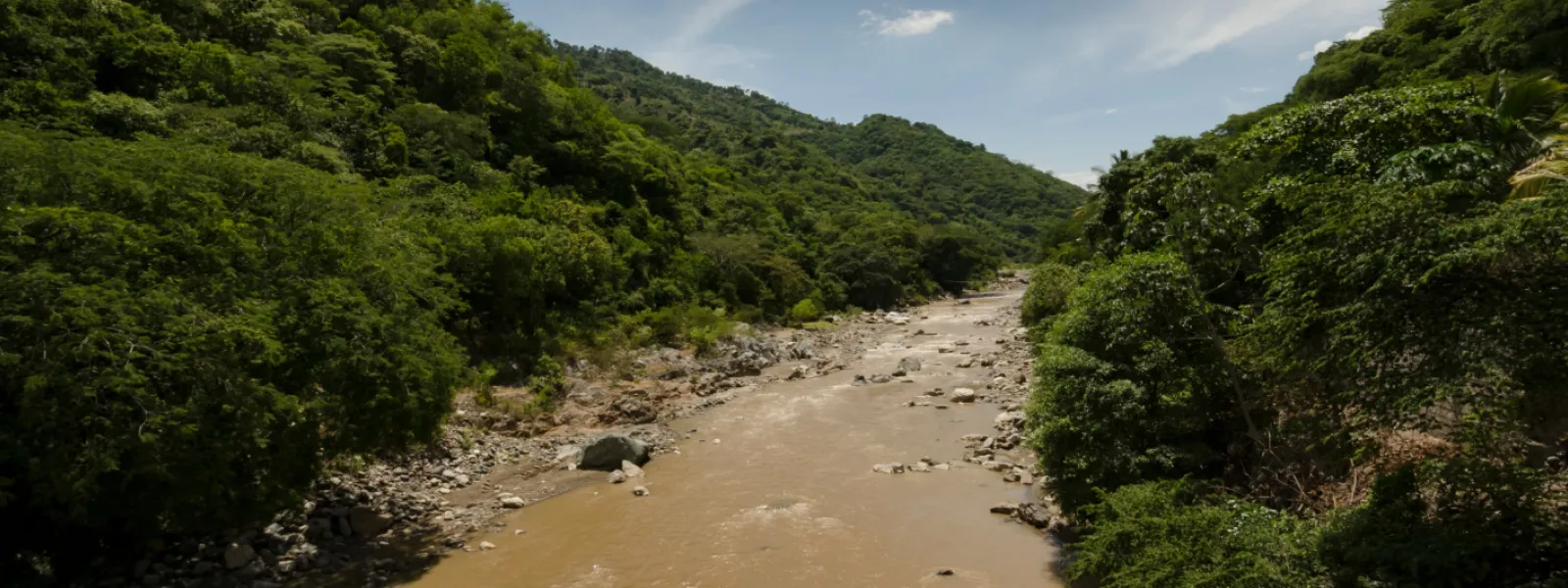
The Motagua River basin—Guatemala’s largest and most important river—is severely polluted with wastewater, solid waste, and other types of debris.
This is a cross-border issue because the Motagua’s polluted waters flow into the Caribbean Sea, reach the coast of Honduras, and threaten the Mesoamerican Reef System.
For decades, this has violated the rights to health, water, development, and a healthy environment of all the people living in the river basin.
In June 2025, the Poqomam Maya community of Santa Cruz Chinautla—supported by AIDA, the Indigenous Peoples’ Law Firm, and allied organizations—achieved an unprecedented legal victory to halt degradation in the basin. In response to the lawsuit it filed, a Guatemalan court ordered the municipality of Chinautla to comply with a series of obligations to curb the pollution of the area’s rivers and soil.
The government's response to the ruling has so far been limited to technical working group meetings. Meanwhile, the community continues to work toward the proper implementation of the ruling and to take other actions to defend its territory and its rights.
Background
The Motagua River, which is 486 km long, flows through 96 municipalities and 14 departments in Guatemala. It originates in Quiché, a department located in the northwest, and empties into the Caribbean Sea.
Polluting activities occur throughout the entire basin, including sub-basins and micro-basins. The largest volume of pollution comes from Guatemala City, the country’s capital, and is carried by the waters of the Las Vacas River, which in turn receives a large amount of waste from the Chinautla River.
The Chinautla River, which flows through the municipality of the same name, carries solid waste from a landfill located in Zone 3 of the capital—where trash from at least 14 municipalities in the department of Guatemala is dumped—as well as sewage generated by some 500,000 people living in the northern part of the capital, which undergoes no prior treatment.
Other sources of pollution include the numerous illegal dumps in the municipality of Chinautla, the waste that private vehicles and garbage trucks dump along the banks of its rivers, as well as the sand-mining companies—which began setting up operations in the area between 1996 and 1997—whose activities weaken the rivers' basins, causing solid waste to be more easily carried away by the river currents.
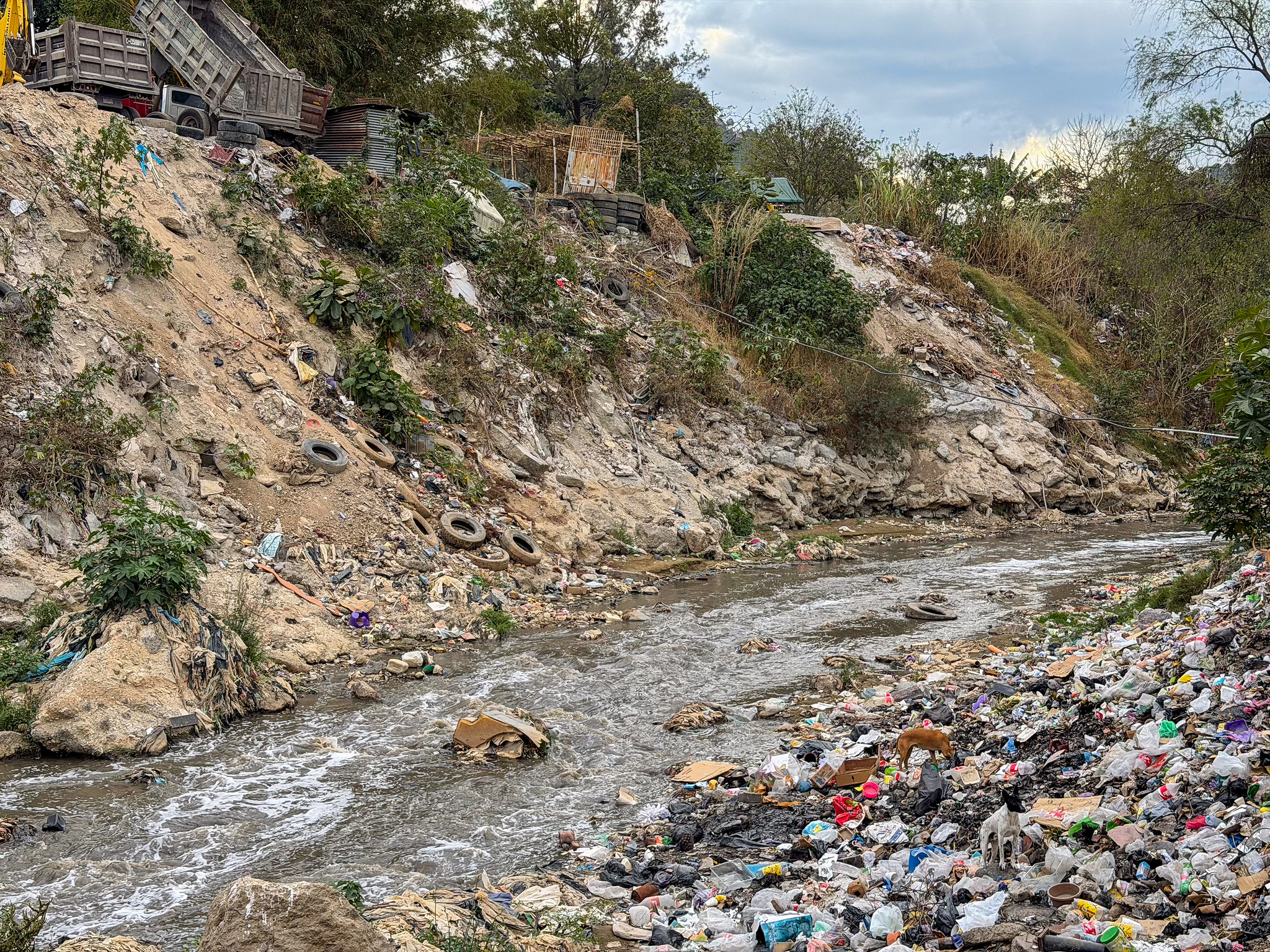
Photo: Mayela Sánchez García.
The situation extends beyond national borders. Every year, the Motagua River discharges some 20,000 metric tons of plastic into the Caribbean Sea, making it one of the rivers that contributes the most plastic pollution to the ocean worldwide, according to estimates contained in a 2025 report by the Inter-American Commission on Human Rights (IACHR).
The river flows into the Mesoamerican Reef at its mouth, so pollution also threatens to degrade one of the largest and most biodiverse transboundary reefs on the planet, which spans the territorial waters of Belize, Guatemala, Honduras, and Mexico.
In addition, the contaminated water reaches the coast of Honduras and spreads into Amatique Bay, located along the eastern coast of Guatemala, affecting the Caribbean Sea.
The roots of this chronic, cross-border problem are structural. Data from the Integrated Environmental Management of the Motagua River Basin project, funded by the United Nations Development Program (UNDP), show that in Guatemala, 66% of municipal solid waste is not collected, and there is no guarantee that the remaining 34% is disposed of properly. Furthermore, of all landfills nationwide, 88.32% are illegal or lack municipal authorization.
In other words, the core issues that need to be addressed are the mismanagement of solid waste and water resources in Guatemala; noncompliance with existing regulations on wastewater discharge and the disposal and treatment of solid waste and residues; and the lack of a water law.
The Poqomam Maya people's quest for justice
The rivers of Santa Cruz Chinautla, a community of the Poqomam Maya people located just twelve kilometers from Guatemala City, have become conduits of pollution that are degrading the Motagua River.
For decades, the local population has seen its health and livelihoods—including pottery, one of the main economic activities and a source of identity—damaged due to the lack of waste management in the municipality of Chinautla and the urban area of the country’s capital, as well as the activities of sand-mining companies.
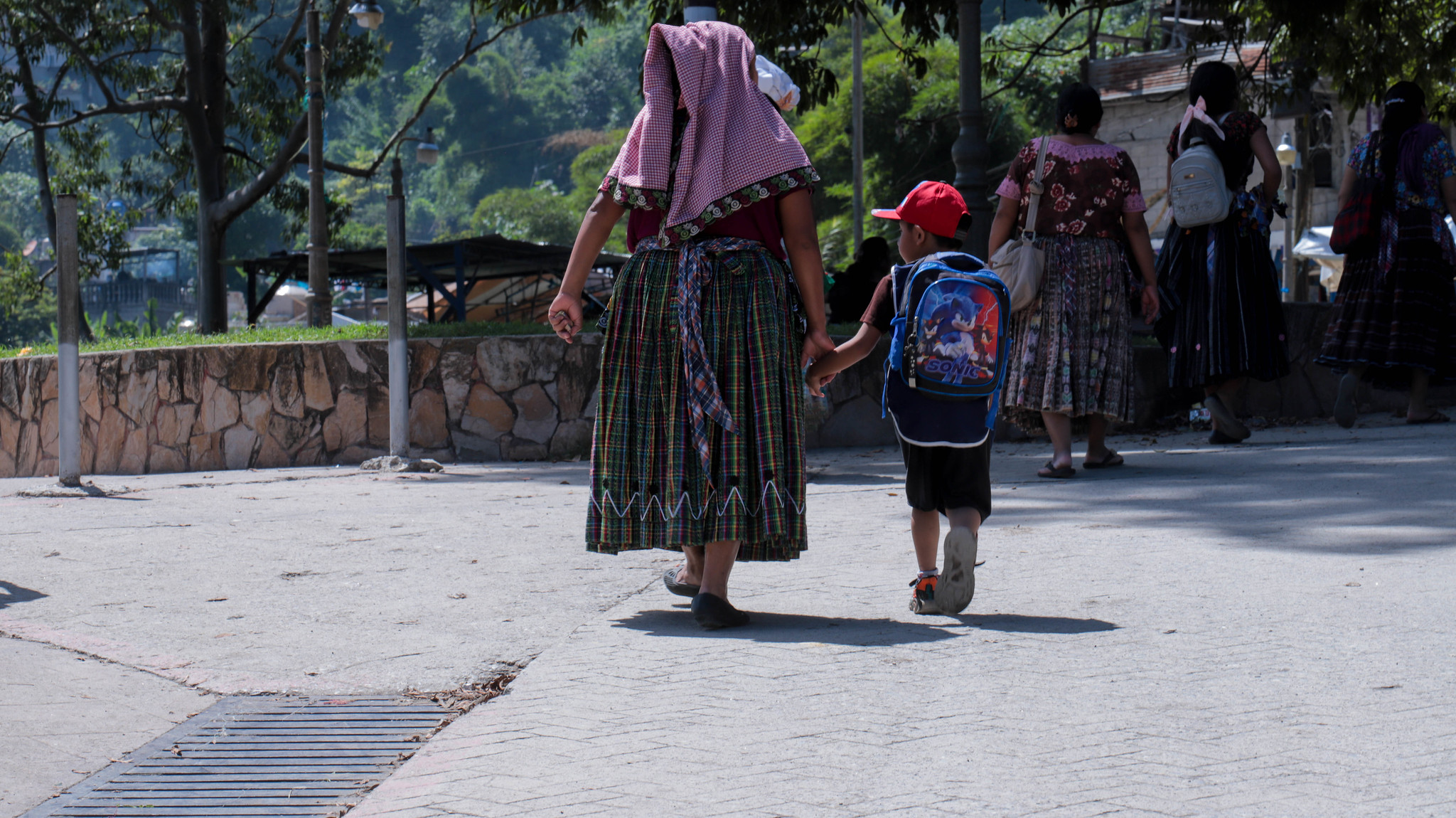
Photo: Mario Winter.
Voices for the Motagua River: Olga Vázquez.
Voices for the Motagua River: Nazario Pascual.
In early 2000, the Maya community organized to stop sand mining on their territory. At that time, the companies held mining permits that remained valid through 2021 and 2022. And although the permits expired, some companies continued to operate after requesting extensions. In June 2022, the indigenous authorities of the Poqomam people began a sit-in protest in front of the Piedrinera San Luis company, which they maintained for four years.
In July 2024, the Special Rapporteur on Economic, Social, Cultural, and Environmental Rights of the IACHR visited Santa Cruz Chinautla. During his visit, traditional authorities and community members spoke about the environmental, water-related, health, economic, and cultural impacts of the pollution in their rivers.
That same year, in October, the community—with support from AIDA, the Indigenous Peoples’ Law Firm, and partner organizations—filed a lawsuit (petition for amparo) against the municipality of Chinautla over its failure to take measures to address the contamination of its rivers and soil caused by improper solid waste management and the existence of illegal landfills.
AIDA’s scientific team, together with local residents and community authorities, collected key information on illegal landfills in the area. This community science initiative supported the litigation by highlighting the severity of the pollution, demonstrating the ongoing use of such practices, and providing evidence of the municipal authorities’ failure to fulfill their legal obligations regarding waste management.
Learn more about this community science initiative.
In June 2025, the Poqomam community won the support of the Guatemalan justice system when a constitutional court ordered the municipality of Chinautla to effectively address the claims in the lawsuit aimed at stopping the pollution of the rivers and soil in Santa Cruz Chinautla.
This is the first time a Guatemalan court has recognized a community's right to a healthy environment and its central role in finding solutions.
Find out the details of the legal victory.
Current situation
Since the ruling was issued, the municipality of Chinautla has held a series of “technical working groups” with representatives from the central government, civil society, and the community. A smaller group of technical experts was later created to develop a work plan with clear goals. Several months have passed without the municipality convening these working groups.
Furthermore, in December 2025, the IACHR noted in its report Human Rights Situation in Guatemala that the Motagua River basin is facing a severe pollution crisis that has had profound impacts on biodiversity and has resulted in systematic violations of the human rights of local communities, including the Maya Poqomam people.
And in May 2026, the Ministry of the Environment and Natural Resources revoked the license of the sand mining company Piedrinera San Luis for "failure to comply with environmental commitments."
AIDA continues to monitor the implementation of the court ruling to ensure the right to a healthy environment for the Poqomam Maya community and all those living in the Motagua River basin. Meanwhile, the residents of Santa Cruz Chinautla remain organized and mobilized to improve their environment and defend their rights.
Related projects
Statement on the murders of environmental defenders in Honduras and Brazil
Threats to, as well as the intimidation, harassment and murder of environmental defenders must stop now! Yesterday we learned of the senseless murder of Lesbia Yaneth Urquía Urquía, a defender of the environment and indigenous rights who fought against the construction of the Aurora I dam in La Paz, Honduras. In a similar tragedy in Brazil, last month authorities found the lifeless body of Nilce de Souza Magalhães, a recognized leader of the Movement of People Affected by Dams (MAB), who worked for the rights of Amazon communities affected by large dams, predatory fishing practices and other threats. Both instances reinforce a tragic trend in Latin America, a region home to seven of the ten most dangerous countries in the world for environmental defenders. According to Global Witness, 185 environmental activists were assassinated worldwide in 2015; two thirds of them were from Latin America. Now, more than ever, it’s time to call for accountability. Lesbia Yaneth worked in alliance with the Council of Popular and Indigenous Organizations of Honduras (COPINH), and her death comes just four months and four days after the assassination of the Council’s leader, Berta Cáceres. Nilce disappeared in January, her body finally discovered on June 21 in the lake formed by the Jirau dam, against which she had fought in defense of the rights of her community. Regarding these unfortunate deaths, María José Veramendi Villa, senior attorney of AIDA’s Human Rights and Environment Program, said: “The increasing rate of murder of environmental defenders in Latin America is alarming. States must guarantee a favorable environment in which people can safely perform their work to protect the natural world. States must also investigate and appropriately punish those responsible for these violent acts. The murders of those who bravely defend the environment must not go unpunished. Threats to, as well as the intimidation, harassment and murder of environmental defenders must stop now!”
Read more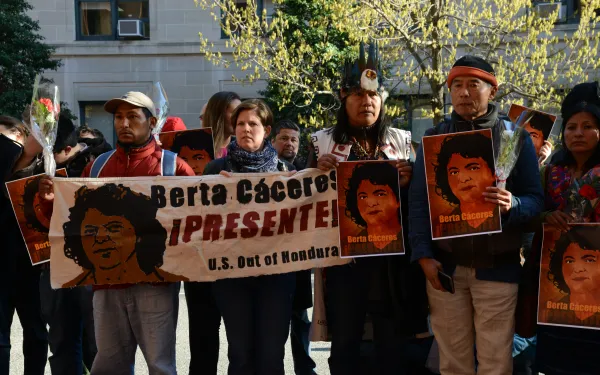
Activist Deaths Demand Accountability
Last year 185 environmental activists were murdered world-wide, two-thirds from Latin America, according to Global Witness. Of the ten most dangerous countries in the world for environmental defenders, seven are in Latin America. The brave activists we lost were killed for resisting mines, dams, and other destructive industrial projects. Now, more than ever, we must demand accountability. For the loss to the environment, the loss of indigenous cultures, the loss of human rights. That just got harder. On May 23 the Inter-American Commission on Human Rights announced a severe financial crisis leading to “suspension of [scheduled] hearings and imminent layoff of nearly half of its staff.” While the Commission has long been short on funds, this is the worst financial crisis it has ever seen. The Commission depends on funding from the Organization of American States (OAS), governments in the Americas and Europe, organizations, and foundations. Nearly all governments have decreased or failed to honor their financial commitments. The financial crisis demonstrates that our work, and the work of colleagues, communities, and movements, is having an impact. The Commission has produced important decisions in cases involving indigenous and community rights, land and environmental protection, and destructive development projects. For a few years countries have complained that the Commission is going beyond its mandate in cases involving development projects. But of course, when development projects violate human rights, they clearly fall within the purview of the Inter-American Human Rights System. The Belo Monte Dam case provides clear evidence that this manufactured crisis is a result of our effectiveness. In 2011 the Commission granted the precautionary measures our colleagues and we requested on behalf of affected indigenous communities. Brazil reacted by immediately withdrawing its ambassador to the OAS and by withholding funding for the rest of the year. A new ambassador did not return until 2015 and Brazil’s payments haven’t normalized since. In addition, after the precautionary measures were issued Brazil started an aggressive process to “reform” the Commission that ended by weakening its power. At AIDA we have analyzed how the crisis affects our cases before the Commission; how it affects future cases that need international attention; and how it affects human rights protection in the Americas. Current cases will likely be delayed. Our case on toxic poisoning in La Oroya, Peru is already seriously delayed. The Commission has promised to release a report on the merits so the case can be taken to the next level, the Inter-American Court of Human Rights. We have been told the Commission will approve the report, which has been completed, this year—despite losing 40% of its staff. This remains to be seen. Of course, we have contacted the Commission and stressed the importance of advancing the case. Informally, some judges from the Inter-American Court have indicated their eagerness to receive the case. Processing the Belo Monte case has only just started, after pending four years at the Commission. Strong political pressure from Brazil will likely delay it further. But political pressure on Brazil and the Commission can help the case move faster. As Belo Monte is linked to the biggest corruption scandal in Brazil, maybe the Commission will understand how relevant it is to advance the case. We will continue advocating for priority processing. New cases require further evaluation. We plan to bring at least one new case to the Commission soon, because unless we meet a deadline in a few weeks, the statute of limitations will prevent its consideration. All domestic remedies have been pursued; the Commission represents the last chance for justice. Despite the uncertainties of the current situation, it is important to preserve our clients’ rights in case the Commission’s funding is brought back to an adequate level. In other cases, we are looking for different ways to achieve justice. For example, we are exploring more than ever the use of national courts and national authorities. In addition, we are looking for new ways to engage financial institutions to prevent funding of projects that harm the environment and human rights. We are working with other organizations to develop response strategies. One of our attorneys, Rodrigo Sales, a Brazilian lawyer, recently represented AIDA at the General Assembly of the OAS. He advocated for human rights solutions in the region, among other issues. We consider collaboration and cooperation among the human rights and environmental communities to be essential. We need to stand together, showing governments and the public that human rights and the Commission are of vital importance. The financial crisis of the Commission—an international entity for hearing and resolving hemispheric human rights concerns—is an urgent issue that requires common understanding, thinking, strategizing, and acting. AIDA is working to make this happen.
Read more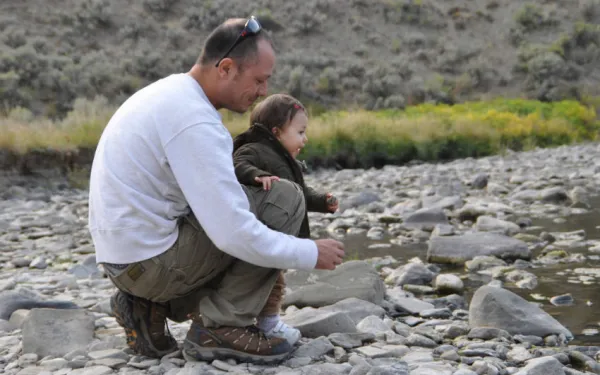
The love of nature, a lesson from father to daughter
By Aida Navarro, AIDA Communications and Human Resources Advisor On Father’s Day, I’d like to share the vision that my daughter Constanza has of her father. At AIDA we celebrate all the fathers who instill in their children a profound love for nature. We share your desire for all children to inherit a healthy planet on which environmental justice thrives. We also celebrate all the lawyers, like those on our team, who fight daily to defend the environment and human rights. We firmly believe that the love of our natural world begins in the cradle. I was barely a year old when my dad took me to one of the most magical places on Earth: Yellowstone National Park, the world’s first protected area. Nature and all the special creatures that live in it have enveloped my childhood ever since. When my teachers at school asked me what my father did for a living, I proudly told him that he is a defender of the planet. In his office, the walls are lined with photos of animals. My favorite is the white shark, which he took in a place called Guadalupe Island, where he’ll take me when I’m older. Every night I choose a book about sharks to read at bedtime. I already know the names of most species of sharks and I know what I must do to protect them. My dad Fernando says that being an environmental attorney is hard sometimes because he has to fight against people that do things to destroy the planet. Attorneys, he said, have to study a lot, know a lot of laws and use their brains to find ways to avoid damage to people and the environment. My mom knows a lot of lawyers who do the same work as my dad. She works with them in an organization that shares her name: AIDA. She helps them so that other people know what the organization does and can help them to defend nature. A Passing Dream I’m not sure if my memories of Yellowstone are real or if they’re all mixed up with photographs and the stories I’ve heard. I remember seeing a huge herd of buffalo out of the car window. They were so close I could smell them. I remember how patient my dad was when we was waiting to take a photo of a group of wolves that looked just like the tattoo on his arm. I can almost still smell the forest and hear the funny sounds that the squirrels make. I remember how amazing it was to discover, beneath the bark of trees, entire worlds so hidden from the gaze of us giants. Among so many other things, on that trip I learned to climb trees and throw stones, important skills for a young girl like me. I remember a mama bear with her two cubs crossing the road right in front of us. All of us in cars smiled an unforgettable smile and waited patiently for the animals to pass. My dad waited for me to grow a little bigger before he took me to meet the giants he had told me so much about: the grey whales. We drove for many hours. On the way, we stopped to walk among giant cactuses that grew up among the rocks. It was very hot and my dad told me about all the animals that lived in the desert. When we finally arrived to where we were going, we got on a small boat. We shouted with joy and excitement when a whale swam up and played with us as if we were a little toy boat in a bathtub. My dad held me tight in his arms as I stretched out to touch the whale. Her skin felt thick and airy, like those inflatable castles I love to jump in. I didn’t like it when the whale blew into my face; it smelled like fish! Living with Nature Even though he grew up in Mexico City, one of the biggest cities in the world, my parents chose to live in a much quieter place, on the Baja California peninsula. The view of the ocean delights every sunrise. We breathe clean air. In the mornings, my dad takes me to school down a long dirt road. On the way there, I like to greet a honey-colored horse that rests beneath a tree. At school, we have chickens and guinea pigs. We make compost, plant vegetables, run between trees and listen to birdsongs. It’s so much fun. When my dad travels, I miss him a lot, but I’m so happy that he’s out there saving the whales, dolphins and turtles. “Save so many dolphins,” I tell him when we talk on the phone. I imagine him as a super hero sailing in distant seas to rescue animals trapped in nets that fishermen forgot, or animals that would die from eating plastic they confused with food. I don’t want them to kill the animals. I think that when I’m older, I’ll be a veterinarian, or maybe a lawyer like my dad. That way I can defend the bears, sharks, trees and rivers; and also the children who have lost their homes to floods, or don’t have clean water to drink. Now that I’m almost five years old, I want my cake to have animals in danger of extinction on it... or maybe reptiles! I have so many unforgettable memories of Yellowstone, and even more photos, but the best memory, the one that still floods his face with happiness, is that on this trip I learned to say, “dad.”
Read more