
Project
Shutterstock.
Pollution of the Motagua River in Guatemala: The Poqomam Maya people’s quest for environmental justice
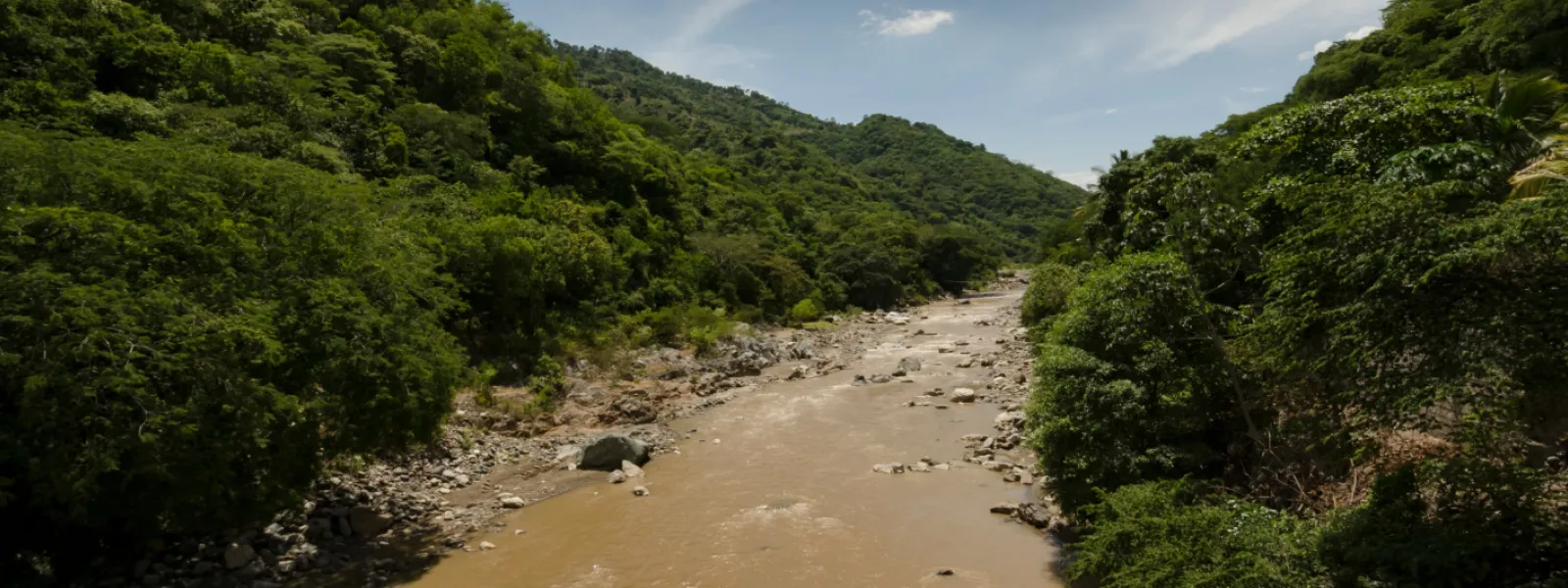
The Motagua River basin—Guatemala’s largest and most important river—is severely polluted with wastewater, solid waste, and other types of debris.
This is a cross-border issue because the Motagua’s polluted waters flow into the Caribbean Sea, reach the coast of Honduras, and threaten the Mesoamerican Reef System.
For decades, this has violated the rights to health, water, development, and a healthy environment of all the people living in the river basin.
In June 2025, the Poqomam Maya community of Santa Cruz Chinautla—supported by AIDA, the Indigenous Peoples’ Law Firm, and allied organizations—achieved an unprecedented legal victory to halt degradation in the basin. In response to the lawsuit it filed, a Guatemalan court ordered the municipality of Chinautla to comply with a series of obligations to curb the pollution of the area’s rivers and soil.
The government's response to the ruling has so far been limited to technical working group meetings. Meanwhile, the community continues to work toward the proper implementation of the ruling and to take other actions to defend its territory and its rights.
Background
The Motagua River, which is 486 km long, flows through 96 municipalities and 14 departments in Guatemala. It originates in Quiché, a department located in the northwest, and empties into the Caribbean Sea.
Polluting activities occur throughout the entire basin, including sub-basins and micro-basins. The largest volume of pollution comes from Guatemala City, the country’s capital, and is carried by the waters of the Las Vacas River, which in turn receives a large amount of waste from the Chinautla River.
The Chinautla River, which flows through the municipality of the same name, carries solid waste from a landfill located in Zone 3 of the capital—where trash from at least 14 municipalities in the department of Guatemala is dumped—as well as sewage generated by some 500,000 people living in the northern part of the capital, which undergoes no prior treatment.
Other sources of pollution include the numerous illegal dumps in the municipality of Chinautla, the waste that private vehicles and garbage trucks dump along the banks of its rivers, as well as the sand-mining companies—which began setting up operations in the area between 1996 and 1997—whose activities weaken the rivers' basins, causing solid waste to be more easily carried away by the river currents.
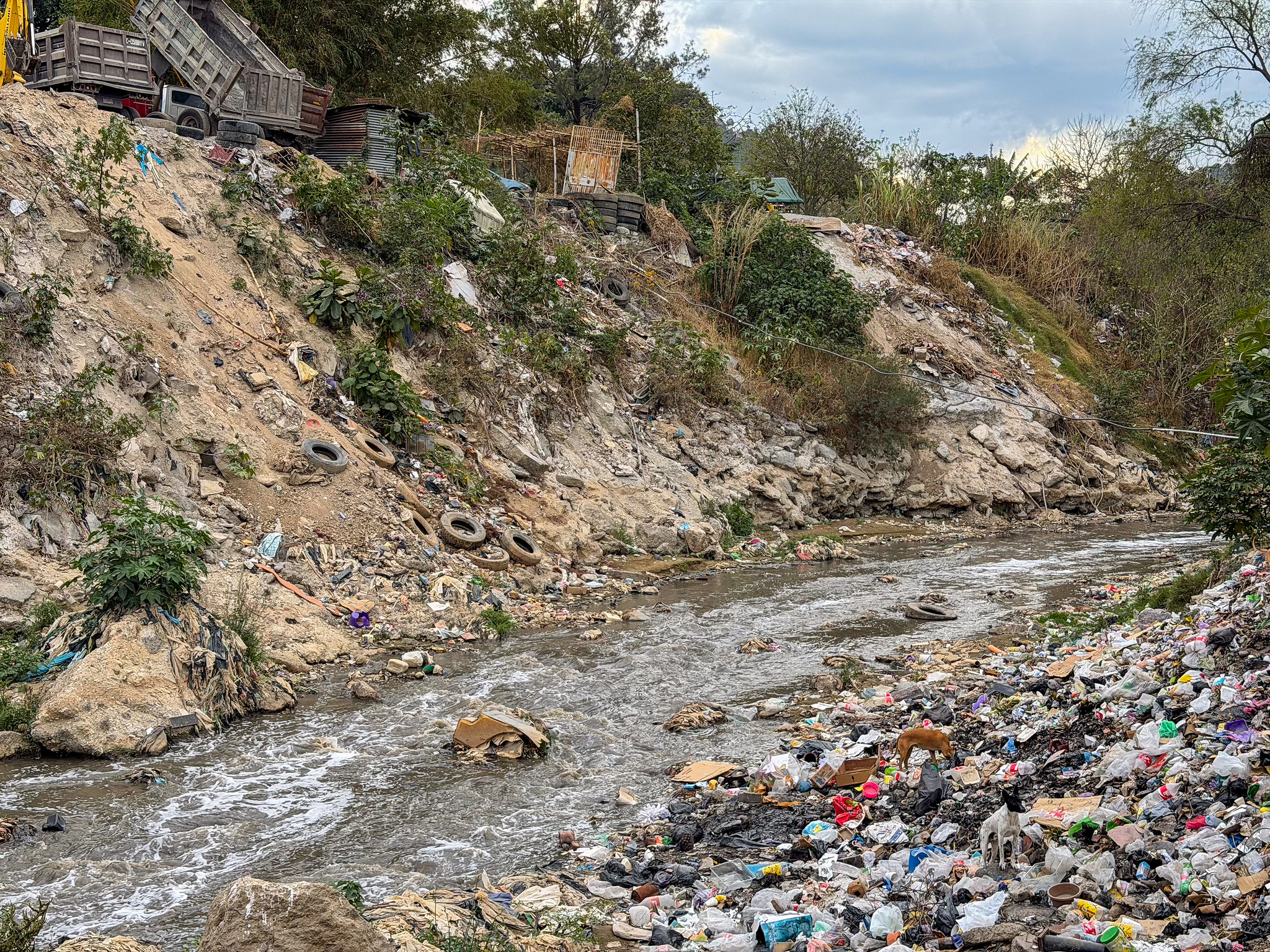
Photo: Mayela Sánchez García.
The situation extends beyond national borders. Every year, the Motagua River discharges some 20,000 metric tons of plastic into the Caribbean Sea, making it one of the rivers that contributes the most plastic pollution to the ocean worldwide, according to estimates contained in a 2025 report by the Inter-American Commission on Human Rights (IACHR).
The river flows into the Mesoamerican Reef at its mouth, so pollution also threatens to degrade one of the largest and most biodiverse transboundary reefs on the planet, which spans the territorial waters of Belize, Guatemala, Honduras, and Mexico.
In addition, the contaminated water reaches the coast of Honduras and spreads into Amatique Bay, located along the eastern coast of Guatemala, affecting the Caribbean Sea.
The roots of this chronic, cross-border problem are structural. Data from the Integrated Environmental Management of the Motagua River Basin project, funded by the United Nations Development Program (UNDP), show that in Guatemala, 66% of municipal solid waste is not collected, and there is no guarantee that the remaining 34% is disposed of properly. Furthermore, of all landfills nationwide, 88.32% are illegal or lack municipal authorization.
In other words, the core issues that need to be addressed are the mismanagement of solid waste and water resources in Guatemala; noncompliance with existing regulations on wastewater discharge and the disposal and treatment of solid waste and residues; and the lack of a water law.
The Poqomam Maya people's quest for justice
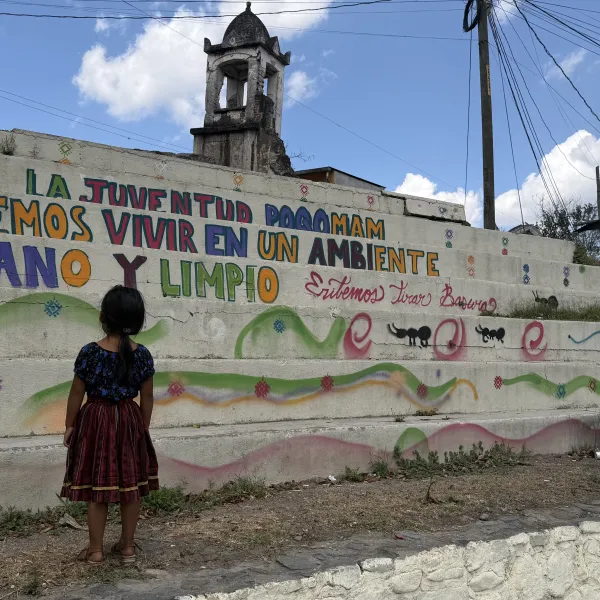
The rivers of Santa Cruz Chinautla, a community of the Poqomam Maya people located just twelve kilometers from Guatemala City, have become conduits of pollution that are degrading the Motagua River.
For decades, the local population has seen its health and livelihoods—including pottery, one of the main economic activities and a source of identity—damaged due to the lack of waste management in the municipality of Chinautla and the urban area of the country’s capital, as well as the activities of sand-mining companies.

Photo: Mario Winter.
Voices for the Motagua River: Olga Vázquez.
Voices for the Motagua River: Nazario Pascual.
In early 2000, the Maya community organized to stop sand mining on their territory. At that time, the companies held mining permits that remained valid through 2021 and 2022. And although the permits expired, some companies continued to operate after requesting extensions. In June 2022, the indigenous authorities of the Poqomam people began a sit-in protest in front of the Piedrinera San Luis company, which they maintained for four years.
In July 2024, the Special Rapporteur on Economic, Social, Cultural, and Environmental Rights of the IACHR visited Santa Cruz Chinautla. During his visit, traditional authorities and community members spoke about the environmental, water-related, health, economic, and cultural impacts of the pollution in their rivers.
That same year, in October, the community—with support from AIDA, the Indigenous Peoples’ Law Firm, and partner organizations—filed a lawsuit (petition for amparo) against the municipality of Chinautla over its failure to take measures to address the contamination of its rivers and soil caused by improper solid waste management and the existence of illegal landfills.
AIDA’s scientific team, together with local residents and community authorities, collected key information on illegal landfills in the area. This community science initiative supported the litigation by highlighting the severity of the pollution, demonstrating the ongoing use of such practices, and providing evidence of the municipal authorities’ failure to fulfill their legal obligations regarding waste management.
Learn more about this community science initiative.
In June 2025, the Poqomam community won the support of the Guatemalan justice system when a constitutional court ordered the municipality of Chinautla to effectively address the claims in the lawsuit aimed at stopping the pollution of the rivers and soil in Santa Cruz Chinautla.
This is the first time a Guatemalan court has recognized a community's right to a healthy environment and its central role in finding solutions.
Find out the details of the legal victory.
Current situation
Since the ruling was issued, the municipality of Chinautla has held a series of “technical working groups” with representatives from the central government, civil society, and the community. A smaller group of technical experts was later created to develop a work plan with clear goals. Several months have passed without the municipality convening these working groups.
Furthermore, in December 2025, the IACHR noted in its report Human Rights Situation in Guatemala that the Motagua River basin is facing a severe pollution crisis that has had profound impacts on biodiversity and has resulted in systematic violations of the human rights of local communities, including the Maya Poqomam people.
And in May 2026, the Ministry of the Environment and Natural Resources revoked the license of the sand mining company Piedrinera San Luis for "failure to comply with environmental commitments."
AIDA continues to monitor the implementation of the court ruling to ensure the right to a healthy environment for the Poqomam Maya community and all those living in the Motagua River basin. Meanwhile, the residents of Santa Cruz Chinautla remain organized and mobilized to improve their environment and defend their rights.
Related projects
Colombian Constitutional Court Admits AIDA's Complaint Against Mining Code (Spanish Text Only)
CORTE CONSTITUCIONAL ADMITE NUEVA DEMANDA CONTRA CÓDIGO DE MINAS PARA DEFENDER EL PRINCIPIO DE PRECAUCIÓN FRENTE A LAS ACTIVIDADES MINERAS PARA PUBLICACIÓN INMEDIATA CONTACTOS: Jerónimo Rodríguez, AIDA, Tel. (571) 2681804 Andrés Idarraga, CENSAT, Tel. (571) 2440581 [email protected] [email protected] BOGOTÁ, 20 de mayo de 2009.- La Corte Constitucional colombiana admitió esta semana la acción de inconstitucionalidad presentada por la Asociación Interamericana para la Defensa del Ambiente (AIDA), CENSAT – Agua Viva, el Observatorio de Conflictos Ambientales de la Universidad de Caldas y la Corporación Gestión por los Intereses Ambientales y Públicos (Iniciativa GESAP) contra los artículos 203 y 213 del Código de Minas, que permiten el uso de los recursos naturales para la exploración minera sin licencia ambiental y limitan las causales por las que las autoridades ambientales pueden negar una licencia ambiental para actividades mineras. Los artículos del Código de Minas demandados violan la Constitución de Colombia y la legislación ambiental internacional. Estos artículos priorizan la actividad minera sobre la protección ambiental, al punto de limitar las capacidades de las propias autoridades para verificar las condiciones de la explotación, y eventualmente autorizar la exploración y explotación con condiciones que sean ambientalmente sostenibles. Por esto, se violan entre otros, los principios de desarrollo sostenible y el principio de precaución que son parte fundamental de nuestra legislación. “Reconocemos que la minería es una industria importante para nuestro país, pero también lo es la protección de los recursos naturales, que garantizan la existencia misma de la especie humana en la actualidad y en el futuro. Por esto solicitamos a la Corte que aplique el principio de desarrollo sostenible reconocido en nuestra Constitución para que la minería se implemente sin la generación de daños severos e irreversibles a zonas estratégicas, como los páramos, y de las que dependen muchas comunidades”, señaló Jerónimo Rodríguez, asesor legal de AIDA en Colombia. Esta demanda se une a la presentada por AIDA y otros contra el artículo 34 del Código de Minas, que está pendiente de sentencia por la Corte Constitucional Colombiana. Ambas demandas recogen e insisten sobre las preocupaciones del Ministerio de Ambiente y de la Procuraduría General de la Nación frente a los efectos de las actividades mineras en el ambiente y la necesidad imperiosa de control, sin debilitar aún más las normas. “Buscamos con esta demanda de inconstitucionalidad la efectiva protección al ambiente y que el uso ocasional o transitorio de los recursos naturales en las actividades de exploración deba evaluarse por las autoridades ambientales. Además que las licencias ambientales no estén limitadas por causales formales, sino que las autoridades ambientales puedan, cuando sea necesario para protección ambiental y del interés público, negar licencias para la minería en aplicación del principio de precaución y de normas ambientales aplicables”, concluyó Rodríguez. AIDA es una ONG legal ambiental hemisférica que trabaja para fortalecer la capacidad de las personas para garantizar su derecho individual y colectivo a un ambiente sano por medio del desarrollo, aplicación y cumplimiento efectivo de la legislación nacional e internacional. Entre otros temas, AIDA prioriza la protección del derecho al agua y asegurar recursos de agua dulce adecuados para las comunidades y los ecosistemas.
Read moreCosta Rican Court Orders Expropriation Of Land Slated For Tourism Development In The Leatherback Marine National Park
For immediate release: May 14, 2008 Press contacts: Rolando Castro, Attorney, CEDARENA Gladys Martínez, Attorney, AIDA (506) 2837080, [email protected] (506) 2837080, [email protected] COSTA RICAN COURT ORDERS EXPROPRIATION OF LAND SLATED FOR TOURISM DEVELOPMENT IN THE LEATHERBACK MARINE NATIONAL PARK SAN JOSÉ— On May 5th, the Constitutional Chamber of the Supreme Court of Justice of Costa Rica ordered the Ministry of Environment and Energy (MINAE) to begin expropriating private lands slated for tourism development within the Leatherback Marine National Park (LMNP) in Guanacaste. This decision follows a lawsuit filed in March 2005 by AIDA and its participating organizations in Costa Rica, the Center for Environmental Law and Natural Resources (CEDARENA), and Justice for Nature (JPN). The complaint alleged that the National Environmental Technical Secretary (SETENA), the Municipality of Santa Cruz, the Ministry of Finance, and MINAE violated the constitutional right to a healthy and ecologically balanced environment by not protecting the LMNP and the nesting sites of the leatherback turtle located therein. This is a very important precedent in Costa Rica and the hemisphere, given that tourism development is proceeding at an unprecedented pace throughout the Americas. The Municipality of Santa Cruz and SETENA had issued construction permits within the park, ignoring the impacts that tourism development would have upon the leatherback turtles. With this decision, these permits are now invalid. “We hope that the Municipality and SETENA have received a clear message that they must take extreme caution with regard to national parks, and not approve projects that endanger what the parks were created to protect,” stated Rolando Castro, an attorney for CEDARENA. “Construction and operation of tourist sites within the LMNP would aggravate existing threats to the beach,” he added. Leatherback turtles are animals from the Jurassic age that have been declared an endangered species on the international level. They require particular nesting conditions that can be easily disturbed by the presence of human beings and construction lights. Hence, the development of tourist sites can severely affect the turtles’ reproduction, and consequently, their survival. The Leatherback Marine National Park has become the most important nesting site for this species in the Western Pacific Ocean. “MINAE should immediately heed this order to prevent the destruction that has occurred at other Costa Rican nesting beaches, such as Flamingo and Tamarindo,” affirmed Gladys Martinez, AIDA attorney. “All authorities within the Costa Rican government have an obligation to protect this species, which is part of our common patrimony, in addition to being a tourist attraction and hence a valuable economic resource for the country,” she added.
Read moreConstitutional Court Orders Change in Environmental License for Baba Dam, Ecuador
CONSTITUTIONAL COURT ORDERS CHANGE IN ENVIRONMENTAL LICENSE FOR BABA DAM, ECUADOR FOR IMMEDIATE PUBLICATION: CONTACTS: Silvana Rivadeneira (593 3) 2 459822 Astrid Puentes, AIDA (5255) 5212-0141 [email protected] [email protected] Quito, January 8, 2009 - The Constitutional Court of Ecuador ordered the country's Ministry of Environment to review and reformulate the environmental authorization granted to Baba's Multi-purpose Project (PMB), and the Attorney-General to audit the procedures and the approval of the environmental impact evaluations. According to the court's decision, there are risks of severe, irreparable damage to the Ecuatorian biodiversity that weren't properly assessed, in accordance with the conclusions of the Inter-American Development Bank experts. This resolution from Ecuador's highest court is a consequence of the lawsuit promoted by ECOLEX in May, 2007, which was rejected by the initial judge. ECOLEX then appealed to the Constitutional Court, insisting that it consisted in a violation of the human rights to a safe environment, to water, to property, to work, and to food, among others. Last June AIDA and the international organizations International Rivers and FIAN International supported the appeal through an amicus curiae document, denouncing the violations to international environmental standards and human rights, all of those binding the State of Ecuador. In addition to that, experts from the US organization ELAW also had mentioned serious mistakes in the study. The Constitutional Court's decision effectively recognized that the lack of a adequate evaluation violated the previously mentioned rights, as well as the principle of environmental caution. Silvana Rivadeneira, from ECOLEX, stated that "the decision is a great triumph to the affected communities and to the country, since it reinforces that the environmental protection is also a matter of national interest." The PMB would have implied in the flooding of more than 2.500 acres of important ecosystems at the province of Los Rios, affecting the river populations of the Baba Quevedo Vinces river and the habitat of endangered species such as the rascón bird, the small deer and chaleco's ant-eating bear. The project was authorized by the Ministry of Environment in November 2006 and it is being executed by the company Hidronación S.A., which took it over after the Brazilian Odebrecht was expeled from the country by the Ecuatorian government. In September 2008, AIDA, Earthjustice and ECOLEX, FIAN International and International Rivers requested for the international credits from the Clean Development Mechanism (a tool from the Kyoto Protocol to help fight climate change) not to be granted to the PMB. "The Baba project is an example of unclean energy and it could worsen the climate change, the court's decision confirms its lack of sustainability", said Monti Aguirre from International Rivers. "It is very significant that the court issued such decision a few days after the World Conference on Climate Change in Poland" mentioned Astrid Puentes, co-director of AIDA. "Given the negative effects for the environment, the people and the climate change caused by the hydroelectric dams - the very reason for which we supported such demand - the order to completely evaluate Baba's project is outstanding news. We will be following the review closely, and we expect this decision to serve as a precedent for the hundreds of hydroelectric powerplants that are currently ongoing in the Americas with flaws very similar to those present in Baba.
Read more