
Project
Shutterstock.
Pollution of the Motagua River in Guatemala: The Poqomam Maya people’s quest for environmental justice
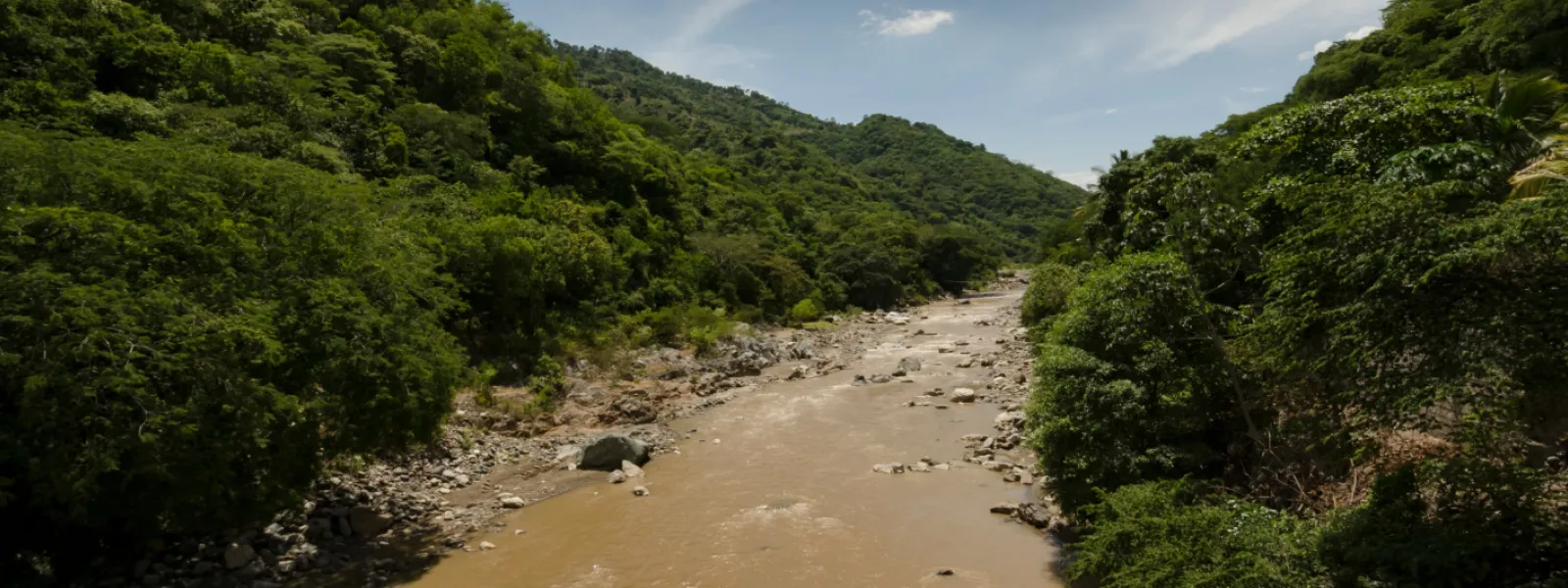
The Motagua River basin—Guatemala’s largest and most important river—is severely polluted with wastewater, solid waste, and other types of debris.
This is a cross-border issue because the Motagua’s polluted waters flow into the Caribbean Sea, reach the coast of Honduras, and threaten the Mesoamerican Reef System.
For decades, this has violated the rights to health, water, development, and a healthy environment of all the people living in the river basin.
In June 2025, the Poqomam Maya community of Santa Cruz Chinautla—supported by AIDA, the Indigenous Peoples’ Law Firm, and allied organizations—achieved an unprecedented legal victory to halt degradation in the basin. In response to the lawsuit it filed, a Guatemalan court ordered the municipality of Chinautla to comply with a series of obligations to curb the pollution of the area’s rivers and soil.
The government's response to the ruling has so far been limited to technical working group meetings. Meanwhile, the community continues to work toward the proper implementation of the ruling and to take other actions to defend its territory and its rights.
Background
The Motagua River, which is 486 km long, flows through 96 municipalities and 14 departments in Guatemala. It originates in Quiché, a department located in the northwest, and empties into the Caribbean Sea.
Polluting activities occur throughout the entire basin, including sub-basins and micro-basins. The largest volume of pollution comes from Guatemala City, the country’s capital, and is carried by the waters of the Las Vacas River, which in turn receives a large amount of waste from the Chinautla River.
The Chinautla River, which flows through the municipality of the same name, carries solid waste from a landfill located in Zone 3 of the capital—where trash from at least 14 municipalities in the department of Guatemala is dumped—as well as sewage generated by some 500,000 people living in the northern part of the capital, which undergoes no prior treatment.
Other sources of pollution include the numerous illegal dumps in the municipality of Chinautla, the waste that private vehicles and garbage trucks dump along the banks of its rivers, as well as the sand-mining companies—which began setting up operations in the area between 1996 and 1997—whose activities weaken the rivers' basins, causing solid waste to be more easily carried away by the river currents.
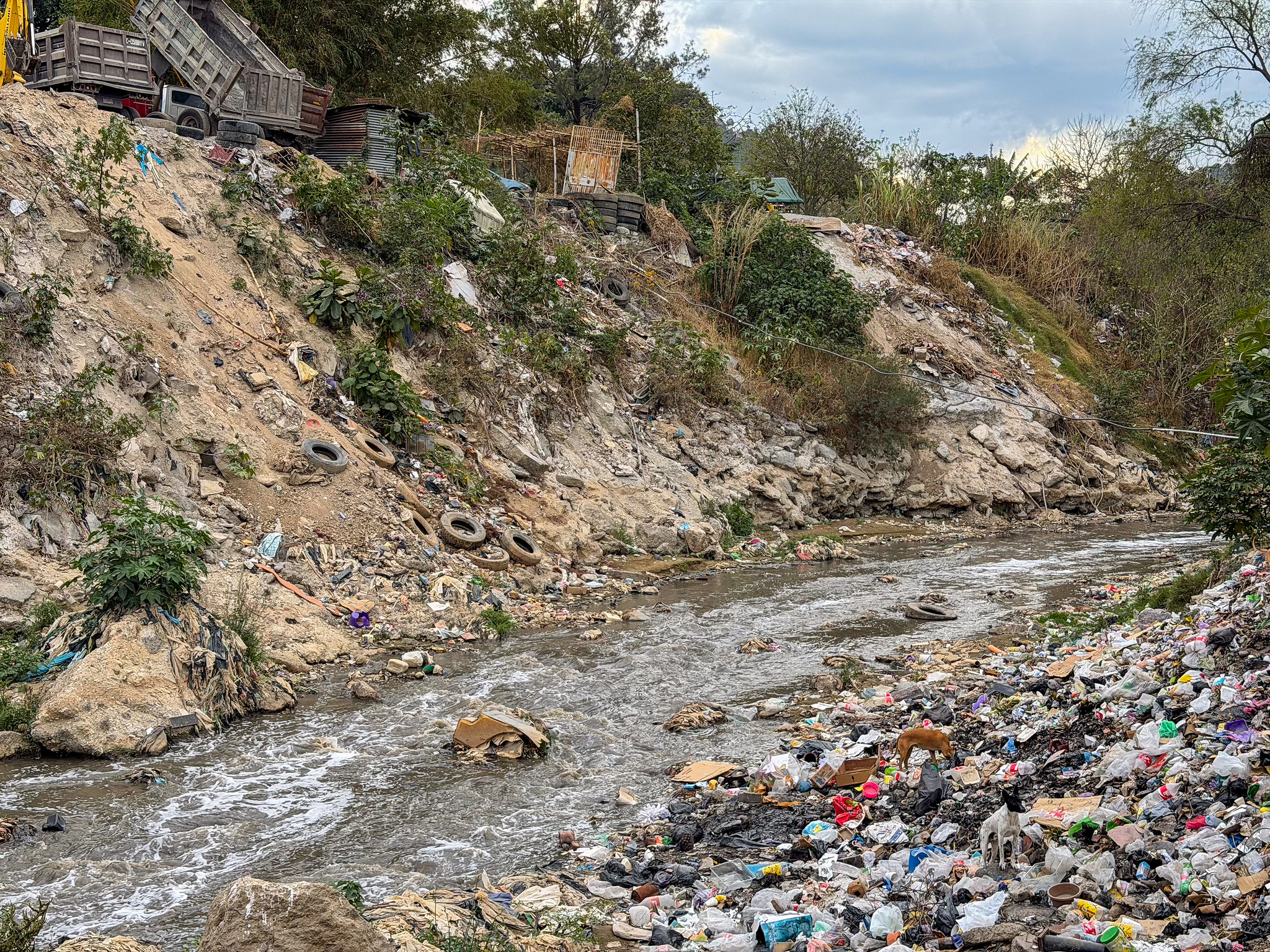
Photo: Mayela Sánchez García.
The situation extends beyond national borders. Every year, the Motagua River discharges some 20,000 metric tons of plastic into the Caribbean Sea, making it one of the rivers that contributes the most plastic pollution to the ocean worldwide, according to estimates contained in a 2025 report by the Inter-American Commission on Human Rights (IACHR).
The river flows into the Mesoamerican Reef at its mouth, so pollution also threatens to degrade one of the largest and most biodiverse transboundary reefs on the planet, which spans the territorial waters of Belize, Guatemala, Honduras, and Mexico.
In addition, the contaminated water reaches the coast of Honduras and spreads into Amatique Bay, located along the eastern coast of Guatemala, affecting the Caribbean Sea.
The roots of this chronic, cross-border problem are structural. Data from the Integrated Environmental Management of the Motagua River Basin project, funded by the United Nations Development Program (UNDP), show that in Guatemala, 66% of municipal solid waste is not collected, and there is no guarantee that the remaining 34% is disposed of properly. Furthermore, of all landfills nationwide, 88.32% are illegal or lack municipal authorization.
In other words, the core issues that need to be addressed are the mismanagement of solid waste and water resources in Guatemala; noncompliance with existing regulations on wastewater discharge and the disposal and treatment of solid waste and residues; and the lack of a water law.
The Poqomam Maya people's quest for justice
The rivers of Santa Cruz Chinautla, a community of the Poqomam Maya people located just twelve kilometers from Guatemala City, have become conduits of pollution that are degrading the Motagua River.
For decades, the local population has seen its health and livelihoods—including pottery, one of the main economic activities and a source of identity—damaged due to the lack of waste management in the municipality of Chinautla and the urban area of the country’s capital, as well as the activities of sand-mining companies.
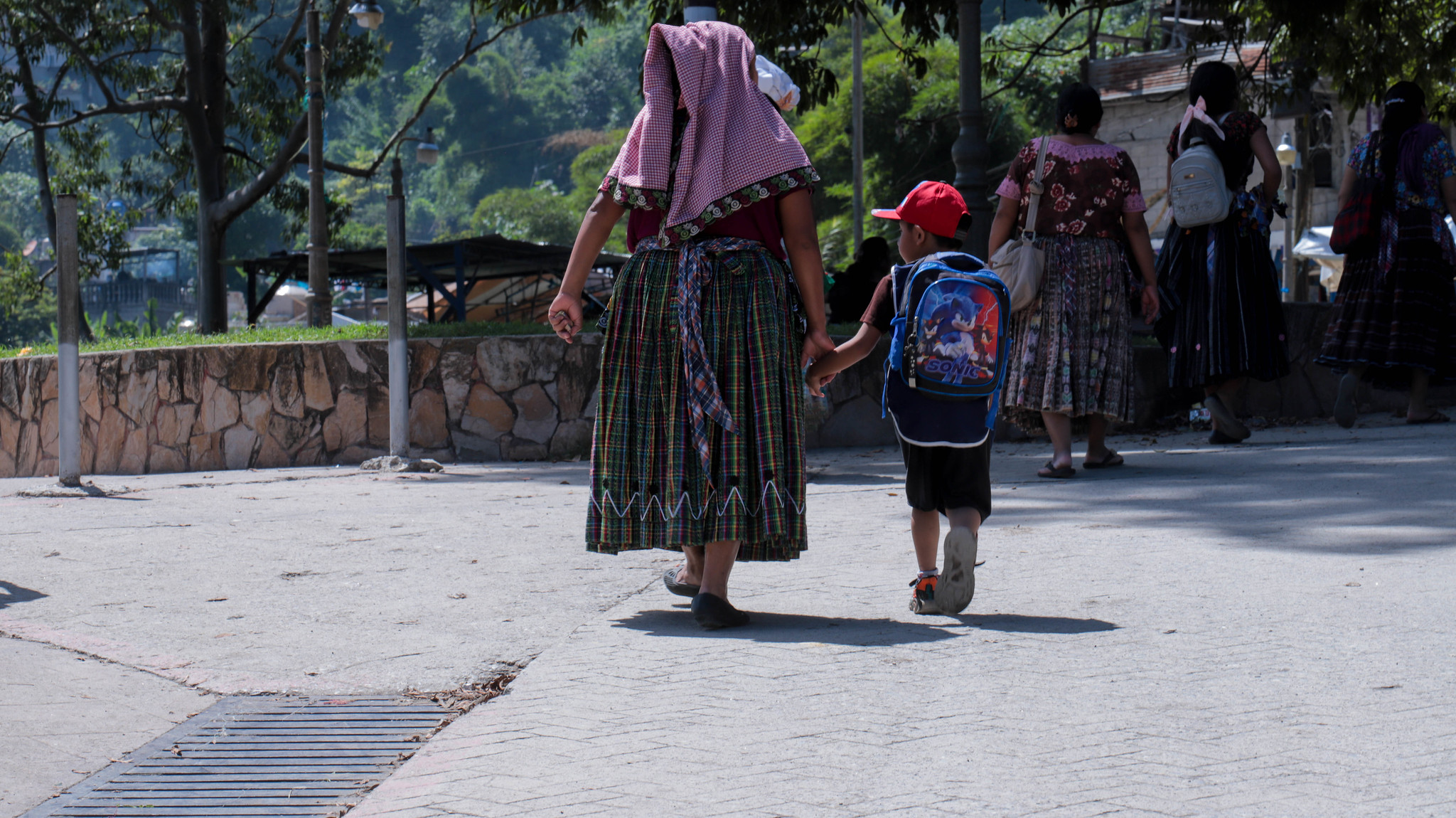
Photo: Mario Winter.
Voices for the Motagua River: Olga Vázquez.
Voices for the Motagua River: Nazario Pascual.
In early 2000, the Maya community organized to stop sand mining on their territory. At that time, the companies held mining permits that remained valid through 2021 and 2022. And although the permits expired, some companies continued to operate after requesting extensions. In June 2022, the indigenous authorities of the Poqomam people began a sit-in protest in front of the Piedrinera San Luis company, which they maintained for four years.
In July 2024, the Special Rapporteur on Economic, Social, Cultural, and Environmental Rights of the IACHR visited Santa Cruz Chinautla. During his visit, traditional authorities and community members spoke about the environmental, water-related, health, economic, and cultural impacts of the pollution in their rivers.
That same year, in October, the community—with support from AIDA, the Indigenous Peoples’ Law Firm, and partner organizations—filed a lawsuit (petition for amparo) against the municipality of Chinautla over its failure to take measures to address the contamination of its rivers and soil caused by improper solid waste management and the existence of illegal landfills.
AIDA’s scientific team, together with local residents and community authorities, collected key information on illegal landfills in the area. This community science initiative supported the litigation by highlighting the severity of the pollution, demonstrating the ongoing use of such practices, and providing evidence of the municipal authorities’ failure to fulfill their legal obligations regarding waste management.
Learn more about this community science initiative.
In June 2025, the Poqomam community won the support of the Guatemalan justice system when a constitutional court ordered the municipality of Chinautla to effectively address the claims in the lawsuit aimed at stopping the pollution of the rivers and soil in Santa Cruz Chinautla.
This is the first time a Guatemalan court has recognized a community's right to a healthy environment and its central role in finding solutions.
Find out the details of the legal victory.
Current situation
Since the ruling was issued, the municipality of Chinautla has held a series of “technical working groups” with representatives from the central government, civil society, and the community. A smaller group of technical experts was later created to develop a work plan with clear goals. Several months have passed without the municipality convening these working groups.
Furthermore, in December 2025, the IACHR noted in its report Human Rights Situation in Guatemala that the Motagua River basin is facing a severe pollution crisis that has had profound impacts on biodiversity and has resulted in systematic violations of the human rights of local communities, including the Maya Poqomam people.
And in May 2026, the Ministry of the Environment and Natural Resources revoked the license of the sand mining company Piedrinera San Luis for "failure to comply with environmental commitments."
AIDA continues to monitor the implementation of the court ruling to ensure the right to a healthy environment for the Poqomam Maya community and all those living in the Motagua River basin. Meanwhile, the residents of Santa Cruz Chinautla remain organized and mobilized to improve their environment and defend their rights.
Related projects
What makes a litigation a climate litigation?
According to a recent report published by the United Nations Environment Programme (UNEP), climate litigation has doubled worldwide in recent years and has become an important and increasingly popular tool for tackling the climate crisis.Furthermore, the Intergovernmental Panel on Climate Change (IPCC) noted in its sixth report that there is now "a growing academic consensus suggesting that climate litigation has become a powerful force in climate governance".Climate litigation is indeed an integral part of the activists' toolkit for promoting climate action. And it is children, youth, indigenous peoples, civil society organizations, women and local communities who have taken the lead in bringing these legal actions.Climate litigation is, at its core, strategic litigation, which means it seeks far-reaching changes in society that go beyond a specific case. Typically, this is achieved by promoting the protection of rights or changes in public policy. Such litigations hold governments, public authorities, companies and other non-state actors accountable in court for the climate crisis and oblige them, among other things, to adopt, implement and gradually increase concrete measures to reduce their emissions and mitigate the impacts of the climate crisis.Over a year ago, AIDA launched the Climate Litigation Platform for Latin America and the Caribbean, a reference website that collects cases of climate litigation in the region. The goal is to promote the exchange of diverse experiences in order to strengthen cases in favor of necessary structural changes.The Platform contains systematized and updated information on litigations filed before any jurisdictional authority (judicial, administrative, international or autonomous). It contains the arguments supporting the cases, related to the legal obligations of States and other actors in the face of the climate crisis.It also contains cases that, while not directly related to the climate crisis, contribute to the pursuit of climate justice on the continent.And this is where confusion and questions arise: what makes a litigation a climate litigation?The truth is that there is no accepted definition to determine which litigation is climate and which is not. It is a relatively new niche in the field of environmental law and -as with many things in life, it has blurred edges. The fact is that our planet is suffering from multiple crises, all of which are interconnected and closely linked to environmental degradation. In this sense, it is almost always possible to link environmental litigations, in some way or another, to the changing climate.In any case, and with the aim of stimulating a discussion on this subject, we venture here to reflect on possible definitions that shed light and allow us to delimit this concept that is gaining so much relevance. An approach to climate litigation and its elementsOne way to approach the question of what makes a litigation a climate litigation is to say that a climate litigation is any litigation that contains arguments related to the climate crisis in its claim or in the sentence that resolves it.Another approach concerns the purpose of the litigation, whereby to say that climate litigation is any litigation relating to climate action. It implies a high complexity and a wide variety of cases, many of which are intertwined. Under this definition, for example, there would be cases that:Seek to mitigate emissions of pollutants that cause global warming.Demand the states to comply (or increase) their international climate commitments.Promote measures to adapt to the unavoidable effects of climate crisis.Demand reparations for damages caused by the climate crisis.Aim to ensure that companies are held accountable for their contribution to the problem.Pursue policies or regulatory changes in favor of climate action.Demand transparency or accountability of government or corporate actions related to the climate crisis.Request that financial institutions raise their standards to take climate and the environment into account in their decision-making.Seek to stop any project that could harm the climate.Aim to protect ecosystems, especially those that act as natural carbon sinks.In some cases, they seek to raise public awareness of issues related to the climate crisis. Climate litigation: A living and ever-growing toolAs can be seen, the variety of cases that can be labeled as climate litigation is enormous and almost as great as the creativity of the people who are implementing this tool.What is interesting is that- despite being a fairly new concept - climate litigation builds on itself. The longer we use it, the more the courts will be involved in examining the obligations of companies and states towards climate action, and the more we will generate more useful jurisprudence, capacities and experiences to move forward.National and international law is strengthened by the use of climate litigation and it is important to keep it alive and growing -and to link it to the responsibility of States and corporations to address the climate crisis- on the basis of the universal human right to a healthy environment.It is important to clarify that strategic litigation -whether climate or environmental- is challenging, complex and expensive. It requires time, resources, skills and commitment. The decision to initiate a climate litigation is not one to be taken lightly. It is often not the best option to achieve a goal.But we can say -with certainty- that it is a key tool in climate action, that has allowed the voices of highly vulnerable and often invisible people and groups to be heard in the forums where decisions are made, where justice is done. It is also the last instance of play in the institutional and legal sphere.Visit the Climate Litigation Platform for Latin America and the Caribbean
Read more
High court orders Colombian government to adopt concrete actions for climate crisis mitigation and adaptation
After evidencing that the Ministry of Environment failed to comply with climate obligations contained in the national legislation, the State Council ordered the entity to take concrete measures to meet these commitments within one year. This is the final decision in the litigation filed by various stakeholders demanding the State to include the climate impact of the coal sector in its climate crisis management. The State Council ordered the Ministry of Environment and Sustainable Development to adopt, within one year, specific measures to mitigate and adapt to the climate crisis in order to fulfill part of the country's climate commitments. With this ruling, the High Court resolved a compliance action filed on May of this year by a coalition of civil society organizations, think tanks and universities to require the State to include the impacts of the coal production chain in the climate policy.In the decision, the State Council acknowledges the Ministry's failure to comply with the norms to include climate impacts in projects with environmental management and control instruments, the lack of regulations regarding emissions from the coal sector, and the absence of a report and evaluation of the impact of the implementation of nature-based solutions programs and projects.Although the decision could have been more ambitious by also recognizing other alleged non-compliances that were proved in the litigation, the high court issued four fundamental orders to be complied by the Ministry of Environment:Inclusion of climate change adaptation and mitigation considerations in the environmental management and control instruments of projects, emphasizing the quantification of greenhouse gas (GHG) emissions and the contributions of environmental compensation measures to the Nationally Determined Contributions, submitted by the State to the United Nations Framework Convention on Climate Change.Adopt a national guideline for formulating, developing, monitoring, reporting and evaluating the impact of implementing nature-based solutions programs and projects. This must include climate change management, integration with an ecosystem approach, contributions to the economy, benefits to biodiversity and human communities.Determining the methodologies for calculating direct and indirect emissions that must be reported, the methods, tools, processes and periodicity of reporting on GHG emissions, and the information and documentation required for GHG inventories.Regulation of the conditions for the verification, certification and registration of GHG emissions, emission reductions and removals as well as determination of the follow-up and control procedures foreseen. Based on the result, this litigation is the first successful case of strategic and climate litigation in the continent, as it was possible to prove that the State failed to comply to specific climate commitments, and has succeeded to order to one of the competent authorities to adopt concrete actions for appropriate climate management. The strategy employed and the precedent achieved can well be replicated in other countries in the region.The enforcement action was filed with the Administrative Court of Cundinamarca by the Interamerican Association for Environmental Defense, the José Alvear Restrepo Lawyers Collective, Censat Agua Viva, Centro de Investigación y Educación Popular, POLEN Transiciones Justas, Universidad de Magdalena and researcher Paola Yanguas.In July, the court issued the first-instance ruling in this case. In it, it issued eight orders requiring not only the Ministry of Environment—but also the Ministry of Mines and Energy—to comply with Law 1931 of 2018 and Law 2165 of 2021, which set out the minimum actions that Colombia must take to meet its climate commitments at international level.This litigation showed that over the last six years, the government has omitted the obligations contained in these laws, particularly in relation to the climate impact caused by the coal sector.The case was subsequently referred to the State Council, whose final decision confirmed part of the ruling of the Administrative Court of Cundinamarca.As the largest coal exporter in Latin America, Colombia is obliged to include in its climate commitments the true extent of the impact of the coal sector. This was demanded by the communities of La Guajira, which have been directly affected for decades.Although these communities did not sign the litigation, they sponsored it and accompanied its presentation with traditional dance and music. Press contact:Víctor Quintanilla-Sangueza (Mexico), AIDA, [email protected], +521 5570522107
Read more
Expanding coal mining in Colombia contravenes a just energy transition
Colombia faces numerous challenges related to the just energy transition the world needs. As the main exporter of thermal coal in Latin America, one of its primary challenges is to define the future of this mineral in the country's economic and energy matrices, as well as how to align this sector with its commitments to address the global climate crisis. Certainly, the measures taken to achieve a just energy transition and meet climate commitments must respect and guarantee human rights. The State must do so with a differentiated perspective that respects the most vulnerable groups in society who are most affected by the impacts of the climate crisis and transition processes. As part of a plan to change the energy transition strategy, the current government has proposed to create a roadmap that focuses, among other things, on promoting renewable energy projects from non-conventional sources, among other initiatives. The proposal is based on four principles: equity, social and binding participation, sovereign graduality with reliability, and a principle of knowledge. Although the proposed strategy can be seen as progress towards energy transition and meeting international commitments and standards, it has some gaps: it does not focus sufficiently on fossil fuel substitution and ignores the role and impact of the coal sector in all its phases. The omission of the structural causes of the climate crisis hinders the consolidation of an energy transition, which is now a contested scenario with various claims and interests at stake. A vivid example is the department of La Guajira in the north of the country, where a high potential for renewable energy coincides with the extraction of 35% of exported coal, exacerbating the climate crisis. This has increased the region's already high climate vulnerability and aggravated human rights violations in that territory. The impacts–particularly water stress, desertification, and reduced rainfall—have been so severe that the government has declared a state of economic, social, and environmental emergency in La Guajira, where the El Niño phenomenon is expected to occur with greater intensity and duration than in previous years. The coal sector’s role in the energy transition process Combating and addressing the climate crisis requires progress in replacing fossil fuels, as well as slowing down the expansion of their extraction and exploitation with the obvious consequence of limiting their use as much as possible. In the countries of the Global South, which are highly dependent on the extraction and commercialization of fossil fuels, the debate has begun on whether and how to move forward with the substitution process. If Colombia is to move forward in meeting its climate commitments and in the process of a just energy transition, it must halt the approval of new thermal coal mining projects, avoid the expansion of existing projects, and initiate responsible exit processes for a gradual closure of mining operations in which rights are guaranteed. The energy transition roadmap should focus on avoiding, as much as possible, human rights impacts (territorial, subsistence, and environmental) on the communities most affected by the impacts of the climate crisis. The goal is to avoid further human rights violations and a lack of protection for the territories traversed by the coal sector's production chain. The debate around the energy transition and the socio-environmental conflicts associated with coal is fully exemplified in the case of the Bruno stream, in La Guajira, with an ongoing legal process. It is now in the hands of the Constitutional Court to decide between the protection of a stream vital to an area of high water stress and the exploitation of its channel to expand the mine of the company Carbones del Cerrejón (owned by the multinational Glencore). What is at stake is the guarantee of the Wayúu communities' rights of access to water, health and life. The debate about the energy transition and the socio-environmental conflicts associated with coal is exemplified by Bruno Stream in La Guajira, which is the subject of a court case. It is now in the hands of the Constitutional Court to decide between the protection of a stream vital to an area of high water stress and the exploitation of its channel to expand the mine of the Carbones del Cerrejón company (owned by the multinational Glencore). What is at stake is the guarantee of the Wayúu communities' rights to access to water, health and life. What just transition does need After analyzing the role of coal in the process of just energy transition in Colombia, it is possible to conclude that the country is not meeting its climate commitments because it has not established specific measures and actions for the coal sector in its climate policy. If Colombia wants to move forward in fossil fuel substitution, climate policy and the energy transition process cannot be separated from the monitoring and decision-making of the relevant authorities regarding specific projects in the coal sector. Climate change management and the energy transition process must recognize the claims of justice, reparation, and non-repetition raised by communities affected by years of coal extraction, such as those in the department of La Guajira. In a just energy transition scenario, progressive, participatory and inclusive processes to end mining - together with the affected communities - must be ensured, aiming to create diversification and conversion scenarios in regions with high dependence on the coal sector. Acting within this framework is desirable and possible.
Read more