
Project
Shutterstock.
Pollution of the Motagua River in Guatemala: The Poqomam Maya people’s quest for environmental justice
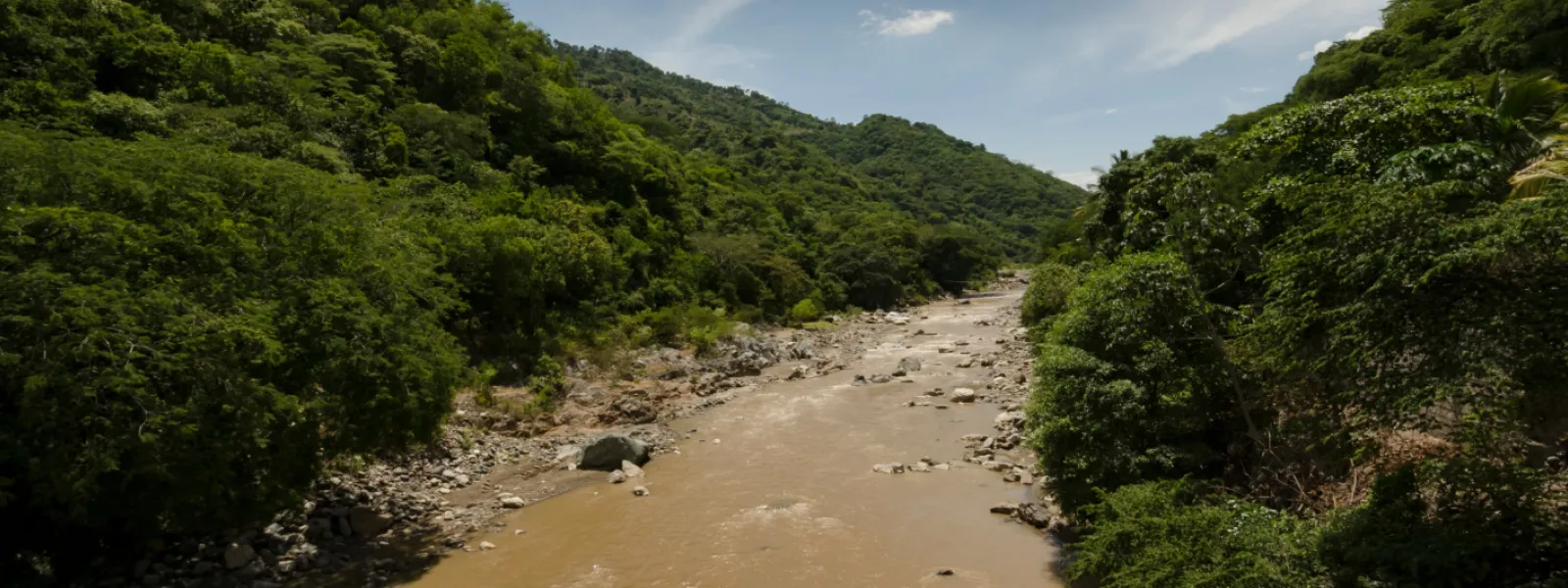
The Motagua River basin—Guatemala’s largest and most important river—is severely polluted with wastewater, solid waste, and other types of debris.
This is a cross-border issue because the Motagua’s polluted waters flow into the Caribbean Sea, reach the coast of Honduras, and threaten the Mesoamerican Reef System.
For decades, this has violated the rights to health, water, development, and a healthy environment of all the people living in the river basin.
In June 2025, the Poqomam Maya community of Santa Cruz Chinautla—supported by AIDA, the Indigenous Peoples’ Law Firm, and allied organizations—achieved an unprecedented legal victory to halt degradation in the basin. In response to the lawsuit it filed, a Guatemalan court ordered the municipality of Chinautla to comply with a series of obligations to curb the pollution of the area’s rivers and soil.
The government's response to the ruling has so far been limited to technical working group meetings. Meanwhile, the community continues to work toward the proper implementation of the ruling and to take other actions to defend its territory and its rights.
Background
The Motagua River, which is 486 km long, flows through 96 municipalities and 14 departments in Guatemala. It originates in Quiché, a department located in the northwest, and empties into the Caribbean Sea.
Polluting activities occur throughout the entire basin, including sub-basins and micro-basins. The largest volume of pollution comes from Guatemala City, the country’s capital, and is carried by the waters of the Las Vacas River, which in turn receives a large amount of waste from the Chinautla River.
The Chinautla River, which flows through the municipality of the same name, carries solid waste from a landfill located in Zone 3 of the capital—where trash from at least 14 municipalities in the department of Guatemala is dumped—as well as sewage generated by some 500,000 people living in the northern part of the capital, which undergoes no prior treatment.
Other sources of pollution include the numerous illegal dumps in the municipality of Chinautla, the waste that private vehicles and garbage trucks dump along the banks of its rivers, as well as the sand-mining companies—which began setting up operations in the area between 1996 and 1997—whose activities weaken the rivers' basins, causing solid waste to be more easily carried away by the river currents.
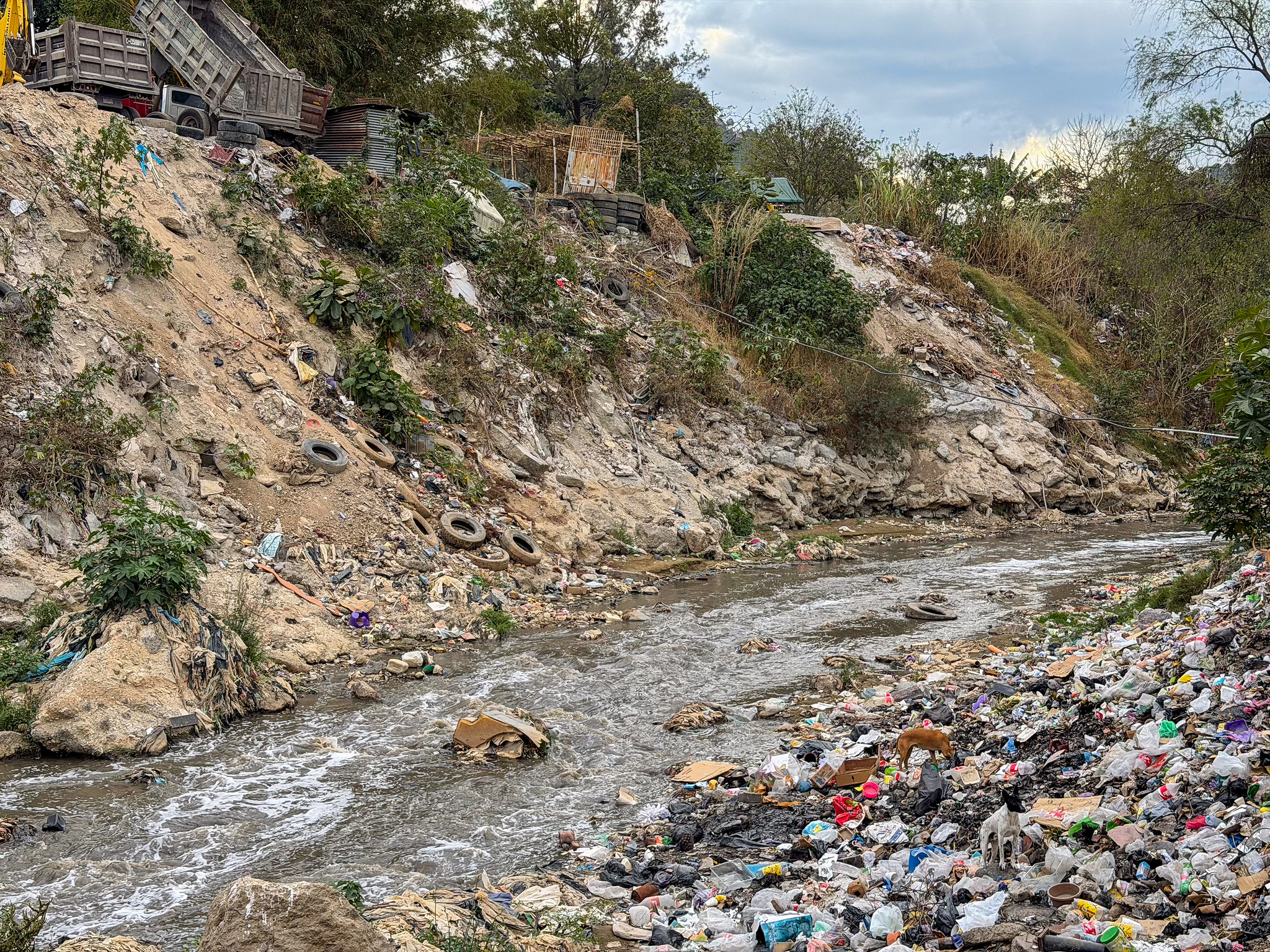
Photo: Mayela Sánchez García.
The situation extends beyond national borders. Every year, the Motagua River discharges some 20,000 metric tons of plastic into the Caribbean Sea, making it one of the rivers that contributes the most plastic pollution to the ocean worldwide, according to estimates contained in a 2025 report by the Inter-American Commission on Human Rights (IACHR).
The river flows into the Mesoamerican Reef at its mouth, so pollution also threatens to degrade one of the largest and most biodiverse transboundary reefs on the planet, which spans the territorial waters of Belize, Guatemala, Honduras, and Mexico.
In addition, the contaminated water reaches the coast of Honduras and spreads into Amatique Bay, located along the eastern coast of Guatemala, affecting the Caribbean Sea.
The roots of this chronic, cross-border problem are structural. Data from the Integrated Environmental Management of the Motagua River Basin project, funded by the United Nations Development Program (UNDP), show that in Guatemala, 66% of municipal solid waste is not collected, and there is no guarantee that the remaining 34% is disposed of properly. Furthermore, of all landfills nationwide, 88.32% are illegal or lack municipal authorization.
In other words, the core issues that need to be addressed are the mismanagement of solid waste and water resources in Guatemala; noncompliance with existing regulations on wastewater discharge and the disposal and treatment of solid waste and residues; and the lack of a water law.
The Poqomam Maya people's quest for justice
The rivers of Santa Cruz Chinautla, a community of the Poqomam Maya people located just twelve kilometers from Guatemala City, have become conduits of pollution that are degrading the Motagua River.
For decades, the local population has seen its health and livelihoods—including pottery, one of the main economic activities and a source of identity—damaged due to the lack of waste management in the municipality of Chinautla and the urban area of the country’s capital, as well as the activities of sand-mining companies.
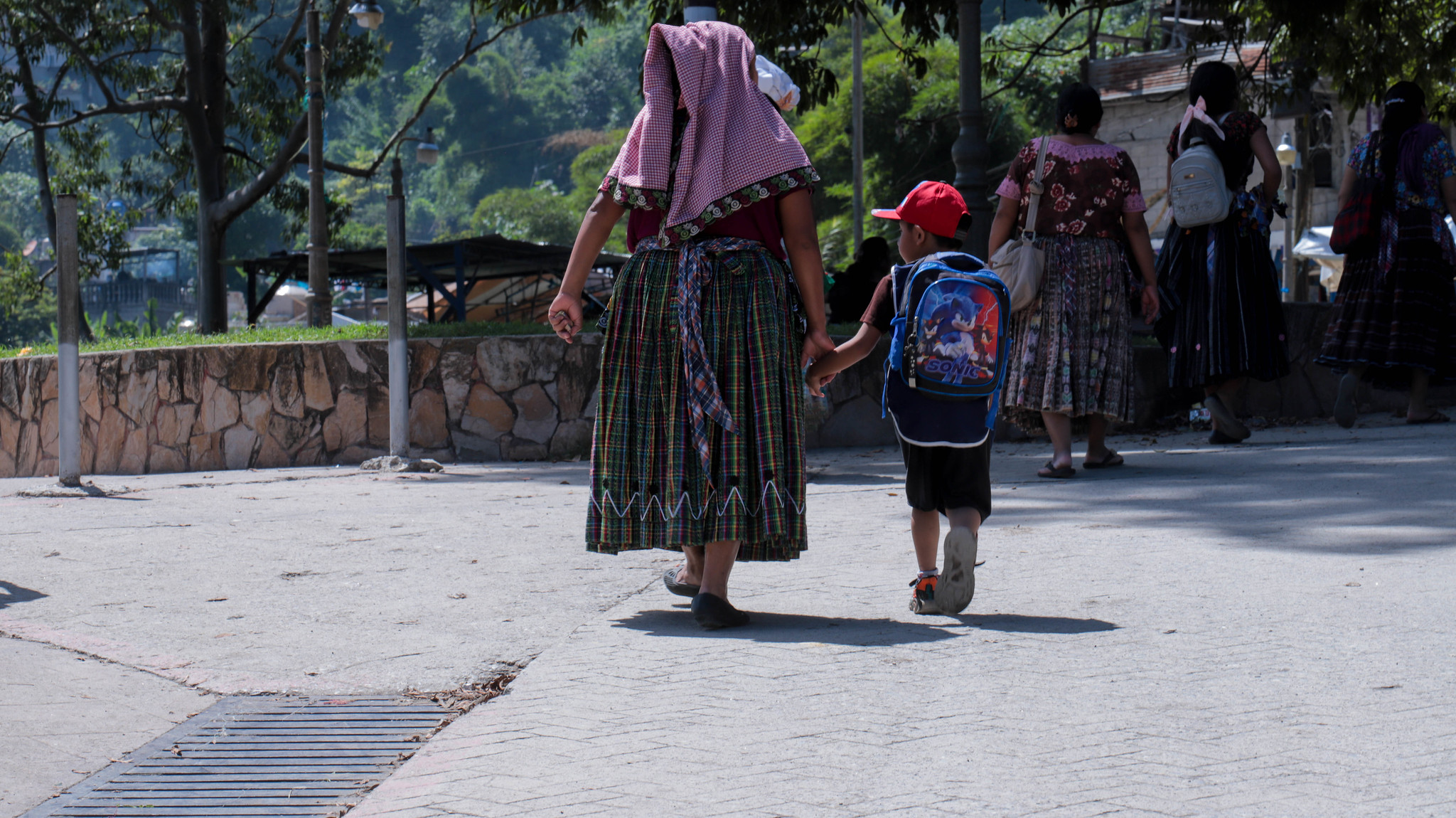
Photo: Mario Winter.
Voices for the Motagua River: Olga Vázquez.
Voices for the Motagua River: Nazario Pascual.
In early 2000, the Maya community organized to stop sand mining on their territory. At that time, the companies held mining permits that remained valid through 2021 and 2022. And although the permits expired, some companies continued to operate after requesting extensions. In June 2022, the indigenous authorities of the Poqomam people began a sit-in protest in front of the Piedrinera San Luis company, which they maintained for four years.
In July 2024, the Special Rapporteur on Economic, Social, Cultural, and Environmental Rights of the IACHR visited Santa Cruz Chinautla. During his visit, traditional authorities and community members spoke about the environmental, water-related, health, economic, and cultural impacts of the pollution in their rivers.
That same year, in October, the community—with support from AIDA, the Indigenous Peoples’ Law Firm, and partner organizations—filed a lawsuit (petition for amparo) against the municipality of Chinautla over its failure to take measures to address the contamination of its rivers and soil caused by improper solid waste management and the existence of illegal landfills.
AIDA’s scientific team, together with local residents and community authorities, collected key information on illegal landfills in the area. This community science initiative supported the litigation by highlighting the severity of the pollution, demonstrating the ongoing use of such practices, and providing evidence of the municipal authorities’ failure to fulfill their legal obligations regarding waste management.
Learn more about this community science initiative.
In June 2025, the Poqomam community won the support of the Guatemalan justice system when a constitutional court ordered the municipality of Chinautla to effectively address the claims in the lawsuit aimed at stopping the pollution of the rivers and soil in Santa Cruz Chinautla.
This is the first time a Guatemalan court has recognized a community's right to a healthy environment and its central role in finding solutions.
Find out the details of the legal victory.
Current situation
Since the ruling was issued, the municipality of Chinautla has held a series of “technical working groups” with representatives from the central government, civil society, and the community. A smaller group of technical experts was later created to develop a work plan with clear goals. Several months have passed without the municipality convening these working groups.
Furthermore, in December 2025, the IACHR noted in its report Human Rights Situation in Guatemala that the Motagua River basin is facing a severe pollution crisis that has had profound impacts on biodiversity and has resulted in systematic violations of the human rights of local communities, including the Maya Poqomam people.
And in May 2026, the Ministry of the Environment and Natural Resources revoked the license of the sand mining company Piedrinera San Luis for "failure to comply with environmental commitments."
AIDA continues to monitor the implementation of the court ruling to ensure the right to a healthy environment for the Poqomam Maya community and all those living in the Motagua River basin. Meanwhile, the residents of Santa Cruz Chinautla remain organized and mobilized to improve their environment and defend their rights.
Related projects
Unmasking Canada Rights Violations Across Latin America (Executive Summary)
In the 4th cycle of Canada’s Universal Periodic Review (UPR), more than 50 civil society organizations and communities impacted by Canadian business conduct in Latin America and the Caribbean presented three reports that reveal troubling findings.Regional Report: Reveals the status of 37 projects in 9 countries in the region, involving 34 Canadian companies and consortiums. Most of these projects are in the extractive sector (27 mining and 8 oil) and two renewable energy projects (1 hydroelectric, 1 wind). In all of them, human rights have been violated and serious environmental impacts have been reported, impacting Indigenous, Afro-descendant, peasant and fishing communities.Amazon Report: Measures the impact of Canadian companies in the Amazon basin of Brazil, Ecuador, Colombia, and Peru. The report analyzes 12 extractive projects that impact fragile ecosystems and Indigenous communities, demonstrating that Canadian companies systematically violate impacted communities’ human rights and threaten the environment in a region with the greatest biodiversity in the world, which is a strategic space to confront the climate crisis.Oil Report: Assessing Canadian business conduct in eight oil projects in Colombia, Ecuador and Peru, the report reveals how the lack of protection mechanisms, access to justice, and comprehensive redress for impacted peoples and communities, requires Canada to recognize the interconnection between human rights and the environment, and take concrete measures to address the negative impacts of Canadian companies. This is not the first time that Canada has been denounced before the United Nations Universal System for the improper behavior of its companies abroad. During its third UPR, Canada received six recommendations that, despite committing to implementation, evidence presented by civil society in this cycle demonstrates the persistence of non-compliance with its extraterritorial obligations and lack of adequate measures to fulfill the responsibility to regulate the conduct of its companies. View and download the Regional Report (in Spanish)View and download the Amazon ReportView and download the Oil Report (in Spanish)
Read more
Report reveals shocking rights violations by Canadian corporations in Latin America
Geneva - A groundbreaking report titled "Unmasking Canada: Rights Violations Across Latin America" was unveiled at the United Nations Universal Periodic Review Process (UPR) pre-session in Geneva, spanning from August 28 to September 1, 2023. This in-depth investigation highlights extensive human rights and environmental breaches by Canadian companies in Latin America and the Caribbean. Compiled through the collaboration of over 50 civil society organizations, the report implicates 37 Canadian projects across nine countries in the region. Of these, 32 projects have been found responsible for environmental rights infringements, including 105 oil spills in Peru's Block 192, directly linked to Frontera Energy. Additionally, the right to Free, Prior, and Informed Consent was violated in 26 projects, exemplified by dubious practices in Ecuador's Warintza project managed by Solaris Resources Inc. Violent confrontations tied to 16 projects are also highlighted, with a notable incident in Peru in July 2023, where 20 individuals were injured. While Canada positions itself as "climate forward," this report challenges such a portrayal, emphasizing Canada's protection of extractive industries that are responsible for significant human rights and environmental harm. In response to these findings and anticipating Canada's UPR on November 10, 2023, the report advocates for UN member states to impose legally binding resolutions on Canada, compelling the nation to address corporate misconduct overseas. Mauricio Terena, Legal Coordinator from Brazil’s Association of Indigenous People (APIB), said: "We have come here to denounce the involvement of Canadian companies in human rights violations in Brazil, particularly the case of the Belo Sun mining company in Pará, which aims to establish the country's largest open-pit gold mine. While Canada portrays itself as a defender of human rights and the environment, its actions contradict this narrative, especially when infringing upon the rights of indigenous peoples in Brazil. The discrepancy becomes evident when we realize that Canada has not signed the ILO's Convention 169. Therefore, we hope that the states with which we are in dialogue recognize this reality and urge Canada to reassess the operations of its corporations, seeking tangible action in defense of indigenous peoples and traditional communities". Addressing the UPR's function, where every four years UN member states review each other's human rights records, Latin American civil society representatives presented new recommendations for Canada. These recommendations underscore the need for Canada to introduce binding and comprehensive legislation centered on due diligence and corporate accountability. This encompasses the oversight of financial institutions and Canadian corporations throughout their global supply chains, aiming to prevent, mitigate, and penalize corporate misdeeds while ensuring victims of such practices overseas can seek justice and full reparation. "We hope that the UPR (Universal Periodic Review) process will establish itself as another strategy in our defense of indigenous peoples' rights, serving as a tool for the protection of human, indigenous, and environmental rights. It is essential to acknowledge that corporations involved in such violations are committing criminal acts. These actions should not be viewed merely as isolated incidents, but rather on a broader scale, as violating indigenous rights impacts all of humanity. Thus, beyond national and international laws, these transgressions should be seen from a more comprehensive perspective. It is crucial for states to commit, within the UN framework, to join a global mechanism where they recognize the need to monitor and mutually hold each other accountable for actions that uphold human, indigenous, and environmental rights", said Maria Judite "Kari" Guajajara, Legal Advisor at the National Indigenous Organization of the Brazilian Amazon (COIAB). This isn't the first instance of Canada facing allegations within the United Nations Universal System due to the activities of its corporations abroad. Six recommendations were directed at Canada during the 3rd cycle of the Periodic Review. These addressed, among other concerns, Canadian businesses' vital assurance and protection of human rights. Nevertheless, even after pledging to meet these recommendations, Canada consistently failed to fulfill its extraterritorial obligations, neglecting to take effective action to supervise corporate activities domestically and internationally. Gisela Hurtado, Advocacy Manager at Amazon Watch, commented: "Our report unveils the disturbing reality behind Canada's corporate endeavors in Latin America. While Canada boasts of ethical business conduct, the documented evidence reveals a starkly contrasting picture – one where profit is prioritized over people and the environment. Urgent change is paramount." The report's presentation in Geneva was spearheaded by a delegation that included Mauricio Terena from APIB; Maria Judite "Kari" Guajajara from COIAB; Josefa de Oliveira, a Popular Educator with Movimento Xingu Vivo Para Sempre; Lorena Aranha Curuaia, Vice President of the Iawá Community; ; and Brayan Mojanajinsoy Pasos, General Secretary of the Association of Indigenous Councils of the Municipality of Villagarzón Putumayo (ACIMVIP). The delegation was further supported by representatives from organizations including Amazon Watch, AIDA (Regional), Earthworks (US) Gaia (Colombia), and Ambiente y Sociedad (Colombia). Short summary involving Canadian companies involved in rights violations highlighted in the report 1. Frontera Energy in Lote 192 in Peru: - Over 2,000 sites contaminated, affecting 26 Amazonian indigenous communities. - Proposed activity closure plan doesn’t include reparations for affected communities. 2. Mineradora Argentina Gold SRL (joint venture between Barrick Gold and Shandong Gold): - Responsible for at least five toxic substance leakages, including cyanide and arsenic, into the Jáchal River in Argentina from the Veladero mine. - The project is in violation of the Glacier Law due to its location in a glacial zone and affects the UNESCO recognized biodiversity heritage site, the San Guilhermo Reserve. 3. Belo Sun's Volta Grande project in Brazil: - Cumulative impacts with the Belo Monte hydroelectric dam, located less than 10 km away from the prospected mining site; - Armed security forces hired by the Canadian mining company to monitor local leaders and hindering their freedom of movement; - Utter disrespect to Free, Prior and Informed Consent of Indigenous and riverine communities; - Imminent and irreversible risks of an environmental tragedy if toxic waste spills into the Xingu River due to a potential dam break, given the lack of sysmic and tailings dam safety studies. - Direct impact on communities, their traditional livelihoods, and local ecosystems. 4. The Mina Varadero in Chile: - Contaminated water sources with mercury, impacting rural populations and children. 5. ISAGEN - Brookfield Asset Management's Hidrosogamoso dam in Colombia: - Significant harm to local ecosystems and communities. 6. American Lithium's mining projects (Falchani, Macusani, and Quelccaya) in Peru: - Regularly release toxic residues, affecting over 700,000 people and contaminating the Lake Titicaca and Amazon River basins. 7. Solaris Resources Inc.'s Warintza mining project in Ecuador: - Ignored the territorial rights of the Shuar Arutam indigenous people and adopted divisive tactics. 8. Mining project of Ixtaca in Mexico: - Suspended due to violations of indigenous rights. 9. El Pato II mining project in Guatemala: - Affected the Poqomam Maya and mestizo communities without proper prior consultation. 10. Libero Copper's Mocoa mining project in Colombia: - Directly harmed the ancestral territory of the Inga people, violating their rights. 11. Cosigo Resources LTD's Machado gold extraction project in Colombia: - Severely impacted sacred indigenous sites in the Yaigojé Apaporis territory. 12. Barrick Gold's Pueblo Viejo mine in the Dominican Republic: - Forced the displacement of 65 local families due to the El Llagal waste dam. 13. Mining projects of La Plata by Atico Mining Corporation and Las Naves by Curimining S.A. (a subsidiary of Adventus Mining Corporation) and **Salazar Resources Limited in Ecuador: - Tried legalizing their operations despite violating national and international human rights laws, leading to confrontations and injuries. 14. Petrotal's Lote 95 in Peru: - Protests demanding community rights resulted in several deaths by police forces guarding the oil field. 15. Equinox Gold in Brazil: - Concealed data regarding their operations and impacts, including a dam break. - 4,000 of people directly impacted by toxic waste resulted from the dam break that contaminated local Amazonian rivers, violating the right to a clean environment and adequate access to drinking water. - Criminalization of local community leaders that protested for the right to water. 16. Gran Tierra Energy in Ecuador: - Conducted explorations without proper information dissemination in the Charapa, Chanangué, and Iguana blocks.
Read more
Voices seeking justice for the community of La Oroya
The situation of the community of La Oroya in Peru, affected by decades of toxic pollution and the lack of effective government action to combat it, is not an exception in Latin America. Unfortunately, there are many environmental and social sacrifice zones in the continent where highly polluting activities, such as the La Oroya metallurgical complex, are developed. These activities are poorly supervised by the authorities responsible for guaranteeing life, health, personal integrity and other human rights. The importance of the case responds precisely to these realities and transcends the Peruvian context, representing a historic opportunity to set an important precedent for the entire continent. The Inter-American Court of Human Rights, which has yet to rule on the responsibility of the Peruvian state and the reparations to be made to the victims, has taken up the case. In anticipation of the decision, we’d like to share the testimonies of those who have been a key part of the search for justice for La Oroya. They are voices that demonstrate the gravity of the damage caused, and that show that the road to justice has been long, but fruitful. They are voices that express the urgency of guaranteeing a better future for the inhabitants of La Oroya and, ultimately, the effective enjoyment of the right to a healthy environment in the continent. 1. yolanda zurita, petitioner in the case "Community of La Oroya v. Peru" before the Inter-American Human Rights System: 2. anna cederstav, AIDA’s Deputy Director and CFO: 3. Liliana Ávila, Coordinator of AIDA's Human Rights and Environment Program:
Read more