
Project
Shutterstock.
Pollution of the Motagua River in Guatemala: The Poqomam Maya people’s quest for environmental justice
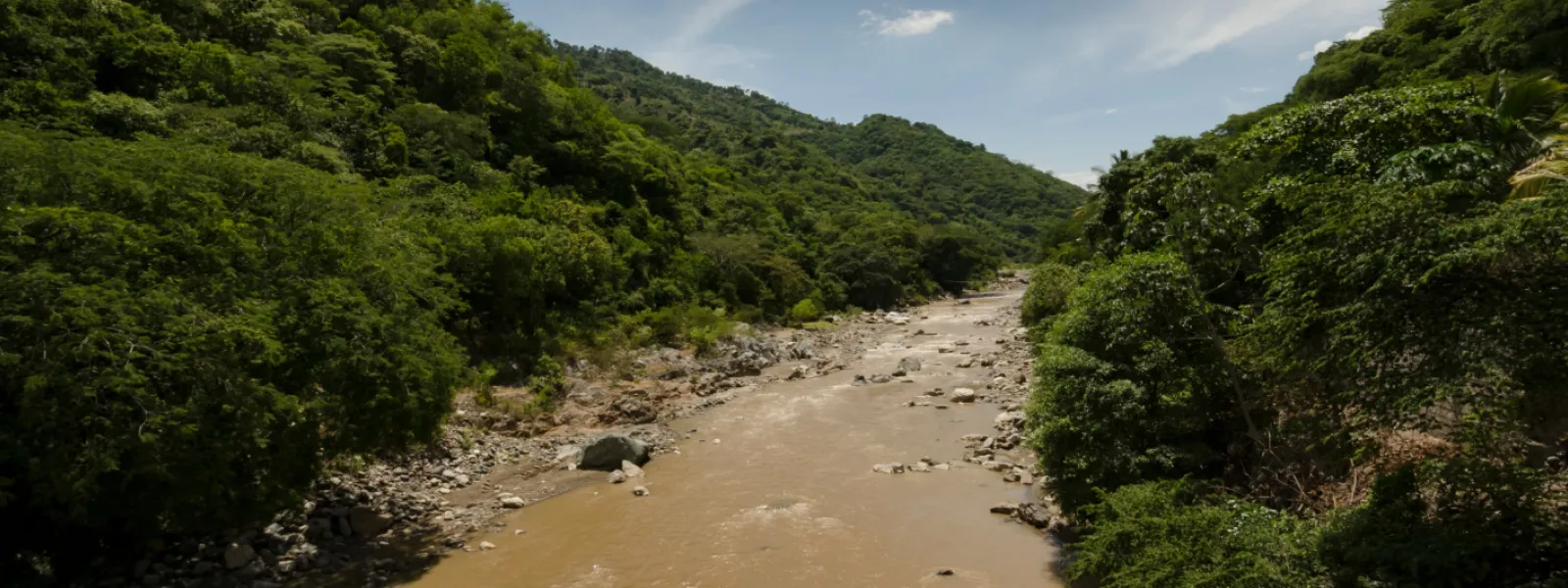
The Motagua River basin—Guatemala’s largest and most important river—is severely polluted with wastewater, solid waste, and other types of debris.
This is a cross-border issue because the Motagua’s polluted waters flow into the Caribbean Sea, reach the coast of Honduras, and threaten the Mesoamerican Reef System.
For decades, this has violated the rights to health, water, development, and a healthy environment of all the people living in the river basin.
In June 2025, the Poqomam Maya community of Santa Cruz Chinautla—supported by AIDA, the Indigenous Peoples’ Law Firm, and allied organizations—achieved an unprecedented legal victory to halt degradation in the basin. In response to the lawsuit it filed, a Guatemalan court ordered the municipality of Chinautla to comply with a series of obligations to curb the pollution of the area’s rivers and soil.
The government's response to the ruling has so far been limited to technical working group meetings. Meanwhile, the community continues to work toward the proper implementation of the ruling and to take other actions to defend its territory and its rights.
Background
The Motagua River, which is 486 km long, flows through 96 municipalities and 14 departments in Guatemala. It originates in Quiché, a department located in the northwest, and empties into the Caribbean Sea.
Polluting activities occur throughout the entire basin, including sub-basins and micro-basins. The largest volume of pollution comes from Guatemala City, the country’s capital, and is carried by the waters of the Las Vacas River, which in turn receives a large amount of waste from the Chinautla River.
The Chinautla River, which flows through the municipality of the same name, carries solid waste from a landfill located in Zone 3 of the capital—where trash from at least 14 municipalities in the department of Guatemala is dumped—as well as sewage generated by some 500,000 people living in the northern part of the capital, which undergoes no prior treatment.
Other sources of pollution include the numerous illegal dumps in the municipality of Chinautla, the waste that private vehicles and garbage trucks dump along the banks of its rivers, as well as the sand-mining companies—which began setting up operations in the area between 1996 and 1997—whose activities weaken the rivers' basins, causing solid waste to be more easily carried away by the river currents.
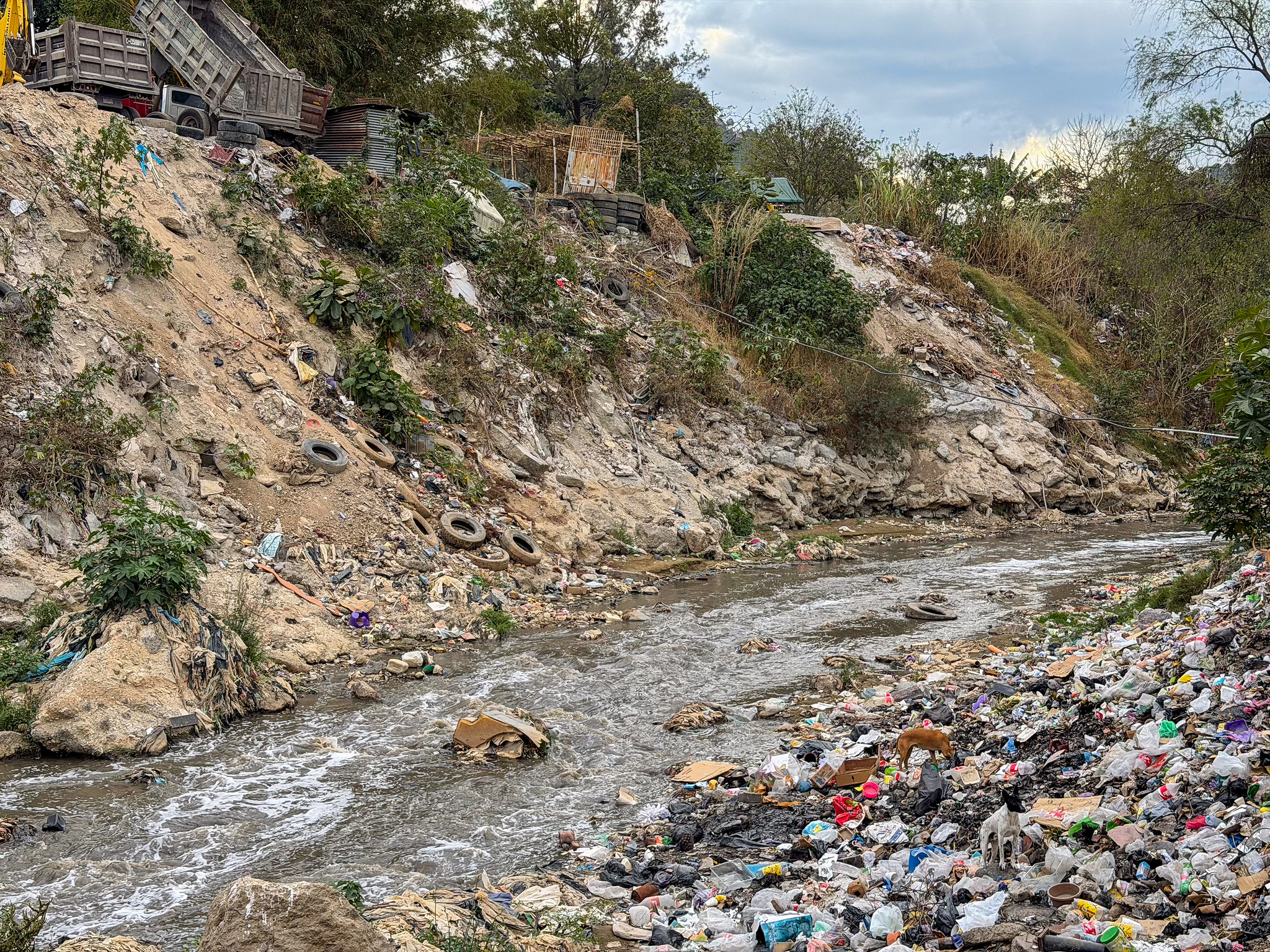
Photo: Mayela Sánchez García.
The situation extends beyond national borders. Every year, the Motagua River discharges some 20,000 metric tons of plastic into the Caribbean Sea, making it one of the rivers that contributes the most plastic pollution to the ocean worldwide, according to estimates contained in a 2025 report by the Inter-American Commission on Human Rights (IACHR).
The river flows into the Mesoamerican Reef at its mouth, so pollution also threatens to degrade one of the largest and most biodiverse transboundary reefs on the planet, which spans the territorial waters of Belize, Guatemala, Honduras, and Mexico.
In addition, the contaminated water reaches the coast of Honduras and spreads into Amatique Bay, located along the eastern coast of Guatemala, affecting the Caribbean Sea.
The roots of this chronic, cross-border problem are structural. Data from the Integrated Environmental Management of the Motagua River Basin project, funded by the United Nations Development Program (UNDP), show that in Guatemala, 66% of municipal solid waste is not collected, and there is no guarantee that the remaining 34% is disposed of properly. Furthermore, of all landfills nationwide, 88.32% are illegal or lack municipal authorization.
In other words, the core issues that need to be addressed are the mismanagement of solid waste and water resources in Guatemala; noncompliance with existing regulations on wastewater discharge and the disposal and treatment of solid waste and residues; and the lack of a water law.
The Poqomam Maya people's quest for justice
The rivers of Santa Cruz Chinautla, a community of the Poqomam Maya people located just twelve kilometers from Guatemala City, have become conduits of pollution that are degrading the Motagua River.
For decades, the local population has seen its health and livelihoods—including pottery, one of the main economic activities and a source of identity—damaged due to the lack of waste management in the municipality of Chinautla and the urban area of the country’s capital, as well as the activities of sand-mining companies.
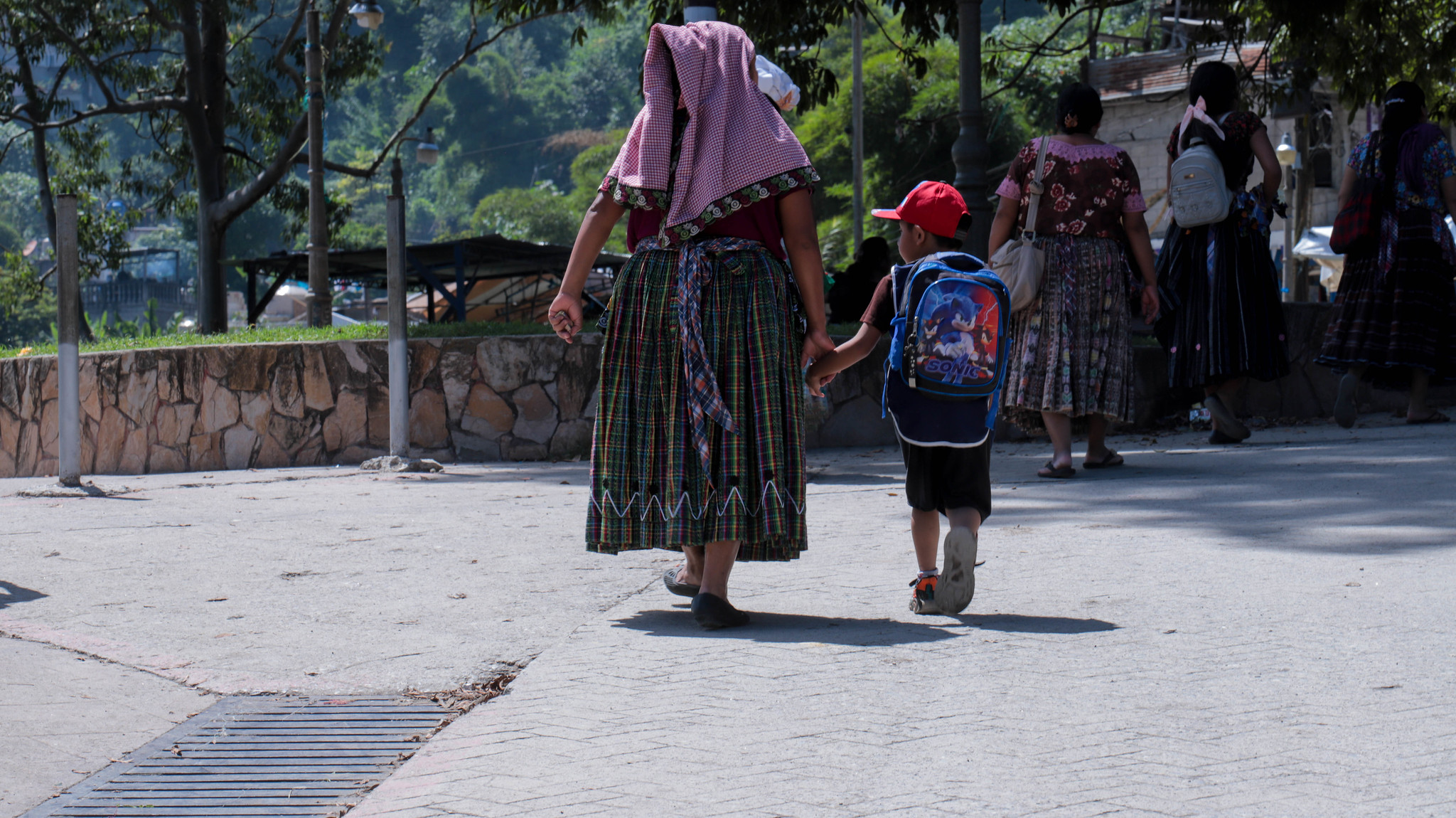
Photo: Mario Winter.
Voices for the Motagua River: Olga Vázquez.
Voices for the Motagua River: Nazario Pascual.
In early 2000, the Maya community organized to stop sand mining on their territory. At that time, the companies held mining permits that remained valid through 2021 and 2022. And although the permits expired, some companies continued to operate after requesting extensions. In June 2022, the indigenous authorities of the Poqomam people began a sit-in protest in front of the Piedrinera San Luis company, which they maintained for four years.
In July 2024, the Special Rapporteur on Economic, Social, Cultural, and Environmental Rights of the IACHR visited Santa Cruz Chinautla. During his visit, traditional authorities and community members spoke about the environmental, water-related, health, economic, and cultural impacts of the pollution in their rivers.
That same year, in October, the community—with support from AIDA, the Indigenous Peoples’ Law Firm, and partner organizations—filed a lawsuit (petition for amparo) against the municipality of Chinautla over its failure to take measures to address the contamination of its rivers and soil caused by improper solid waste management and the existence of illegal landfills.
AIDA’s scientific team, together with local residents and community authorities, collected key information on illegal landfills in the area. This community science initiative supported the litigation by highlighting the severity of the pollution, demonstrating the ongoing use of such practices, and providing evidence of the municipal authorities’ failure to fulfill their legal obligations regarding waste management.
Learn more about this community science initiative.
In June 2025, the Poqomam community won the support of the Guatemalan justice system when a constitutional court ordered the municipality of Chinautla to effectively address the claims in the lawsuit aimed at stopping the pollution of the rivers and soil in Santa Cruz Chinautla.
This is the first time a Guatemalan court has recognized a community's right to a healthy environment and its central role in finding solutions.
Find out the details of the legal victory.
Current situation
Since the ruling was issued, the municipality of Chinautla has held a series of “technical working groups” with representatives from the central government, civil society, and the community. A smaller group of technical experts was later created to develop a work plan with clear goals. Several months have passed without the municipality convening these working groups.
Furthermore, in December 2025, the IACHR noted in its report Human Rights Situation in Guatemala that the Motagua River basin is facing a severe pollution crisis that has had profound impacts on biodiversity and has resulted in systematic violations of the human rights of local communities, including the Maya Poqomam people.
And in May 2026, the Ministry of the Environment and Natural Resources revoked the license of the sand mining company Piedrinera San Luis for "failure to comply with environmental commitments."
AIDA continues to monitor the implementation of the court ruling to ensure the right to a healthy environment for the Poqomam Maya community and all those living in the Motagua River basin. Meanwhile, the residents of Santa Cruz Chinautla remain organized and mobilized to improve their environment and defend their rights.
Related projects
What is a just energy transition?
It is possible to propose real solutions to current problems. The various crises facing humanity—climate, energy, food, environment, health—as well as the enormous inequalities that cause, and are deepened by, them can be overcome if we manage to rethink the systems in which we live. In 2021, the energy sector contributed 73.2 percent of total global greenhouse gas emissions. The current energy system, based on fossil fuels, is unequal and inequitable. It is concentrated in large private or state-owned companies, is particularly conflictive in terms of access to resources, and is closed to social participation in decision-making. For these reasons, progress on the energy transition is urgent. There is no single view of energy transition; it is a concept in dispute. Toward what? For whom? How? Conservative views focus the transition on a process of technological substitution toward a change in the energy matrix focused on renewable resources and the search for energy efficiency. On the other hand, the most complete proposals warn that a change in the energy matrix is necessary, but not enough. They see the transition as a process of integral transformation, territorially situated and plural, which implies the creation of new socio-political conditions that restructure the organization, ownership and distribution of the current production and consumption systems. The goal is advancing the right to energy. If we consider the transition as a systems change, it is essential to build another type of relationship between human beings, nature and means of production. Guidelines for thinking about the energy transition in Latin America Based on the arguments of Pablo Bertinat, an expert on the subject, to walk this path in the region requires that we: Build the right to energy as a collective right, in congruence with the rights of nature. We must: take into account the damages to territories and communities created by energy development; eradicate Sacrifice Zones by recognizing their vulnerability; and guarantee respect for human rights during the transition. Solve energy poverty problems with clean, accessible, reliable and affordable energy. Energy projects must benefit the territory in which they are installed in terms of creation, supply and work force, in order to achieve the redistribution of wealth. Advance a process of energy reduction in the face of a scenario of restriction in which resources do not cover the demand. This implies an integral transition. A new productive model based on the availability of energy must be considered, as well as rethinking transportation systems, agriculture, infrastructure, etc. Deepen the change of the energy matrix from processes of resignification of technologies to those that are adequate, that is to say, that allow social inclusion, that are built from the communities, that are oriented to solve their problems, and that take into account the processes of acceptance of new energy enterprises. Promote energy democratization processes through the participation of diverse actors, particularly excluded sectors, in decision-making regarding the transition and the creation and implementation of policies, guaranteeing the rights of access to timely and complete information, quality participation and access to environmental justice, in order to ensure energy autonomy at the local level. In conclusion, speaking of a just energy transition implies recovering energy as a tool to satisfy human needs in a context of finite resources and inequalities. We must not start from scratch. Local communities, academic institutions, non-governmental organizations, social organizations and governments have already taken important steps towards a just, democratic and popular energy transition in the region. With this momentum, the transition is not only desirable, but possible.
Read more
5 reasons to end coal extraction and use
The use of coal to generate energy began two thousand years ago. Today, its role as a fuel must come to an end: the negative impacts of its exploitation and use far outweigh the benefits. The solution to the climate crisis lies, in large part, in ending dependence on coal. Across the region, we’re seeing a growth in coal projects that conflicts with global emissions reduction targets. In a post-pandemic context, nations must commit to an economic recovery that keeps coal in the ground. As governments and companies across Latin America continue to promote the industry and ignore the true costs of coal, we’re offering them five reasons why the mining and burning of coal is a bad decision – economically, politically, environmentally, for human rights and the climate. 1. Coal is economically unviable due to the high costs of its impacts. The current production chain fails to consider the external costs derived from coal’s climate and environmental impacts, and social damages and it causes, which could double or even triple the price of electricity generated. For example, exporting a ton of coal from Colombia to Europe, the United States or Asia entails estimated external costs between $144.64 and $210.95 per ton, three times the market price of coal (which was $47.80 per ton in August 2019) (1). The exploitation and use of coal becomes economically unviable because the market price is not enough to cover the repair of the damage caused. The most serious aspect is that since the companies in the industry do not assume these costs, they are left in the hands of States, communities and ecosystems. 2. Coal projects create unemployment Arguments that coal mining stimulates development wherever it is carried out are a myth. The pollution created by coal mining impacts the health of the people exposed to it, affecting their work effectiveness and putting them at a disadvantage in accessing other work options. This results in up an unemployment rate of up to 40 percent in populations located near coalmines. In addition, the non-conventional renewable energy industry currently employs many more people than the coal industry. According to the International Renewable Energy Agency, that industry generated 11 million jobs worldwide in 2018, while the 10 countries with the most coal-dependent labor sources only generate approximately 225 thousand jobs. According to UN estimates, switching to renewable energies could generate up to 35 million additional jobs between 2020 and 2050. 3. Investing in coal is increasingly risky Both banks and insurance companies are ceasing to invest in the coal sector because of its high costs, high risks and low profitability. Today, 26 of the world's 35 largest banks have policies restricting financing for projects related to coal mining or coal-fired power generation. In fact, a group of OECD countries recently announced that they will end financial support for coal-fired power plants. Similarly, at least 18 of the world's largest insurance companies have decided to restrict activities linked to the coal industry. This shows that, thanks to public pressure, the industry is being de-financed and its market is no longer insurable. 4. Coal use aggravates the global climate crisis The extraction and burning of coal aggravates the climate crisis and causes vast human rights impacts: among them floods that displace residents, fires that destroy villages and ecosystems, and droughts that destroy crops. According to the Intergovernmental Panel on Climate Change, coal is responsible for 44 percent of carbon dioxide (C02) emissions from fossil fuels. Just nine countries are responsible for 85 percent of global emissions from its combustion. Coal mining also emits methane, a gas with 67 times more power than CO2 to warm the planet over a 20-year period and whose emissions are responsible for about 25 percent of global warming. Building new coal-fired power plants implies catastrophic climate change. This is why the UN proposed urgently accelerating the decarbonization of all aspects of the economy. To stay on track toward limited warming just 1.5°C by 2050, 90 percent of coal must remain in the ground. 5. Coal mining and use violate essential human rights, such as health. The entire cycle of coal—from its extraction, transport and export, to its burning or combustion—causes irreversible damage to people. One of the main impacts of coal mining is the degradation of air quality, which in turn violates the rights to health, life and a healthy environment, generating high rates of morbidity and mortality. The damages caused by coal mining include pneumoconiosis (black lung), known as "the miner's disease", which considerably reduces the life expectancy of those who work in mines and the surrounding communities, where children are the most affected. Likewise, pollutant emissions from coal-fired power plants are mainly responsible for the formation of microscopic particles (PM10 and PM2.5) capable of penetrating the respiratory and blood systems, increasing the rates of serious diseases such as lung cancer, and causing premature deaths. These five reasons are at the same time arguments for the decarbonization of Latin America's energy matrix. The region can and should direct its efforts towards a matrix based on non-conventional renewable energies that are environmentally friendly, people-friendly and sustainable over time. For more information, see our report Carbón, un combustible condenado al entierro. El final de una era y la promesa de una transición justa. (1) Precios actualizados a 2019 tomados de Cardoso A. Behind the life cycle of coal: Socio-environmental liabilities of coalmining in Cesar, Colombia. Ecological Economics 120 (2015) 71- 82, y Cardoso A., Santamaria R,. Peñalver L. (2019). Thetrue cost of coal in Colombia.
Read more
Latin American fisheries are at risk
By Magie Rodríguez (AIDA) and Ernesto Fernández Monge (The Pew Charitable Trusts) Fishing is fundamental to the Latin American economy and, for of our region’s people, their way of life. It’s a centuries-old industry at risk. According to the Food and Agriculture Organization of the United Nations, the region produces 21.5 million metric tons of fish each year, a quarter of the world's annual production. Roughly 2.3 million people are involved in fishing activities. However, the industry is losing out to aggressive foreign fleets, mostly from Europe and Asia, fishing within Latin America's exclusive economic zones (EEZs) and in areas just outside them. Unlike domestic vessels, these fleets often benefit from substantial funding from their home governments, which allows them to fish outside their own countries' waters. These fishing subsidies, intended to increase capacity, are harmful. They pay for fuel and other expenses, artificially reduce the cost of fishing, and allow fleets to fish in areas where it would otherwise be unprofitable to do so. After more than two decades of talks, the 164 member governments of the World Trade Organization (WTO) are closer than ever to agreeing on a new globally binding treaty that would curb harmful subsidies that allow fleets to fish both in other countries' waters and on the high seas. Fishing offshore, on the periphery of another nation's waters, can harm a country's fisheries in part because it allows foreign vessels to catch migratory species, such as tuna or billfish, before they enter the EEZ. As trade ministers prepare to meet in Geneva for a WTO ministerial conference June 12-15, Latin American leaders must push for a fisheries subsidies agreement that will help their countries' fishermen better compete with foreign fleets. To do so, the agreement should eliminate all capacity-enhancing subsidies that prop up so-called distant-water fishing and allow more fishing than the market would otherwise sustain. Each year, governments around the world dole out $22 billion in harmful subsidies to fisheries and, of that amount, nearly two-thirds comes from just six countries and the European Union. About one-third of that amount, $7.2 billion, is targeted to help countries fish in other nations' EEZs and offshore at the edge of those territorial waters, according to a new research-based tool developed by scientists at the University of California, Santa Barbara, with funding from The Pew Charitable Trusts. The increase in distant-water fishing is driven by a sad reality: having depleted fish stocks in their own waters, major fishing nations are looking elsewhere to fill their nets. Ecuador's Galapagos Islands made headlines last year when research revealed that in just one month, 300 Chinese vessels spent 73 thousand hours fishing off the EEZ surrounding the Galapagos. In addition, the tool shows that, for example, 180 vessels from just four countries (China, South Korea, Chinese Taipei and Spain) spent a total of 84 thousand hours fishing in Argentina's EEZ in 2018. That's the equivalent of 9.6 years on the water. That undertaking was made possible by nearly $92 million in harmful subsidies. Encouragingly, leaders across the region have long supported reducing subsidies in distant waters: Argentina, Chile and Uruguay co-sponsored a WTO proposal in 2019 to ban such subsidies and, in July 2021, Uruguay's foreign minister stated that such a ban would have "enormous potential to have a significant impact on the state of the oceans and the livelihoods of fishing communities." However, major fishing nations are seeking to water down the text of the potential WTO agreement so that they can continue fishing in other countries' waters. That’s why Latin American trade ministers must continue to push for the elimination of subsidies in distant waters, helping to ensure that fish from their waters primarily reach their vessels, restore competitive advantage to the region's fishermen, and sustain a vital industry—and livelihood—across the continent.
Read more