
Project
Shutterstock.
Pollution of the Motagua River in Guatemala: The Poqomam Maya people’s quest for environmental justice
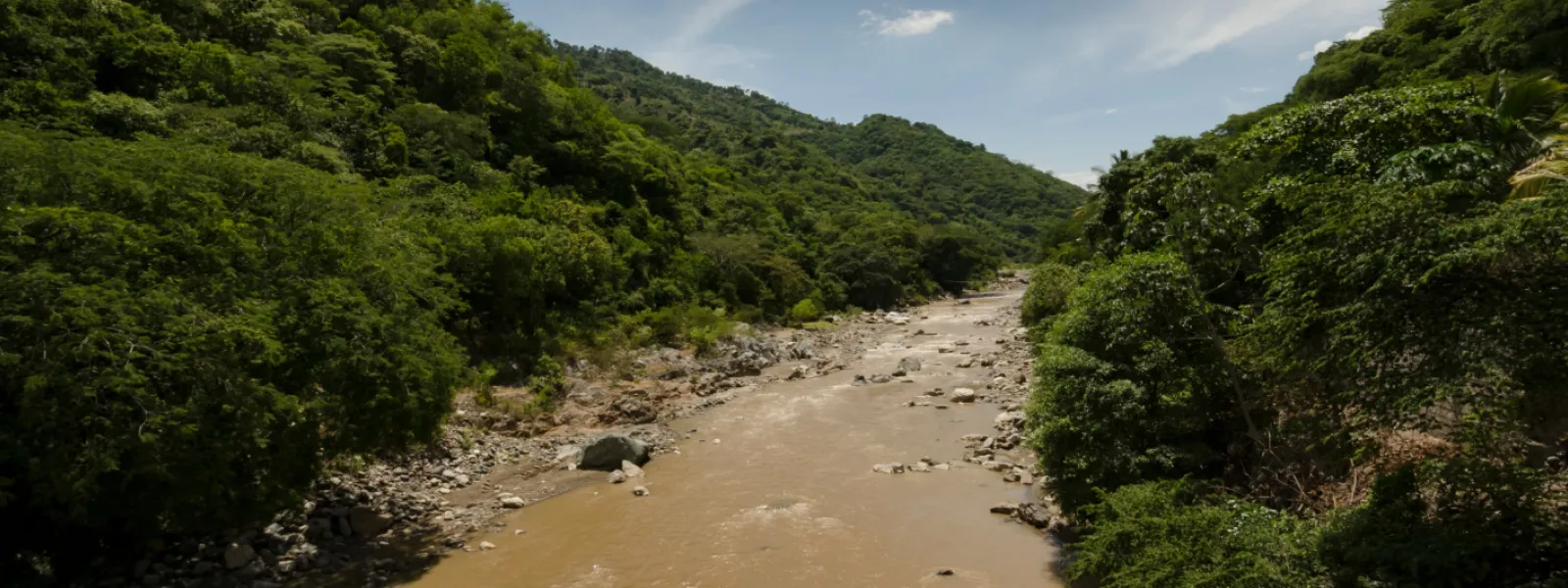
The Motagua River basin—Guatemala’s largest and most important river—is severely polluted with wastewater, solid waste, and other types of debris.
This is a cross-border issue because the Motagua’s polluted waters flow into the Caribbean Sea, reach the coast of Honduras, and threaten the Mesoamerican Reef System.
For decades, this has violated the rights to health, water, development, and a healthy environment of all the people living in the river basin.
In June 2025, the Poqomam Maya community of Santa Cruz Chinautla—supported by AIDA, the Indigenous Peoples’ Law Firm, and allied organizations—achieved an unprecedented legal victory to halt degradation in the basin. In response to the lawsuit it filed, a Guatemalan court ordered the municipality of Chinautla to comply with a series of obligations to curb the pollution of the area’s rivers and soil.
The government's response to the ruling has so far been limited to technical working group meetings. Meanwhile, the community continues to work toward the proper implementation of the ruling and to take other actions to defend its territory and its rights.
Background
The Motagua River, which is 486 km long, flows through 96 municipalities and 14 departments in Guatemala. It originates in Quiché, a department located in the northwest, and empties into the Caribbean Sea.
Polluting activities occur throughout the entire basin, including sub-basins and micro-basins. The largest volume of pollution comes from Guatemala City, the country’s capital, and is carried by the waters of the Las Vacas River, which in turn receives a large amount of waste from the Chinautla River.
The Chinautla River, which flows through the municipality of the same name, carries solid waste from a landfill located in Zone 3 of the capital—where trash from at least 14 municipalities in the department of Guatemala is dumped—as well as sewage generated by some 500,000 people living in the northern part of the capital, which undergoes no prior treatment.
Other sources of pollution include the numerous illegal dumps in the municipality of Chinautla, the waste that private vehicles and garbage trucks dump along the banks of its rivers, as well as the sand-mining companies—which began setting up operations in the area between 1996 and 1997—whose activities weaken the rivers' basins, causing solid waste to be more easily carried away by the river currents.
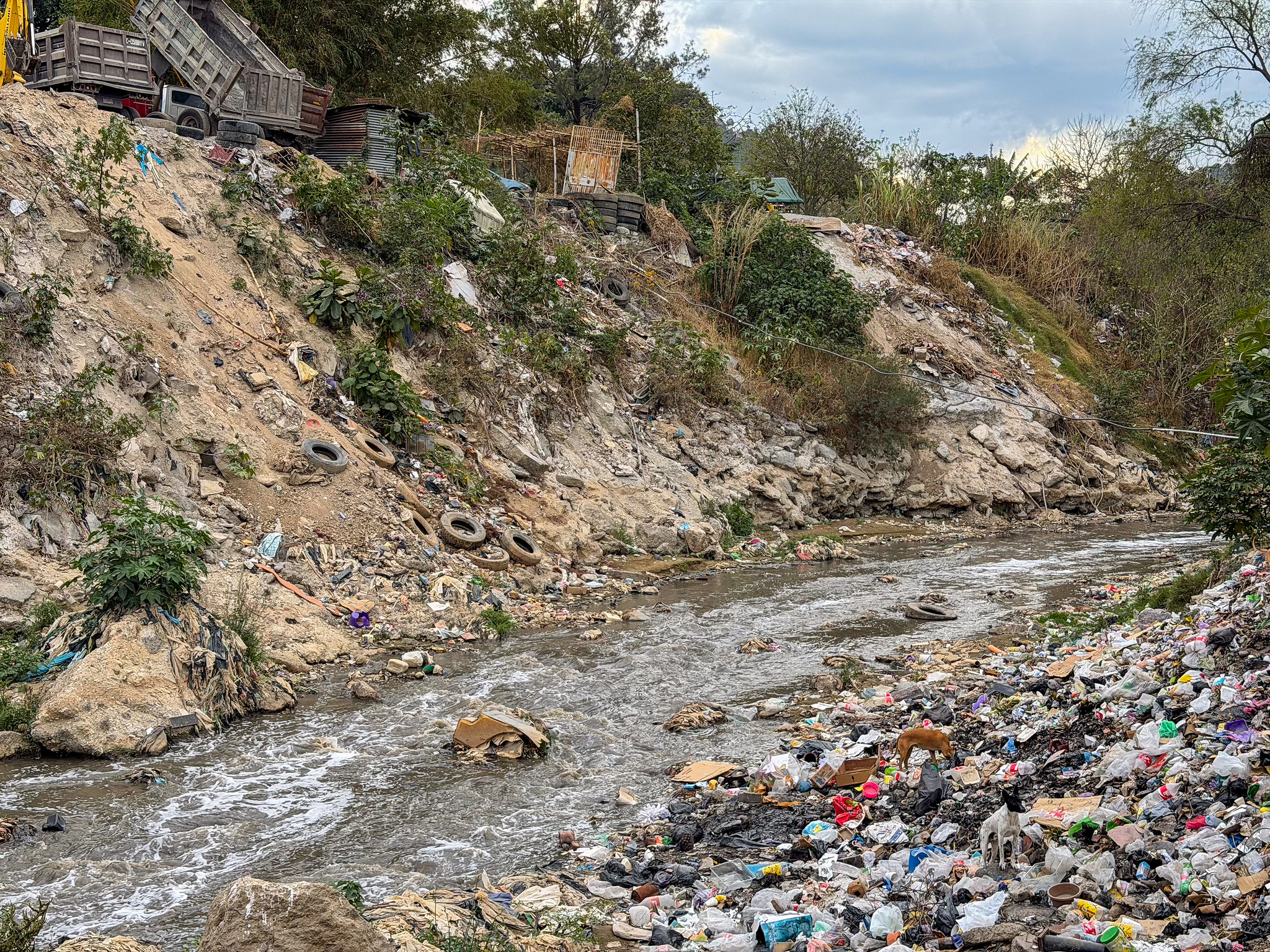
Photo: Mayela Sánchez García.
The situation extends beyond national borders. Every year, the Motagua River discharges some 20,000 metric tons of plastic into the Caribbean Sea, making it one of the rivers that contributes the most plastic pollution to the ocean worldwide, according to estimates contained in a 2025 report by the Inter-American Commission on Human Rights (IACHR).
The river flows into the Mesoamerican Reef at its mouth, so pollution also threatens to degrade one of the largest and most biodiverse transboundary reefs on the planet, which spans the territorial waters of Belize, Guatemala, Honduras, and Mexico.
In addition, the contaminated water reaches the coast of Honduras and spreads into Amatique Bay, located along the eastern coast of Guatemala, affecting the Caribbean Sea.
The roots of this chronic, cross-border problem are structural. Data from the Integrated Environmental Management of the Motagua River Basin project, funded by the United Nations Development Program (UNDP), show that in Guatemala, 66% of municipal solid waste is not collected, and there is no guarantee that the remaining 34% is disposed of properly. Furthermore, of all landfills nationwide, 88.32% are illegal or lack municipal authorization.
In other words, the core issues that need to be addressed are the mismanagement of solid waste and water resources in Guatemala; noncompliance with existing regulations on wastewater discharge and the disposal and treatment of solid waste and residues; and the lack of a water law.
The Poqomam Maya people's quest for justice
The rivers of Santa Cruz Chinautla, a community of the Poqomam Maya people located just twelve kilometers from Guatemala City, have become conduits of pollution that are degrading the Motagua River.
For decades, the local population has seen its health and livelihoods—including pottery, one of the main economic activities and a source of identity—damaged due to the lack of waste management in the municipality of Chinautla and the urban area of the country’s capital, as well as the activities of sand-mining companies.
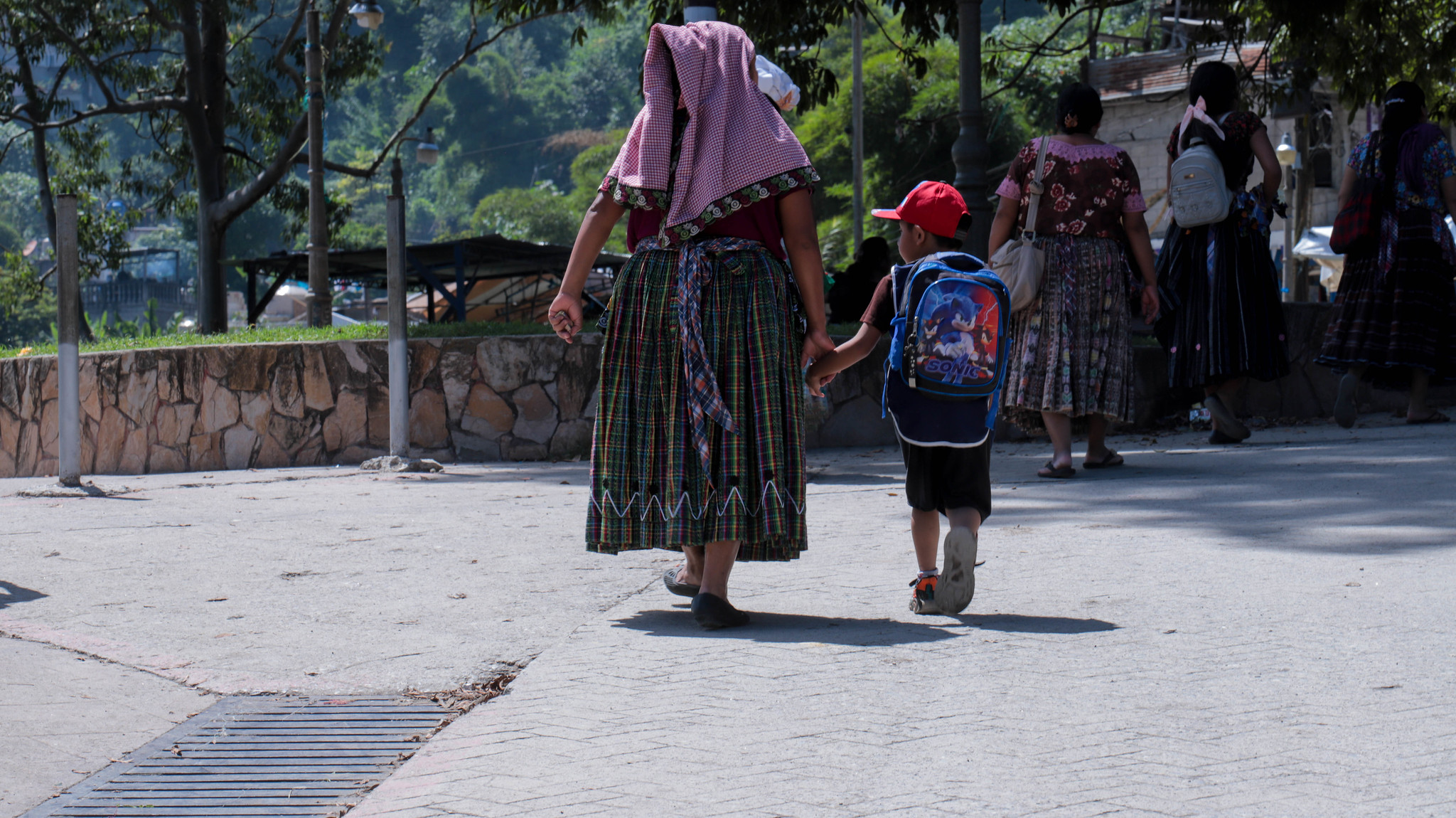
Photo: Mario Winter.
Voices for the Motagua River: Olga Vázquez.
Voices for the Motagua River: Nazario Pascual.
In early 2000, the Maya community organized to stop sand mining on their territory. At that time, the companies held mining permits that remained valid through 2021 and 2022. And although the permits expired, some companies continued to operate after requesting extensions. In June 2022, the indigenous authorities of the Poqomam people began a sit-in protest in front of the Piedrinera San Luis company, which they maintained for four years.
In July 2024, the Special Rapporteur on Economic, Social, Cultural, and Environmental Rights of the IACHR visited Santa Cruz Chinautla. During his visit, traditional authorities and community members spoke about the environmental, water-related, health, economic, and cultural impacts of the pollution in their rivers.
That same year, in October, the community—with support from AIDA, the Indigenous Peoples’ Law Firm, and partner organizations—filed a lawsuit (petition for amparo) against the municipality of Chinautla over its failure to take measures to address the contamination of its rivers and soil caused by improper solid waste management and the existence of illegal landfills.
AIDA’s scientific team, together with local residents and community authorities, collected key information on illegal landfills in the area. This community science initiative supported the litigation by highlighting the severity of the pollution, demonstrating the ongoing use of such practices, and providing evidence of the municipal authorities’ failure to fulfill their legal obligations regarding waste management.
Learn more about this community science initiative.
In June 2025, the Poqomam community won the support of the Guatemalan justice system when a constitutional court ordered the municipality of Chinautla to effectively address the claims in the lawsuit aimed at stopping the pollution of the rivers and soil in Santa Cruz Chinautla.
This is the first time a Guatemalan court has recognized a community's right to a healthy environment and its central role in finding solutions.
Find out the details of the legal victory.
Current situation
Since the ruling was issued, the municipality of Chinautla has held a series of “technical working groups” with representatives from the central government, civil society, and the community. A smaller group of technical experts was later created to develop a work plan with clear goals. Several months have passed without the municipality convening these working groups.
Furthermore, in December 2025, the IACHR noted in its report Human Rights Situation in Guatemala that the Motagua River basin is facing a severe pollution crisis that has had profound impacts on biodiversity and has resulted in systematic violations of the human rights of local communities, including the Maya Poqomam people.
And in May 2026, the Ministry of the Environment and Natural Resources revoked the license of the sand mining company Piedrinera San Luis for "failure to comply with environmental commitments."
AIDA continues to monitor the implementation of the court ruling to ensure the right to a healthy environment for the Poqomam Maya community and all those living in the Motagua River basin. Meanwhile, the residents of Santa Cruz Chinautla remain organized and mobilized to improve their environment and defend their rights.
Related projects
In regressive decision, high court endorses fracking in Colombia
Bogotá, Colombia. Colombia’s highest administrative court, the Council of State, on Thursday ruled against a lawsuit that sought to nullify the government’s regulation of fracking, effectively endorsing the controversial technique’s implementation in the Andean nation. The nullity lawsuit was filed by the Public Interest Law Clinic of the Universidad del Norte—which was jointly advised by AIDA, Corporación Podion, and the legal clinics of Universidad Javeriana and Universidad de los Andes—in an attempt to challenge the legality of the rules that would allow for fracking operations in the country, found in 2013’s Decree 3004 and 2014’s Resolution 90341. This decision means the suspension of Colombia’s judicial moratorium on fracking, which has been in place since 2018, when the when the Council preventively suspended the rules based on the precautionary principle and due to the lack of certainty about the risks of irreversible damage that the technique implies for the environment, climate and public health. Fracking has been assessed by national and international academics and scientists as an experimental technique that threatens air, water, human health, democratic participation, social fabric and culture, traditional knowledge systems, biodiversity and, in the long term, economic, seismic and climatic stability. In addition, it creates atmospheric pollution due to the emission of methane—a potent gas whose warming potential is 84 to 87 times greater than carbon dioxide on a 20-year scale. While the Council of State's ruling ratifies the government's regulations and lifts the moratorium, it does not exonerate national and local authorities from protecting the environment and respecting the fundamental rights of the population as they consolidate the mining and energy policy. Legal experts who brought the case before the Court respond to the ruling: "In Latin America and around the world, many countries have banned fracking because of its impacts on the environment and on the protection of human rights. The ruling of Colombia’s Council of State is regressive and goes against international advances on environmental, climate and human rights issues.” - Yeny Rodríguez, attorney with the Interamerican Association for Environmental Defense (AIDA) "The Council of State has issued a decision contrary to the facts proven in the litigation. They have ignored the survey conducted by the National University of Colombia, the report of the expert commission, the concept of the Attorney General's Office, and the rest of the documentary evidence and scientific texts that clearly demonstrated the need to prohibit this technique under the precautionary principle. In addition, the ruling ignores Colombia's international climate commitments and the principle of intergenerational solidarity, as it ignores the fundamental rights of future generations." - Juan Pablo Sarmiento, plaintiff’s attorney in the case. “The Council of State lost a great opportunity to strengthen, through the courts, a regulation that many experts considered too weak to protect the environment and public health. Its now is in the hands of the national government and the legislature to guarantee society the protection of the precautionary principle and democratic participation in environmental matters" - Juan Felipe García, attorney with the Law and Territory Clinic of the Universidad Javeriana “The decision of the highest administrative court in the country is not an open invitation to carry out fracking in Colombia. The government must fully guarantee the right to participation and the voice of communities in decision-making about projects that may generate environmental impacts in their territories, as well as guarantee the safety and protection of environmental leaders who defend their territories". - Silvia Quintero, legal advisor to the Environmental and Public Health Legal Clinic of the Universidad de Los Andes “The lifting of the judicial moratorium on fracking leaves open the possibility of moving forward with such projects whose contracts were previously suspended. It’s necessary that fracking have a social license because several regions of the country have been considered as potential areas for its implementation." - Lizeth Gómez, attorney with Corporación Podion Contactos de prensa: Juan Pablo Sarmiento, [email protected], +573005514583 Yeny Rodríguez, AIDA, [email protected], +573107787601 Juan Felipe García, Clínica en Derecho y Territorio de la Universidad Javeriana, [email protected], +573125588889 Lizeth Gómez, PODION, [email protected], +573176430036
Read more
Examining the obstacles to energy transition in Latin America
The climate crisis and its impacts on human rights require the governments of Latin America to design and implement laws, public policies, and other measures aimed at protecting the lives and integrity of their people. In the region most threatened by global warming, they must do so through mitigation, adaptation and attention to the losses and damages already caused. Given that the current energy system based on fossil fuels is the main cause of the climate crisis, as well as the inequalities that are closely linked to it, the framework for climate action in the Americas must be that of a just energy transition. The energy transition is an opportunity for the continent to abandon old energy production models characterized by large social and environmental impacts, and to move towards environmentally and climatically sustainable methods, while respecting the human rights of the communities and sectors involved. Several countries in the region are failing to integrate this perspective. The case of Colombia exemplifies a risky trend for the region—the government is currently promoting a host of climate-aggravating projects, which deepen dependence on fossil fuels, as useful to the energy transition. Such regressive measures include: the expansion of coalmines in operation or the opening of new mines under the argument that the export of the mineral will finance the transition; and the favoring of natural gas exploitation through tax benefits and the easing of environmental permitting processes, under the false premise that gas is a clean energy source. Sounding the alarm Given the worrying panorama in Colombia, AIDA will be drafting and distributing a series of Urgent Alerts that call attention to projects, public policies and regulations that hinder a just transition, and deepen dependence on fossil fuels. They will be collective alerts, supported by other international organizations that, like AIDA, seek climate justice and work in defense of environmental and human rights. Each alert will be sent to the national authorities in charge of the measure in question. Geared toward promoting reflections on how to advance in the just energy transition, each alert will include public policy and regulatory recommendations based on the State's international obligations and commitments on climate, environmental and human rights issues. In each case, the message is clear—by continuing with the promotion, extraction and use of gas and coal, the Colombian State would be failing to comply with these obligations. The first alert calls attention to the potential definitive diversion of the Bruno stream in the department of La Guajira to expand production at and revenue from El Cerrejón, the largest open-pit coal mine in Latin America and one of the ten largest in the world. The project not only implies an increase in greenhouse gas emissions—coal is responsible for 44 percent of global carbon dioxide emissions—but is also a threat to the rights to water, food security and health of the Wayuu indigenous communities that depend on the stream. A regional scope The measures adopted by the Colombian State may well reflect the situation in other countries of the region, or be replicated in them. Several alerts will refer to the exploitation of hydrocarbons through fracking, a controversial technique advancing blindly in Colombia and other Latin American countries. Another will warn of the use of hydrogen, promoted as a viable and clean energy alternative. In Colombia there is already a public policy route to advance with its implementation and two pilot projects underway. Hydrogen production results from burning coal or gas at high temperatures. Recent studies warn that this requires capturing and storing carbon dioxide, so the alternative depends on being able to store carbon indefinitely and avoid leakage into the atmosphere. In addition, hydrogen production is energy-intensive and involves the emission of gases during the heating and pressurization process, as well as the use of natural gas as fuel. As a region, we cannot afford to delay the energy transition and the achievement of climate justice, both urgent and necessary goals, with options that will only tie us more and more to fossil fuels and to an energy system that only intensifies social inequalities and environmental degradation.
Read more
AIDA celebrates WTO agreement to curb harmful fisheries subsidies
We consider the agreement a "crucial step" for the sustainability of fishery resources in the short, medium and long term, as well as for ensuring food security and the livelihoods of coastal communities. Geneva, Switzerland. As an environmental organization that has closely followed the negotiations to limit global fisheries subsidies, the Interamerican Association for Environmental Defense (AIDA) applauds that member countries of the World Trade Organization (WTO) reached, after more than two decades, a binding agreement to curb some harmful fisheries subsidies. It represents a fundamental step toward achieving the effective management of our fisheries resources, as well as toward ensuring global food security and the livelihoods of coastal communities. "This is a crucial step towards ensuring the sustainability of fishery resources in the short, medium and long term," said Gladys Martinez de Lemos, executive director of AIDA. "We urge the 164 member countries of the WTO to ratify the agreement as soon as possible, and to implement the necessary changes derived from it to contribute significantly to the health of marine life and the well-being of those who depend on it." It is estimated that, each year, governments spend approximately $22 billion in negative subsidies to offset costs for fuel, fishing gear and vessel improvements, among others. As a result of that support, 63 percent of fish stocks worldwide must be rebuilt and 34 percent are fished at "biologically unsustainable" levels, according to recent data. The agreement reached at the 12th WTO Ministerial Conference, held June 12-16, provides for the creation of a global framework to reduce subsidies for illegal, unreported and unregulated fishing; subsidies for fishing overexploited stocks; and subsidies for vessels fishing on the unregulated high seas. The high seas fishing provisions represent an achievement for Latin America, a region whose fishing industry is severely threatened by aggressive foreign fleets fishing inside and outside of national jurisdictions. The agreement also includes measures aimed at greater transparency and accountability in the way governments support their fisheries sector. The countries agreed to continue negotiating rules to curb subsidies that promote fishing in other countries' waters, overfishing and the overcapacity of a fleet to catch more fish than is sustainable. "This agreement is one part of the movement we need at the international level to contribute to the health of the ocean," explained Magie Rodríguez, AIDA attorney. "We have three more to go: the high seas treaty, more ambitious and rigorous standards for ocean mining, and recognition of the key role the ocean plays in the climate crisis. We will continue to work with our allies to achieve these goals.” Although negotiations on fisheries subsidies officially began in 2001, it was not until the 2017 WTO Ministerial Conference that countries committed to taking action to reach an agreement at the next conference—which was to take place in December 2020, but was suspended due to the pandemic. This commitment also responds to the fulfillment of target 14.6 of the United Nations Sustainable Development Goals. In 2021, the Ministerial Conference failed to reach an agreement, but it did reach a draft text. "This year's achievement would not have been possible without the joint efforts of many different organizations, academia, governments and the private sector," said Martinez. press contact Victor Quintanilla (Mexico), [email protected], +525570522107
Read more