
Project
Shutterstock.
Pollution of the Motagua River in Guatemala: The Poqomam Maya people’s quest for environmental justice
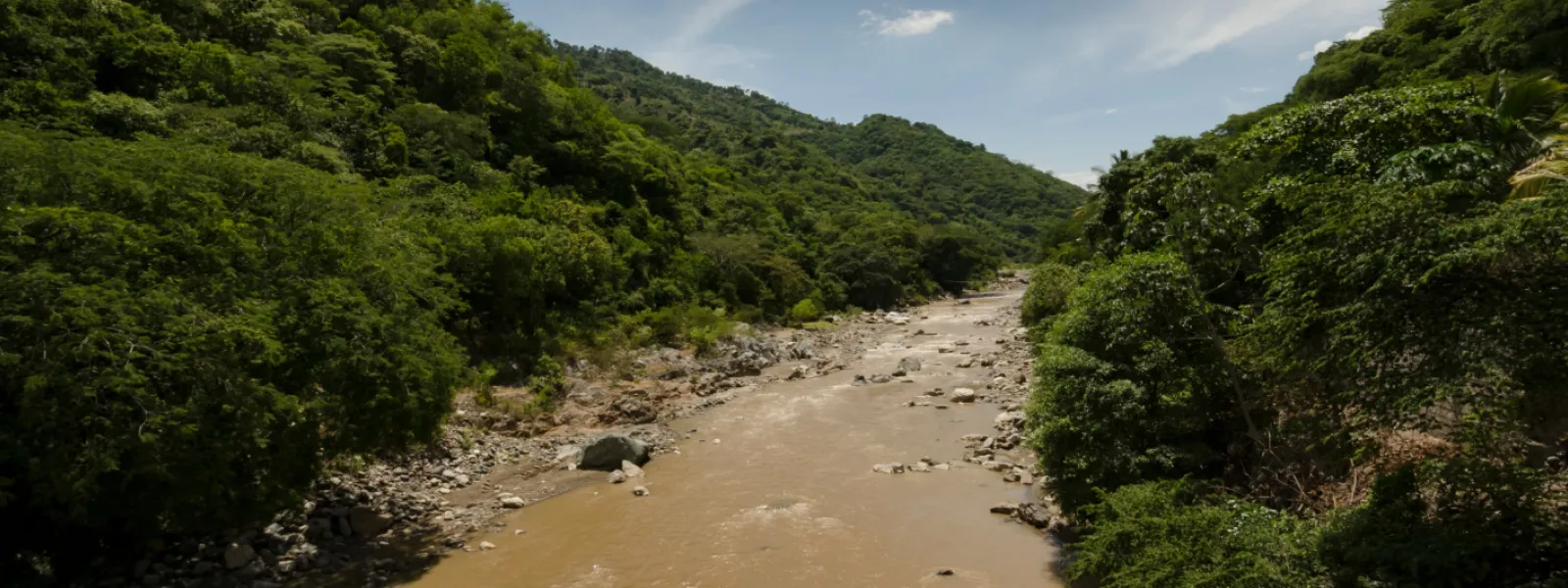
The Motagua River basin—Guatemala’s largest and most important river—is severely polluted with wastewater, solid waste, and other types of debris.
This is a cross-border issue because the Motagua’s polluted waters flow into the Caribbean Sea, reach the coast of Honduras, and threaten the Mesoamerican Reef System.
For decades, this has violated the rights to health, water, development, and a healthy environment of all the people living in the river basin.
In June 2025, the Poqomam Maya community of Santa Cruz Chinautla—supported by AIDA, the Indigenous Peoples’ Law Firm, and allied organizations—achieved an unprecedented legal victory to halt degradation in the basin. In response to the lawsuit it filed, a Guatemalan court ordered the municipality of Chinautla to comply with a series of obligations to curb the pollution of the area’s rivers and soil.
The government's response to the ruling has so far been limited to technical working group meetings. Meanwhile, the community continues to work toward the proper implementation of the ruling and to take other actions to defend its territory and its rights.
Background
The Motagua River, which is 486 km long, flows through 96 municipalities and 14 departments in Guatemala. It originates in Quiché, a department located in the northwest, and empties into the Caribbean Sea.
Polluting activities occur throughout the entire basin, including sub-basins and micro-basins. The largest volume of pollution comes from Guatemala City, the country’s capital, and is carried by the waters of the Las Vacas River, which in turn receives a large amount of waste from the Chinautla River.
The Chinautla River, which flows through the municipality of the same name, carries solid waste from a landfill located in Zone 3 of the capital—where trash from at least 14 municipalities in the department of Guatemala is dumped—as well as sewage generated by some 500,000 people living in the northern part of the capital, which undergoes no prior treatment.
Other sources of pollution include the numerous illegal dumps in the municipality of Chinautla, the waste that private vehicles and garbage trucks dump along the banks of its rivers, as well as the sand-mining companies—which began setting up operations in the area between 1996 and 1997—whose activities weaken the rivers' basins, causing solid waste to be more easily carried away by the river currents.
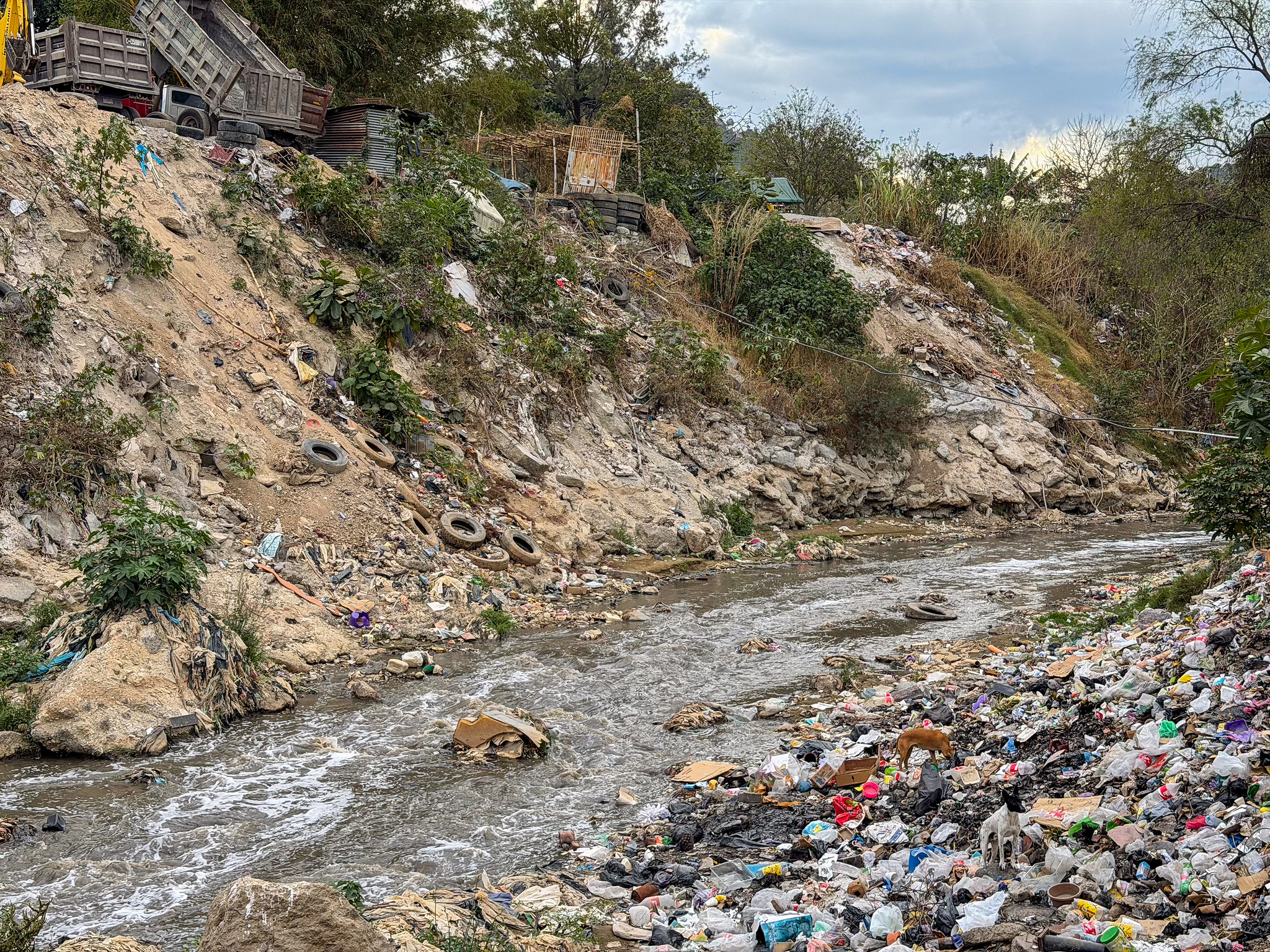
Photo: Mayela Sánchez García.
The situation extends beyond national borders. Every year, the Motagua River discharges some 20,000 metric tons of plastic into the Caribbean Sea, making it one of the rivers that contributes the most plastic pollution to the ocean worldwide, according to estimates contained in a 2025 report by the Inter-American Commission on Human Rights (IACHR).
The river flows into the Mesoamerican Reef at its mouth, so pollution also threatens to degrade one of the largest and most biodiverse transboundary reefs on the planet, which spans the territorial waters of Belize, Guatemala, Honduras, and Mexico.
In addition, the contaminated water reaches the coast of Honduras and spreads into Amatique Bay, located along the eastern coast of Guatemala, affecting the Caribbean Sea.
The roots of this chronic, cross-border problem are structural. Data from the Integrated Environmental Management of the Motagua River Basin project, funded by the United Nations Development Program (UNDP), show that in Guatemala, 66% of municipal solid waste is not collected, and there is no guarantee that the remaining 34% is disposed of properly. Furthermore, of all landfills nationwide, 88.32% are illegal or lack municipal authorization.
In other words, the core issues that need to be addressed are the mismanagement of solid waste and water resources in Guatemala; noncompliance with existing regulations on wastewater discharge and the disposal and treatment of solid waste and residues; and the lack of a water law.
The Poqomam Maya people's quest for justice
The rivers of Santa Cruz Chinautla, a community of the Poqomam Maya people located just twelve kilometers from Guatemala City, have become conduits of pollution that are degrading the Motagua River.
For decades, the local population has seen its health and livelihoods—including pottery, one of the main economic activities and a source of identity—damaged due to the lack of waste management in the municipality of Chinautla and the urban area of the country’s capital, as well as the activities of sand-mining companies.
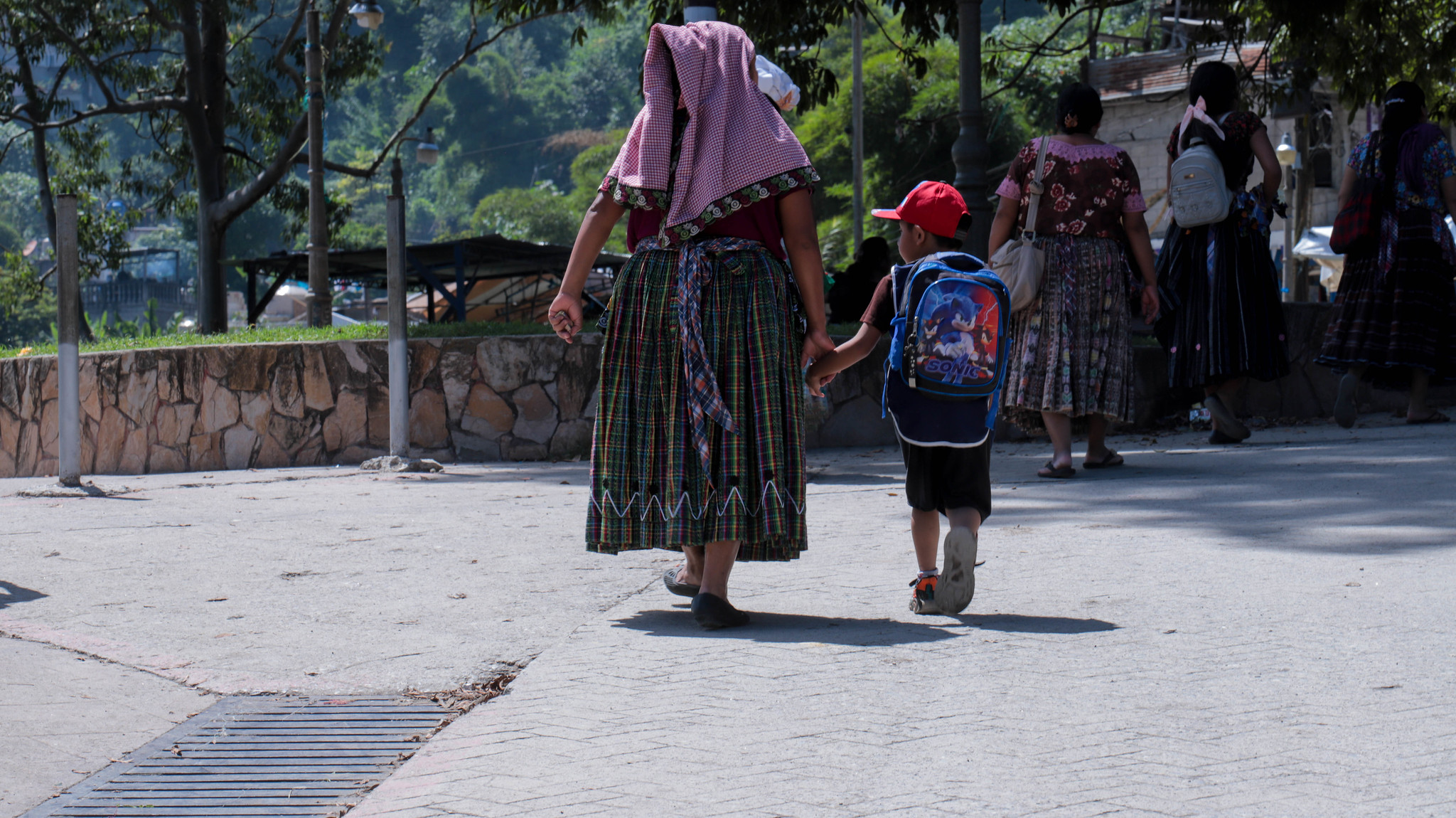
Photo: Mario Winter.
Voices for the Motagua River: Olga Vázquez.
Voices for the Motagua River: Nazario Pascual.
In early 2000, the Maya community organized to stop sand mining on their territory. At that time, the companies held mining permits that remained valid through 2021 and 2022. And although the permits expired, some companies continued to operate after requesting extensions. In June 2022, the indigenous authorities of the Poqomam people began a sit-in protest in front of the Piedrinera San Luis company, which they maintained for four years.
In July 2024, the Special Rapporteur on Economic, Social, Cultural, and Environmental Rights of the IACHR visited Santa Cruz Chinautla. During his visit, traditional authorities and community members spoke about the environmental, water-related, health, economic, and cultural impacts of the pollution in their rivers.
That same year, in October, the community—with support from AIDA, the Indigenous Peoples’ Law Firm, and partner organizations—filed a lawsuit (petition for amparo) against the municipality of Chinautla over its failure to take measures to address the contamination of its rivers and soil caused by improper solid waste management and the existence of illegal landfills.
AIDA’s scientific team, together with local residents and community authorities, collected key information on illegal landfills in the area. This community science initiative supported the litigation by highlighting the severity of the pollution, demonstrating the ongoing use of such practices, and providing evidence of the municipal authorities’ failure to fulfill their legal obligations regarding waste management.
Learn more about this community science initiative.
In June 2025, the Poqomam community won the support of the Guatemalan justice system when a constitutional court ordered the municipality of Chinautla to effectively address the claims in the lawsuit aimed at stopping the pollution of the rivers and soil in Santa Cruz Chinautla.
This is the first time a Guatemalan court has recognized a community's right to a healthy environment and its central role in finding solutions.
Find out the details of the legal victory.
Current situation
Since the ruling was issued, the municipality of Chinautla has held a series of “technical working groups” with representatives from the central government, civil society, and the community. A smaller group of technical experts was later created to develop a work plan with clear goals. Several months have passed without the municipality convening these working groups.
Furthermore, in December 2025, the IACHR noted in its report Human Rights Situation in Guatemala that the Motagua River basin is facing a severe pollution crisis that has had profound impacts on biodiversity and has resulted in systematic violations of the human rights of local communities, including the Maya Poqomam people.
And in May 2026, the Ministry of the Environment and Natural Resources revoked the license of the sand mining company Piedrinera San Luis for "failure to comply with environmental commitments."
AIDA continues to monitor the implementation of the court ruling to ensure the right to a healthy environment for the Poqomam Maya community and all those living in the Motagua River basin. Meanwhile, the residents of Santa Cruz Chinautla remain organized and mobilized to improve their environment and defend their rights.
Related projects
Inter-American Court upholds indigenous rights in Argentina
In Argentina’s Rivadavia department, along the border of Bolivia and Paraguay, the lands have been inhabited by indigenous people for at least 60 years. Communities there subsist primarily from hunting, gathering, and fishing. Many of these ancestral peoples have been battling for governmental recognition of their land rights since 1984, when the country’s transition from dictatorship to democracy began. This lack of recognition has had profound impacts on the lives of indigenous inhabitants, affected by changes in their land and its use. As Creole families settled in the area, they brought their own customs and economic activities, such as animal grazing and illegal logging. Barbed wire fence was erected without consulting indigenous populations, and an international bridge was built that crosses into their land. These developments have changed how the indigenous people eat and disrupted their access to water, threatening their very cultural identity. With no protection from the Argentine government, in 1998 a coalition of indigenous groups took their struggle before the Inter-American Commission on Human Rights. Grouped in the Lhaka Honhat (Nuestra Tierra) Association—made up of Wichí (Mataco), Iyjwaja (Chorote), Komlek (Toba), Niwackle (Chulupí) and Tapy'y (Tapiete) indigenous peoples—, they were represented by the Centre for Legal and Social Studies. In 2012, the Commission issued its Merits Report, establishing the violation of indigenous communities' rights and recommending that the State adopt reparation measures. When Argentina failed to comply with the provision, the case was referred to the Inter-American Court of Human Rights. On April 2, 2020, the Court’s decision declared Argentina responsible for the violation of the indigenous peoples’ rights to community property, cultural identity, a healthy environment, and adequate food and water. The ruling marks an important milestone in the struggle for indigenous rights. It is the first time that the Court, in a contentious case, has analyzed these rights autonomously on the basis of Article 26 of the American Convention, and ordered specific measures for their restitution, including actions for access to food and water, the recovery of forest resources, and the recovery of indigenous culture. Actions for Reparation Among other implications, the Court's decision could lead to solutions to the health issues afflicting the indigenous communities of Lhaka Honhat. The violation of their rights to food and water has caused deaths from malnutrition and dehydration. The Court demanded that the State present a study within six months that identifies critical situations of lack of access to drinking water and food, formulates a plan of action to address them, and begins its implementation. It also ordered the creation and implementation of a community development fund within a period of no more than four years. As for the territory, the State shall, within a maximum period of six years: Delineate, demarcate, and grant a single collective title without subdivisions or fragmentations for the indigenous communities. Transfer the Creole population out of the indigenous territory through specific mechanisms that promote, above all, voluntary transfer. Remove barbed wire fences and livestock belonging to Creole settlers from indigenous lands. Refrain from carrying out acts, works or undertakings in indigenous territory. Additionally, the Court requested the adoption of legislative and/or other measures to provide legal certainty to the right to indigenous community property in Argentina. Supporting the Indigenous Struggle In March 2019, AIDA helped author and amicus brief in support of the climate of the indigenous communities of the Lhaka Honhat Association. We did so alongside our allies on the litigation group of the International Network for Economic, Social and Cultural Rights (ESCR-Net), including Amnesty International, the Asociación Civil por Igualdad y Justicia, the Colombian Commission of Jurists, Dejusticia, FIAN International, International Women's Rights Action Watch - Asia Pacific, and the Minority Rights Group International. Our arguments highlighted the importance of recognizing economic, social, cultural, and environmental rights as real enforceable rights—similar to others such as the right to life or personal integrity—due to their independent and indivisible nature. In this sense, AIDA recalled the important advance that the Court promoted with Advisory Opinion 023, which recognizes the right to a healthy environment as fundamental to human life. Our brief called on the government to respect the rights of indigenous peoples—as outlined in Article 26 of the American Convention on Human Rights—to a healthy environment, food and water, and cultural identity. The Court's decision establishes an important regional precedent for the protection of the environment in the Americas. It contributes to the consolidation of standards to protect the land of indigenous communities, as well as their rights to a healthy environment, water and culture.
Read moreInter-American Court upholds indigenous rights in Argentina
In Argentina’s Rivadavia department, along the border of Bolivia and Paraguay, the lands have been inhabited by indigenous people for at least 60 years. Communities there subsist primarily from hunting, gathering, and fishing. Many of these ancestral peoples have been battling for governmental recognition of their land rights since 1984, when the country’s transition from dictatorship to democracy began. This lack of recognition has had profound impacts on the lives of indigenous inhabitants, affected by changes in their land and its use. As Creole families settled in the area, they brought their own customs and economic activities, such as animal grazing and illegal logging. Barbed wire fence was erected without consulting indigenous populations, and an international bridge was built that crosses into their land. These developments have changed how the indigenous people eat and disrupted their access to water, threatening their very cultural identity. With no protection from the Argentine government, in 1998 a coalition of indigenous groups took their struggle before the Inter-American Commission on Human Rights. Grouped in the Lhaka Honhat (Nuestra Tierra) Association—made up of Wichí (Mataco), Iyjwaja (Chorote), Komlek (Toba), Niwackle (Chulupí) and Tapy'y (Tapiete) indigenous peoples—, they were represented by the Centre for Legal and Social Studies. In 2012, the Commission issued its Merits Report, establishing the violation of indigenous communities' rights and recommending that the State adopt reparation measures. When Argentina failed to comply with the provision, the case was referred to the Inter-American Court of Human Rights. On April 2, 2020, the Court’s decision declared Argentina responsible for the violation of the indigenous peoples’ rights to community property, cultural identity, a healthy environment, and adequate food and water. The ruling marks an important milestone in the struggle for indigenous rights. It is the first time that the Court, in a contentious case, has analyzed these rights autonomously on the basis of Article 26 of the American Convention, and ordered specific measures for their restitution, including actions for access to food and water, the recovery of forest resources, and the recovery of indigenous culture. Actions for Reparation Among other implications, the Court's decision could lead to solutions to the health issues afflicting the indigenous communities of Lhaka Honhat. The violation of their rights to food and water has caused deaths from malnutrition and dehydration. The Court demanded that the State present a study within six months that identifies critical situations of lack of access to drinking water and food, formulates a plan of action to address them, and begins its implementation. It also ordered the creation and implementation of a community development fund within a period of no more than four years. As for the territory, the State shall, within a maximum period of six years: Delineate, demarcate, and grant a single collective title without subdivisions or fragmentations for the indigenous communities. Transfer the Creole population out of the indigenous territory through specific mechanisms that promote, above all, voluntary transfer. Remove barbed wire fences and livestock belonging to Creole settlers from indigenous lands. Refrain from carrying out acts, works or undertakings in indigenous territory. Additionally, the Court requested the adoption of legislative and/or other measures to provide legal certainty to the right to indigenous community property in Argentina. Supporting the Indigenous Struggle In March 2019, AIDA helped author and amicus brief in support of the climate of the indigenous communities of the Lhaka Honhat Association. We did so alongside our allies on the litigation group of the International Network for Economic, Social and Cultural Rights (ESCR-Net), including Amnesty International, the Asociación Civil por Igualdad y Justicia, the Colombian Commission of Jurists, Dejusticia, FIAN International, International Women's Rights Action Watch - Asia Pacific, and the Minority Rights Group International. Our arguments highlighted the importance of recognizing economic, social, cultural, and environmental rights as real enforceable rights—similar to others such as the right to life or personal integrity—due to their independent and indivisible nature. In this sense, AIDA recalled the important advance that the Court promoted with Advisory Opinion 023, which recognizes the right to a healthy environment as fundamental to human life. Our brief called on the government to respect the rights of indigenous peoples—as outlined in Article 26 of the American Convention on Human Rights—to a healthy environment, food and water, and cultural identity. The Court's decision establishes an important regional precedent for the protection of the environment in the Americas. It contributes to the consolidation of standards to protect the land of indigenous communities, as well as their rights to a healthy environment, water and culture.
Read more
What I learned from my internship at AIDA
Last year, I completed a three-month internship with AIDA in La Paz, the capital of Baja California Sur, Mexico. It was part of the academic process to become a lawyer in Germany, my home country. The internship allowed me to combine my professional training with my passion for nature, as well as to gain experience working with an international NGO in the field of environmental law. I applied to the internship with AIDA's Marine Biodiversity and Coastal Protection Program without specifying a preferred location. Imagine my delight to learn that the internship would take place in La Paz, Mexico, a small city surrounded by nature. Coming from one of the most densely populated countries in the world, it was amazing to live in a place with so much space. I was fascinated by the diversity of ecosystems in the area: deserts, mangroves, mountainous pine forests, and the rock and coral reefs of the Gulf of California. On my first weekend, I was able to take in the abundance of wildlife in La Paz when Camilo Thompson, AIDA attorney and my supervisor, and Mario del Angel, his neighbor and a kayak guide, took me on a tour of the El Mogote wetlands, an ecosystem of international importance. I was impressed to see, in the first light of day, a group of dolphins in the bay. The morning was complete when I had my first chilaquiles, a typical Mexican dish, for breakfast. As we toured the waterways taking pictures of herons among the mangroves, I learned about the importance of coastal wetlands—they serve as habitat for key species and are natural carbon sinks. From the beginning of my internship, I participated in the virtual meetings of AIDA’s marine team, distributed throughout several countries of the region. I learned about the variety of animals and ecosystems that AIDA works to protect. From the office in La Paz, our contribution was focused on Mexico. I learned about national regulations related to reefs, herbivorous fish, and Natural Protected Areas. I supported research on the state of protection of these fish, which are essential for keeping Latin American and global coral reefs healthy. The combination of direct contact with nature and working in the office for local and regional projects gave me a different perspective on the nature of environmental law, and increased my motivation to learn. I learned that AIDA has worked for years with other organizations, local stakeholders, and scientists to protect fisheries and endangered species such as whales and sea turtles. One of the most enriching aspects of my internship was being able to experience first-hand the natural wealth that AIDA seeks to preserve. Though I’d been a diver for many years, I never ceased to be amazed by the sight of sea lions, bull and hammerhead sharks, killer whales, rays, sea turtles, and countless species of reef fish in their natural habitat. While in La Paz, I finished my rescue diver course and accompanied a team of marine biologists to conduct a visual census of marine life on Espiritu Santo Island. On four occasions, I visited Cabo Pulmo National Park, the largest coral reserve in the Gulf of California. I went diving and snorkeling. I participated in meetings of the Cabo Pulmo Vivo coalition, dedicated to protecting the park and its area of influence. It was gratifying to know that I was doing my small part for the site’s conservation. The internship gave my professional training a multidisciplinary approach. La Paz is one of the scientific centers of marine biology in Mexico and, while there, I was able to exchange ideas with marine biologists on diving trips and while socializing in bars in the city. Around La Paz, I was also able to spend time bird watching, one of my hobbies. The state of Baja California Sur is home to roughly 432 species of birds. I was able to see a wide variety of migratory species, as well five of the six endemic ones. I completed the internship very grateful for the experiences I had gained. Now, I’m back in Berlin, but I plan to return soon to La Paz to see the birds, whale sharks, and other majestic species that inhabit the area and are living proof of the valuable work of organizations like AIDA.
Read more